Moving in together? Split the chores before the boxes
Moving in together? Split the chores in move week: list every job, mark loves and hates, agree what done means, and review it after 30 days.


Moving in together chores are easiest to settle in the week you move, before anyone has a habit to defend. Once the boxes are unpacked, whoever happened to deal with the bins in week one is the person who deals with the bins. This guide is a move-week playbook: list every job before you unpack, including the ones that only exist in the new home, mark the ones you love and hate, write down what done means, and put a 30-day review in the diary.
Why move week is the time to do it
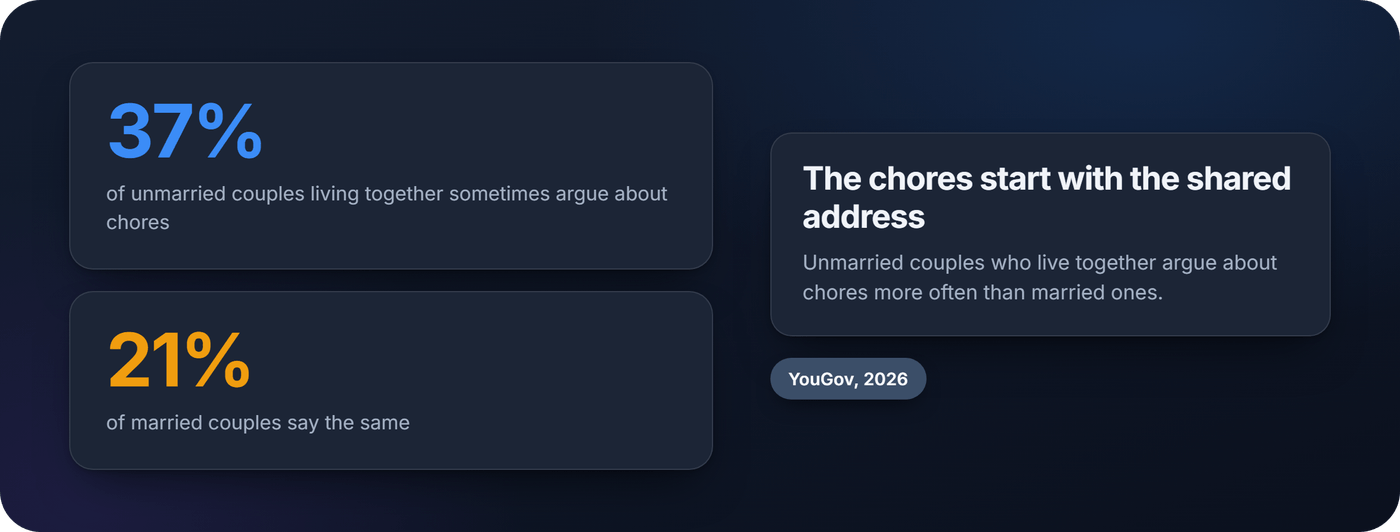
Living together without a plan is where chore arguments start. In a YouGov survey of 1,114 US adults, published in February 2026, 37% of unmarried people living with a partner said they sometimes argue about household chores, against 21% of married people. Couples in serious relationships who live apart? Just 9%. The survey cannot tell you why, but the pattern fits what you would expect: the chores start the day the shared address does.
The cost of not settling it is concrete. In a Mortar Research survey for Starling Bank (November 2023), couples who do not divide housework fairly reported more than five arguments about it a month. Where one person did all of it, the figure was eight. The same survey found that 72% of women said they do most of the household tasks, while only 18% of men agreed. Two people can live in the same flat and see two different splits.
Step 1: list every job before you unpack
Most advice says to sit down and talk early. Primer's guide to moving in together, by Mike Henson, puts it well: the point is "less about keeping score and more about building new habits". The habits form in the first few weeks, so the list has to exist before they do.
Write down every job, not just cleaning. Nationwide's guide to combining households suggests a list of daily, weekly and monthly chores, posted where you both see it. Start there, then add the part most lists miss.
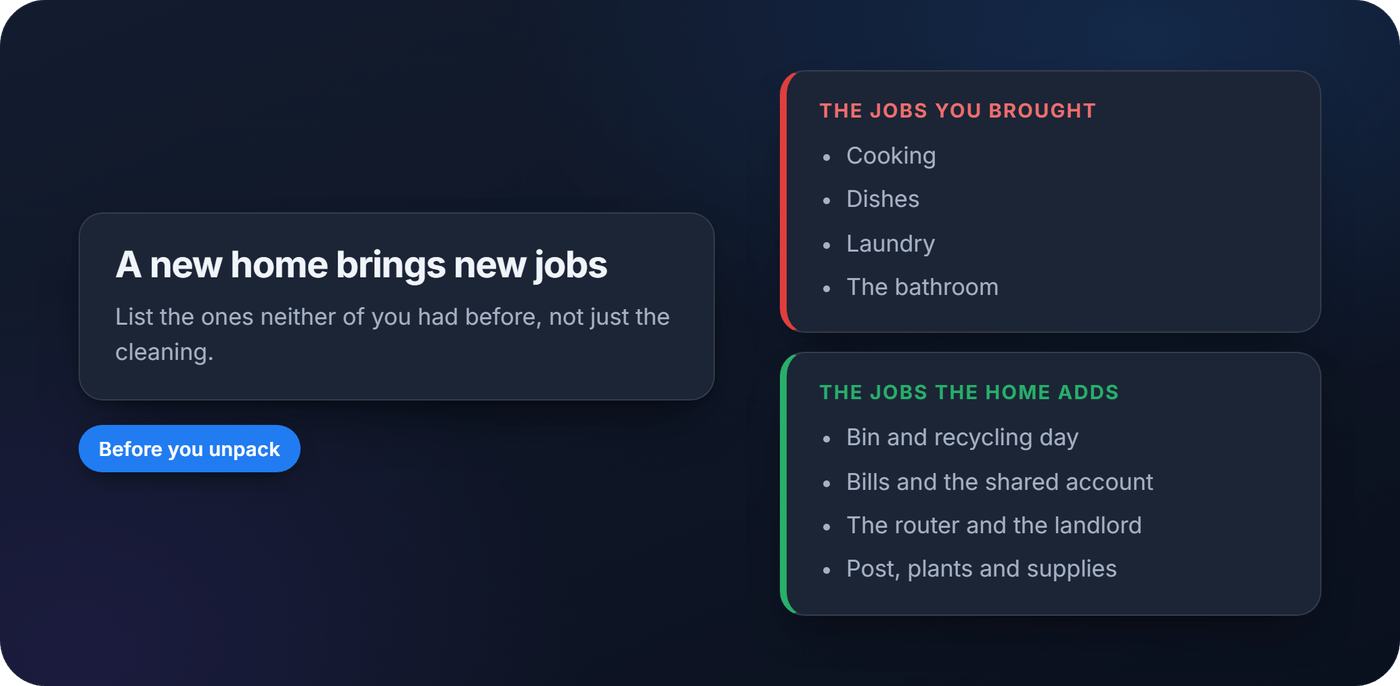
Picture a couple who list cooking, dishes, laundry and the bathroom, shake hands, and feel done. A month later they find out that nobody owns bin day, nobody knows the recycling rules, and the router password lives in one head. That couple is made up, but the gap is real: a new home brings jobs neither of you had before.
Jobs that only exist once you share a home:
- Bin and recycling day. Which day, which bin, and where the bags live.
- Bills and the shared account. Who pays, who checks, who notices a rise.
- The router, the meters and the landlord. Who calls when something breaks.
- Post and parcels. Change of address, forwarding, the pile by the door.
- Plants, pets and the fridge. The quiet jobs that only show up when missed.
- Supplies. Bin bags, washing-up liquid, toilet roll. Someone has to notice they are running low.
Let an AI draft the first list
A blank page is the hardest part, and an AI chat is good at long lists. If you use MatePoints, Task import writes the prompt for you. Pick a starter or describe your home in a sentence ("two adults, a one-bedroom flat, a cat"), then open the prompt in ChatGPT or Claude with one click. Leave the box empty and the AI asks you a few questions first. You paste the reply back, untick anything you don't want, and the rest become real tasks with points. Owners and editors of a household can use it, and how many tasks you can import depends on your plan.

Whichever way you make it, read the list together. The AI will miss things only your home has, like the gate that sticks or the neighbour who takes in your parcels.
Step 2: mark what you love and what you hate
Go down the list and each mark every job: love it, don't mind it, or hate it. Primer's advice is the same, decide "which chores you love, which chores you hate, and which neither of you mind", then divide from there.
The loves are easy. If one of you finds ironing calming, that is settled. The hates are where the real deal gets made. Share the jobs you both hate, or rotate them, rather than leaving one person with all of them. For the full range of ways to split, from 50/50 to splitting by area, see our guide to dividing household chores. For what works once you're past the move, see splitting chores with your partner.
Step 3: write down what done means
"Clean the bathroom" means something different to everyone. One person wipes the sink. The other scrubs the grout. Neither is wrong, and both will feel cheated.
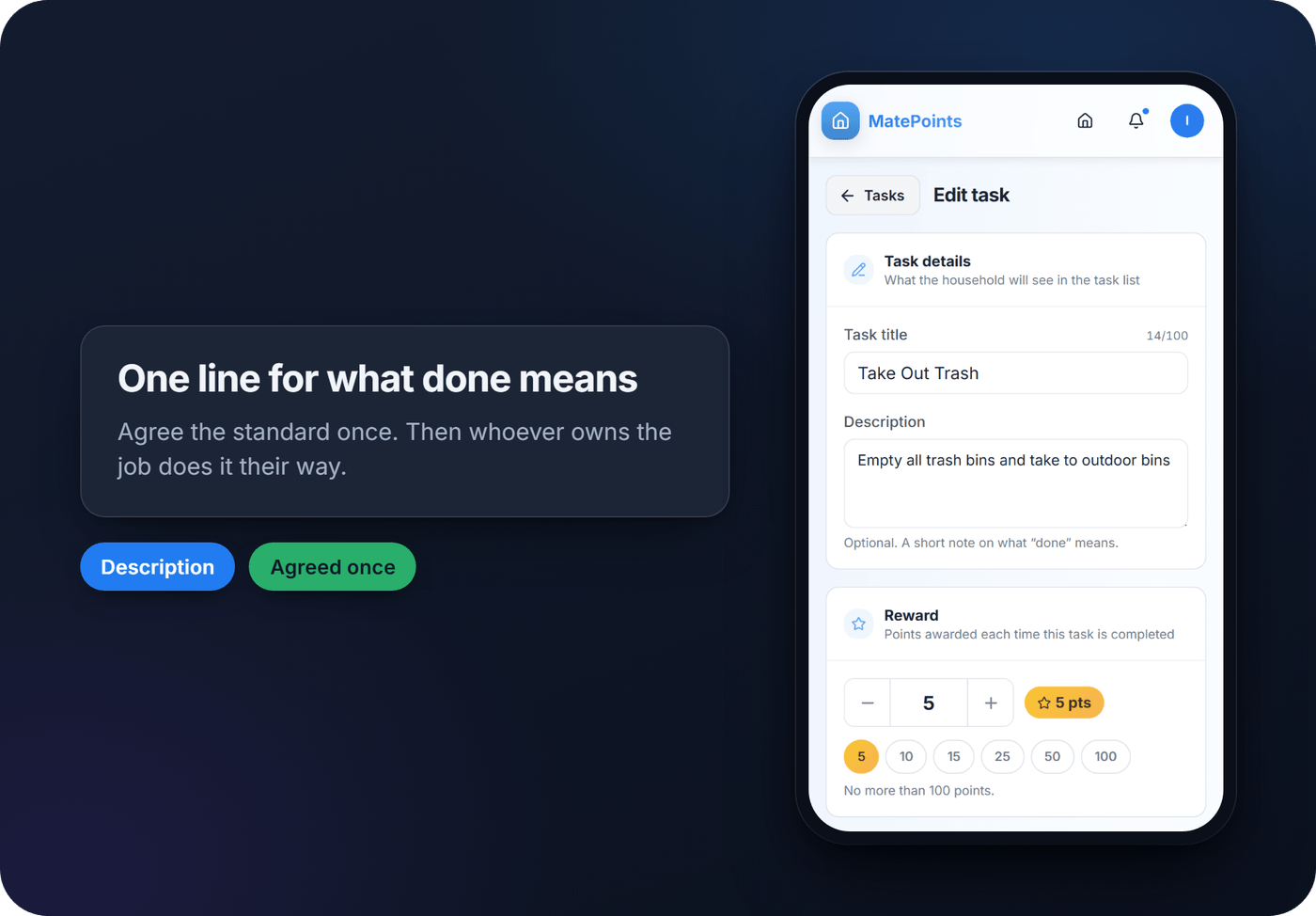
Give every job one line that says what finished looks like. "Bins: out the night before collection, new bag in, lid shut." It takes ten minutes for the whole list and saves a month of quiet resentment. Agree the standard once, then let whoever owns the job do it their way.
If one of you works from home, say so now. The person at home all day sees the dishes all day, and that changes the split. Our guide to chores when you work from home covers it.
Step 4: put a 30-day review in the diary
The split you agree in move week is a first draft. You have not lived with it yet. Before you finish the talk, pick a date about 30 days out and put it in both calendars.
At the review, keep it to fifteen minutes:
- Which jobs slipped, and why?
- Did anything turn up that was not on the list?
- Does either of you feel the split is unfair? Say it now, while it is small.
- Swap one job if it helps.

Splits drift, even good ones. In a WeddingWire forum thread on dividing chores (2019), one commenter advised making "a chart or something before y'all move in together", and another admitted, "I've been slacking a bit, and nagging him, need to rebalance!" They are forum posts, not research, but they describe the pattern well. A fixed date catches the drift before it becomes a habit.
Should moving in together chores be split 50/50?
Not necessarily. The Daily Star's advice for new couples is to split "50/50 or according to each person's talents and preferences". What matters is that you both agree it is fair, not that the hours match. Someone who works longer hours may take fewer weekday jobs and more at the weekend. That is a fair trade if you both chose it.
Start before the last box is open
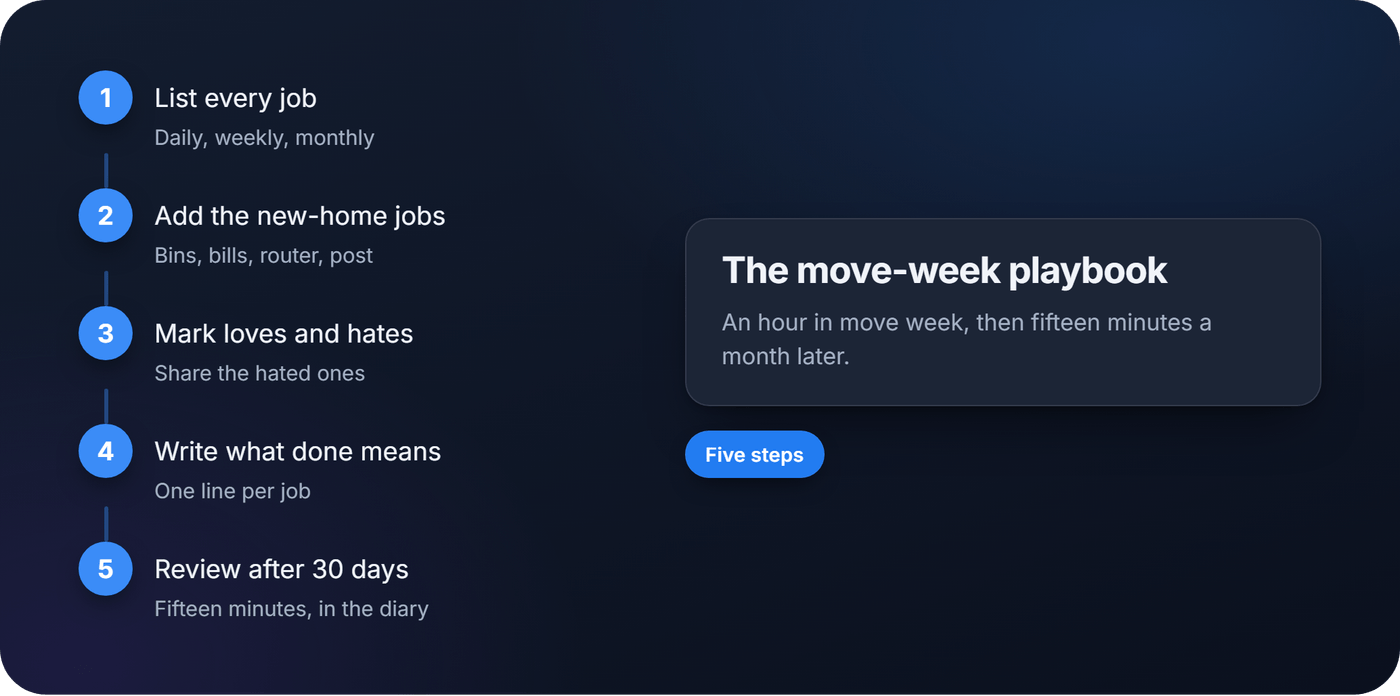
You will never have a cleaner start than move week. Nobody owns anything yet, so nobody loses anything. List the jobs, add the ones the new home brings, mark loves and hates, write what done means and set the date.
If you want the list to live somewhere you both see it, MatePoints is free to start. Create a household, invite your partner, and let Task import draft the first list from a prompt.
Sources
- What do couples argue about? Tone of voice, communication styles, and money top the list, Jamie Ballard, YouGov, February 2026
- Household chores aren't divided equally in UK relationships, Starling Bank (survey by Mortar Research), November 2023
- Moving In Together? How to Join Households Without Losing Your Mind (Or Your Relationship), Mike Henson, Primer, January 2020
- How to effectively combine households, Nationwide, undated
- How do you divide chores with your So?, WeddingWire forums, 2019-2020
- How to share daily chores as a newlywed?, The Daily Star, April 2023