Dividing household chores: audit first, split by domain
Dividing household chores fairly starts with an audit. Cut what nobody needs, give each person whole domains, agree what done means, then check in weekly.

Most fights about chores are not really about chores. They are about one person seeing a task and the other not seeing it at all. That is why dividing household chores should start with an audit, not an argument. List everything, cut what nobody needs, give each person whole domains, agree what "done" means, and check in weekly. It works for partners, families and housemates alike. The goal is not a stopwatch-perfect 50/50. It is a split everyone in the house believes is fair.
Fair is not the same as equal
Eve Rodsky, who created the Fair Play system for sharing household tasks, puts it plainly: what is fair is not necessarily equal, and what is equal is not necessarily fair. A split can be exactly even on paper and still feel wrong to the person doing all the remembering.
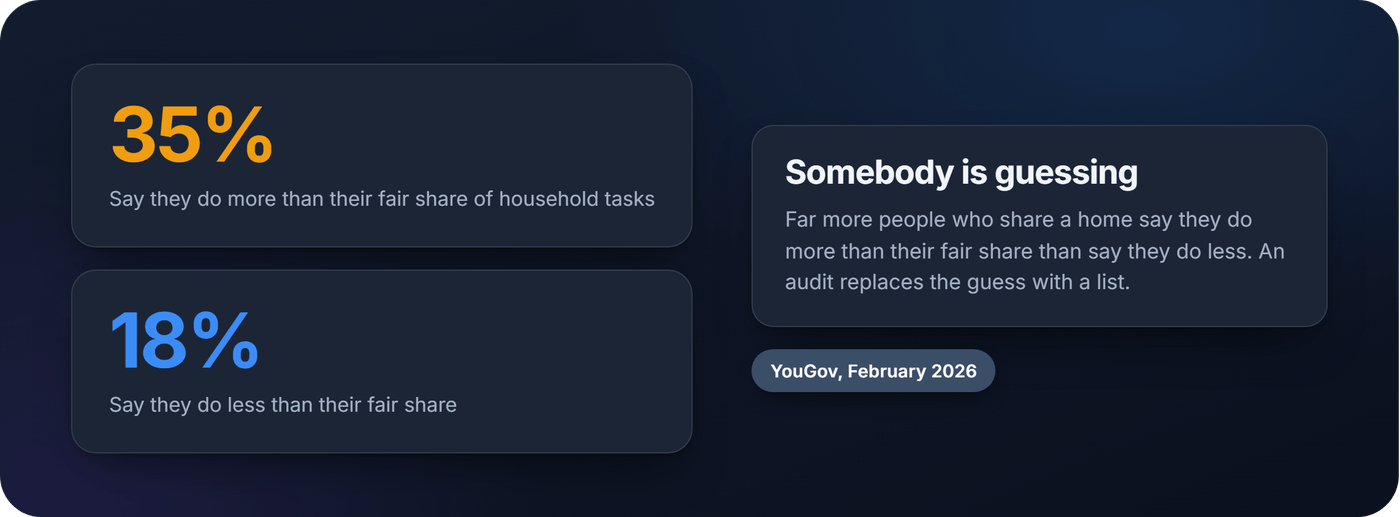
In a February 2026 YouGov survey, 35% of Americans who live with other people said they do more than their fair share of household tasks, and only 18% said they do less. If everyone judged accurately, those numbers would be close. Somebody is guessing, and an audit replaces the guess with a list.
The time gap is real and narrowing. The UK's Office for National Statistics found that in autumn 2023 women spent 3 hours 37 minutes a day on unpaid work and men 2 hours 43 minutes, a gap of 54 minutes, down from 1 hour 12 minutes in 2020. If you are still arguing about who does more, settle that with a shared list first. This article is about what comes next.
Start with a chore audit
Block off 30 to 60 minutes with a shared doc, a whiteboard or a stack of sticky notes, and write down everything. Not just dishes and laundry. Include the invisible chores: restocking the paper towels before they run out, remembering the dentist appointment, noticing the fridge smells off before it becomes a problem.
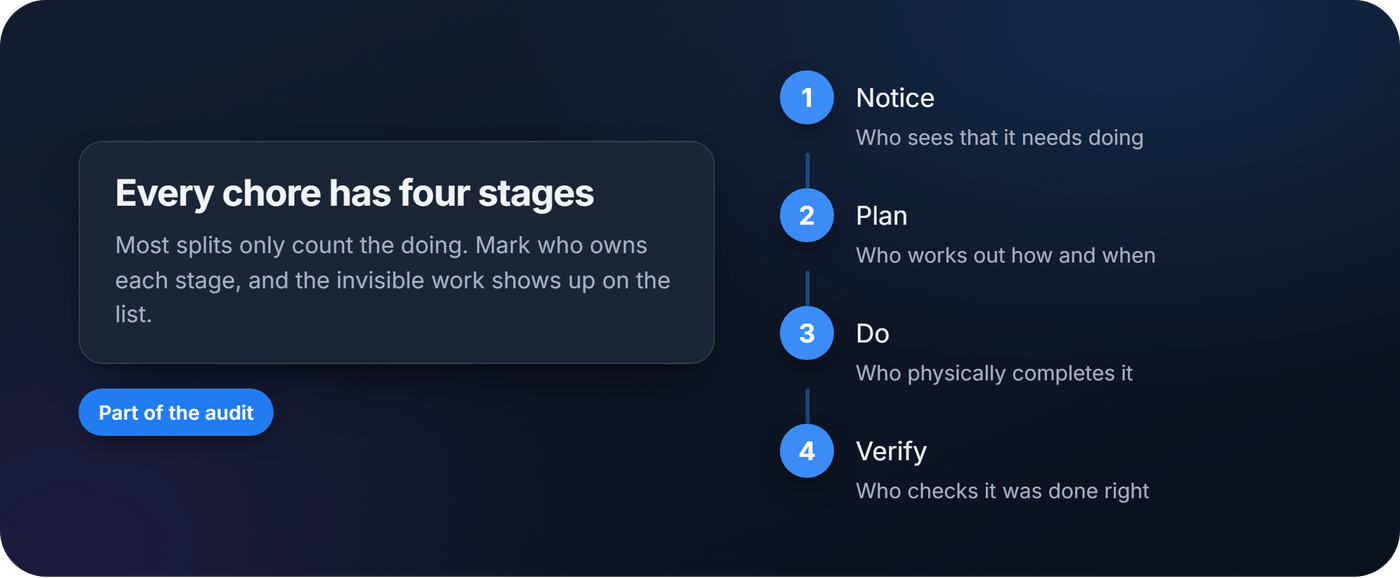
For each item, mark who currently handles it, and which of four stages they own:
- Notice: who sees that the task needs doing
- Plan: who works out how and when
- Do: who physically completes it
- Verify: who checks it was done right
That breakdown is our own shorthand, but it rests on real research. Sociologist Allison Daminger interviewed 35 couples and described the cognitive side of household labour as anticipating needs, identifying options, making decisions and monitoring progress, work that is "often invisible" to both people and "a frequent source of conflict" (American Sociological Review, 2019). Rodsky's version is Conception, Planning and Execution. The failure looks the same in any vocabulary: one person handles every stage of most tasks, while the other only ever "does", after being asked. That gap is where resentment lives.
Time-estimate the recurring tasks too. One 20-minute chore often eats more of the week than five quick ones combined.
Cut low-value chores before you split the rest
Before you assign anything, look for chores worth dropping, downgrading or outsourcing. Jennifer Petriglieri, an organisational behaviour professor at INSEAD, puts one question ahead of any division: "What can we simply stop doing?" (TED Ideas, 2020). Fewer tasks means less to argue over, and a shorter household cleaning schedule.
Ask three questions about each chore. Does anyone notice when it is not done? Does skipping it cause a real problem, or only an aesthetic one? Could a service or a once-a-quarter push handle it instead of a weekly slot on someone's list?
- Make the bed only when guests are coming, not daily
- Book a quarterly deep clean instead of chasing baseboards every weekend
- Batch-cook two nights a week instead of cooking fresh every night
Pro tip: if a chore has been argued about three or more times, it is a candidate for cutting or outsourcing, not for another round of negotiation.
Own whole domains, rotate only what nobody wants
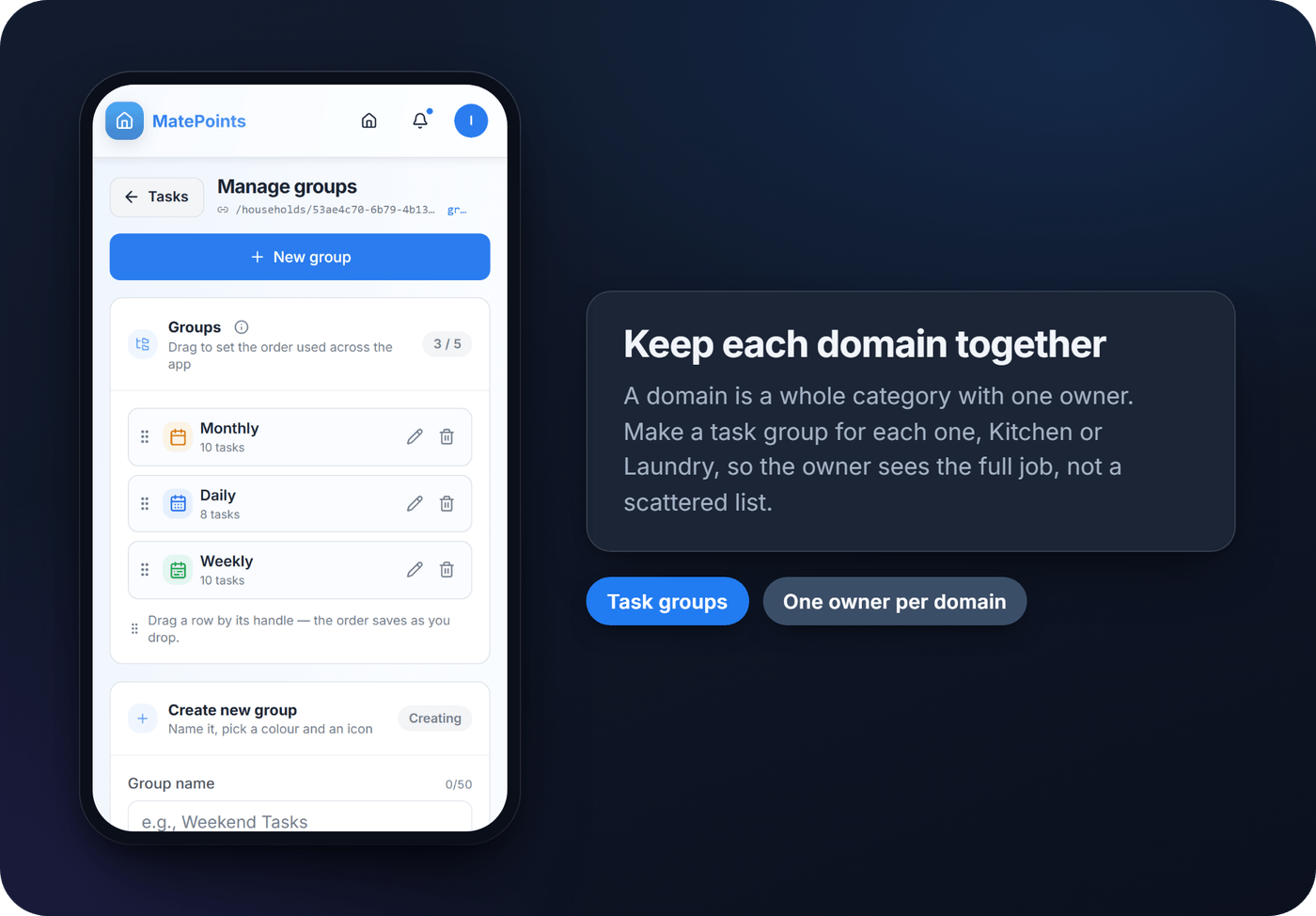
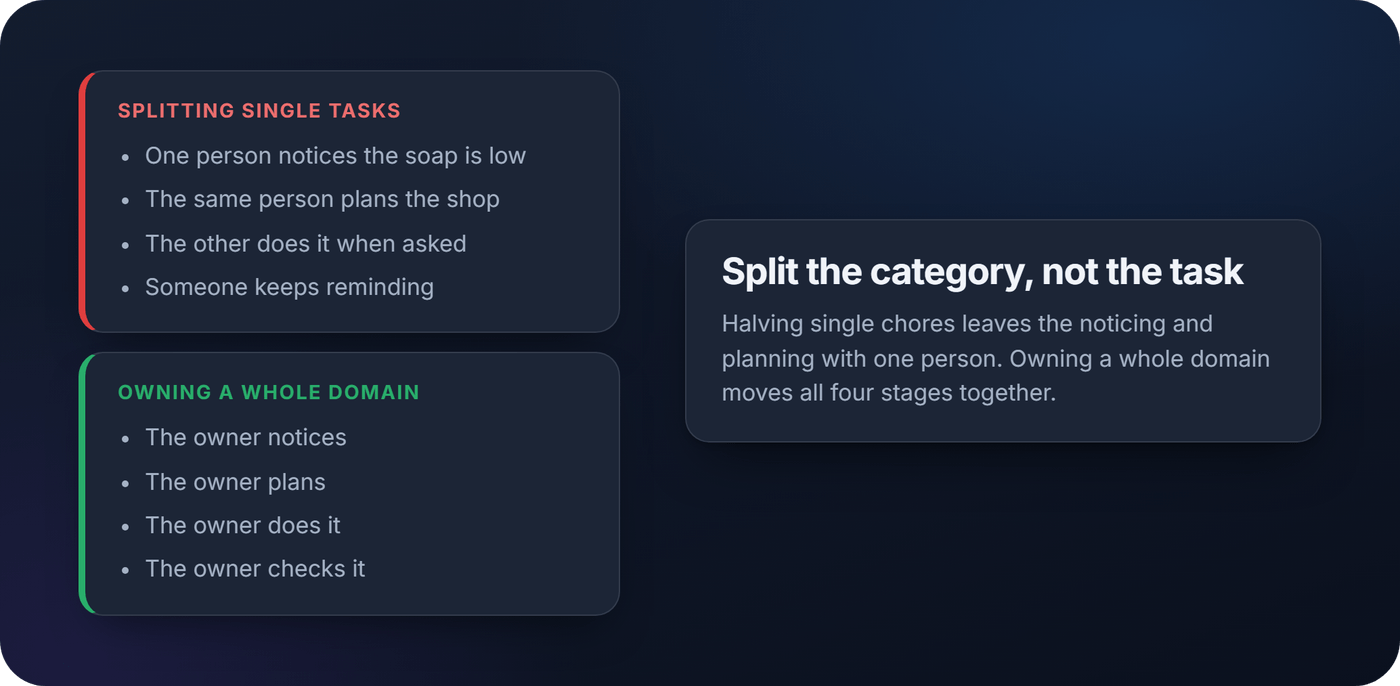
The instinct when you split household chores is to halve each task. It is also what causes the most low-grade conflict. The fix is domain ownership: one person owns a full category, start to finish, across all four stages.
- Assign whole domains, not tasks. One person owns "kitchen", another owns "laundry and linens". The kitchen owner notices when dish soap runs low, plans the shop, does the dishes and checks the counters. No hand-offs, no reminders.
- Rotate the domains nobody wants permanently. Bins and recycling can swap monthly so the same person is not stuck with them forever.
- Balance by time when domains alone do not. Estimate weekly hours per domain and trade until the totals are close, adjusted for schedules (more below).
- Match domains to preference where you can, but watch the thinking load. Someone who loves cooking can still end up buried if the domain also carries all the meal planning and shopping lists.
In a family, a teenager can own "recycling" end to end. If you are working out how to divide chores in a flatshare, domains end the "I did the hob, you do the sink" haggling; our roommate chore system covers that version.
Set a clear standard for "done"
Assigning a domain without agreeing what "done" looks like just moves the argument from "who does this" to "you didn't do it right". Rodsky calls the agreed floor the minimum standard of care: the level below which a task is not really done, whoever does it. Write a short, testable one for each essential chore before you start.
"Kitchen clean" means counters wiped, dishes washed or in the dishwasher, and the bin taken out if full. "Laundry done" means washed, dried and put away within 48 hours, not moved from the washer to a pile.
- Agree which tools are acceptable (a robot vacuum is fine, but the floors still get mopped weekly)
- Set the frequency up front so it is not a surprise later
- Decide what "good enough" means, in writing, not in someone's head
If an owner keeps missing the standard, do not quietly take the task back. Name the gap, ask what is getting in the way, and adjust the standard or swap domains if it is genuinely a bad fit.
Check in weekly, review monthly
A chore system without maintenance decays within weeks. The split that worked in January will not automatically work in June. The most effective chore management strategies are not clever, just regular:
- Weekly, 10 minutes. Two questions: "Did anything feel unfair this week?" and "Does anything need to change for next week?"
- Monthly, a short review. Look over the whole list. Did a domain quietly balloon? Did a cut chore creep back in?
- When life shifts. A new job, an injury, a new baby, a housemate moving out: redo the audit rather than waiting for the monthly check.
For temporary swaps, agree a simple protocol: whoever needs the swap asks, the other person confirms, and it reverts after the agreed window unless renewed.
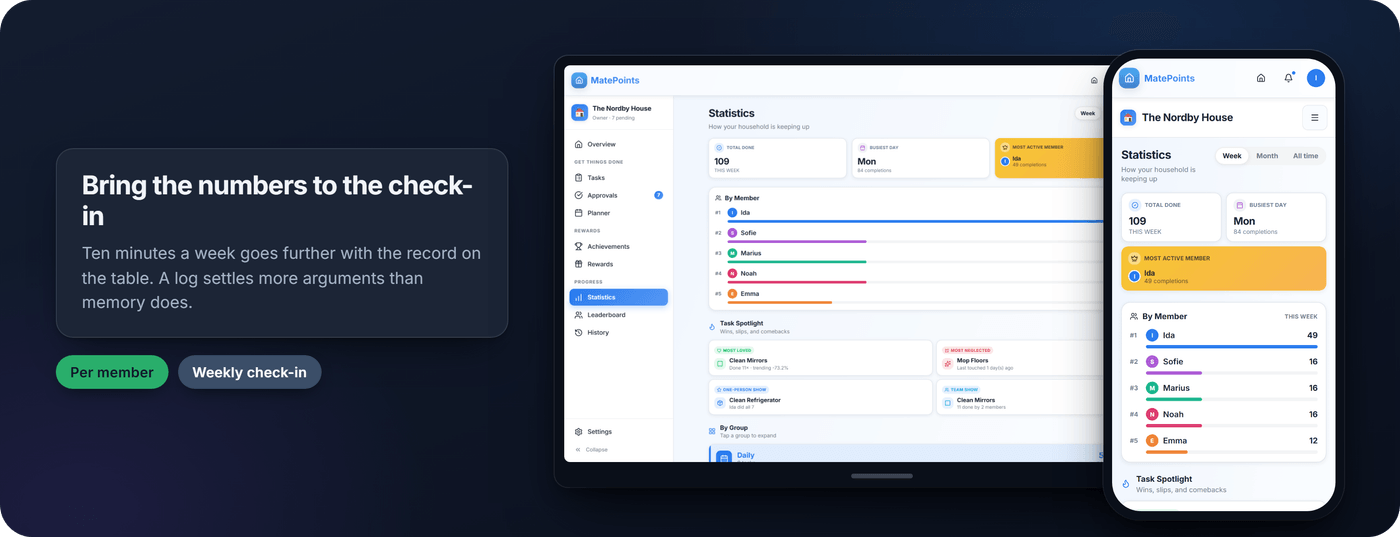
Pro tip: bring the actual numbers to a disagreement about fairness. A log settles more arguments than memory does.
How to split chores fairly when schedules are unequal
Equal time almost never exists. One person works 50-hour weeks, another works part-time, a teenager has exams. Rodsky's first rule in her TIME essay on dividing household duties is that all time is created equal: one person's hour is not worth more than another's. So estimate each person's realistic weekly chore hours, not their salary or ideal availability, and share domains in proportion to that.
Then weigh the chores by time, frequency and unpleasantness. In the same YouGov survey, 52% of Americans said they hate or dislike cleaning bathrooms, more than any other chore, while 59% like or love preparing meals. A rough weighting beats arguing from gut feeling.
- Pair a disliked domain with a preferred one for each person, so nobody gets only the chores everyone hates
- Alternate the universally disliked jobs, like a deep bathroom clean, rather than assigning them permanently
- In high-load stretches (exams, a work crunch, a new baby), use a temporary fix: paid help, or a short swap that reverts once things settle
Common mistakes when dividing household chores
Splitting single tasks rather than whole domains is the most frequent mistake. It quietly recreates the "one person manages everything" problem even when the labour looks shared on paper.
- Keeping a mental scorecard. It breeds resentment faster than any actual imbalance does.
- Micromanaging someone else's domain. It undoes the point of handing it over.
- Ignoring invisible work. If noticing and planning are not on the list, one person carries them even in a "fair" split.
- Skipping check-ins. Small imbalances become entrenched ones.
When conflict does surface, a better script than "you never do X" is "I noticed X is falling on me, can we look at the audit again?" It points at the system, not the person. And one of the best tips for chore delegation: hand over the outcome and the standard, then leave the method alone.
Where MatePoints fits
MatePoints keeps the record, so the weekly check-in starts from the same facts. All of this works on the free plan:
- A shared task list with points. Built-in chores plus your own, each with a point value you set, and task groups to keep a domain's chores together. The free plan caps how many custom tasks and groups you can add; Pro raises the caps.
- Approval, so done means done. A completion can wait for an approver to confirm it, and points count only once it is approved.
- Statistics per member, with spotlights such as "One-Person Show" (one person did every completion of a task) and "Most Neglected" (the chore nobody has touched for days). They are the imbalances the audit was meant to catch.
- Planner wishes. Post a job on a date and anyone in the house can claim it with "I'll do it": the temporary swap, written down.
- Task history, so "I already did that twice" is something you can look up.
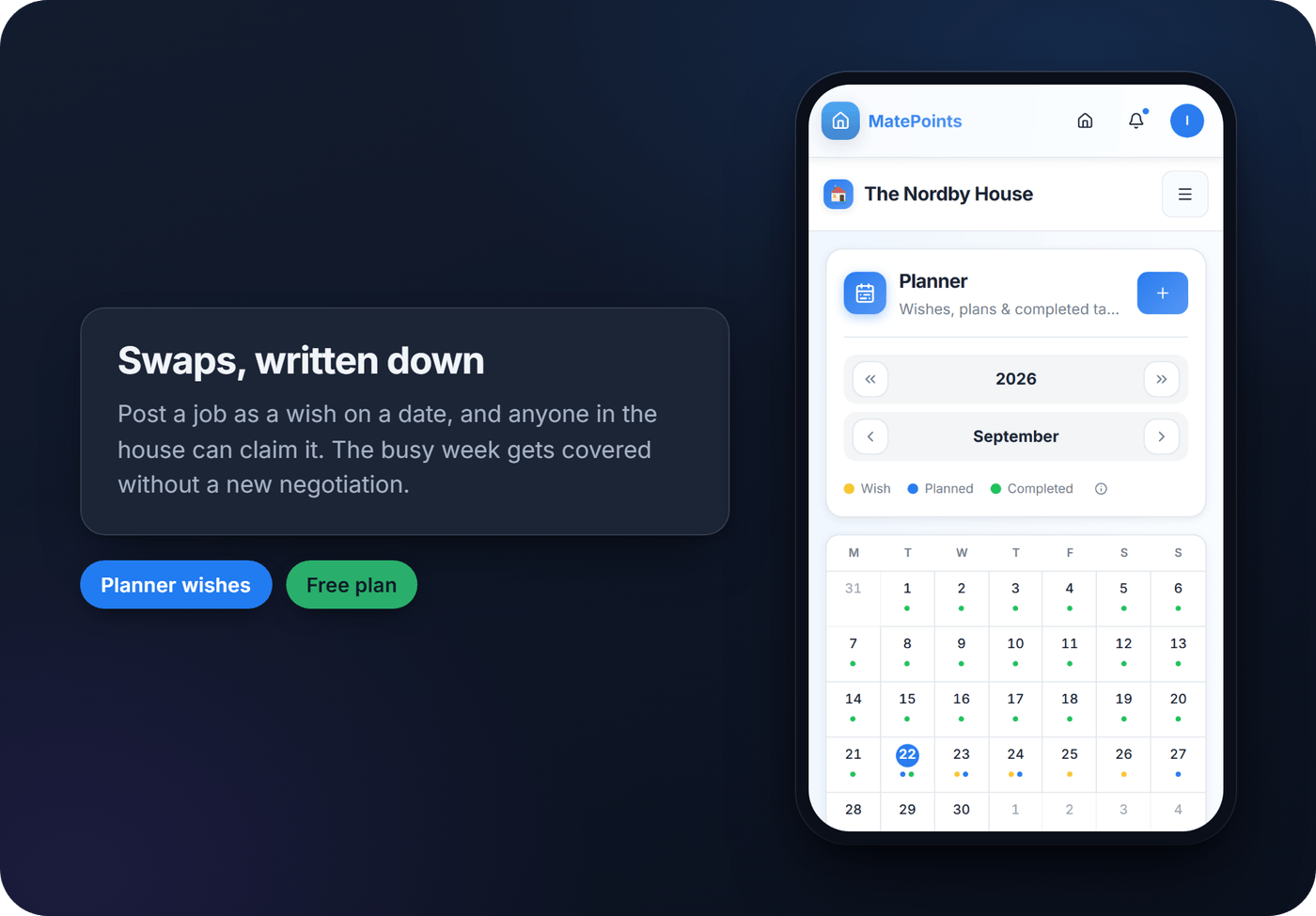
What it does not do: assign a task to a person, rotate chores or set due dates. Domain ownership stays a household agreement; the app shows whether it is holding. It does not time chores, so the time-weighted split stays on paper, and accounts start at 13, so a younger child's jobs do too. If you are still choosing a method, our guide to splitting chores with your partner compares ownership, rotation, time budgets and points side by side.
Give it eight weeks before you judge it
Any new chore system feels clunky at first. Give it six to eight weeks before you judge it. That fits habit research: in a 2010 study led by Phillippa Lally, new daily habits took an average of 66 days to become automatic, with a range from 18 to 254 days.
Watch for three signs: fewer "did you remember to..." reminders, a little more actual free time, and a clear enough sense of ownership that nobody has to ask who is handling something. If those show up, the system is working, even if it still needs adjustments.
The audit is the part people skip, and it is the part that does the work. An hour with a stack of sticky notes buys more fairness than any rota.
Marcus
FAQ
How do you divide chores fairly?
Audit every task, including the invisible planning and noticing. Aim for a fair split rather than an equal distribution of chores: cut what nobody needs, give each person whole domains weighted by the time they really have, agree a standard for "done", and check in weekly.
What is the most disliked household chore?
Cleaning bathrooms. In YouGov's February 2026 survey, 52% of Americans said they hate or dislike it, more than any other chore. Alternate it rather than giving it to one person for good.
Can chores strain a relationship?
They can. In a 2016 Pew Research Center survey, 56% of married adults said sharing household chores is very important to a successful marriage, the third most common answer on the list. And a 2022 study reported by TIME found that the number of equally shared tasks matters a great deal for both men's and women's relationship quality. The same logic applies to any shared home: an unfair split wears on everyone in it.
How often should a household review its chore split?
Ten minutes every week, a fuller look at the list every month, and a fresh audit whenever life changes: a new job, a new baby, someone moving in or out.
Does this work for housemates and families, not only couples?
Yes. The audit, domains and standards do not care who lives in the house. In a family, give teenagers small domains they own end to end; in a flatshare, let domains replace the task-by-task haggling.
Sources
- Author Q+A, Eve Rodsky, Fair Play
- How Americans feel about household chores, and dividing them, Taylor Orth, YouGov, February 2026
- Time use in the UK: 23 September to 1 October 2023, Office for National Statistics, November 2023
- Sharing chores a key to good marriage, say majority of married adults, A.W. Geiger, Pew Research Center, 2016
- The Cognitive Dimension of Household Labor, Allison Daminger, American Sociological Review, 2019
- The Cognitive Dimension of Household Labor (research summary), Work and Family Researchers Network
- How to split the chores with your partner, minus the drama and fighting, Jennifer Petriglieri, TED Ideas, 2020
- I Created a System to Make Sure My Husband and I Divide Household Duties Fairly, Eve Rodsky, TIME, 2019
- The Way Couples Split Chores Can Improve Relationships, According to a New Study, Belinda Luscombe, TIME, 2022
- How to form a habit, British Psychological Society Research Digest, 2010