Splitting chores with your partner: four ways that work
Four ways couples divide chores, what to do when your schedules do not match, and the repair language worth agreeing before an argument needs it.

If you have already worked out that the chores are not split evenly, the next question is the harder one: how do you actually divide them? Not who is right about the past — what the arrangement should be from Sunday.
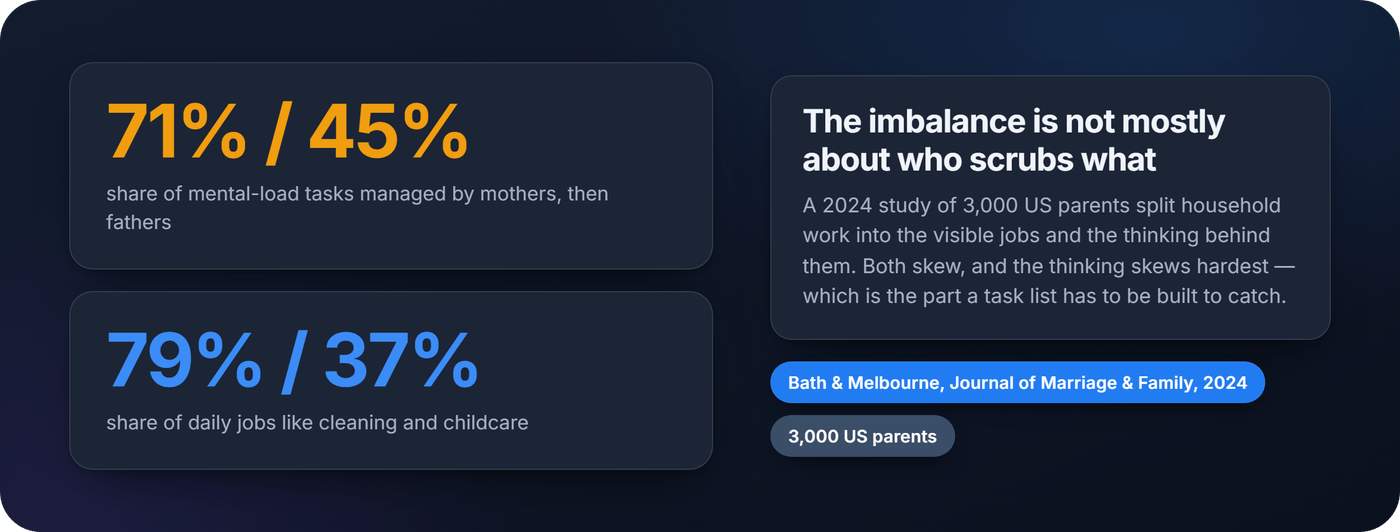
It is worth knowing what you are dividing. A 2024 study of 3,000 US parents by the universities of Bath and Melbourne found that mothers manage 71% of household mental-load tasks against fathers' 45%, and 79% of the daily jobs like cleaning and childcare against 37%. Time-use data says the same thing more plainly: 87% of women did household activities on an average day against 75% of men, at 2.8 hours against 2.1.
The gap between those two rows is the point. The visible jobs skew, and the thinking behind them skews harder — so a split that only divides the visible jobs leaves most of the imbalance exactly where it was. If you have not yet done the part where you find out what your own split actually is, start there instead; this article assumes you already have.
Clarity beats equity

Jennifer Petriglieri, who studies dual-career couples at INSEAD, puts the problem somewhere most couples do not look. Her advice is that the key is clarity, and that tensions almost always come from a lack of it rather than a lack of equity. The couples who manage this well, she finds, divide deliberately — not necessarily equally.
That is a relief, if you let it be. You are not trying to build a perfectly balanced ledger. You are trying to get to a state where neither of you is guessing who has got the bins.
Her framework has two steps almost everybody skips, and they come before the dividing:
- What can you stop doing entirely? Go down the list and ask which jobs would genuinely be fine undone. Ironing bedsheets. Hoovering twice a week rather than once. The fastest way to split a chore fairly is to delete it, and it is worth being strict about what belongs on a daily list at all.
- What can you buy back? A fortnightly cleaner, a supermarket delivery slot, the pre-chopped vegetables. Not available to every budget, and worth pricing honestly against the argument it prevents when it is.
Only then do you divide what is left. Doing it in that order means you are not carefully negotiating ownership of a job neither of you needed to do.
Four ways to divide, and when each one fits
There is no correct system, but there is a wrong way to choose one: guessing. Match the method to your actual schedules, not to what felt fair when you moved in together.
Ownership suits tasks with a learning curve or a real preference attached. If one of you already knows the dishwasher's quirks or genuinely likes the food shop, permanent ownership beats rotation because it removes the negotiation entirely. The risk is that it calcifies into "that has always been my job", so revisit assignments every few months.
Rotation suits chores that are roughly equal in effort and unpleasant enough that nobody wants permanent custody. Bins, litter trays, the bathroom. Alternating weekly or monthly keeps the load feeling even even when the jobs are not glamorous.
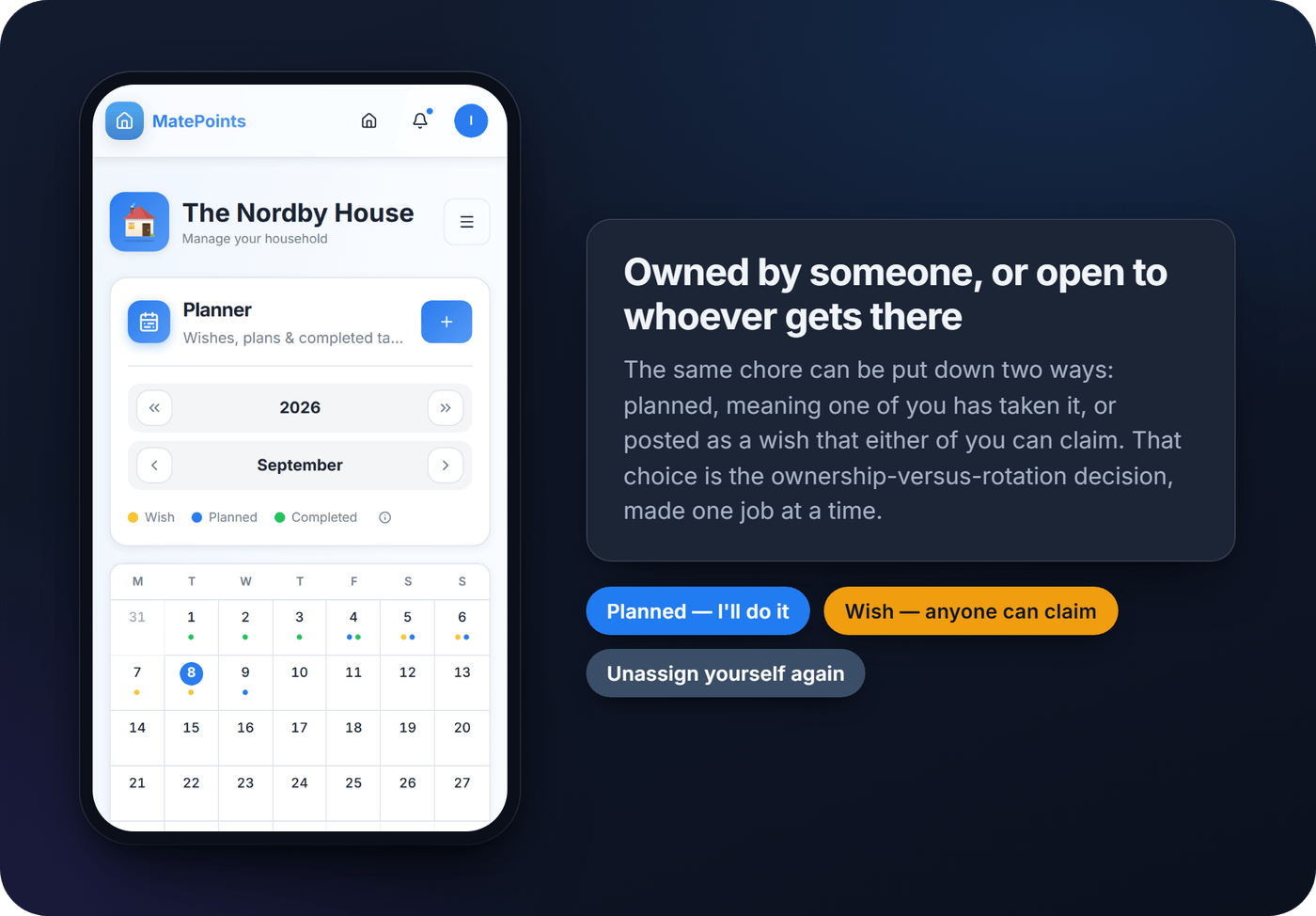
In practice these two are a per-job decision rather than a household policy, and it helps to have somewhere that can hold both. A job can go down as taken by one of you, or posted for whoever gets to it first — which is the ownership and rotation choice made one chore at a time rather than settled once for everything.
Time-budgeting matters most when the schedules are genuinely asymmetric — one of you works nights, or travels, or carries a caregiving load. Split hours instead of tasks. If one person has five available hours a week for household work and the other has twelve, dividing by task count will always feel unfair to somebody, and both of you will be right.
Points work when motivation rather than time is the bottleneck. A shared total turns "I did more than you" into something checkable instead of arguable.
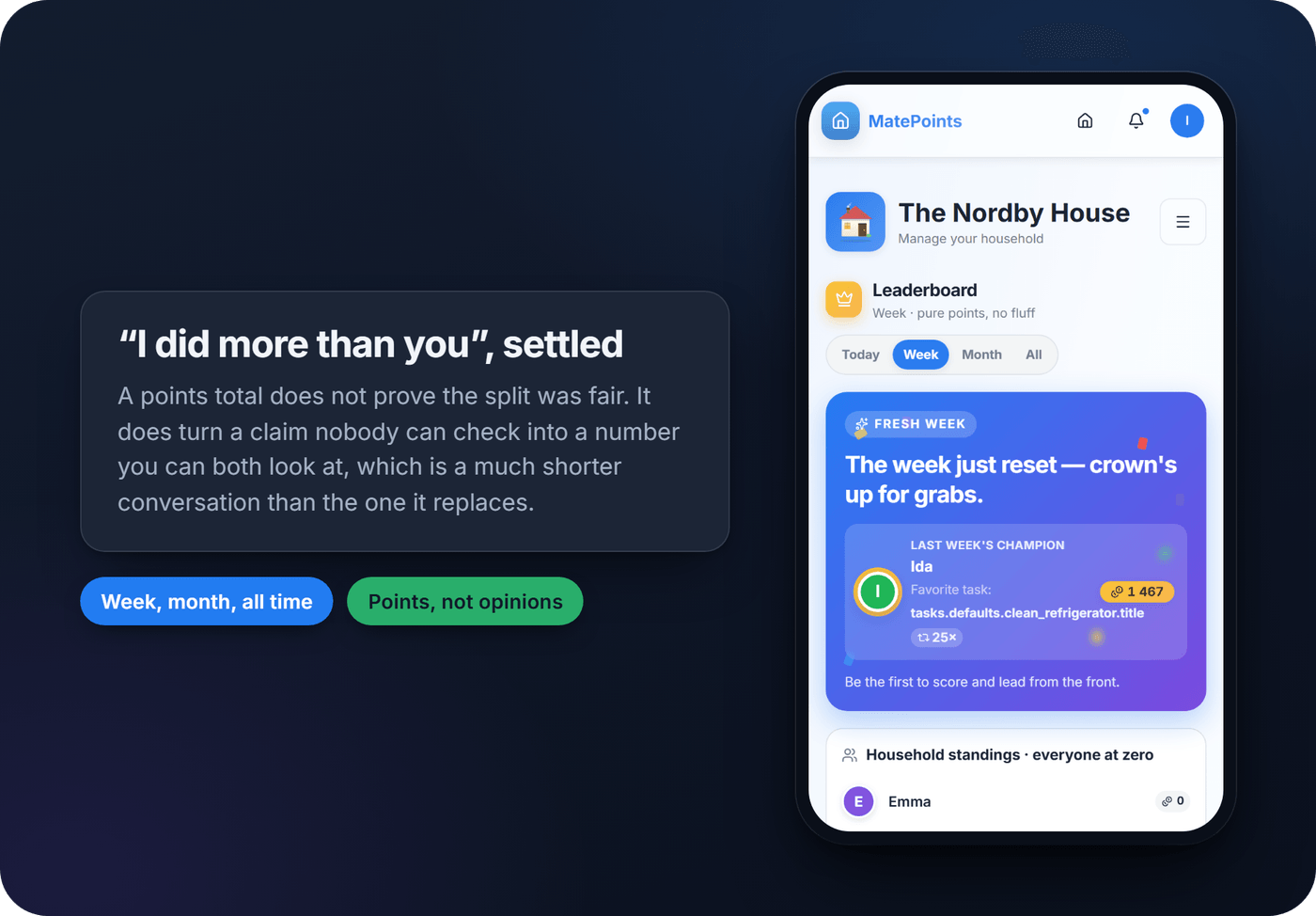
The guardrail matters here more than with the other three: points only work if you set the values together and revisit them when circumstances change. A points system one of you imposed feels like being marked, not partnered — and a number that says you did less does not distinguish between a lazy week and a brutal one.
Most couples end up hybrid. Ownership for the big recurring items, rotation for the ones nobody wants, and a time budget or a points total over the top to catch what does not show up on any single list. If you find yourselves switching systems every few weeks, that is usually a sign the underlying task list is still wrong rather than the method.
Repairing it when it breaks
Every arrangement breaks eventually. What decides whether it recovers is having the repair language agreed while nobody is annoyed.
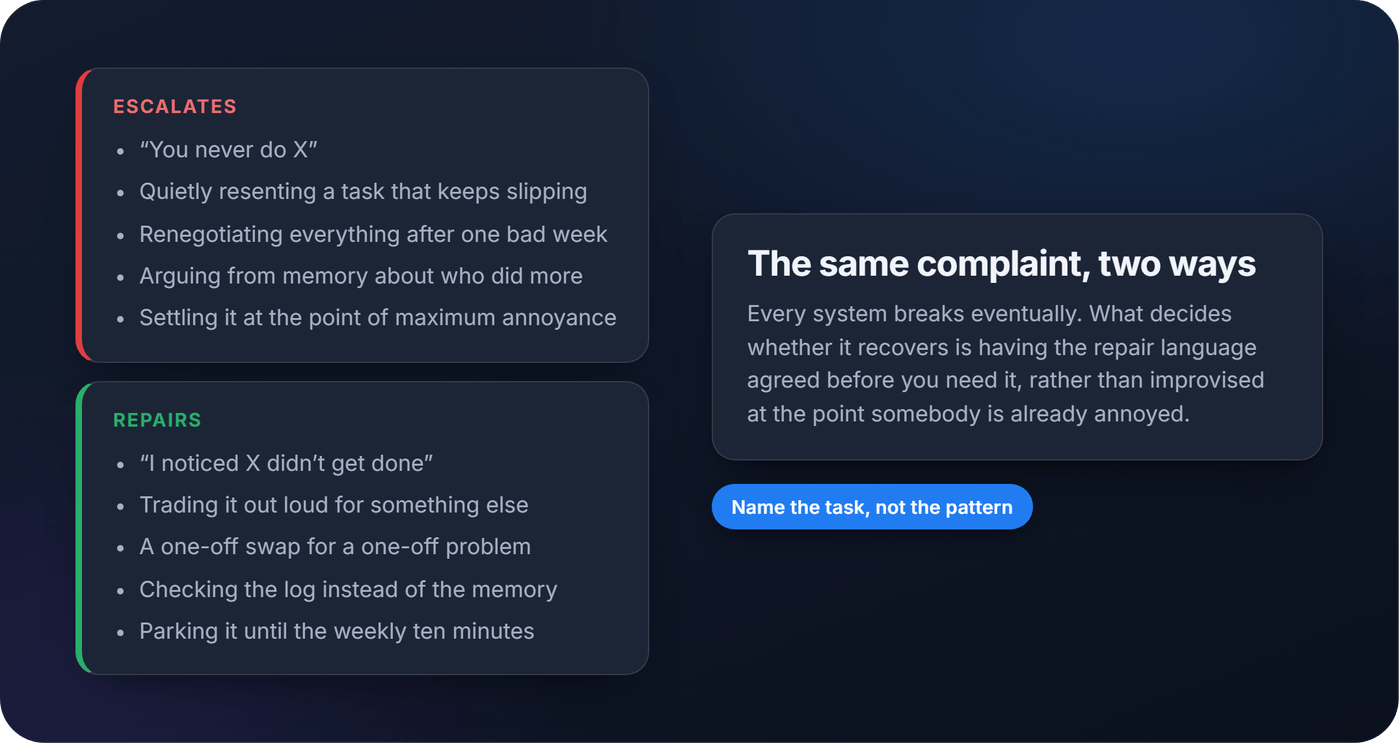
- Name the task, not the pattern. "I noticed the bins didn't go out" is a logistics problem. "You never do the bins" is a character assessment, and people defend their character.
- Reassign out loud. If a job keeps slipping, trade it for something else rather than quietly resenting it for another month.
- Check the record, not the memory. Two tired people genuinely remember the same week differently. That is not dishonesty, it is how memory works under load, and it is why the log exists.
- Temporary fixes for temporary problems. A brutal week justifies a one-off swap. It does not justify renegotiating the whole arrangement.
- Park it for the weekly ten minutes. Fixing friction in the moment produces rules nobody actually wants to keep. Write it down, raise it Sunday.
That last one is the habit worth protecting. A short weekly check-in does more to prevent recurring miscommunication than any number of reminders, because it gives every irritation a scheduled place to go. Some couples settle the channel as well as the timing — deciding in advance that recurring friction gets raised somewhere specific, rather than arriving across the kitchen at seven o'clock on a Tuesday.
And if the same fight keeps coming back, call a cooling-off week. Pause the points, split everything fifty-fifty by pure count for seven days, and revisit the real arrangement once tempers have settled. A flat split is a bad permanent system for exactly the reasons above — it ignores schedules, preferences and effort — but it is an excellent temporary one, because for one week nobody has to agree on anything except the count.
What this looks like in MatePoints
MatePoints is a shared task list with points and an approval step. Worth knowing which parts of the above it does and does not do, before you decide whether it fits.
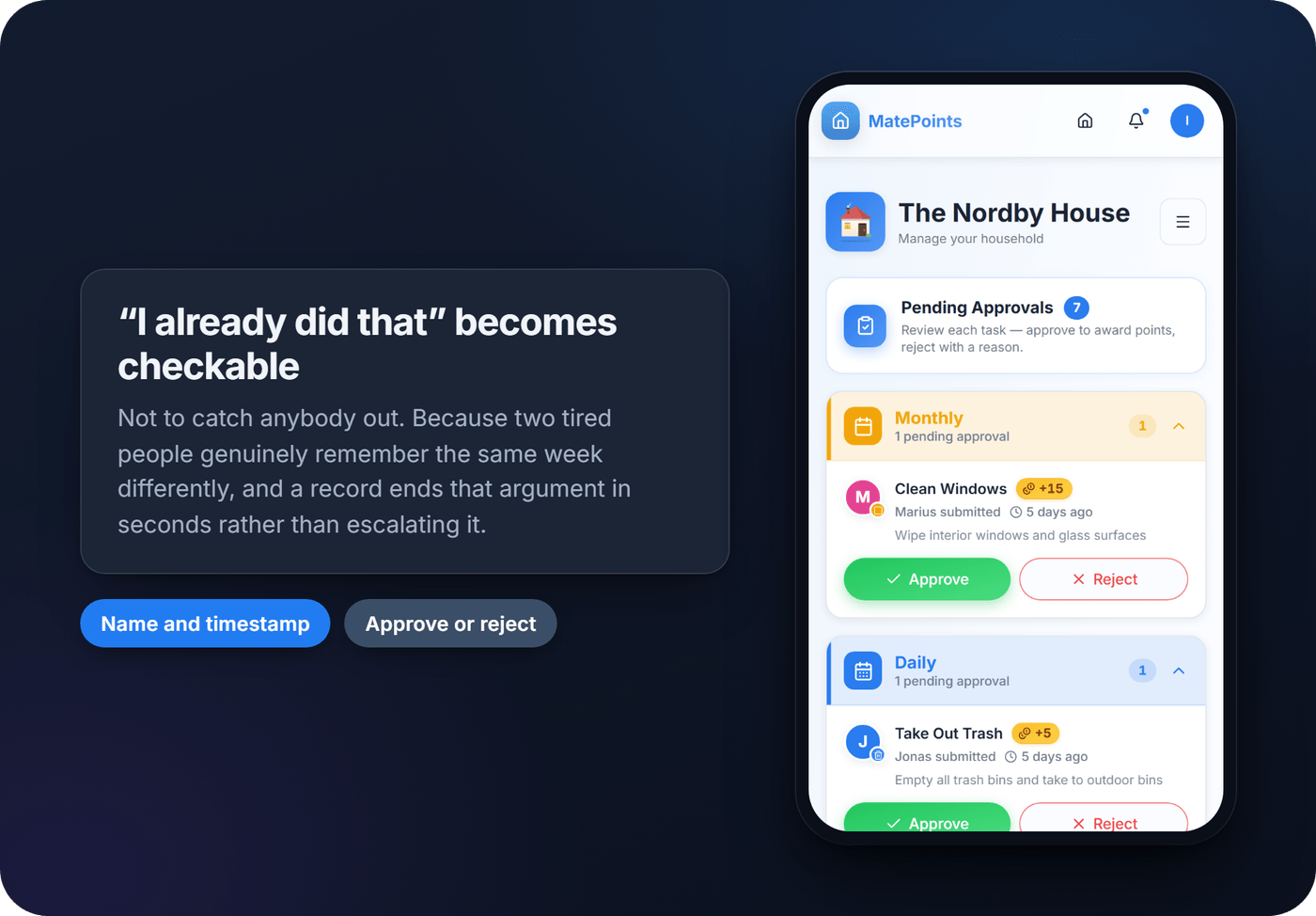
A record instead of a memory contest. Every completion carries a name and a timestamp, and the approval step means "I already did that twice this week" is checkable rather than assertable. That single thing settles most of what couples actually argue about.
Ownership, per occurrence rather than permanently. A task belongs to the household and anybody can complete it — there is no permanent assignee. What the planner adds is the per-job version: an entry is either planned, meaning one of you has taken it, or a wish that either of you can claim, and you can unassign yourself again. That is closer to how couples actually work than a fixed rota.
Points and a leaderboard, if motivation is your bottleneck. Achievements that pay out an agreed reward sit on top, and those need a Pro subscription.
Tap-to-complete, so logging a chore costs less than skipping it — a tag on the machine, tapped as you pass. This needs a household owned by a Pro member, which is worth knowing up front: it is the verification piece, and it is not on the free tier.
What it does not do: there is no smart-home automation today, and no permanent per-task owner. If either is the thing your house needs, better to know now.
Why automation beats willpower
Most chore systems do not fail because a couple lacks effort. They fail because effort is what is being asked of the tired partner, again. Automation is not a shortcut around commitment — it is a way of removing the parts that depend on memory, which is exactly where the mental load piles up.
Two failure modes turn up over and over. Either nothing is written down, so every disagreement becomes a memory contest. Or everything is written down but nobody automated the repeating parts, so the list becomes another chore to maintain. Visibility solves the first. Automation solves the second. Neither replaces the conversation about fairness, and no app will have that conversation for you.
Treat your first arrangement as a draft, not a verdict. The couples who stay with a system are the ones who adjust it every month or two, rather than abandoning it the first time it feels unfair.
Sources
- Mothers bear the brunt of the mental load, managing 7 in 10 household tasks — University of Bath and University of Melbourne, Journal of Marriage & Family, 2024
- How to split the chores with your partner — minus the drama and fighting — Jennifer Petriglieri, TED Ideas
- American Time Use Survey — 2025 results, US Bureau of Labor Statistics, June 2026