Blended family chores: one system for two homes
Blended family chores that work across two homes: agree adult roles first, keep a few core rules fixed, match chores to age, and share one chart.

Blended family chores work when the adults agree, privately and first, on who assigns, reminds and approves, and then build one portable chart that travels between both homes and gives each child tasks that fit their age and ability. Chores done regularly are linked to better outcomes for children, and stepfamily research reviewed in Family Relations (2022) points to the piece most families skip: stepparents building a relationship before they enforce anything.
Why chores are harder in a blended family
Two households almost never run on the same rules. One home might expect children to clear their own plates by age five while the other lets it slide until ten, and children notice the mismatch fast. Custody rhythms add another layer: a routine built for a full week falls apart when a child is only there three days out of fourteen.
Chores can also stand in for bigger questions about fairness and belonging. When a stepparent assigns a task differently from how a biological parent would, it can read as favouritism even when nobody means it that way. And yet shared routines help. The 2022 review by Sanner, Ganong, Coleman and Berkley found that "routine shared activities such as going for walks, playing games, and even doing household chores together" contribute to "feelings of continuity and stability among adolescents in stepfamilies". The chart matters less than the adult agreement behind it.
One shared system that travels between both homes
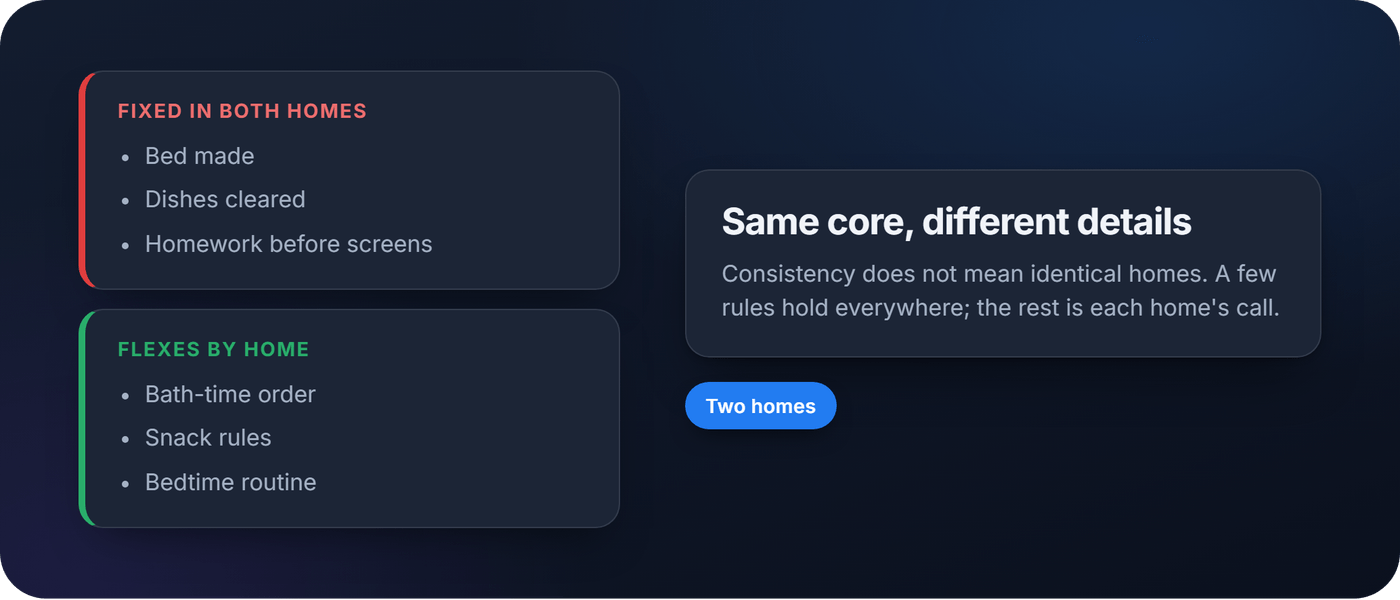
Consistency does not mean identical households. It means a short list of core expectations that hold everywhere, with room for each home to handle the details its own way.
- Core rules stay the same: bed made, dishes cleared, homework done before screens.
- The details flex by household: bath-time order, snack rules or the order of the bedtime routine can differ.
- One portable tool carries the plan: a laminated card, a printable routine sheet, or a shared app both homes can open.
For coordination, a five-minute weekly check-in between the adults, even by text, keeps both homes aligned on what a child has and hasn't done. A shared calendar or checklist means the children don't have to carry messages between parents. And a simple fallback rule (if unsure, use the stricter home's expectation) prevents arguments in front of the children.
Match chores to age, ability and development
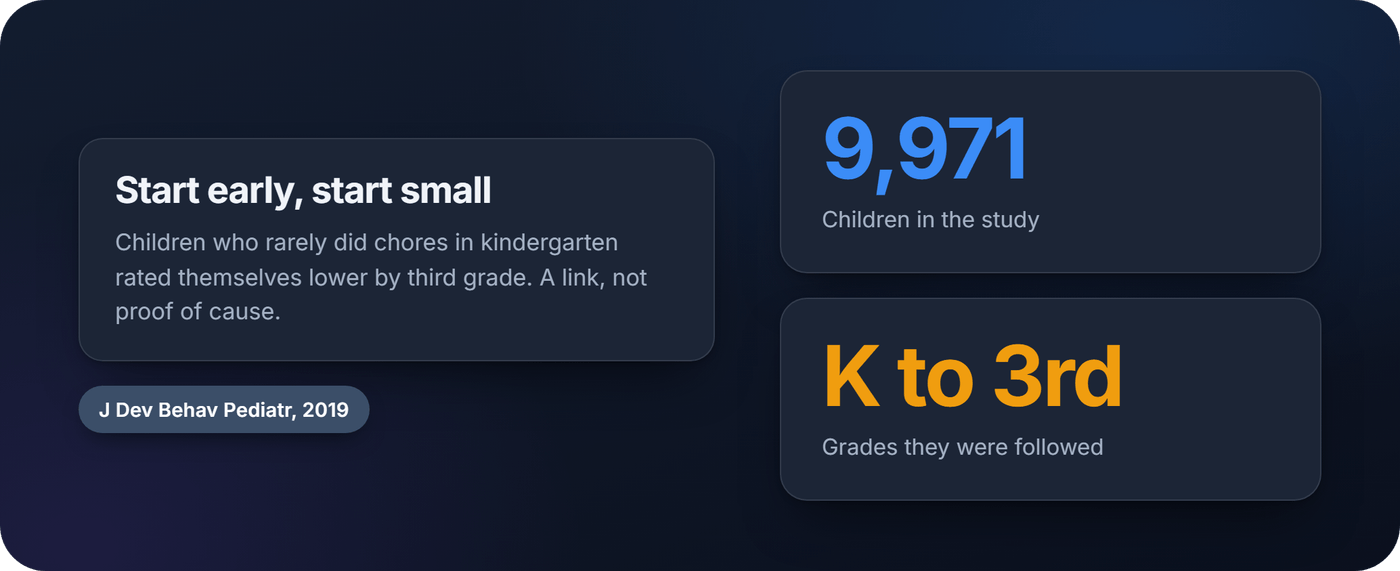
Age-appropriate tasks make the system feel fair instead of arbitrary. In a 2019 study in the Journal of Developmental and Behavioral Pediatrics, White, DeBoer and Scharf at the University of Virginia followed nearly 10,000 US children. Those who rarely did chores in kindergarten were more likely, by third grade, to rate themselves in the bottom fifth for prosocial behaviour, academic ability, peer relationships and life satisfaction than children who did chores regularly. It is an association, not proof that chores caused the difference, but it is a reason to start early and small rather than perfectly.
Rough guidelines by age:
- Preschool: self-care basics like putting toys away and helping set the table.
- School age: family-care basics such as feeding a pet, folding laundry or emptying the bin.
- Teens: bigger or rotating tasks like cooking a simple meal, yard work or running their own laundry.
Teach each new chore by showing it, helping with the first few attempts, then stepping back as the child gets the hang of it. A 2022 study by Tepper, Howell and Bennett at La Trobe University found that children who did more self-care and family-care chores, like making a meal for themselves or for someone else, had better working memory and inhibition. It was a one-time survey, so again a link rather than a cause, but it is another reason to teach gradually rather than expect mastery on day one. Reassess the chart whenever custody schedules, schools or the household change.
How the adults divide roles and present a united front
The most common failure point is not the chart. It is the adults disagreeing about who enforces it. The 2022 review is clear on this: children and the stepfamily do best "when biological parents continue to be the primary disciplinarian, especially early in stepfamily formation, and especially with adolescents", while stepparents contribute most by supporting the parent's efforts.
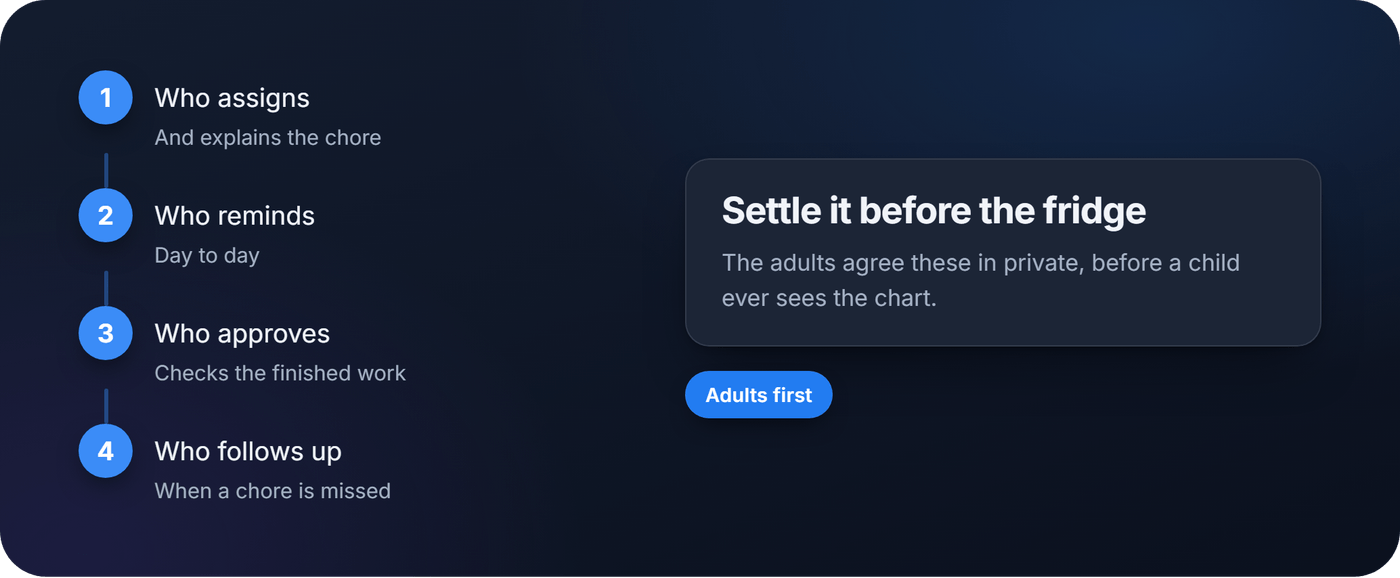
Settle these questions privately before any chart goes on the fridge:
- Who assigns the chore and explains it to the child.
- Who sends the reminders.
- Who checks and approves finished work.
- Who follows up when a chore is missed.
A simple script helps: "In our house, everyone pitches in. Here's your part this week." When a child pushes back with "you're not my parent", the stepparent can say something like "I'm not replacing anyone, I'm just helping keep things running," and let the biological parent handle any consequence.
Tip: write the adult agreement down, even informally. A shared note both adults can check stops the plan drifting when memory or stress get in the way.
Templates and tools that make the system concrete
A rotating weekly chart works for most households: every chore down one side, every family member across the top, rotated weekly so nobody is stuck with the least favourite task for good. A compact version, sized for a backpack or a binder, lets children carry this week's assignments between homes.
For rewards and consequences:
- Frame finished chores as contributing to household privileges, like choosing a film or a weekend activity.
- Agree proportionate consequences for missed chores in advance rather than improvising in the moment.
- Review the reward system together every few months so it grows with the children.
Low-friction tech has its place too:
- Use a shared app when children move between homes often and need the same list visible everywhere.
- Stick with a paper chart for younger children who respond better to something they can tick.
- Look for reminders and approvals that run themselves, so the adults spend less time nagging and more time following up on what matters.
What makes a chore system stick, and the mistakes that sink it
Start with one routine, not five. A single chore done reliably for a few weeks builds more trust than an ambitious chart abandoned after ten days. Celebrate small wins out loud before you add more.
Avoid these common traps:
- Never use chores as a surprise punishment, or tie them to a child's sense of belonging in the house.
- Watch for inconsistent enforcement between the two homes, which undermines the plan faster than any single missed chore.
- Keep adult disagreements about the system away from the children entirely.
Tip: if a chore keeps getting skipped, the task is usually too big or too vague, not the child being difficult. Break it into a smaller, more specific step. For a fuller look at splitting the work fairly, see dividing household chores.
Where a chore app fits into the picture
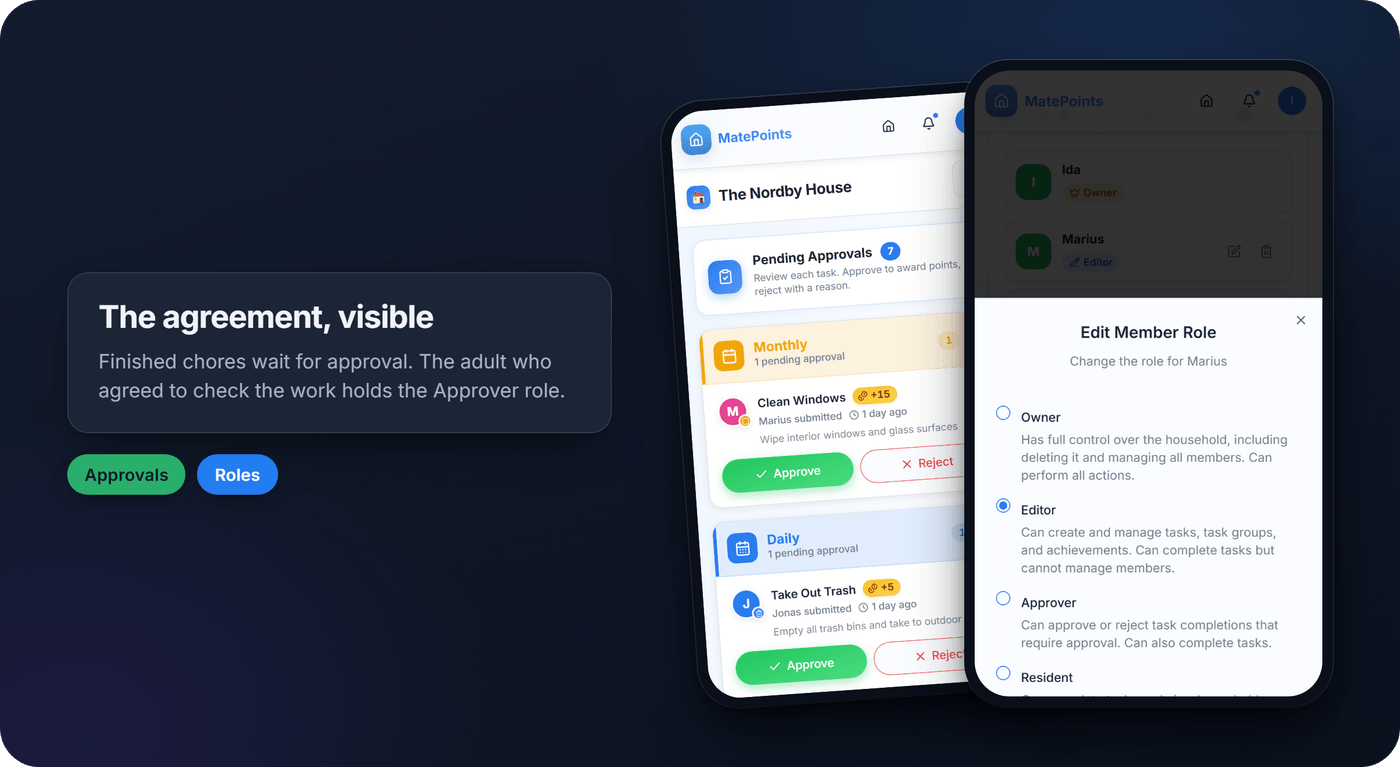
An app can support a chore system without replacing the adult work behind it. In MatePoints, every chore has points, everything that gets done is logged with a name, and finished chores can wait for an adult to approve them before they count.
That approval step does a specific job in a blended family. Any adult can hold the Approver role, so the parent who agreed to be the one who checks the work is the one who confirms it. The decision you made in private shows up in the app, without anyone having to say it out loud.
None of this replaces the private adult agreement on roles, or the relationship work a stepparent needs to do before enforcing anything. The tech supports the system. It doesn't build it.
Respecting cultural traditions when dividing chores
Blended families often bring together two sets of cultural expectations about which chores matter, who does them and at what age a child takes on responsibility. In some households, cooking and caregiving carry strong gender or generational roles; in others, chores are shared without regard to age until a child can manage a whole task alone. Neither is wrong, but combining two households means these expectations will meet at some point.
The most workable path is naming the differences rather than assuming one household's norm should win. If one parent's family tradition has elders overseeing meal preparation while the other gives cooking to whoever is free, talk through which pieces matter enough to keep and which can flex. A chore chart that ignores a family's traditions around hospitality, religious observance or caregiving will feel disconnected from what the child has grown up understanding as normal.
Involve older children and teens when a tradition affects their own responsibilities. A teenager asked to look after younger siblings may need that role explained in terms of family values rather than handed over as a chore. Small adjustments, like keeping a particular holiday task or letting a grandparent shape one routine, go a long way toward a system that belongs to both sides of the family.
A relationship-first note on making chores work
The chart is the easy part. What holds a blended family chore system together is two adults agreeing on roles before a child ever sees the plan, and a stepparent building trust before stepping into enforcement. The 2022 review describes this as stepparents' "affinity-seeking": "actions intentionally performed to get stepchildren to like them". Expect some weeks to fail. Try one small change at a time and watch what sticks.
Run the system you just built in MatePoints
Once the adults agree on roles, MatePoints keeps the system running without anyone becoming the household nag. It fits two homes in a way a paper chart can't:
- One account, both homes. Each parent's home is its own household, and a child can be a member of both with the same login. Each home keeps its own chores, approvals and leaderboard, so the details can flex while the child's level and points keep growing from both.
- Approvals with a named approver, so the adult agreement is visible before anything counts.
- Points you set per chore, and rewards your family writes and gives itself, like a takeaway night or a family outing. MatePoints hands nothing out.
- The Planner, where a job gets a day and a time, a child taps "I'll do it", and a reminder arrives shortly before it starts.
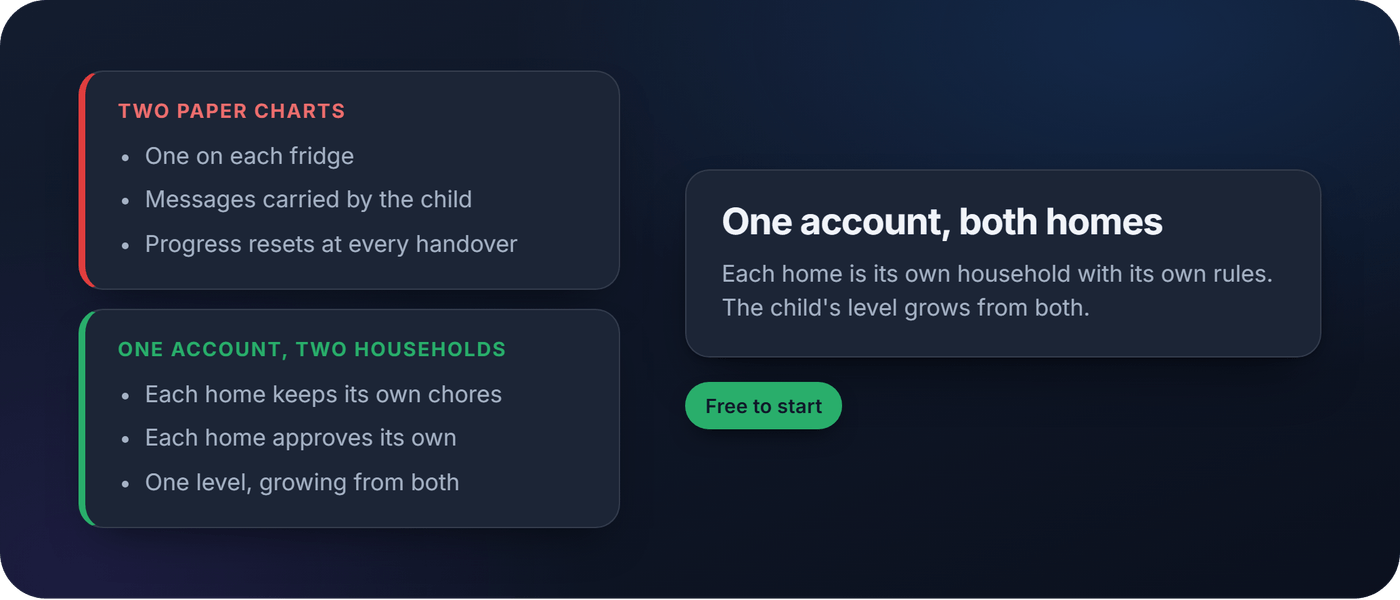
MatePoints is free to start, with a Pro plan for families who want more households and members, NFC and QR tags, and rewards on achievements. If you're ready to put a portable system in place, set up your households on MatePoints. For an age-by-age chart to start from, see our family chore chart guide.
FAQ
What is considered a blended family?
A household formed when two adults with children from previous relationships join together, through marriage, living together or remarriage. It can include stepchildren, half-siblings or step-siblings, living together full time or part time across two homes.
What is the 7-7-7 rule for parenting?
It isn't a chore rule. As Good Inside describes it, it is "seven minutes of dedicated, uninterrupted time, three times a day": in the morning, after school and at bedtime. In a blended family it is a natural fit with the relationship-first approach.
Can a blended family work well long term?
Yes. The 2022 review in Family Relations links shared routines, including doing chores together, to stability among adolescents in stepfamilies. Success depends more on consistent adult agreement and a relationship-first approach from stepparents than on any single strategy.
Sources
- Effective parenting in stepfamilies: Empirical evidence of what works, Sanner, Ganong, Coleman and Berkley, Family Relations, 2022
- Associations Between Household Chores and Childhood Self-Competency, White, DeBoer and Scharf, Journal of Developmental and Behavioral Pediatrics, 2019
- Executive functions and household chores: Does engagement in chores predict children's cognition?, Tepper, Howell and Bennett, Australian Occupational Therapy Journal, 2022
- What is the 7-7-7 rule in parenting?, Good Inside