Family chore chart: age by age, and a fair rotation
A family chore chart that survives past week three: the age-by-age ladder the AAP actually uses, and a rotation that ends the whose-turn argument.

A family chore chart is the easiest part of this to get right, which is why so much advice stops there. Pick a grid, print it, stick it on the fridge. The hard parts are the two things underneath it: who does what, and what happens when the novelty wears off.
It is worth knowing how unusual it is to be asking at all. In a 2014 survey of 1,001 US adults, 82% said they had regular chores growing up — and only 28% ask the same of their own children.
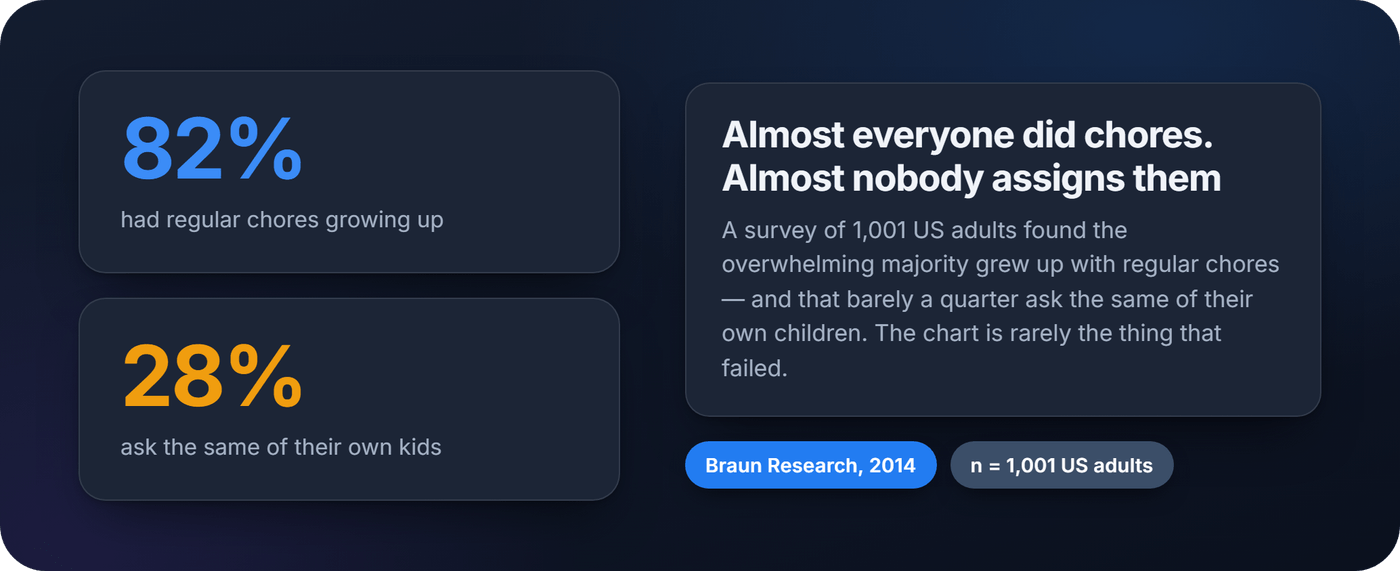
So if your last chart died on the fridge, the chart is probably not what failed.
What a chore chart has to decide before it looks like anything
Four formats cover almost every household: a weekly grid, a sticker chart for young children, a rotation schedule that assigns chores by name, and a single-page chart for everyone at once. Which you pick matters less than how often your chores and your children change — a printed PDF is fine for a stable house, an editable template earns its setup time if you expect to swap tasks monthly.
What every format has to settle first is cadence. Daily, weekly and monthly are three different promises, and a chart that mixes them into one undifferentiated column is the chart that starts to feel like nagging by Thursday.

Daily chores want a visible check or a magnet that moves. Weekly chores want a fixed reset — Sunday night works, and it doubles as the moment rotation slots change hands. Separate those two rhythms and the layout question mostly answers itself.
The age-by-age chore ladder
Most chart failures are really assignment failures: a task that a child cannot do yet, or one so vague they cannot tell when it is finished. The American Academy of Pediatrics publishes bands that are cumulative by design — each rung is everything below it, plus a little more.
Two rules matter more than the list itself.
Introduce one new task at a time. This is the AAP's own guidance, and it is the opposite of how most charts get launched — a full column handed over on a Sunday, resented by Tuesday.
Never write "clean your room." Break it into "books on the shelf", "clothes in the hamper", "toys in the bin". A young child cannot mark a vague instruction as done, so it stays open, and an open row on a chart is the thing that makes the whole chart feel like failure.
The ladder also starts earlier than its bottom rung suggests. Most preschoolers can pitch in with something, and the AAP's reason for wanting them to is not productivity — helping to keep the home running boosts a child's self-esteem, and small children generally want to help before anyone thinks to ask them. Take that offer while it is going. Adding a rung at a time from three or four is a different experience from meeting a full list for the first time at fifteen.
Rotation: the argument is about the procedure, not the bins
"It's always my turn" is not a complaint about the bins, and answering it with a better bin schedule misses what is being said.
Children hold procedural fairness far more tightly than adults expect. In a 2012 experiment, Alex Shaw and Kristina Olson gave six-to-eight-year-olds one spare eraser to hand to one of two equally deserving children. Most of them threw it away rather than create an uneven split. They gave up a real resource to avoid an unfair procedure — which tells you the objection was never about wanting the eraser.
The fix is a rotation everyone can inspect. Round-robin is enough: each period, every assignment shifts by one, so across a full cycle everybody does everything exactly once. You can run it with index cards.

Three things make a rotation actually settle arguments:
- Show the whole cycle, not this week's row. When a child can check for themselves that the dishes really were theirs last Tuesday, and see whose week is coming, the fairness argument loses its subject.
- Pair a hard chore with an easy one in the same slot, so a difficult week is difficult for whoever is in that slot rather than for one child forever.
- Let them choose within the rotation. Decades of procedural-justice research find people accept outcomes they did not want far more readily when they had a say in how the decision was made. Letting a ten-year-old pick between dishes and trash costs you nothing and buys real cooperation.
Week three is when you find out
Charts do not die from bad design. They die when the novelty goes and nothing replaces it.
This is where the standard advice — run a one-week trial, then lock it in — is simply too short to tell you anything. In the best-known study of real habit formation, Phillippa Lally and colleagues followed 96 people adopting a daily behaviour and found a median of 66 days to reach automaticity, with a range from 18 to 254. A week is not a trial. It is the honeymoon.
The same study carries the more useful finding: missing a single day did not break the curve. One skipped chore is not the system failing, and treating it as a breach is how a chart turns into a discipline mechanism nobody wants to look at.
So what has to survive week three is not enthusiasm, it is visibility. Two things help more than anything you can do to the layout:
- Attach checking the chart to something that already happens — right before dinner, or right after. A chore chart that depends on somebody independently remembering to consult it is competing with everything else in the house.
- Keep it boring. Redesigning the chart is the most satisfying and least useful thing you can do to it. Novelty is the thing that wore off; more novelty just resets the same clock.
When enforcement starts slipping, the answer is almost never a stricter chart. It is usually a shorter one. If you want a concrete floor to fall back to, we wrote up a daily chore checklist built for exactly that.
Fit it around the week, without letting the week become the excuse
If football runs until six three nights a week, do not give that child the dinner-prep chore on those nights. Build the chart around the week you actually have. Short daily chores — making a bed, feeding a pet, clearing a plate — survive a packed schedule because they collide with nothing.
There is a second half to this that is easy to skip.

Both things are true at once. Move the chore to the evening it fits; swap a child's rotation slot with a sibling's during an exam week. But "busy" is a reason to reschedule a chore, not to be exempt from the rotation, and children work out which one you mean quite quickly.
Ten minutes on a Sunday, looking at the week's practices and deadlines before they arrive, handles almost all of this.
Rewards, and the people who are not on the chart
Per-task micropayments tend to collapse. Children start negotiating rates, quietly skip anything unpaid, and lose interest when the novelty of cash goes. Visible progress and shared privilege hold up better — a streak worth protecting for younger children, and something the whole household gets for older ones. If you are weighing this properly, the research on paying kids for chores is less flattering to the obvious approach than you would expect.
One reward is worth avoiding by default: screen time. It sounds like the cleanest rule in the house, and using screens as the currency is associated with more screen time rather than less. We went through what actually works there separately.
Then there is the section most chore charts leave out entirely: the adults.

Leaving parents off the chart quietly states that chores are something children do and adults assign. Children notice, and it undercuts the fairness argument you are trying to make with the rotation. Listing each adult's recurring jobs — the shopping, the bills, the garden — alongside everyone else's is, for a lot of households, the single change that buys the most buy-in. It costs nothing, and it models the behaviour the chart exists to teach.
Building it, in about an hour
- Inventory every recurring task and put a rough time against each. Dishes, ten minutes. Bins, five. Laundry, twenty.
- Assign by ability using the ladder, and mark each task daily, weekly or rotating.
- Post it where people already pass several times a day. Visibility beats cleverness; a beautiful chart in a drawer is not a chart.
- Walk everyone through it once, out loud, so nobody is guessing what "kitchen duty" covers.
- Set the review date for six weeks out, not one. Then leave it alone.
After that, revisit properly every six months, or whenever a birthday moves someone up a rung. The shift as children get older is not mainly harder chores — it is supervised tasks becoming unsupervised ones.
When the chart should stop being paper
Everything above works with a printed page and a marker. It stops working at the point where the chart depends on somebody's memory: who did what, whose week it is, whether the job was actually finished.
That is the job MatePoints does. Every chore carries its own points value, visible to everyone, so the rate is posted before anyone asks. Completions are logged with a name and a time, which makes the rotation checkable instead of a matter of opinion. Finished jobs wait for an approver, which is where a redo gets asked for rather than argued about. Rewards are written by the household, so what points are worth is your decision, not ours.
Setting up a household, the task list and the approval queue is free. Creating achievements with rewards attached needs Pro, as does tap-to-complete with NFC tags or QR codes — once a household's owner has it, anyone can tap a tag on the bin to log the chore where the chore actually happens.
None of that replaces the two things this article is about. A rotation everybody can see, and a system that is still there in week three. The chart was always the easy part.
Sources
- Age-Appropriate Chores for Children — American Academy of Pediatrics, HealthyChildren.org
- Household Chores for Teens — Dr. Shelly Flais, MD, FAAP, HealthyChildren.org
- How are habits formed: modelling habit formation in the real world — Lally, van Jaarsveld, Potts & Wardle, European Journal of Social Psychology, 2010
- Children discard a resource to avoid inequity — Shaw & Olson, Journal of Experimental Psychology: General, 2012
- Chores may have long-lasting benefits for kids — CBS News on the 2014 Braun Research survey