Housework motivation systems, 15 minutes at a time
How to stay motivated to clean when willpower runs out: 15-minute routines, a zone rotation, and what research says about points and planning.

How to stay motivated to clean is the wrong question most of the time. Motivation comes and goes. Housework does not. The households that keep on top of it rarely rely on feeling like it. They rely on a system.
The systems that hold up combine three things: short routines you can finish in 15 minutes, a rotation so no single area piles up, and a visible record that makes progress and fairness obvious. Together they make starting easy, spread the work predictably, and give everyone a reason to keep going. Below are the common systems and who each one suits, templates you can copy today, and what the research does and does not say about points and rewards.
Why motivation for household chores runs out
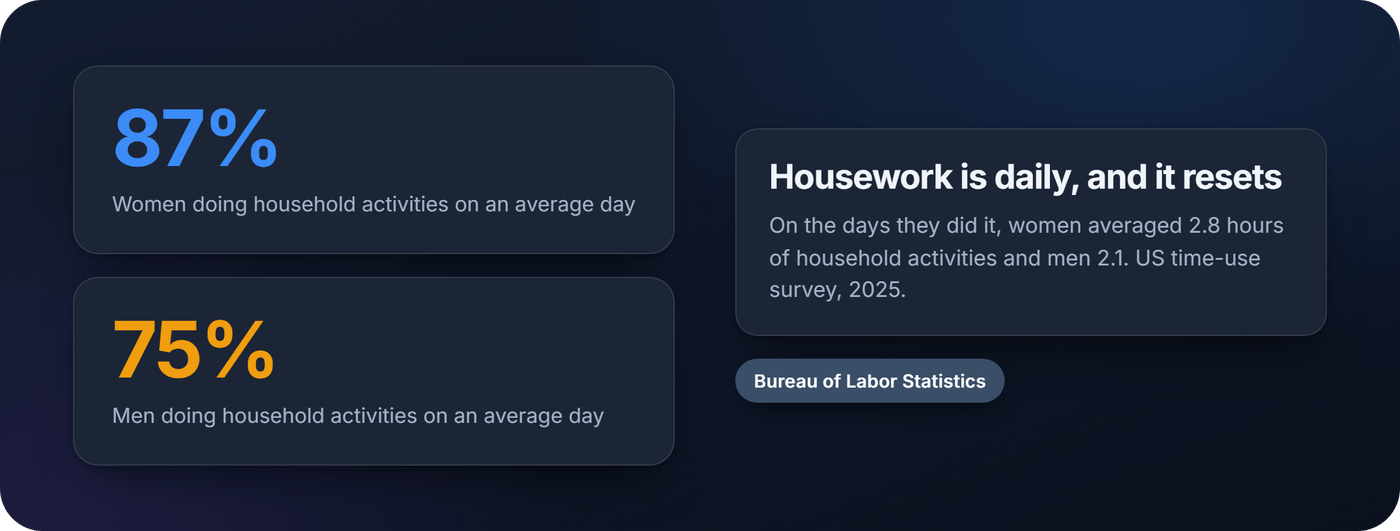
Housework is daily and it resets. The US Bureau of Labor Statistics' 2025 time-use survey found that on an average day, 87% of women and 75% of men spent some time on household activities. On the days they did, women averaged 2.8 hours and men 2.1.
That is a lot of effort for a job that undoes itself by dinner. Most of what drains motivation is ordinary: not knowing where to start, the sense that it will just get messy again, and one person quietly carrying the job of remembering everything. A system answers all three. It tells you where to start, it makes the reset small, and it puts the remembering somewhere other than one person's head.
Common housework systems, and who they fit
Most systems fall into a handful of types, and each solves a different problem.
15-minute blitzes break cleaning into short bursts you can fit between other things. They suit people with unpredictable schedules or little energy to spare, because the barrier to starting is tiny. The failure mode is treating the blitz as optional rather than scheduled, so it slides.
Day-by-day zone rotation gives each day one area: bathrooms on Monday, the kitchen on Tuesday, and so on. It works well in shared homes, because it spreads ownership without a daily negotiation. It breaks when a household skips a day and never catches up, and one zone slides for weeks.
Task batching groups similar jobs: all the laundry, then all the surfaces, then all the floors. It suits people who dislike interruptions and prefer fewer, longer sessions.
FlyLady-style routines come from Marla Cilley, whose FlyLady system started in 2001. It builds short daily habits, famously starting with a shined sink, uses a 15-minute timer, and divides the house into five zones that rotate by week of the month. It suits people who like ritual, and can feel rigid with an irregular schedule.
Quick resets like the 5-5-5 rule get you moving when you are stuck. One popular version, as The Simple Paradise describes it, is five minutes in each of five spots. They are a good way to break inertia, and rarely enough to run a household on their own.
- 15-minute blitzes: people living alone, and low-energy days.
- Zone rotation: housemates and families who want fair, rotating ownership.
- Task batching: people who prefer fewer, longer sessions.
- FlyLady-style routines: households that like a steady daily habit.
- Quick resets: a restart, not a permanent system.
How to choose a system that fits
Picking a system is less about finding the best one and more about matching it to your household's time, energy and comfort with sharing. Be honest about how much time you have on a normal day, not your best day.
- How much time can each person give daily without resentment building?
- Do tasks need to be visible to everyone, or can they stay private?
- Who does the planning now, not just the doing, and should that change?
- When someone misses a day, does the system recover or collapse?
- Does the household want shared rewards, individual ones, or neither?
Watch for red flags early. If one person is always the one reminding everyone, the system is really a task list disguised as teamwork. If chores pile up the moment the organiser gets busy, the system has no backup. If anyone feels watched rather than supported, lighten the tracking.
When a system starts failing, simplify before you abandon it. Halve the list, stretch the rotation, or move from daily to twice-weekly check-ins before you scrap the lot.
Pro tip: Give any new system two full weeks before you judge it. Week one tells you about the novelty, not the system.
A 15-minute daily routine you can copy
A short daily routine removes the guesswork. Start here:
- Two minutes: clear one flat surface, like the counter, table or desk.
- Five minutes: wash or load the day's dishes.
- Three minutes: sort the mail and loose papers into keep, file or bin.
- Five minutes: a quick floor pass in the busiest room.
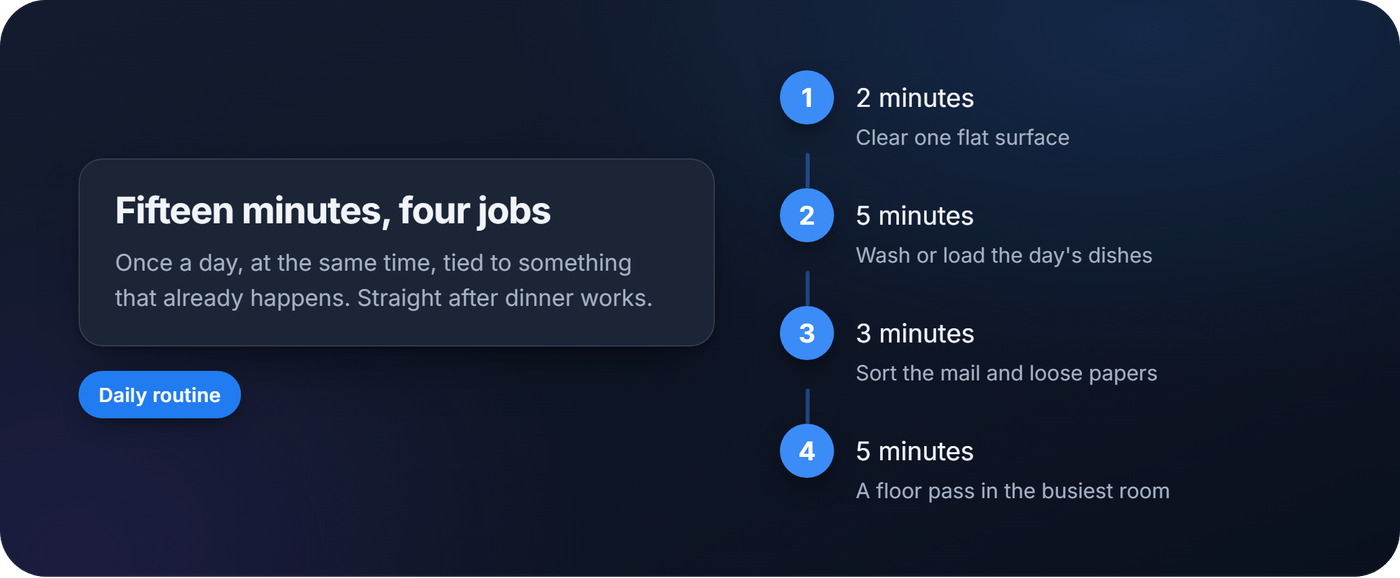
That is fifteen minutes, once a day. Do it at the same time, ideally tied to something that already happens, like straight after dinner, so it stops being a decision.
Missing a day is not failure. In a well-known habit study, Phillippa Lally and colleagues followed 96 volunteers adopting a daily behaviour. As the British Psychological Society's summary reports, it took a median of 66 days to become automatic, with a range from 18 to 254, and "a single missed day had little impact." Expect two months, not two weeks, and do not let one skipped evening end it.
For a fuller room-by-room list of five-minute jobs, our daily chore checklist has one ready to print.
A weekly zone rotation you can copy
Give each day one area:
- Monday: bathrooms, meaning surfaces, mirrors and floor.
- Tuesday: the kitchen, meaning counters, hob and sink.
- Wednesday: living areas, meaning dusting, tidying and vacuuming.
- Thursday: bedrooms, meaning laundry and surfaces.
- Friday: floors throughout.
- Saturday: errands and restocking.
- Sunday: rest, or catch up on anything missed.
For two people, split zones by preference rather than a strict 50/50. One person taking the kitchen and bathrooms while the other takes the living areas and laundry often works better, because people stick with jobs they mind less. Add one rule: a zone counts as done when the other person agrees it meets a basic standard. That ends the argument about what "clean" means.
For families, assign parts of a zone by age rather than whole rooms. A ten-year-old can own "clear and wipe the table" without owning the kitchen. A rotating chart, updated weekly, keeps it fair without renegotiating every few days.
If you started with a quick reset, move to a full routine gradually. Keep the daily 15 minutes as your anchor, then add one zone a week over two or three weeks, rather than switching everything at once.
What points and rewards actually do
There is some evidence that turning chores into a game helps, and it is worth reading carefully. In a master's thesis at NTNU, Jonas Jevnaker Aas and Svenn Roland Refsnes Grønbeck built a gamified chore app called Tidy and had 50 people use it for two weeks. Engagement and enjoyment rose across the group, and motivation rose most for partners, women and participants aged 25 or older.
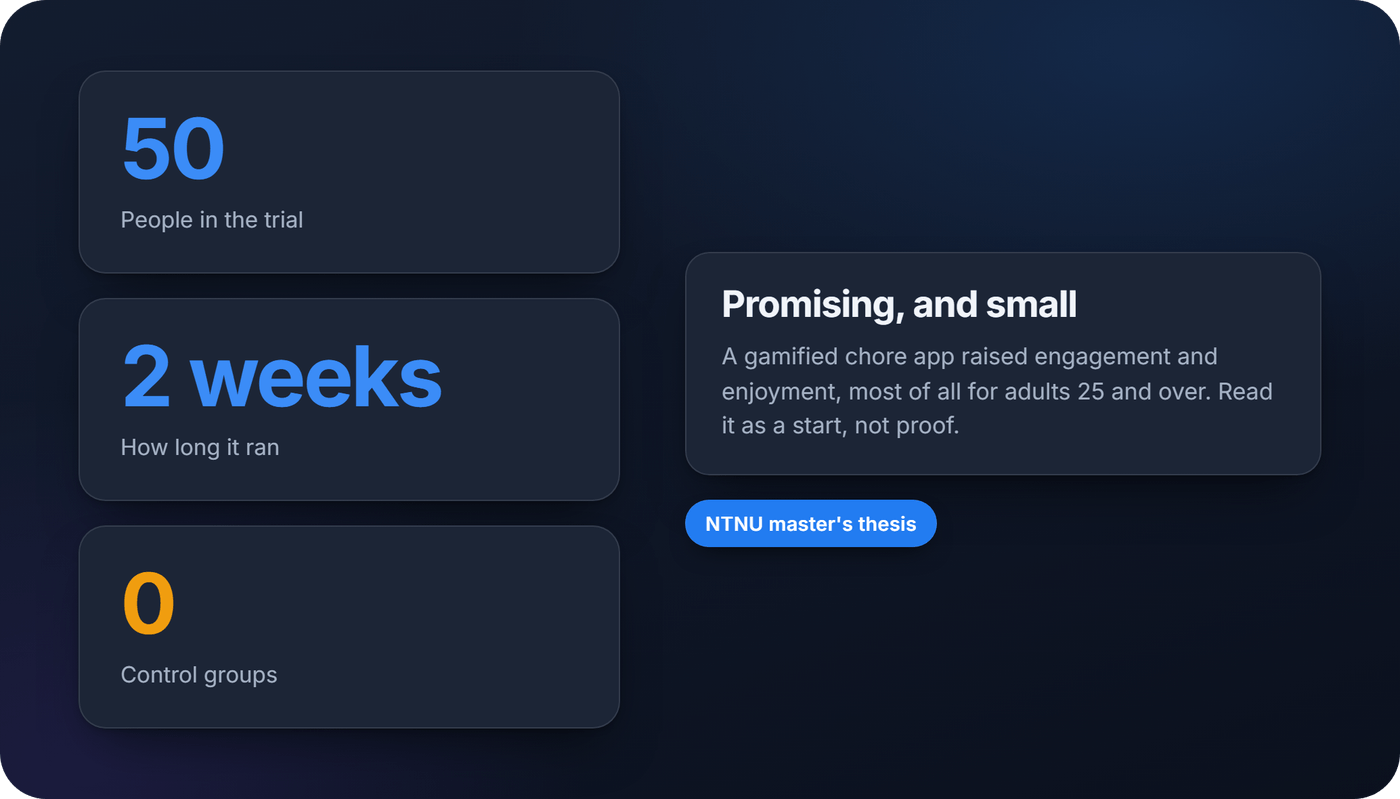
That age detail matters, because chore gamification is usually sold for children. But it was a small trial with no control group, over a fortnight. It says more about breaking the first inertia than about building a habit, which is why the routine above has to carry the long run.
A few design rules keep points helpful rather than gimmicky:
- Do not make the leaderboard the whole point. Forced competition backfires on people who dislike being compared.
- Tie rewards to the work. A clean kitchen earns the takeaway, not an unrelated prize.
- Track only what the system needs. Nobody signed up to be monitored.
- Mix small, frequent perks with the occasional shared reward, like a movie night, so cooperation stays ahead of competition.
Our guide to chore games that get played goes deeper into which mechanics last.
Share the planning, not just the tasks
Doing chores is only half the work. Someone also has to remember what needs doing, when and by whom. That planning work is the mental load, and it is easy to miss because nobody sees it happen.
A 2025 preprint by Barigozzi and colleagues, not yet peer reviewed, surveyed 415 couples in Italy with children under 11. It found women were significantly more likely to carry the organising of domestic work, and reported lower satisfaction and more emotional fatigue. Partners also tended to underestimate each other's load, and employed, college-educated women reported the most spillover into their working hours.

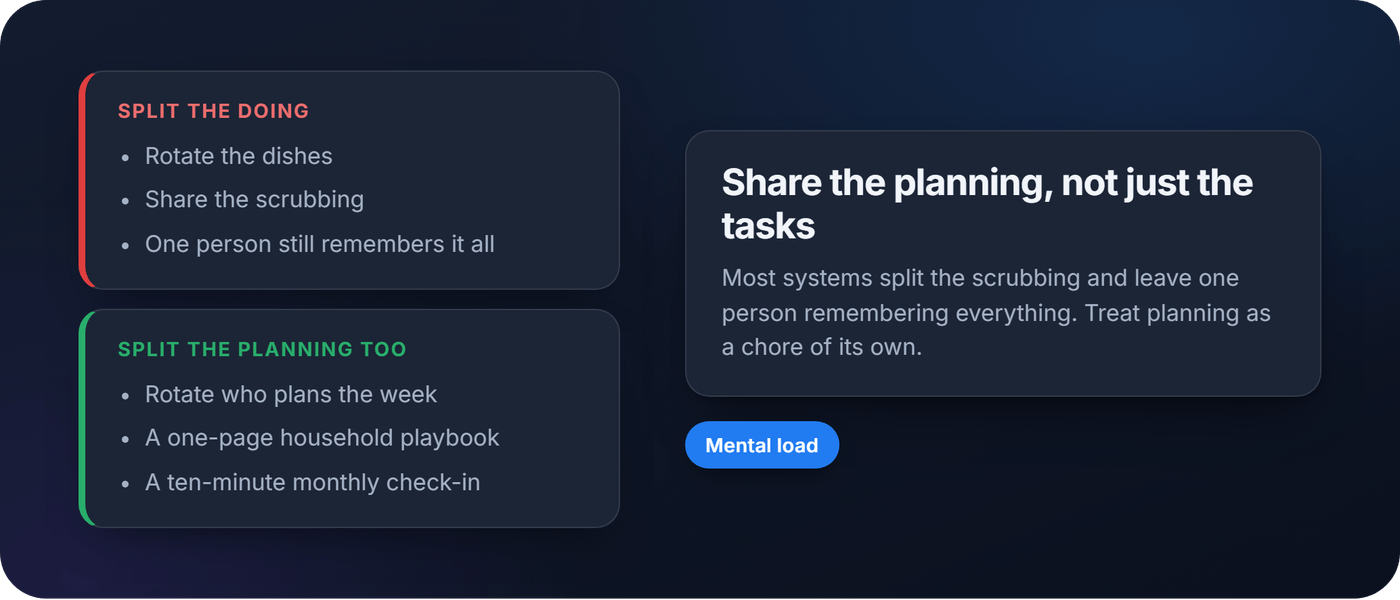
That is where most chore systems fall short. They share out the scrubbing but leave one person tracking everything in their head. The fix is to treat planning as a chore of its own:
- Rotate who plans the week, not just who does it.
- Keep a one-page household playbook with the routines, the rotation and the standards, so nobody has to hold it all in memory.
- Hold a short monthly check-in to adjust things before small frictions become resentment.
- Put the schedule somewhere shared, a calendar or an app, so it lives outside anyone's head.
Pro tip: If one person always notices what needs doing first, they are carrying the mental load. Hand the weekly walkthrough to someone else.
Approval helps here too. When a task only counts once another member confirms it, nobody has to double-check everything by hand, and rotating that role keeps it from becoming one person's unpaid management job. Our look at who does more housework goes into the numbers behind that imbalance.
Three rules of thumb
Three rules stand out. First, start smaller than feels necessary: a five-minute task done daily beats an ambitious plan abandoned after three days. Second, make the planning visible, not just the doing, because invisible planning is what quietly wears people out. Third, make rewards real and specific. A takeaway night holds attention in a way that vague praise does not.
Systems fail less because people are lazy and more because the planning work stayed invisible.
Marcus
Where MatePoints fits
If you want the routines above without keeping a spreadsheet, MatePoints turns them into a shared app:
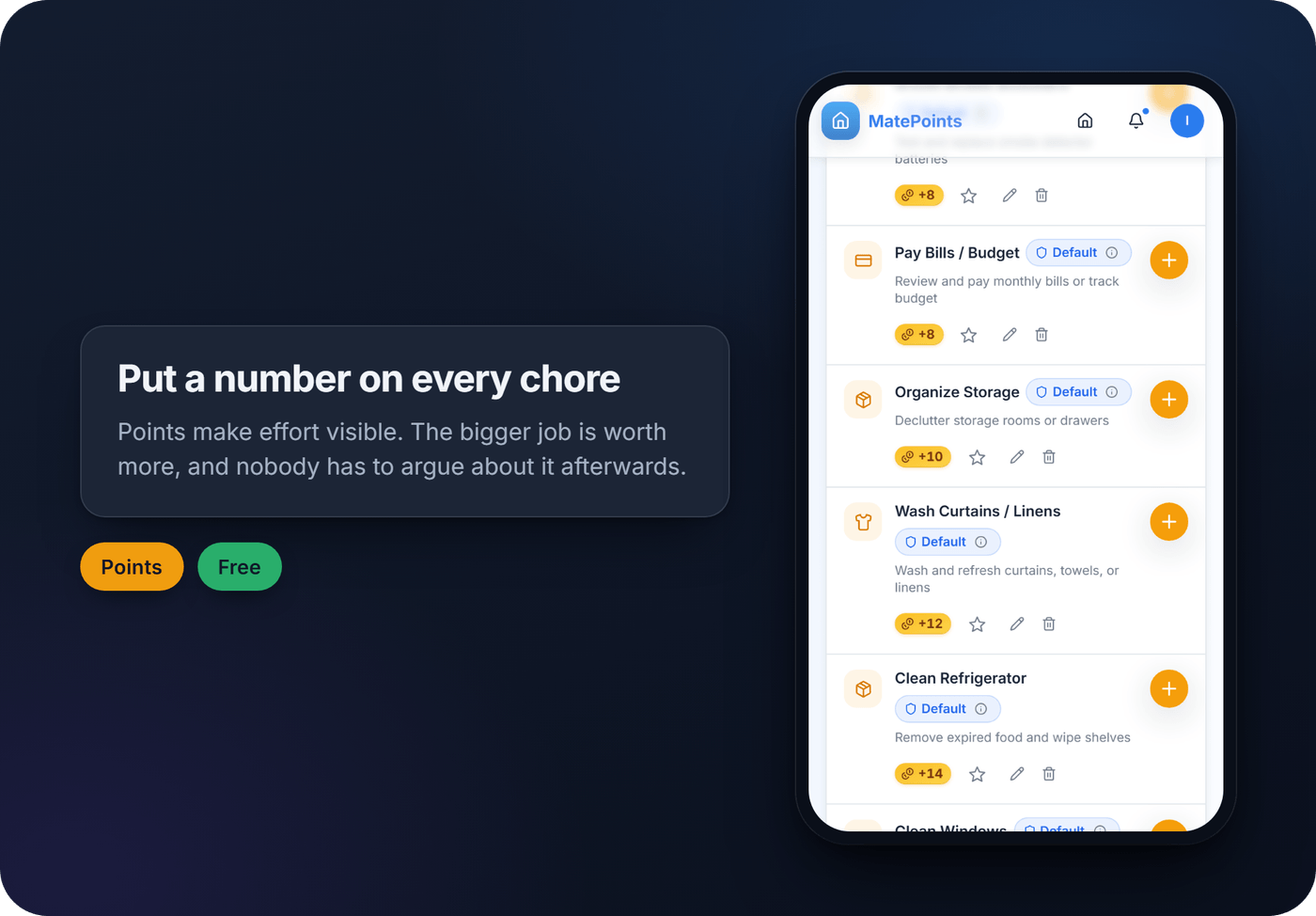
- Points on every chore, so the 15-minute jobs and the zone jobs both count, and a leaderboard shows who did what this week.
- Approval, as a household setting, so a resident's chore only counts once someone confirms it.
- The Planner, a shared calendar of dated jobs. Put a task on a day for yourself, or post a wish anyone can claim, and get a reminder 30 minutes before a planned job with a start time. It takes the schedule out of one person's head.
- Real rewards on Pro, like a takeaway night, attached to an achievement level and granted when someone reaches it.
- Tap or scan to complete on Pro, with an NFC tag or a printed QR code where the chore happens.
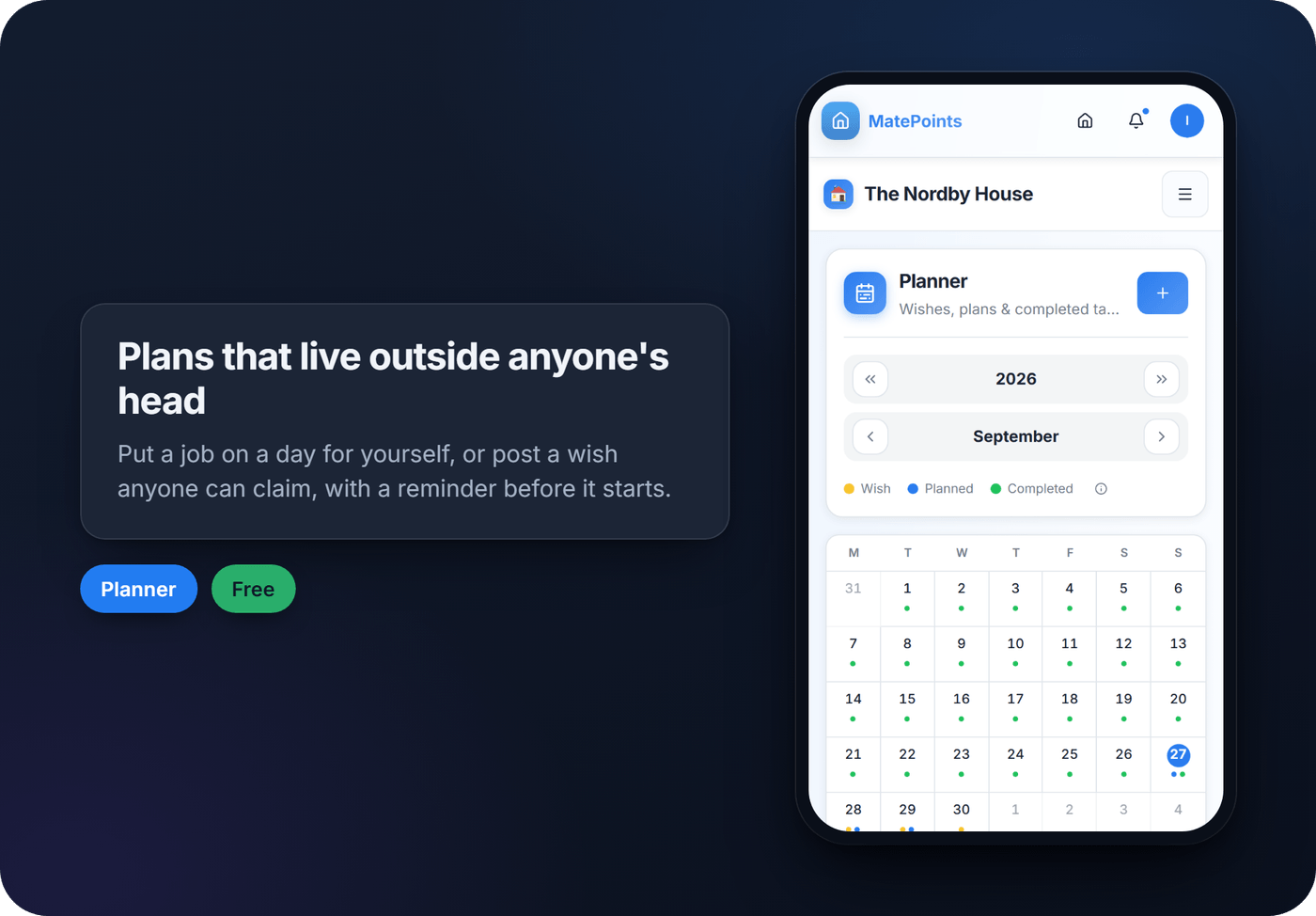
The Planner does not repeat entries on its own, and there is no calendar sync, so the weekly rotation is something you add rather than something it builds. The free plan covers one household with points, the leaderboard, approvals and the Planner. The getting-started guide walks through your first household and first chores, or you can start on the free plan.
FAQ
How do I motivate myself to do housework?
Stop waiting to feel like it. Make the task small enough that skipping it feels pointless, like a two-minute surface clear, tie it to something that already happens, and let a visible record show your progress.
What is the 5-5-5 rule for cleaning?
Definitions vary. One popular version is five minutes in each of five spots, about 25 minutes in all, usually aimed at decluttering. It works as a reset rather than a full system.
What is the 6/10 rule for cleaning?
A checklist method: six small tasks every day, like making beds, dishes and one load of laundry, and ten tasks spread across the week. The Simplicity Habit credits it to Organized Chaos.
How long does it take to build a cleaning habit?
Longer than most people expect. In Lally's habit study, the median was 66 days to become automatic, with a range from 18 to 254, and missing a single day made little difference.
Does gamification really help with chores?
There is some evidence. A small two-week trial at NTNU found a gamified chore app raised engagement and enjoyment, and motivation especially among participants aged 25 or older. It had no control group, so pair gamification with a routine that carries the long run.
Sources
- American Time Use Survey, 2025 results, US Bureau of Labor Statistics, June 2026
- FlyLady, Wikipedia
- The 5-5-5 decluttering rule, The Simple Paradise
- How are habits formed: Modelling habit formation in the real world, Lally, van Jaarsveld, Potts and Wardle, European Journal of Social Psychology, 2010
- How to form a habit, British Psychological Society Research Digest
- Gamification of Chores, Jonas Jevnaker Aas and Svenn Roland Refsnes Grønbeck, master's thesis, NTNU, 2020
- Beyond time: Unveiling the invisible burden of mental load, Barigozzi, Biroli, Monfardini, Montinari, Pisanelli and Vitellozzi, arXiv preprint, 2025
- Use the 6/10 cleaning rule to keep a clean home, The Simplicity Habit