Age appropriate chores, from toddlers to teens
Age appropriate chores from toddler to 18: a chore list by age, the safety minimums pediatricians set, and when to start an allowance.


Age appropriate chores start earlier than most parents expect. Children can begin helping at 2 or 3, according to Lifework at the University of Arizona, and by 18 they can run most of a household. The whole job is matching the chore to the child in front of you.
This is a chore list by age, from toddlers to 18, with the safety minimums pediatricians set, where an allowance fits, and what the research actually says chores build. If you want a chart to put it on, our family chore chart guide covers the layout and a rotation that ends the whose-turn argument.
A chore list by age
Treat the bands as a starting point, not a test. Two children the same age can be a year apart in what they manage, and every band assumes everything below it. The American Academy of Pediatrics makes the same point in its guidance on age-appropriate chores: most preschoolers can start pitching in with simple tasks, and "a specific chore chart or checklist can help."
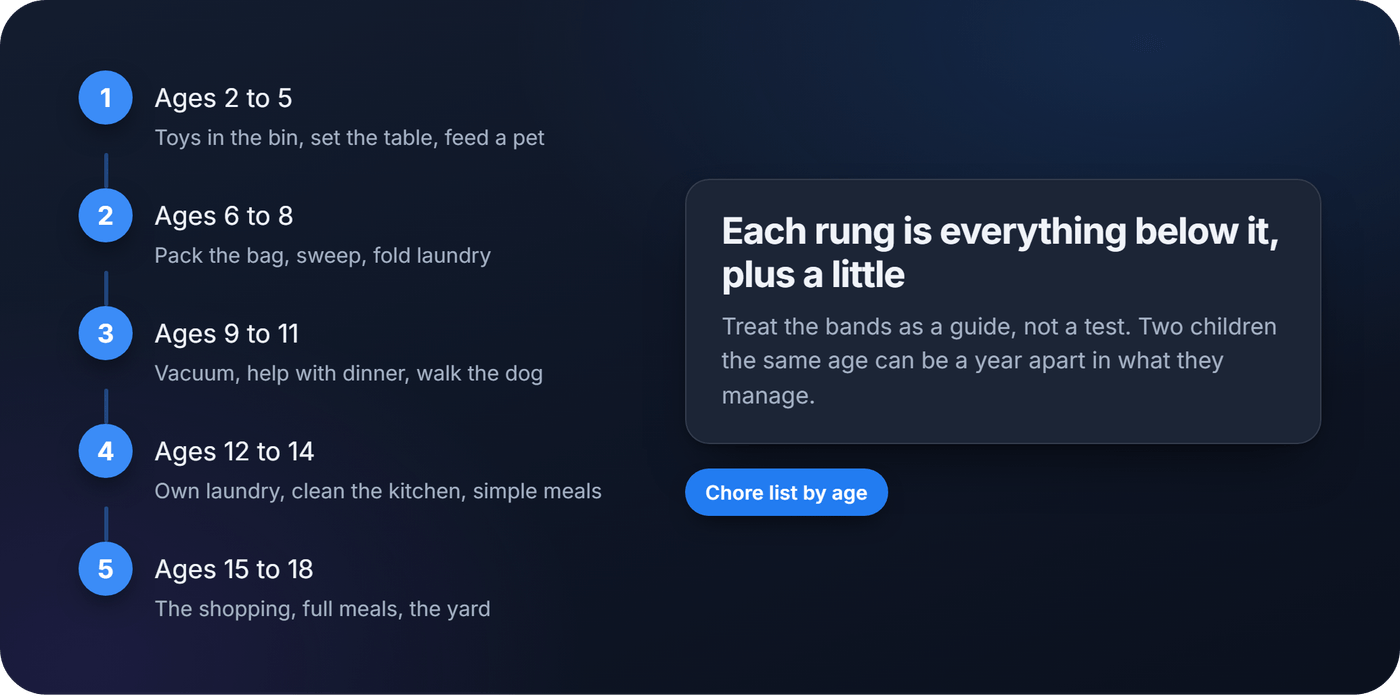
Best chores for toddlers: ages 2 to 3
At this age chores are mostly imitation and self-care, and "done" means tried. The American Academy of Child and Adolescent Psychiatry lists putting toys and groceries away at 2 to 3.
- Put toys in a bin
- Put dirty clothes in the hamper
- Wipe up a small spill with a cloth
- Help put the shopping away
- Carry unbreakable things to the table
Ages 4 to 5
Kids can now follow two-step instructions and start helping the family, not just themselves.
- Make the bed, even imperfectly
- Set the table with unbreakable dishes
- Help feed a pet
- Water indoor plants
- Sort laundry by colour
- Clear their own plate after meals
Ages 6 to 8
Attention spans lengthen, and short routines work without constant supervision.
- Pack their school bag the night before
- Sweep up small messes
- Empty the wastebaskets and help with recycling
- Help prepare simple snacks
- Fold and put away their own laundry
- Load and unload the dishwasher, which the AACAP places at 7 to 9
Ages 9 to 11
This band handles multi-step jobs with the occasional check-in. The AAP puts vacuuming, helping with dinner and walking a pet at 8 to 10.
- Vacuum the shared rooms
- Help make dinner
- Make their own snacks and simple breakfasts
- Put the groceries away
- Walk the dog on a familiar route
- Change their own sheets
Ages 12 to 14
Now the jobs need planning and some judgement.
- Do their own laundry, start to finish
- Clean the kitchen after a meal
- Clean a bathroom, toilet included
- Cook a simple meal with supervision
- Mow the lawn with a walk-behind mower, once trained
- Watch a younger sibling while an adult is home
That last one comes with a condition. The AAP lists watching younger siblings at 11 to 12, but "with an adult present at home."
Helpful chores for teens: 15 to 18
The AAP's page on household chores for teens puts it bluntly: "If your teen can operate a smartphone, they can figure out how to use a washing machine, an oven and a dishwasher."
- Do the grocery shopping, with a list and a budget
- Clean the kitchen after cooking
- Mow, weed and spread mulch
- Clear snow from the path and the drive
- Wash and vacuum the car
- Cook a full meal for the family
- Handle small repairs, like changing a bulb or a filter
- Look after younger siblings
A part-time job is not an exemption. Many teens start working after 16, the same page notes, "but it's not a reason to stop contributing to home chores."

What chores actually build
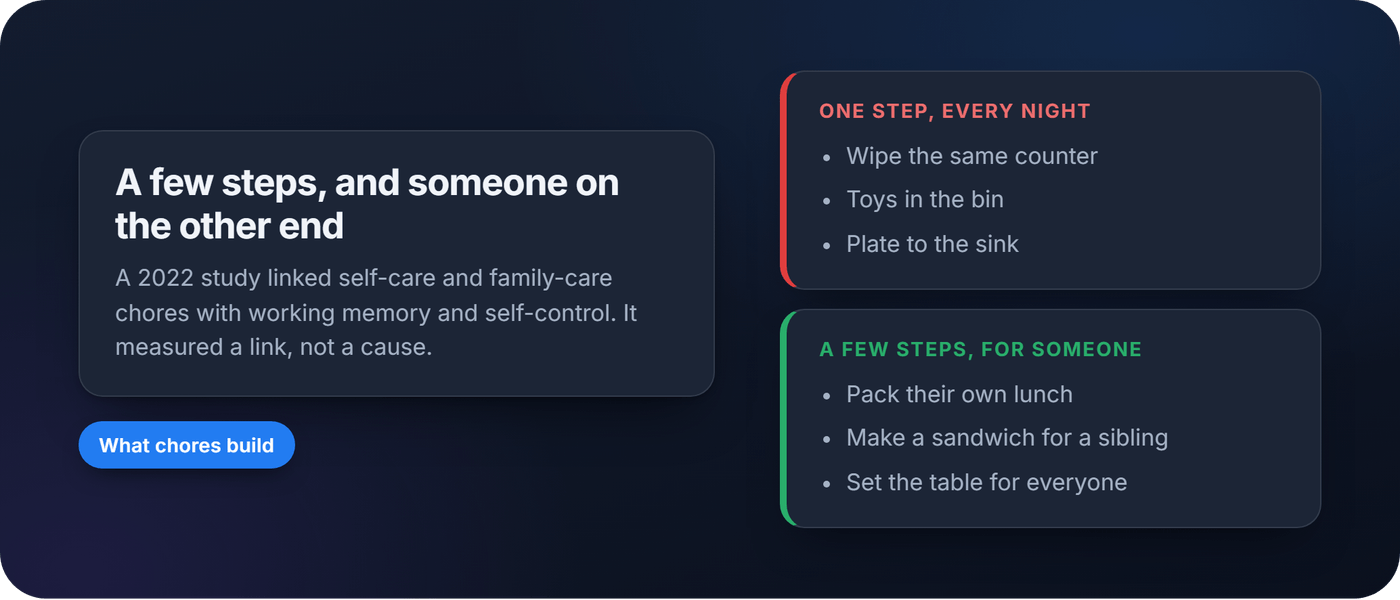
Chores are not only about a tidy house, and there is some evidence behind that. In a 2022 study in the Australian Occupational Therapy Journal, Tepper, Howell and Bennett surveyed the parents of 207 children aged 5 to 13. Children who did more self-care chores, like making themselves a meal, and more family-care chores, like making someone else one, had stronger working memory and inhibition: the ability to hold a plan in mind, and to stop and think before acting. That held after allowing for the child's age and other factors. Pet care showed no significant link at all.
Two honest caveats. The study relied on parents' reports, and it measured one moment in time, so it cannot say which way the arrow points. The authors say so themselves: children with stronger skills may simply be more willing to do chores.
So read it as a reason, not a promise. The practical takeaway still holds up: include some chores where your child looks after themselves or someone else, and that take a few steps to finish. Packing their own lunch, or making a sandwich for a younger sibling, asks more of them than wiping the same counter every night.
The safety minimums
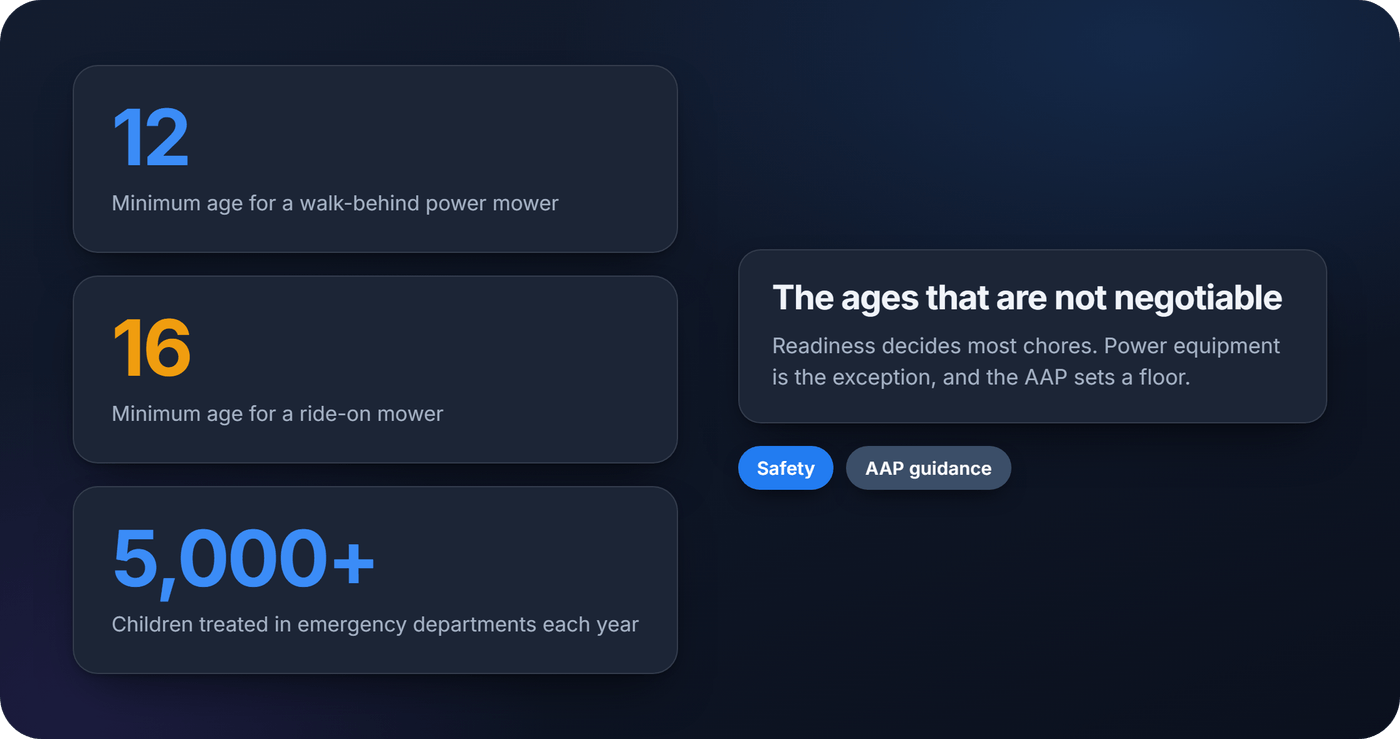
Most chore lists skip this, and it is the one place where age matters more than readiness. The AAP's lawn mower safety guidance says children should be at least 12 to operate a walk-behind power mower and 16 for a ride-on. It also notes that more than 5,000 children are treated in emergency departments for power mower injuries every year.
Pro tip: Before you hand over any power equipment, walk through the controls, do the job yourself while they watch, and supervise the first few attempts. Whatever their age.
Chores and allowance: keep them apart
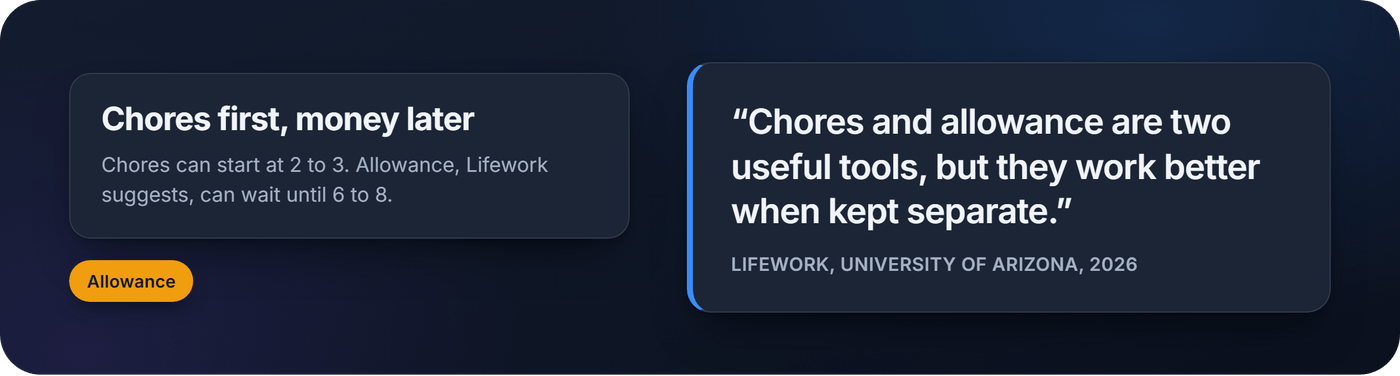
Lifework's guidance draws two lines. Chores can start at 2 to 3, but "allowance should wait until the child is 6 to 8 years old." And the two "work better when kept separate": chores because you live here, money as its own lesson. Start small, it says, and increase the amount as your child matures.
A middle ground some families use: the everyday chores are expected and unpaid, and genuine extras, like washing the car, can earn money. Whichever you pick, write the rule down. An allowance rule that lives in a parent's head gets renegotiated every Saturday. Our guide to allowance and chores goes through the trade-offs.
Setting it up so it lasts
A list posted where everyone passes removes most of the guesswork. The AAP recommends a specific chart or checklist, and specific is the word doing the work.
- Define each task exactly. "Wipe the kitchen table after dinner", not "help with dinner".
- Split daily jobs from weekly ones, so the bins and the bathroom are not in the same column.
- Praise effort and consistency over a perfect result, especially under 6.
- Revisit the list every few months, and on birthdays, as skills change.
For younger children, a reward chart is often the easiest way to make progress visible. No tool replaces clear expectations, supervision on the risky jobs, or the conversation that makes chores feel fair.
The list matters less than the routine
The most overrated part of chore advice is the age chart itself, this one included. Parents worry about whether a seven-year-old "should" unload the dishwasher. The more useful questions are whether the chores have a few steps and a person on the other end, and whether they happen every time.
A rotating chart everyone ignores teaches a child that responsibility is optional. A short, boring, reliably kept list teaches the opposite. So start with a few multi-step chores done consistently rather than a long list done occasionally. Skip the elaborate reward system until the habit exists. Get the routine solid first, then decide whether a chart, an app or a jar of coins keeps it going in your house.
Marcus
Where an app fits, and where it does not
MatePoints is a chore app built around points. Every chore carries a value, completions add up on a household leaderboard, and approvals decide what counts.
One limit first. Every member needs their own account, and the MatePoints terms set a minimum age of 13, with parental consent under 18. So for toddlers and primary-school children, a paper chart on the fridge is the right tool, and the list above works fine on paper.
Where an app earns its place is a household of teenagers and adults:
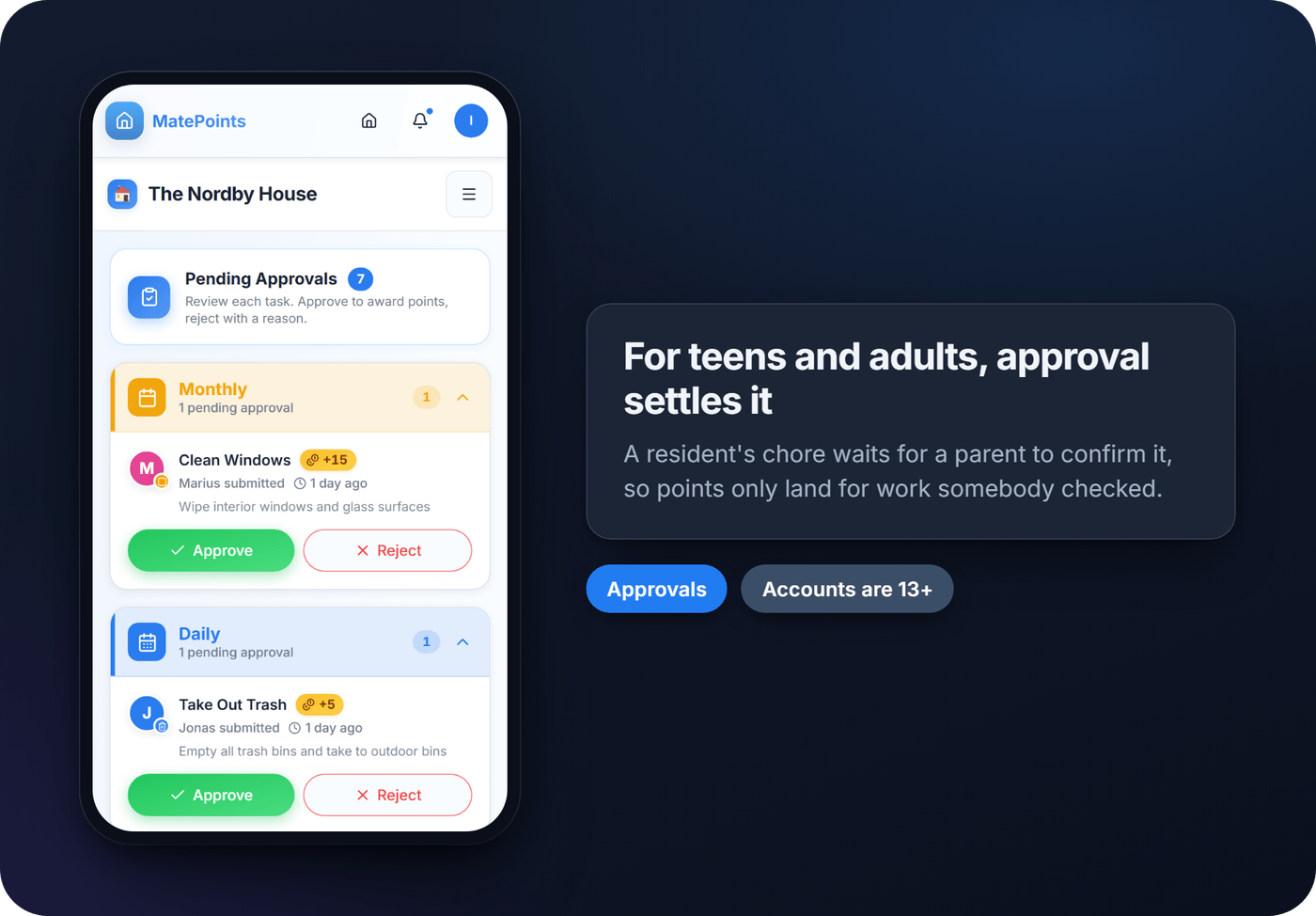
- Approval. A household setting holds a resident's completed chores until an owner, editor or approver confirms them, so points only land for work somebody checked.
- Points and a leaderboard. Everybody sees who did what this week, which settles most arguments before they start.
- Real rewards. On Pro, you can attach a reward, like picking Friday's takeaway, to an achievement level. It is granted the moment a member reaches it.
- Tap or scan to complete. On Pro, you can put an NFC tag or a printed QR code on the washing machine, and a tap logs the chore.

The free plan covers one household with points, levels, the leaderboard and approvals. You can try MatePoints and see whether it suits your teenagers better than the fridge does.
FAQ
What chores should a 7 year old do?
Most 7 year olds can pack their school bag, sweep small messes, empty the wastebaskets, fold their own laundry and start on the dishwasher. The American Academy of Child and Adolescent Psychiatry lists loading and unloading the dishwasher and packing their own lunch at 7 to 9.
What should a 10 year old be doing around the house?
Vacuuming shared rooms, helping make dinner, making their own snacks, putting the shopping away and walking the dog on a familiar route. The AAP places vacuuming, helping with dinner and walking a pet at 8 to 10.
At what age should kids start doing chores?
From about 2 or 3, with simple jobs like putting toys in a bin. Lifework at the University of Arizona puts the start at 2 to 3 years old.
Should I pay my 5 year old for doing chores?
Lifework's advice is to wait: start an allowance at 6 to 8, and keep it separate from chores. At 5, praise and a visible chart are enough to start with.
What age can a child mow the lawn?
The AAP says at least 12 for a walk-behind power mower and 16 for a ride-on, with training and supervision first.
Sources
- Executive functions and household chores: Does engagement in chores predict children's cognition?, Tepper, Howell and Bennett, Australian Occupational Therapy Journal, 2022
- Age-Appropriate Chores for Children, HealthyChildren.org, American Academy of Pediatrics, 2024
- Household Chores for Teens, Shelly Flais, HealthyChildren.org, American Academy of Pediatrics, 2024
- Lawn Mower Safety: Information for Families, HealthyChildren.org, American Academy of Pediatrics, 2025
- Children, Chores, and Allowance, Lourdes A. Rodríguez, Lifework, University of Arizona, 2026
- Chores and Children, Facts for Families No. 125, American Academy of Child and Adolescent Psychiatry, 2018