Equal paychecks, unequal chores: what Pew just found
Equal pay, unequal housework: Pew's new report shows the gap. How to split chores when you both work full time, by hours instead of tasks.


You both work full time. You earn about the same. And still, one of you does most of the housework. If that sounds familiar, the numbers are on your side: a new report from Pew Research Center shows the pattern holds even in marriages where pay is equal. This guide shows how to split chores when you both work full time, starting with what the research says and ending with a method you can set up in one evening.
What Pew found about couples who earn the same
On 22 October 2026, Pew published Women, Work and Caregiving Through the Arc of Family Life. Part of it looks at what Pew calls egalitarian marriages, where each spouse earns 40 to 60 percent of the couple's joint income. They are no longer rare. According to the report, the share of marriages where husband and wife earn about the same "has roughly tripled to 29%", from 11 percent in 1972 to 29 percent in 2022.
Equal pay has not brought equal housework. In these marriages, Pew finds that wives average 4.6 hours of housework a week and husbands 1.9. Wives also do more of the caregiving: 6.9 hours a week against 5.1.
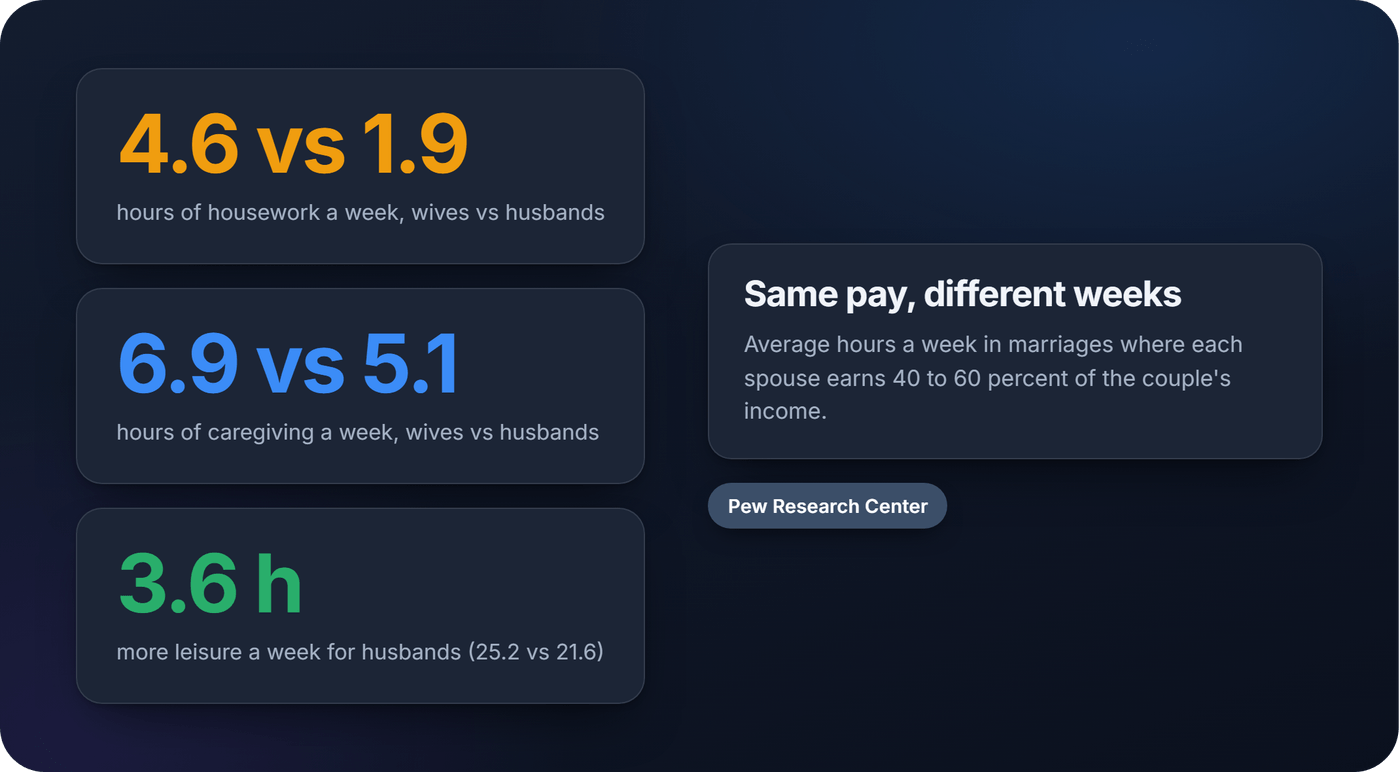
One honest caveat. The hours come from Pew's analysis of the American Time Use Survey for 2016 to 2021. The report is new; the time-use data underneath it is a few years old. It is still the clearest picture there is of what equal earners do with their week.
The gap shows up in leisure
The number that stings is not the housework. In the same marriages, Pew finds that husbands average 25.2 hours of leisure a week and wives 21.6. That is 3.6 hours a week, roughly a free evening, that one partner gets and the other spends on the house.
It shows in how people feel, too. In Pew's March 2026 survey of full-time working parents, 67 percent of mothers and 50 percent of fathers said they couldn't give their all at home.
None of this needs a villain. In most couples the split was never decided. It happened one default at a time: whoever noticed the empty fridge did the shop, whoever knew the school's email answered it. Equal pay does not change who notices.

How to split chores when you both work full time
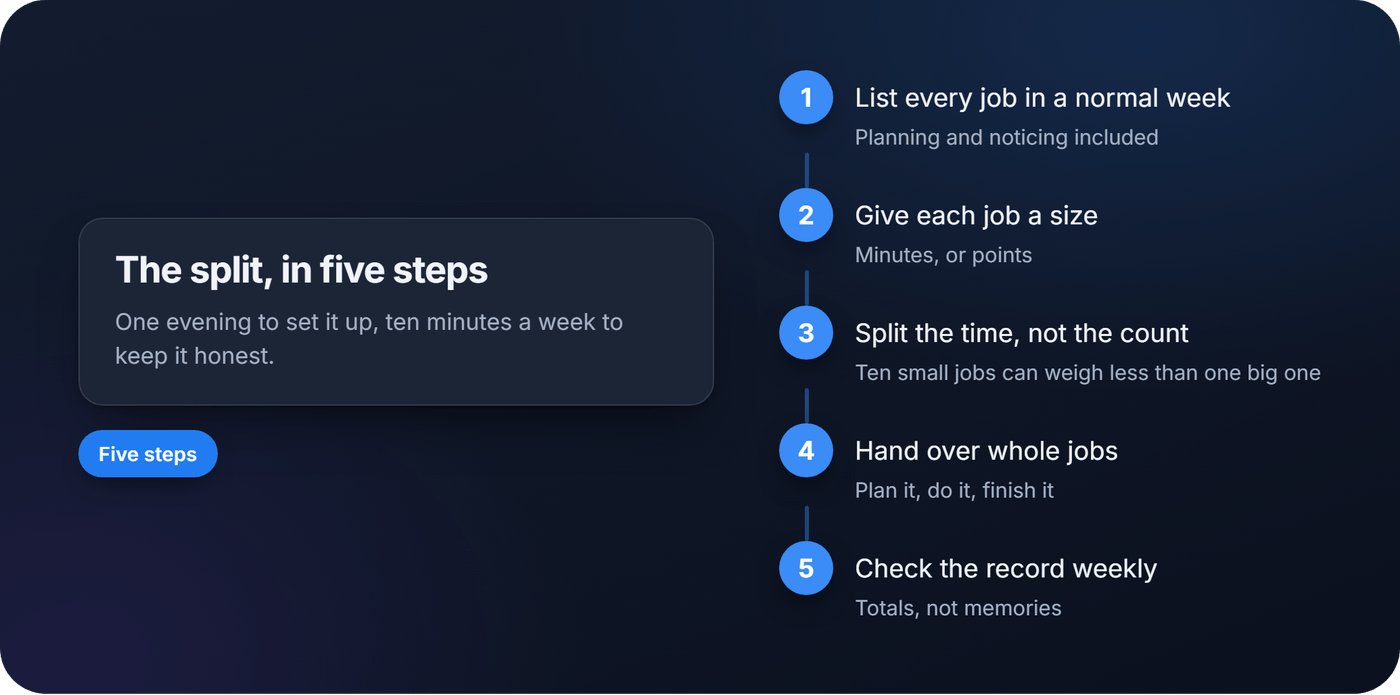
Couples ask this all the time. A Mumsnet thread from March 2024 asks simply whether people split jobs 50/50, and the replies range from careful rotas to a shrug. What the forums rarely offer is a method. Here is one, in five steps.
1. List every job in a normal week
Sit down together for half an hour and write down everything that keeps the house running in an ordinary week. Include the jobs nobody sees: planning meals, booking the dentist, noticing the bin is full, buying the birthday present. Picture a couple, both in office jobs, who think they split things evenly. Their list often runs to thirty or forty items, and the invisible ones are where the gap hides.
2. Give each job a size
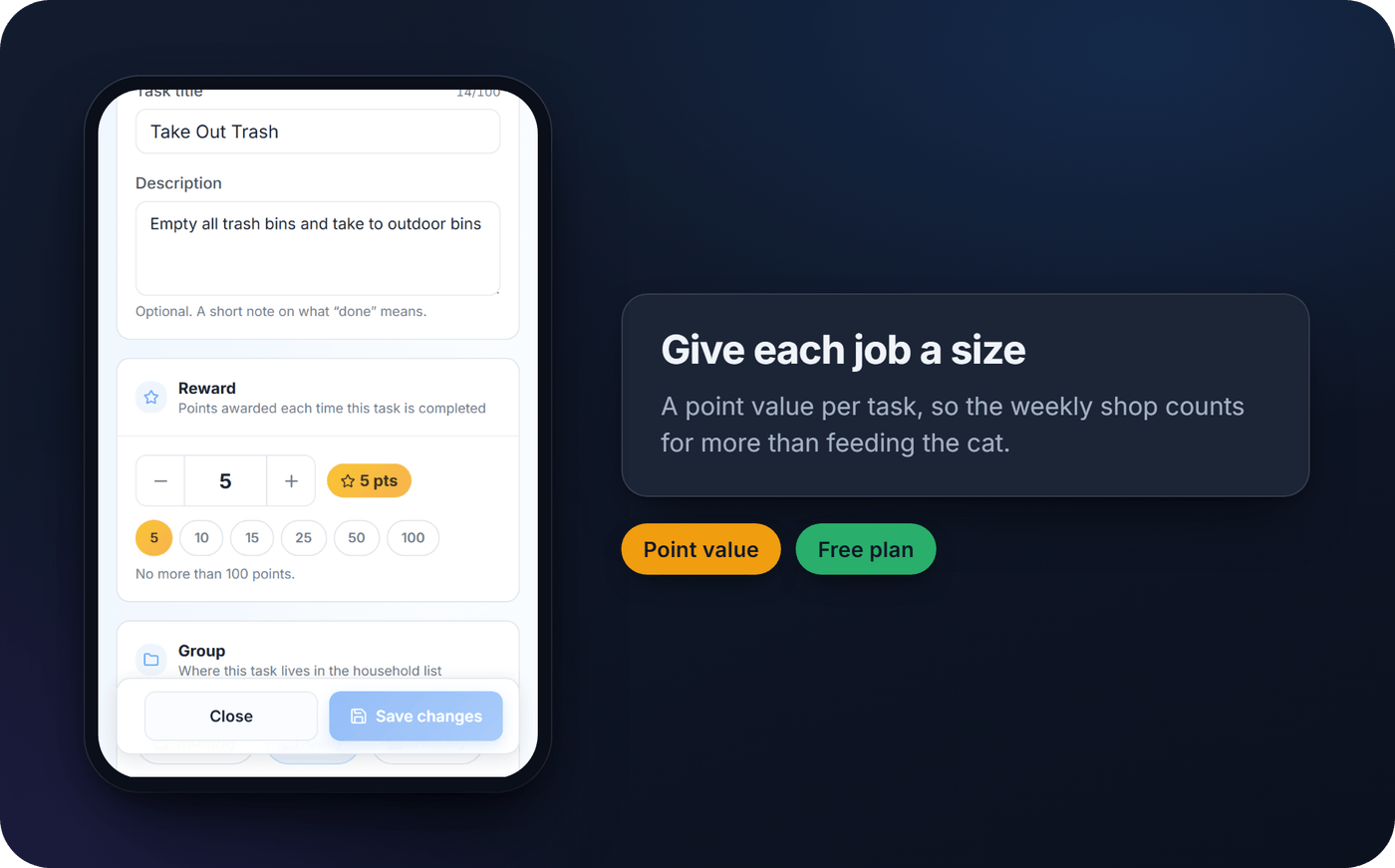
A list says nothing about time. Ten minutes emptying the dishwasher is not the same as two hours of meal planning and the weekly shop. Give every job a rough size in minutes, or in points if minutes feel fiddly. Agree on the sizes together. That conversation is half the work.
3. Split the time, not the count
Now add up the sizes, not the number of jobs. "I do fifteen things and you do fifteen things" can hide a two-to-one split in hours. Aim for roughly equal time across a normal week, and adjust honestly for anything one of you can't do, like a long commute on certain days.
4. Hand over whole jobs
Splitting the doing but not the planning keeps the gap alive. If one of you shops but the other writes the list, the list-writer still carries the job. Hand over whole jobs, from noticing to finished: the shopping including the list, the laundry including spotting the full basket. It feels slower at first. It is the only version that frees the other person's head.
5. Check the record once a week
Memory is a poor referee. Each of you remembers your own jobs in detail and the other's in outline, so both of you can honestly feel you do more. Spend ten minutes once a week looking at what actually got done, then adjust a size or swap a job if the totals drift.
Settle it with a record, not two memories
This is where a shared record helps, and where MatePoints comes in. Each job you listed becomes a task with a point value. Every time one of you finishes it, it lands in Task History: who did it, when, and what it was worth. Make both of you owners of the household, so both of you see the whole record rather than only your own jobs. The leaderboard adds up each person's points for the week, so the Sunday check is a glance at two totals instead of a debate about the bins.

It helps with step 4 as well. A job's points go to whoever finished it, so a handed-over job is visibly handed over. If the totals drift two weeks in a row, that is your cue to talk, with the numbers already on the table. For more on why a shared list settles the argument, read Who does more housework? Settle it with a shared list.
A gap can close, and fast
It is easy to read Pew's numbers as fixed. They are not. On 19 October 2026, The Korea Times reported new time-use figures from South Korea's Ministry of Data and Statistics. Among dual-income married parents aged 25 to 39, mothers spent four hours a day on housework and caregiving in 2024 and fathers two hours and 17 minutes. The gap was one hour and 43 minutes, down from three hours and 16 minutes in 2014. Fathers' time rose by just over an hour a day in ten years.
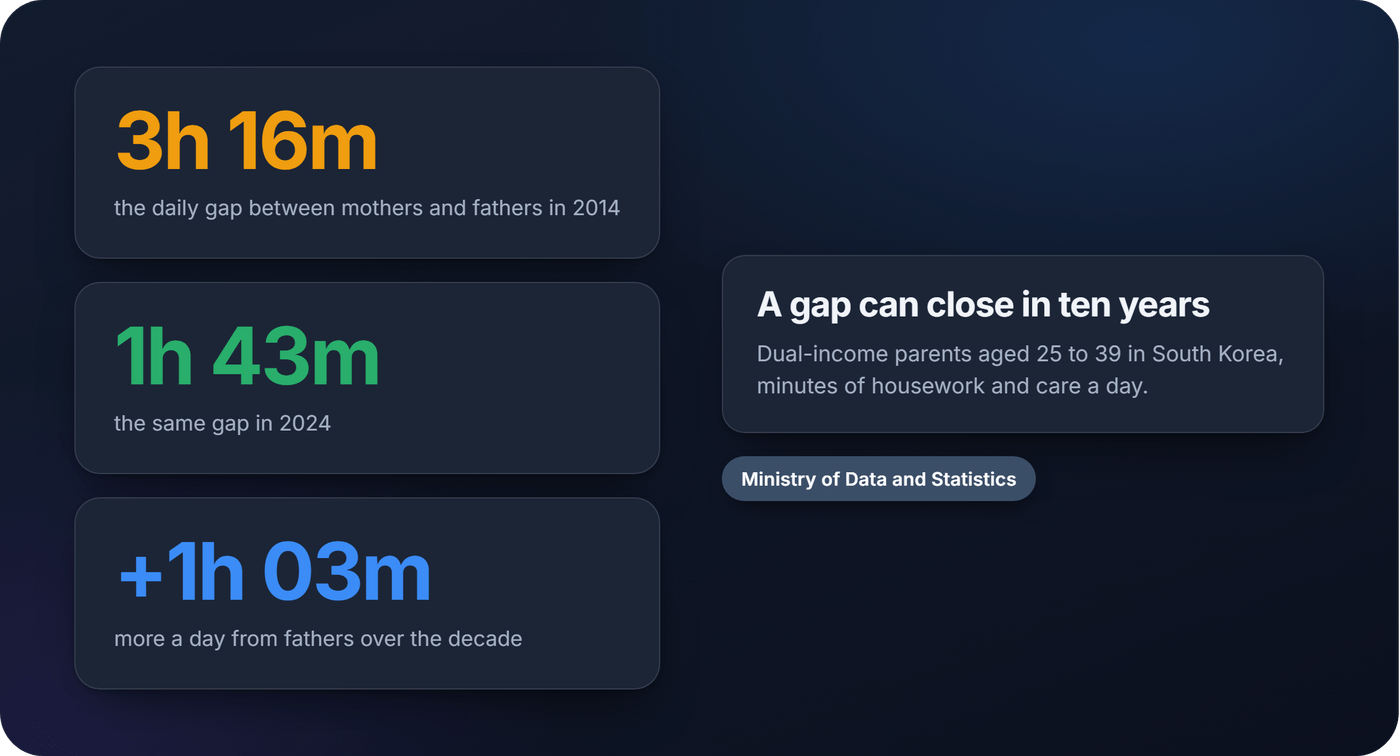
It is a different country with different measures, so don't set the numbers side by side with Pew's. The direction is the point: when habits change, the split changes with them.
Where to start this week
You don't need a perfect system. You need one evening and a list. Write the jobs down, give them sizes, split the time and agree on a Sunday check. For a structure for the conversation itself, Dividing household chores: audit first, split by domain walks through the audit in more detail, and Splitting chores with your partner: four ways that work compares the ways couples usually divide the load.
If you would rather keep the record in an app than on the fridge, MatePoints is free to start.
Sources
- Women, Work and Caregiving Through the Arc of Family Life, Kim Parker, Kiley Hurst, John Carlo Mandapat, Nick Zanetti and Julia O'Hanlon, Pew Research Center, October 2026
- Fathers take on more, but mothers still bear heavier domestic workload, Jun Ji-hye, The Korea Times, October 2026
- Do you split jobs 50/50 in your household?, Mumsnet, March 2024