Why you both think you do more of the chores
Your partner thinks they do more chores. So do you. New research shows why both of you can be honest and still disagree, and how to settle it.


Your partner thinks they do more of the chores. You think you do. One of you must be wrong, so the argument goes round and round. The research says something more useful: in most homes, both of you are being honest. You just see different parts of the same week. This guide explains why partners keep disagreeing about who does more, why the disagreement matters more than the gap, and how to settle it with a record instead of two memories.
Same house, two different answers
In March 2026, Pew Research Center surveyed 2,242 working parents for its report For working parents, the boundary between work and family is often blurred. Newsweek set the mothers' and fathers' answers side by side, and they barely overlap. Asked who does more of the household chores, 63 percent of working mothers said they do, 29 percent said the work is shared equally, and 8 percent said the father does more. Among working fathers, 50 percent said it is shared equally, 25 percent said the mother does more, and 25 percent said they do more themselves.
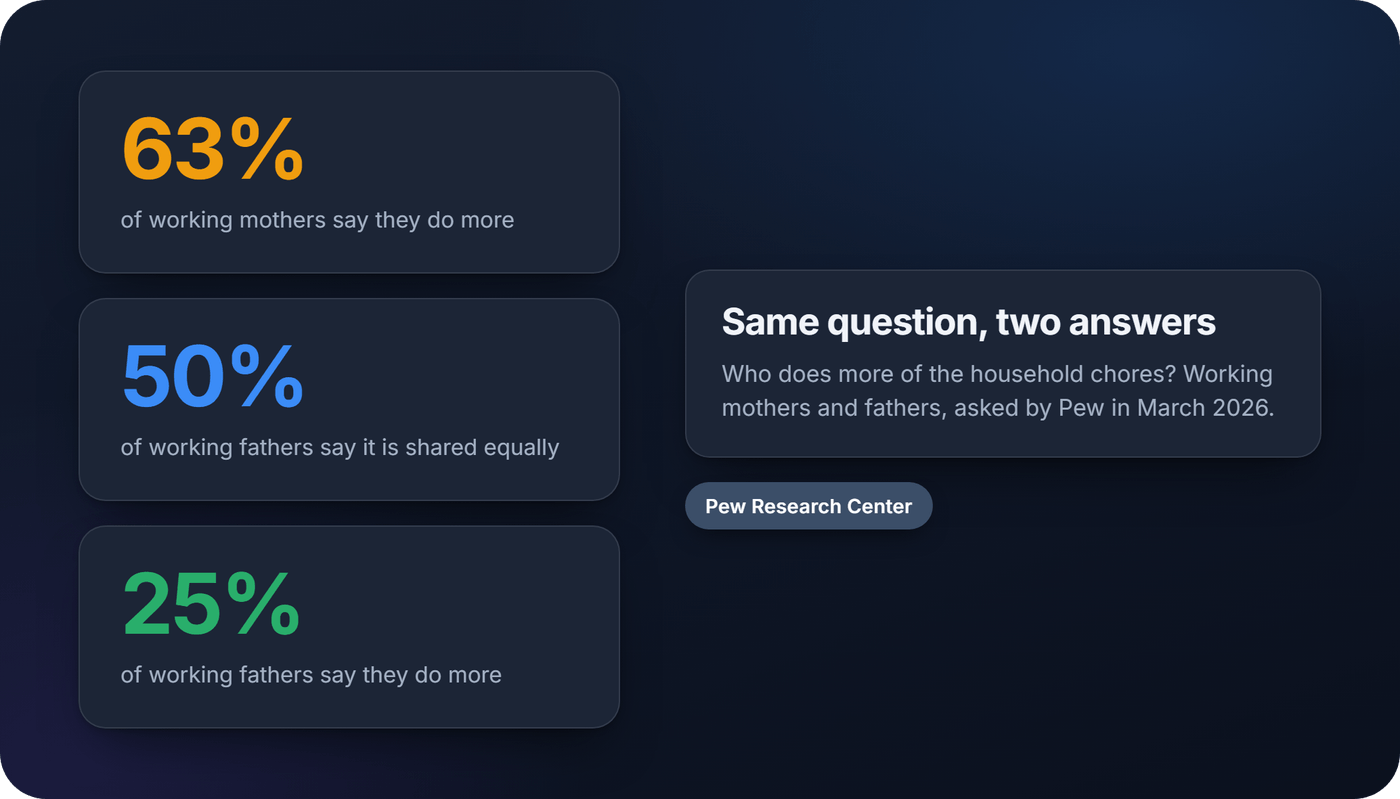
Those are answers from mothers and fathers in general, not from the same couples, so they don't prove anyone is lying. They show how differently the two sides of a home can see the same work.
A University of Bath study points the same way. Surveying 3,000 US parents, the researchers found that fathers overestimate their own contribution more than mothers do, and are more likely to see the mental load as equally shared, which mothers dispute. The same study found mothers handle 71 percent of the household tasks that need mental effort.
Why you can both be right
Nobody needs to be dishonest for this to happen. Three ordinary things are enough.
You remember your own jobs in detail. You know how long the bathroom took because you were there. Your partner's jobs reach you as results: the bins are gone, the fridge is full. A result feels smaller than an effort.
Some jobs are invisible to the other person. Noticing the milk is low, booking the dentist, remembering the school trip money. These take thought, and nobody sees thinking.
You count different things. One of you counts tasks. The other counts time, or worry. Ten quick jobs and one long one can feel like a fair swap to one partner and a raw deal to the other.

The disagreement has a cost of its own
It is tempting to treat this as a harmless difference of opinion. Research from the University of Queensland says otherwise. In a study of 235 couples, published in Scientific Reports in August 2026, women reported taking on almost 25 percent more of the thinking, planning and scheduling than their partners credited them with. The bigger the difference between partners' views of the split, the lower the quality of the relationship they reported.

The detail is worth reading closely. Different views of the physical and emotional work hit women's happiness hardest. Different views of the planning work were linked to poorer relationship quality only for men. So the gap in perception hurts both partners, just in different places.
That changes the goal. You are not only trying to split the work more fairly. You are trying to agree on what the split actually is.
How to settle who does more
1. Each write your own list first
Sit down separately for fifteen minutes and list every job you did last week, including the thinking jobs. Then swap lists. Most couples find items on the other list they had never counted as work.
2. Agree on what counts
Decide together whether you are measuring tasks, time or both. If one long job is worth three short ones, say so out loud. A shared rule ends half the argument before it starts.
3. Keep a record for two weeks
Memory is a poor referee, for both of you. For two ordinary weeks, write down each job when it is done, with who did it. It takes seconds, and it replaces "I always" and "you never" with a list you both trust.

4. Read it together, then adjust
At the end of the two weeks, look at the record side by side. If it shows a gap, move a whole job across, planning included. If it shows a fair split that one of you didn't feel, that is worth knowing too.
Let the record do the remembering
This is the part MatePoints was built for. Each household job becomes a task with a point value, so a long job can be worth more than a quick one. When someone finishes it, it lands in Task History with their name, the time and the points it earned. Nobody has to keep a notebook or remember who did the bathroom on Tuesday.

The leaderboard then adds up each person's points for the week or the month, so your weekly check is two totals instead of two memories. The record won't end every disagreement. It will make sure you are arguing about the same week.
For the bigger picture on who does the housework, read Who does more housework? Settle it with a shared list. If the gap you find is mostly planning, not doing, how to share the mental load goes deeper, and chore completion tracking covers the record itself.
You can set up a household and start a record in a few minutes. MatePoints is free to start.
Sources
- For working parents, the boundary between work and family is often blurred, Pew Research Center, June 2026
- Dads, moms have drastically different views of how they share the workload, Jenni Fink, Newsweek, 2026
- Mothers bear the brunt of the mental load, managing 7 in 10 household tasks, University of Bath, EurekAlert, December 2024
- How everyday household tasks impact relationships, University of Queensland, Phys.org, August 2026