How to talk to a messy roommate (and what to bring)
Living with a messy roommate? Bring a short record of who did what, one specific ask and a date to review it, instead of a list of grievances.

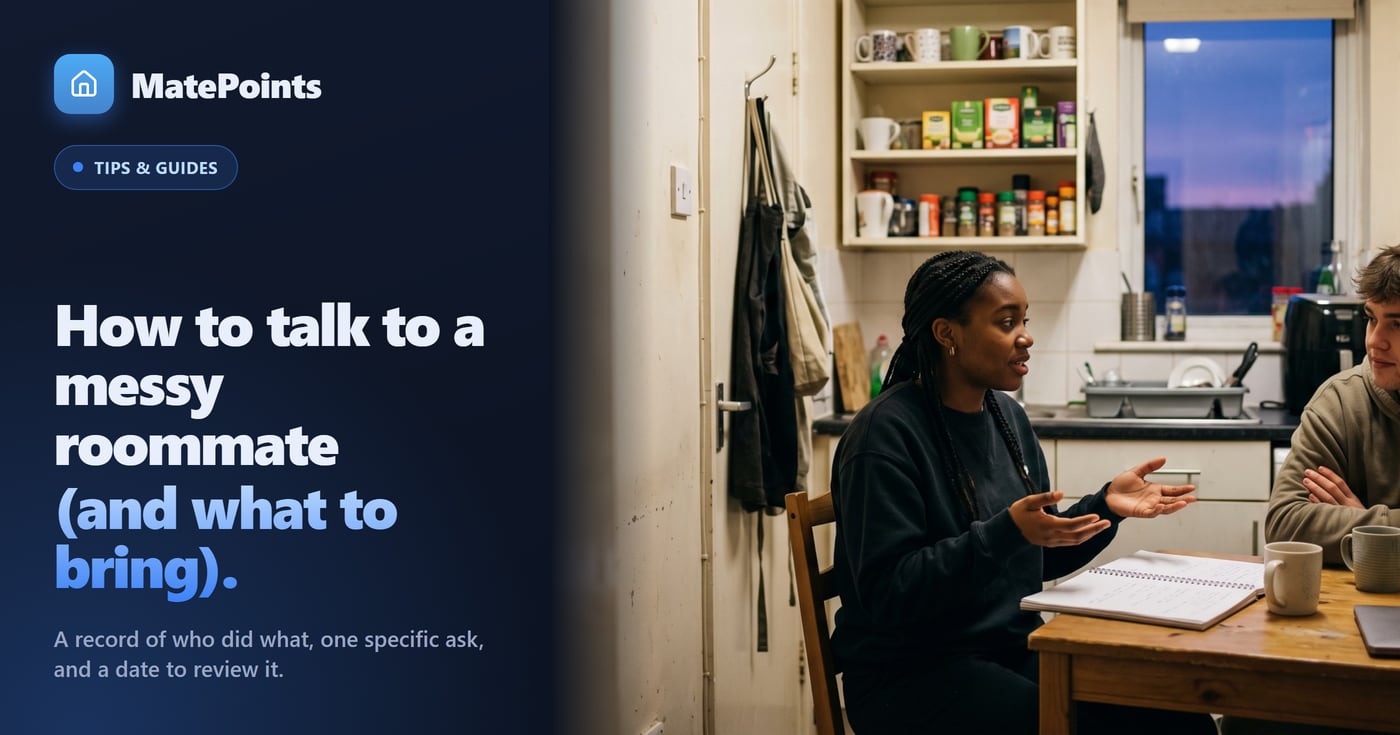
Living with a messy roommate wears you down slowly. The pan that soaks for three days. The bin that is somehow always full when it is your turn to notice. Most advice tells you to "talk to them". This guide is about what to bring to that talk: a short record of who did what, one specific ask, and a date to check in again. Those three things turn a complaint into a plan, and they make the conversation much harder to derail.
You are not the only one arguing about this
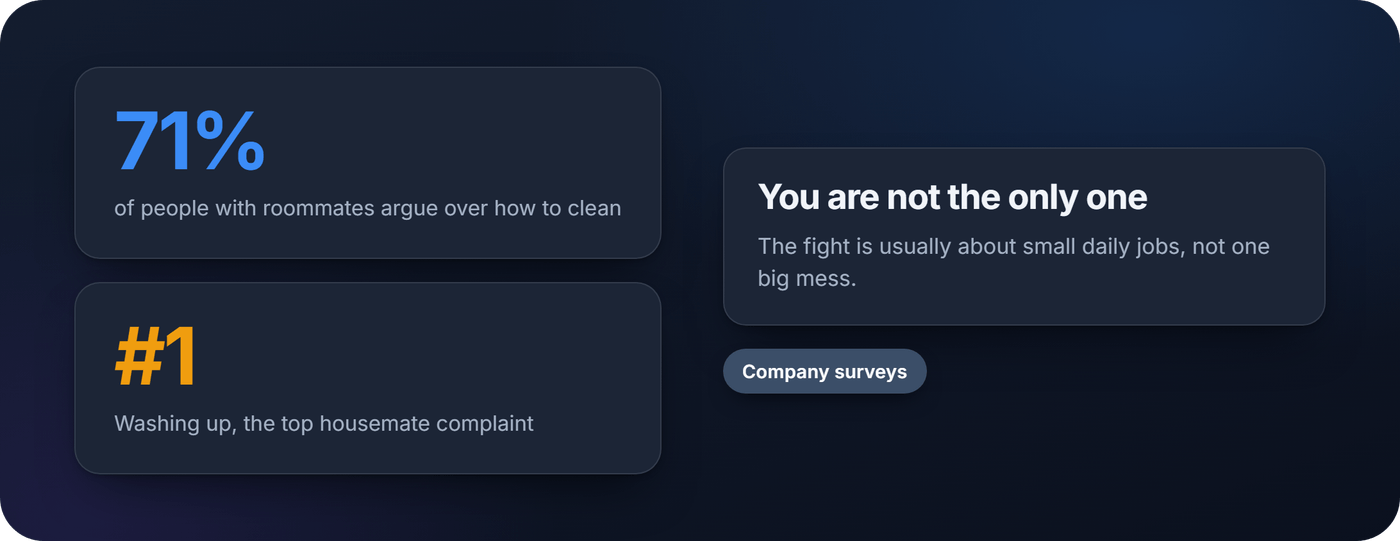
Cleaning is one of the most common things people who share a home fall out over. In a 2022 survey for the American Cleaning Institute, an industry body, 71 percent of respondents with roommates said they argue over how to clean. Student Beans asked 1,414 UK students about their housemates in 2024, and washing up topped the list of complaints at 24.89%, ahead of bins at 21.78%. Both are company surveys, so treat the exact numbers loosely. The pattern is clear enough: the fight is usually about small, daily jobs, not one big mess.
Is it mess, or a different standard?
Before you say anything, decide what you are actually asking for. A roommate who leaves dishes in the sink overnight and a roommate who never washes them at all are different problems. The first is a different standard. The second is a job not being done.
Pick the one or two things that genuinely affect you: shared spaces, food going off, the bathroom. Leave their bedroom out of it. A conversation about five grievances becomes a conversation about none of them.
Pick the moment
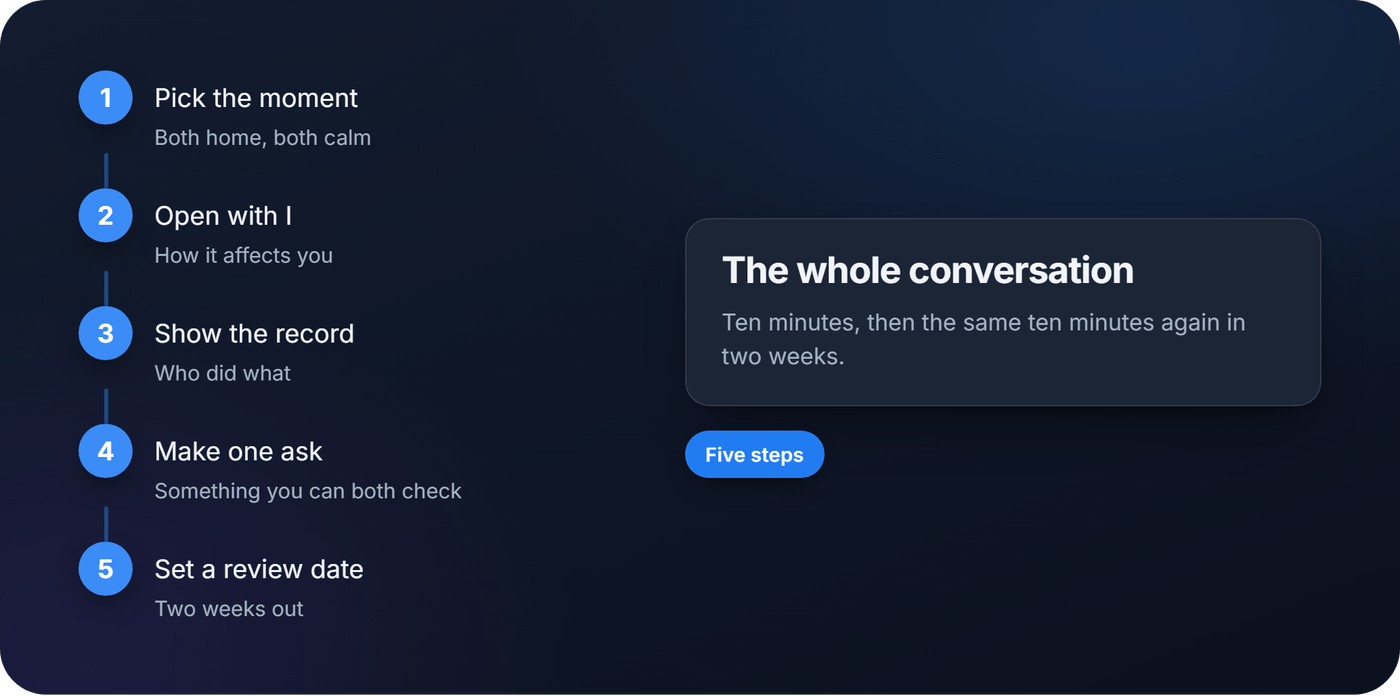
Timing does a lot of the work. Not when they walk in the door, not in the middle of an argument about something else, and not by text after a long day. Ask for ten minutes when you are both home and calm: "Can we talk about the kitchen tonight or tomorrow?" Giving notice is not a trap. It lets them arrive ready to talk instead of defensive.
Open with "I", not "you"
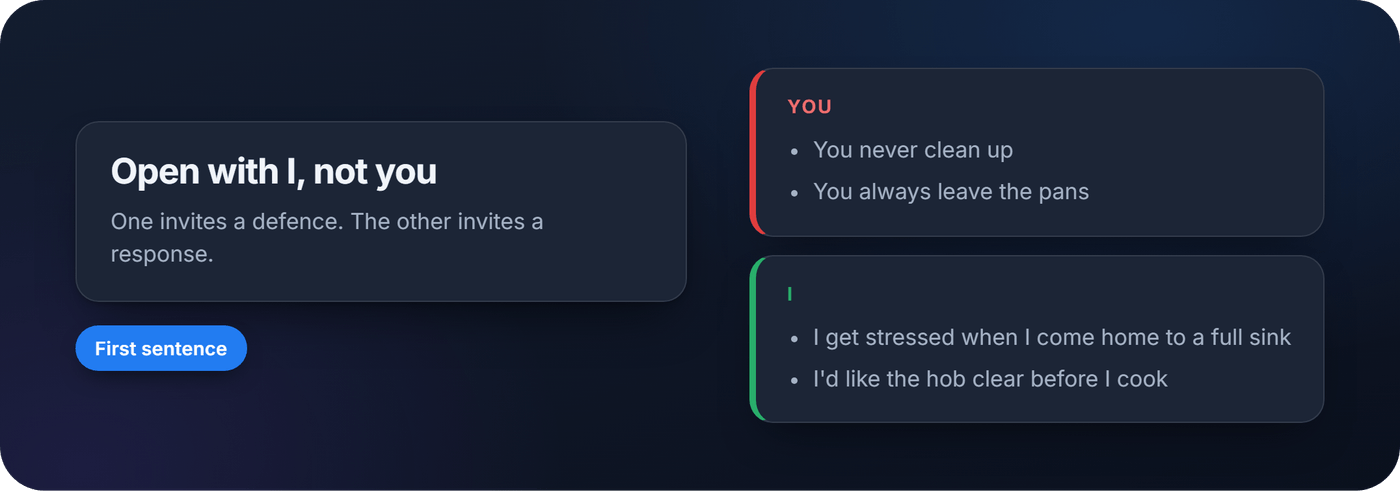
How you start matters more than how you finish. "You never clean up" invites a defence. "I get stressed when I come home to a full sink" invites a response.
There is some evidence behind this. In a study published in PeerJ in 2018, Shane Rogers, Jill Howieson and Casey Neame found that "using I-language and communicating perspective were both found to reduce perceptions of hostility". The benefit was larger when the speaker also showed they understood the other person's point of view. One caveat: the 253 students in the study rated written, hypothetical scenarios, not real arguments. It tells you which opening sounds less hostile, not what happens next. That is still useful at the start of a hard conversation.
Bring a record, not a grievance
Here is the step most guides skip. Memory is a poor referee. Two people who share a kitchen genuinely remember the same week differently, and each tends to remember their own effort best.
Research on families points the same way. In a 2024 study of 3,000 US parents, Weeks and Ruppanner found that parents "overestimated their contributions to the household in general", as the British Psychological Society reported. That study is about parents, not flatmates. The lesson carries over anyway: everyone believes they do their share, so "I do everything" is a claim the other person will dispute.
A record ends that dispute in seconds. It does not need to be elaborate. Two weeks of who did the dishes, the bins and the bathroom, written on the fridge or kept in an app, is enough. Bring it to show what is happening, not to win.
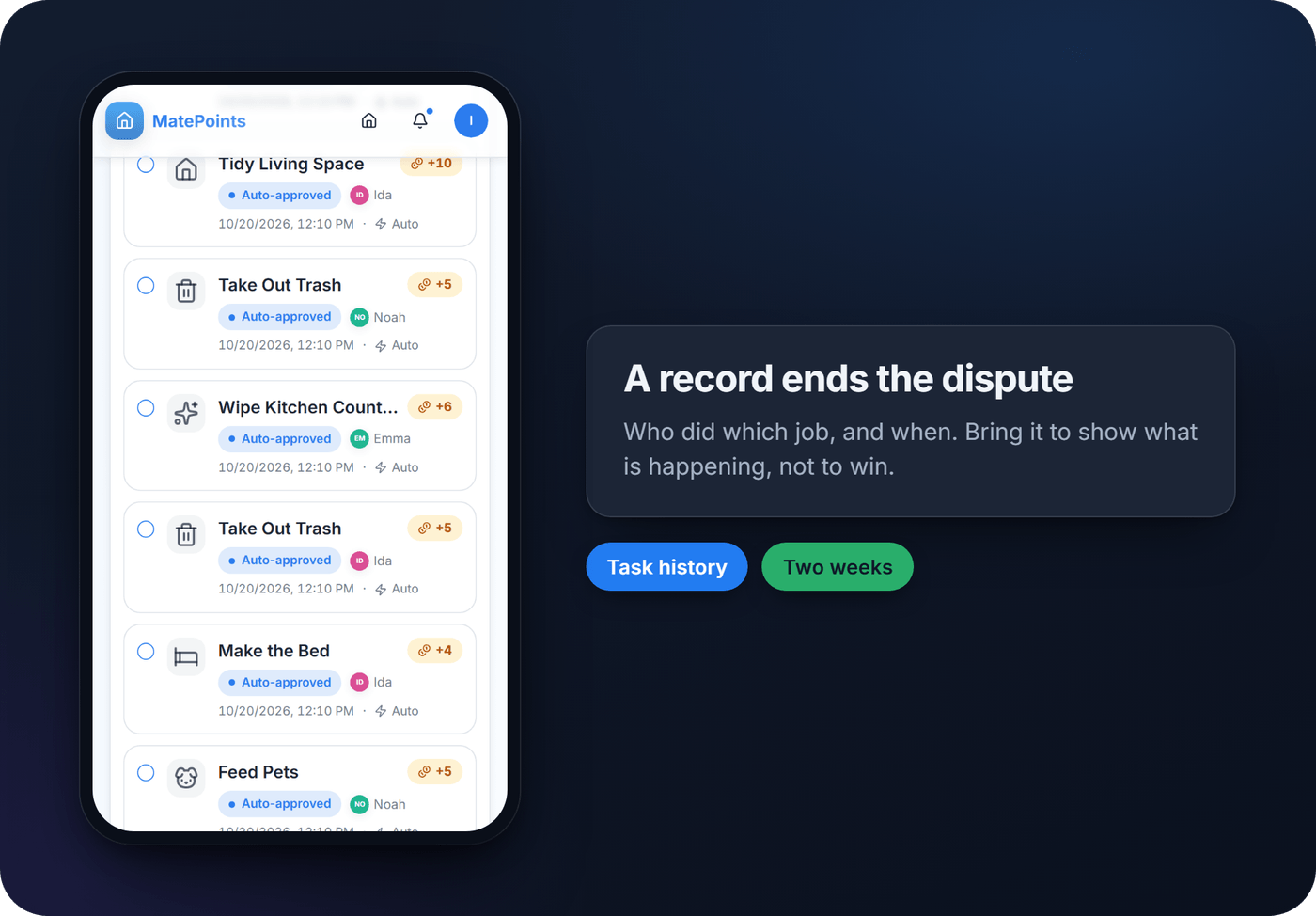
If your flat uses MatePoints, the Task history tab is that record. Every completed chore is logged with the time and the points. The person who set up the household (the owner) can filter it by member and date to see who did what; everyone else sees their own completions, which is still the fastest way to show your side of the fortnight. For more on keeping a record that does not feel like surveillance, see our guide to chore completion tracking.
Make one specific ask
End the talk with one request, phrased as something you can both check. "Can you help more?" fails because nobody knows when it is done. "Can we wash our own dishes the same day we use them?" passes, because on any given evening you can both see whether it happened.
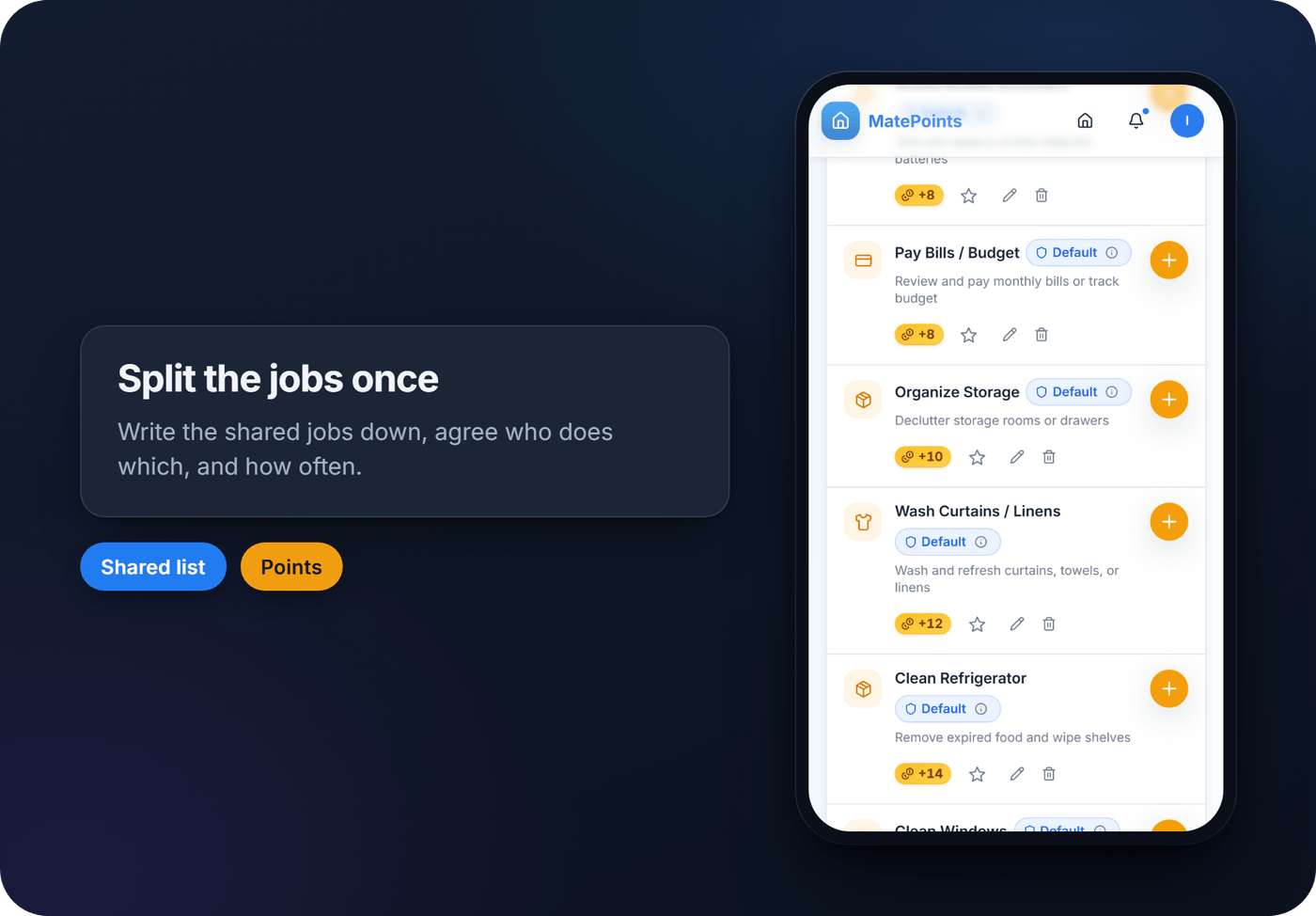
If the honest answer is that the jobs were never clearly split, split them now. Write the shared jobs down, agree who does which, and agree how often. Our roommate chore system walks through one way to do it fairly.
Put a review date in the diary
This is the step that makes the other four stick. Before you get up from the table, agree to check in again in two weeks. Same ten minutes, same record.
A review date changes the tone of the first talk. Nobody has to win today, because you will both see in a fortnight whether the change worked. It also gives a roommate who agreed under pressure a fair chance to show they meant it.

What if nothing changes?
At the review, look at the record together. If the change happened, say so. That matters more than it sounds. If it half happened, adjust the ask rather than starting over: maybe the same-day dishes rule becomes "before bed".
If nothing changed at all, you now know something useful. You can ask what got in the way, renegotiate the split, bring in a landlord or other flatmates for shared spaces, or decide it is not a living arrangement you want to renew. Each of those decisions is easier with two weeks of facts in front of you than with a feeling.
Messy roommates are rarely villains. Usually they have a different standard, a different schedule, or simply have not noticed. A calm opening, a record, one clear ask and a date to review give them every chance to fix it.
Sources
- Survey: Do College Students Make the Grade on Cleaning?, American Cleaning Institute and Wakefield Research, CleanLink, July 2022
- Most Common Arguments You'll Have With Uni Housemates, Mikaela Bartlett, Student Beans, August 2024
- I understand you feel that way, but I feel this way: the benefits of I-language and communicating perspective during conflict, Rogers, Howieson and Neame, PeerJ, 2018
- Mothers report taking the brunt of household mental load, Emily Reynolds, BPS Research Digest, January 2025