Roommate chore chart: a 20-minute system, two templates
A roommate chore chart that lasts: agree what clean means, list the invisible jobs, then copy a four-week rotation grid or a chore wheel for your house.

A roommate chore system does not need an app or a free weekend. It needs a 20-minute setup meeting, a written answer to what "done" means, and a roommate chore chart somewhere everyone looks. Below are five steps and two templates you can copy tonight: a four-week rotation grid and a chore wheel. In my experience, weekly check-ins, not enforcement, are what keep a system alive past week three.
You are not the only house arguing about this. In a 2025 Barclays survey of UK house-sharers, 88% of young flat sharers said they had clashed with housemates over shared-space etiquette, and 86% had resorted to passive-aggressive tactics.
Step 1: Agree on what "clean" means
Most roommate arguments aren't about chores. They're about mismatched definitions of "clean". One person's fine is another person's disaster, and no chart fixes that until you name the standard out loud.
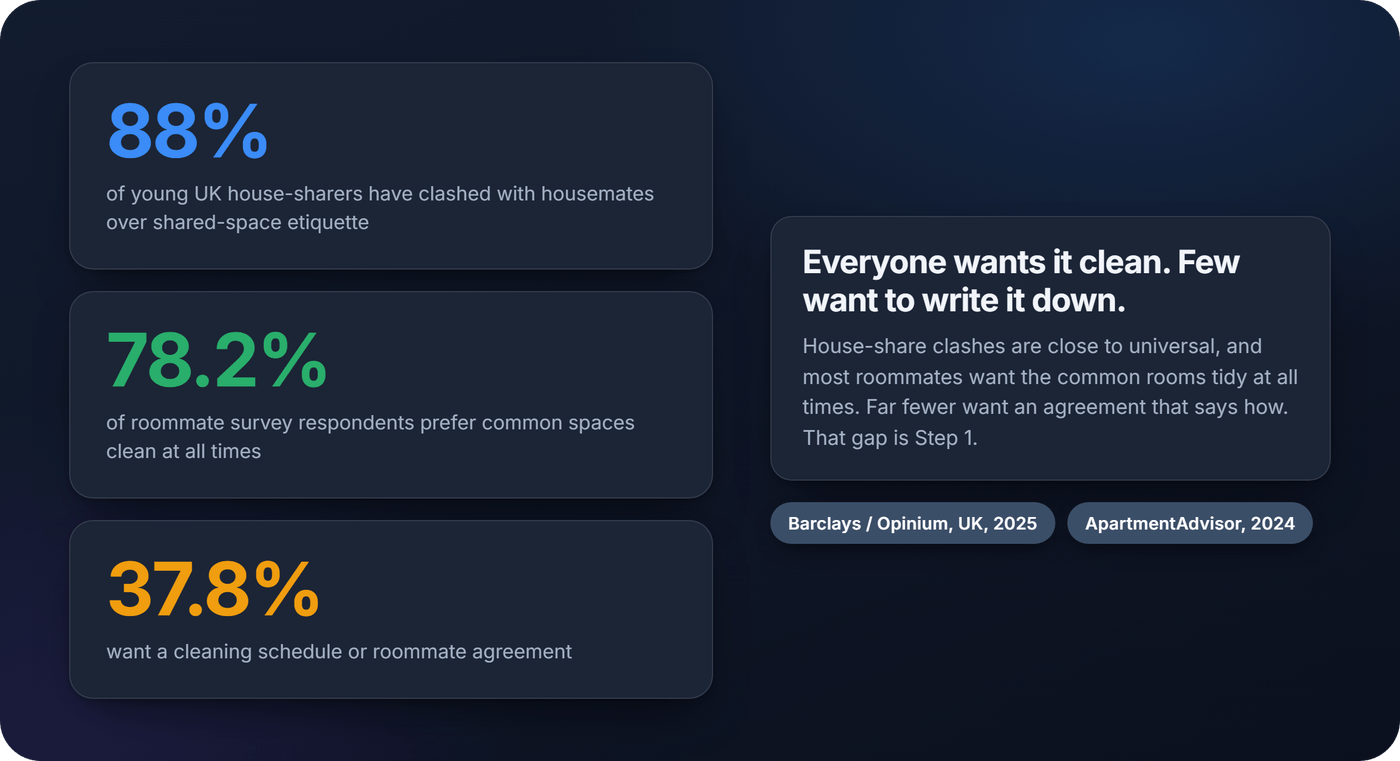
In ApartmentAdvisor's 2024 roommate survey of 1,016 respondents, 78.2% wanted common spaces clean at all times, but only 37.8% wanted a cleaning schedule or roommate agreement. Everyone wants the result. Few write down how.
Agree on four things:
- What "clean enough" looks like in the kitchen, bathroom and common areas
- Who buys shared supplies, and how you split the cost
- Which spaces are shared and which are private
- What counts as "done" for each recurring task
Write it where everyone can see it: a kitchen whiteboard or a pinned message in the group chat. NPR's Life Kit guide, built on advice from Eve Rodsky and Jacqueline Misla, starts the same way: list every chore, then "set clear expectations of how and when a task should be done." If standards slip, a script beats a passive-aggressive text: "Hey, can we reset on the kitchen standard we agreed on?"
Step 2: Build a complete roommate cleaning checklist
Walk the apartment room by room. One person calls out every task; everyone else adds what they missed.
- Daily: dishes, wiping counters, overflowing trash
- Weekly: vacuuming, bathroom scrub, trash and recycling day
- Monthly: deep-cleaning the fridge, washing windows, air filters
- Invisible: restocking supplies, booking repairs, remembering whose turn it is
In my experience, that last category is where chore systems quietly fail. Eve Rodsky built her Fair Play system, described in Time in 2019, to "make visible all the invisible and often unacknowledged work" of running a home. She wrote about her marriage, but it transfers: remembering is work too. Skip it and someone does far more than their share while "technically" owning one chore.
Step 3: Pick how to split chores with roommates
There's no single best method, only the one that matches how your household operates.
- Rotation. Tasks move in order on a set cadence, weekly for most groups. Agree swap rules up front: 24 hours notice and a reply confirming the trade.
- Zones. Each person owns a space rather than a task list. Write a short duties list per zone so "owning the kitchen" has a defined floor.
- Preference. People claim the chores they don't mind, then split the rest.
- Points. Each task gets a value for time and difficulty, and everyone hits a weekly target however they like, so scrubbing a bathroom and wiping a counter don't score the same.
Mixing works. Zones plus a rotating bathroom is a good pairing because, as NPR's guide puts it, "no one should have to be responsible for one task forever, especially if it's unpleasant."
Pro Tip: If your household has wildly different schedules, points beat rotation. Someone working nights can bank points on their days off instead of missing their slot every third week.
Step 4: Make the chart (two templates)
Template 1: a rotating chore chart for four roommates
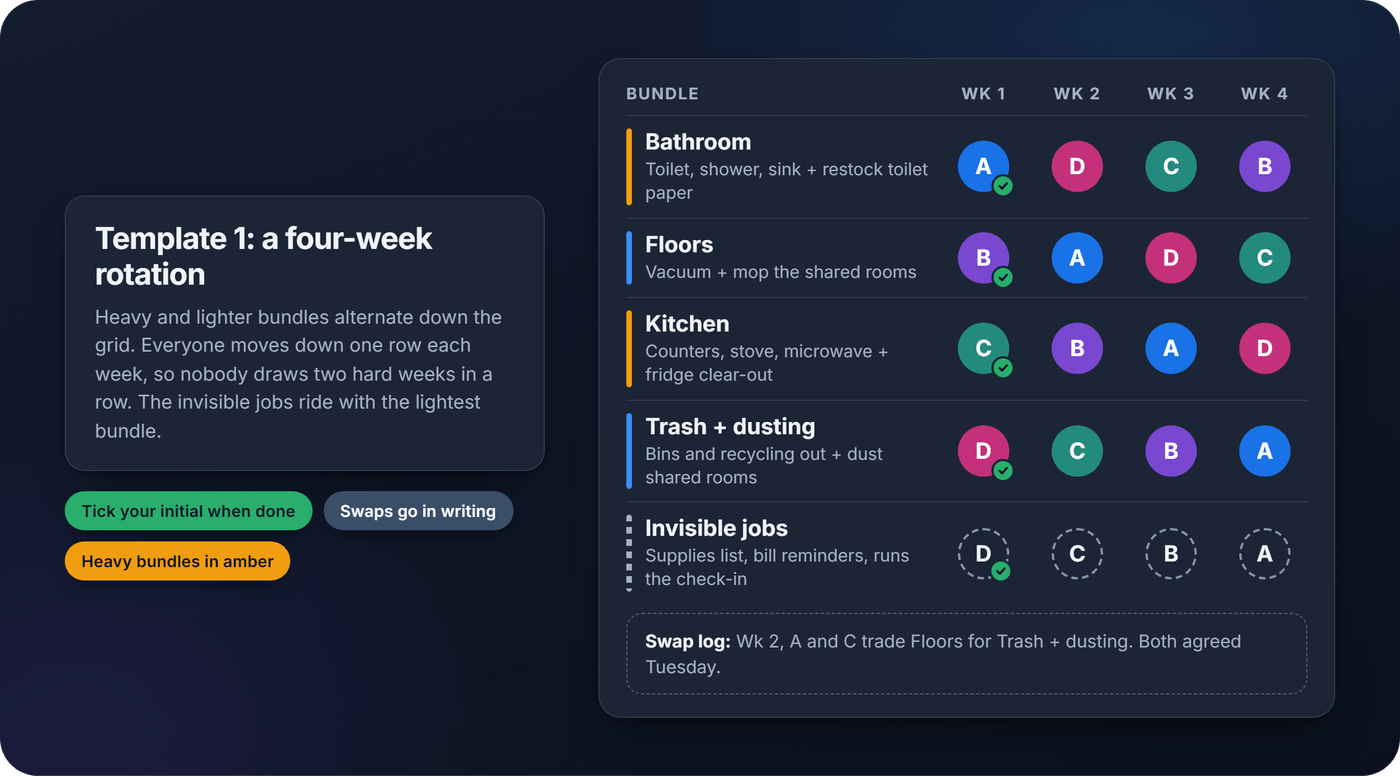
The layout follows a roommate chore chart from the University of Florida's Off-Campus Life office (2025): four names, four weeks, chores bundled per slot. Here heavy and lighter bundles alternate down the rows, and everyone moves down one row a week, so nobody draws two hard weeks in a row. Roommates are A, B, C and D; weeks 1 to 4 in order.
- Bathroom (toilet, shower, sink, restock toilet paper): A, D, C, B
- Floors (vacuum and mop shared rooms): B, A, D, C
- Kitchen (counters, stove, microwave, fridge clear-out): C, B, A, D
- Trash and dusting (bins, recycling, dust shared rooms): D, C, B, A
- Invisible jobs (supplies list, bill reminders, running the check-in): ride with the lightest bundle, so D, C, B, A
- Swap log: "Week 2, A and C trade Floors for Trash and dusting. Both agreed Tuesday."
Initial your cell when it's done. Three roommates: pair each heavy job with a lighter one (bathroom plus trash, kitchen plus dusting, floors on its own) over three weeks. Two of those three bundles are the bigger ones, so each person gets them back to back once a cycle, with floors as the breather. Two roommates: bathroom plus floors against kitchen plus trash, swapped weekly, with the invisible jobs alternating too.
Template 2: a chore wheel for roommates
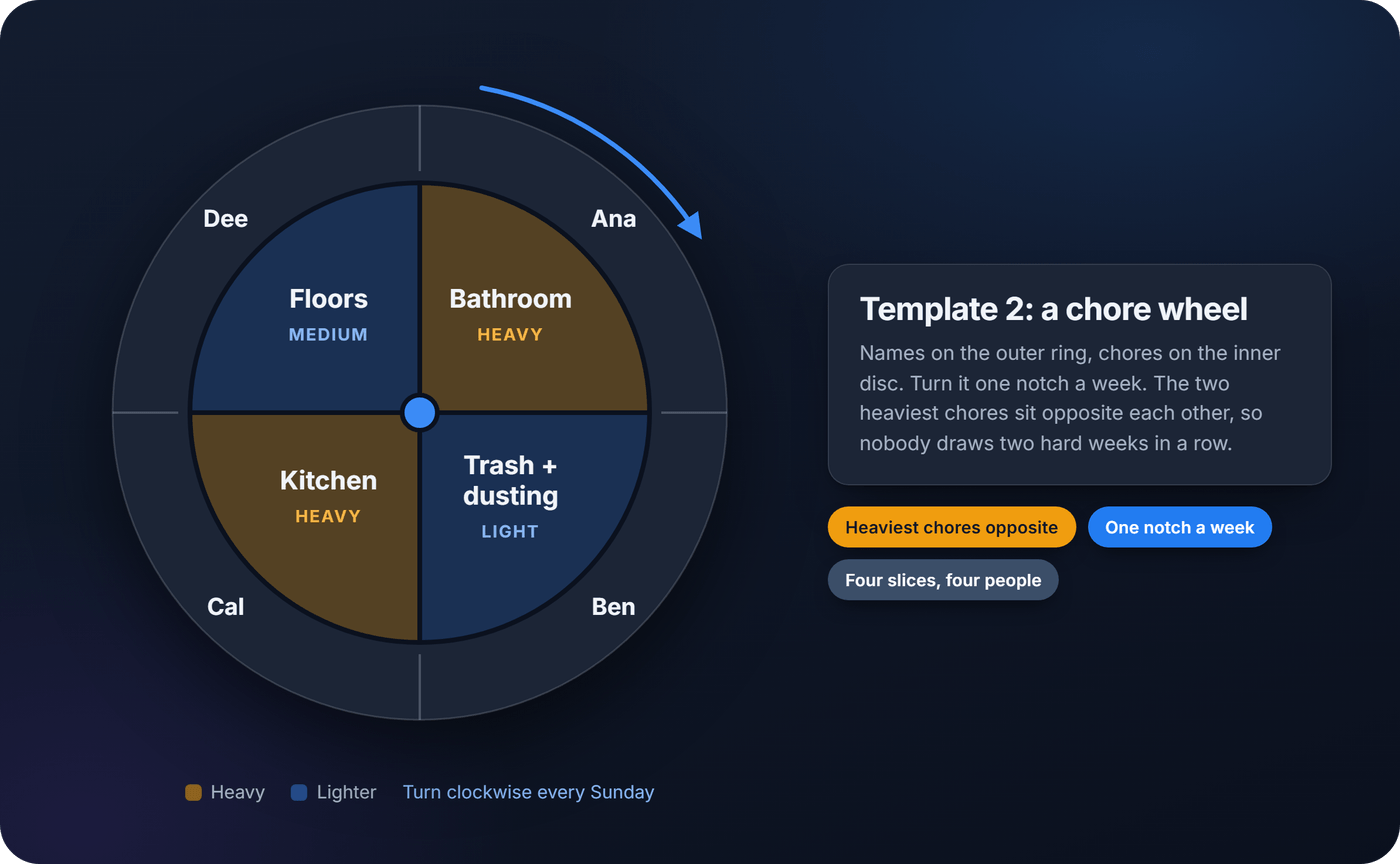
A roommate chore wheel is the same rotation as a circle: names on a fixed outer ring, chores on an inner disc, turned one notch every Sunday. The four slices, clockwise:
- Bathroom (heavy)
- Trash and dusting (light)
- Kitchen (heavy)
- Floors (medium)
The two heaviest chores sit opposite each other, so nobody draws two hard weeks in a row.
There is field evidence, too. In a test written up in 2021 by Irrational Labs with the co-living company PadSplit, half the homes got a wheel and half did not. In the wheel homes, a house leader picked the chores after asking every housemate for input. The team reported a 99% probability that wheel homes did better, a 49% expected drop in cleanliness-related support tickets or negative ratings, and 65% of wheel-home residents rating their house clean or very clean, against 55% in homes without one. Two caveats: the sample size is not disclosed, and it is a company blog post, not a peer-reviewed study.
Chore wheel ideas: make one from two paper plates and a split pin. With three roommates, cut three slices to match the three-person bundles above. With five, add a slice for the invisible jobs.
Step 5: Check-ins, swaps and a backup plan
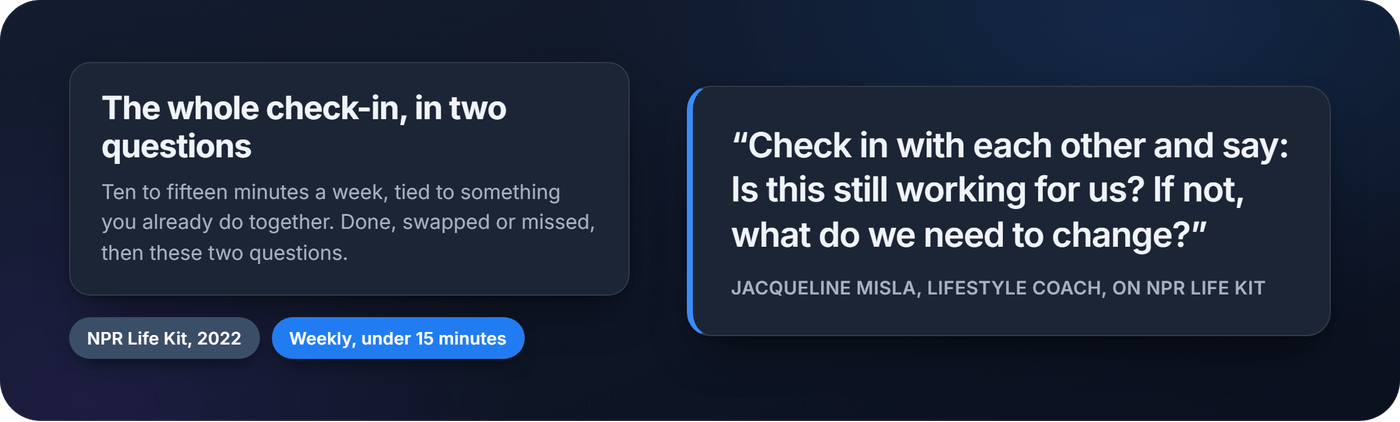
A chart without a check-in is just decoration. Block 10 to 15 minutes a week, tied to something you already do together:
- Mark each task done, swapped or missed
- Write swaps down as they happen
- Agree a policy for sick days and travel
Rodsky's advice in NPR's guide is to "set regular check-in times to walk through your weekly schedule and reassign chores and duties where necessary." Misla's version fits on a sticky note.
Pro Tip: Keep the check-in under 15 minutes on purpose. Longer meetings turn into venting sessions, and people start avoiding them.
Troubleshooting: when the system breaks down
In my experience, chore systems usually fail for one of three reasons: expectations were never made explicit, invisible work was left off the list, or enforcement was inconsistent. The first has research behind it: in a small 2020 New Zealand study of 37 flatmates, the sources of conflict participants described were differing expectations of cleanliness and freeloading.
Don't rebuild from scratch. Reset:
- Pause the chart for a week rather than letting it limp along
- Re-audit the list, since new invisible tasks surface after a month
- Ask a neutral roommate to mediate if the same two keep clashing
If one task keeps getting skipped whoever has it, pool money for a cleaner. NPR's guide suggests exactly that for roommates who "constantly bicker about whose turn it is to deep clean the bathroom."
What to look for in a roommate chore app
Paper works for small, low-conflict households. My rule of thumb is that an app earns its keep around four people, or once no-shows become a pattern. In a 2021 Rent.com survey of 1,900 renters, poor cleaning habits were the top roommate pet peeve at 37%, and 40% among people with four or more roommates.
Look for a shared list, reminders if forgetting is the problem, proof of completion (a checkbox, a photo or an NFC/QR tap) and a record of swaps. Some tools reach into wider household coordination, the way family reminder apps sync calendars and gift lists across a group.
Where MatePoints fits, and where it doesn't
MatePoints does not run your rota. It won't rotate or assign chores, remind anyone about ordinary ones, record swaps, take photo proof or pay out for a weekly target. The rota stays on the wheel or the grid. MatePoints handles the layer around it.
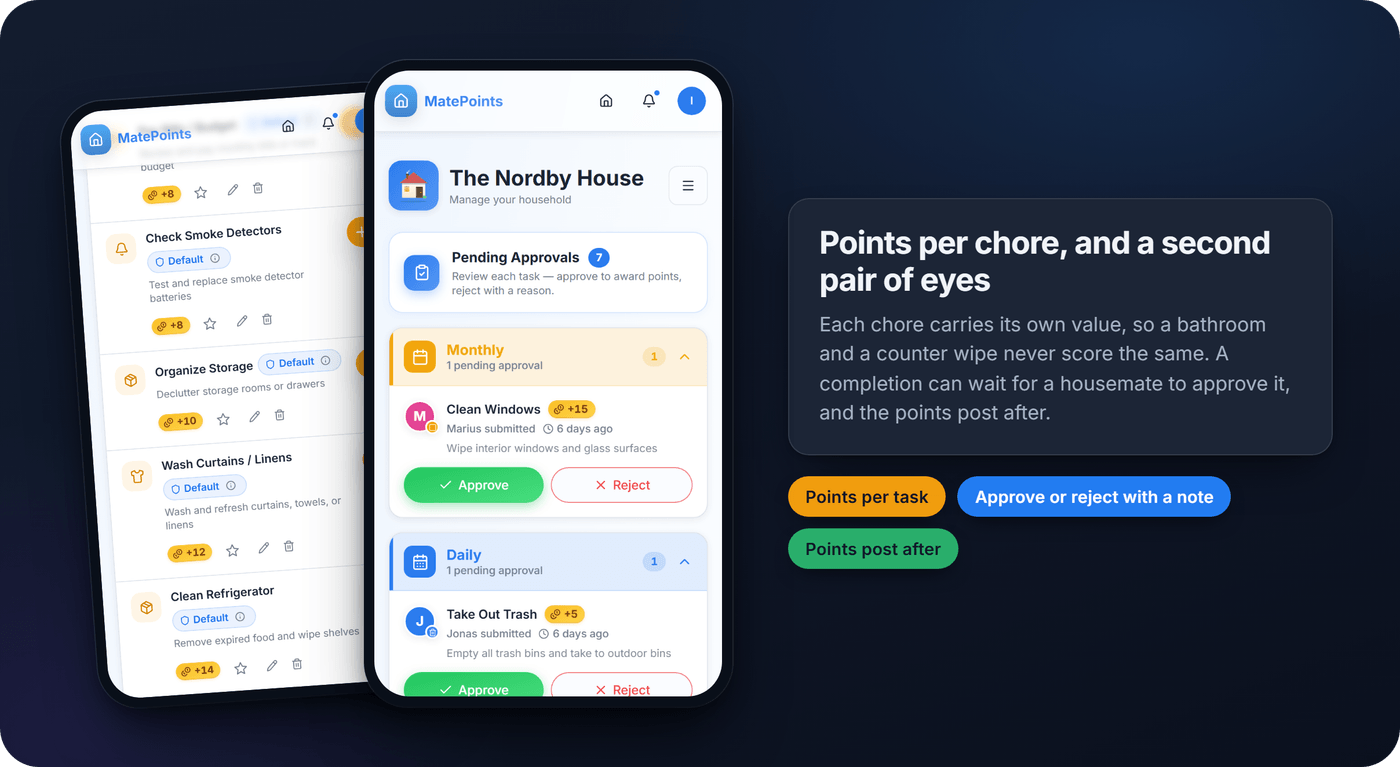
- Points per chore, set once in the open: Step 3's effort weighting without the tally sheet.
- An approval step. A completion can be held for a housemate with approver rights, who approves it or rejects it with a note. Points post after approval.
- A tap at the chore's spot. An NFC tag or QR code on the bathroom door logs the chore. It needs a household owned by a Pro member; then anyone in the house can tap.
- A leaderboard for today, the week, the month or all time, which settles "I always do more" with points.
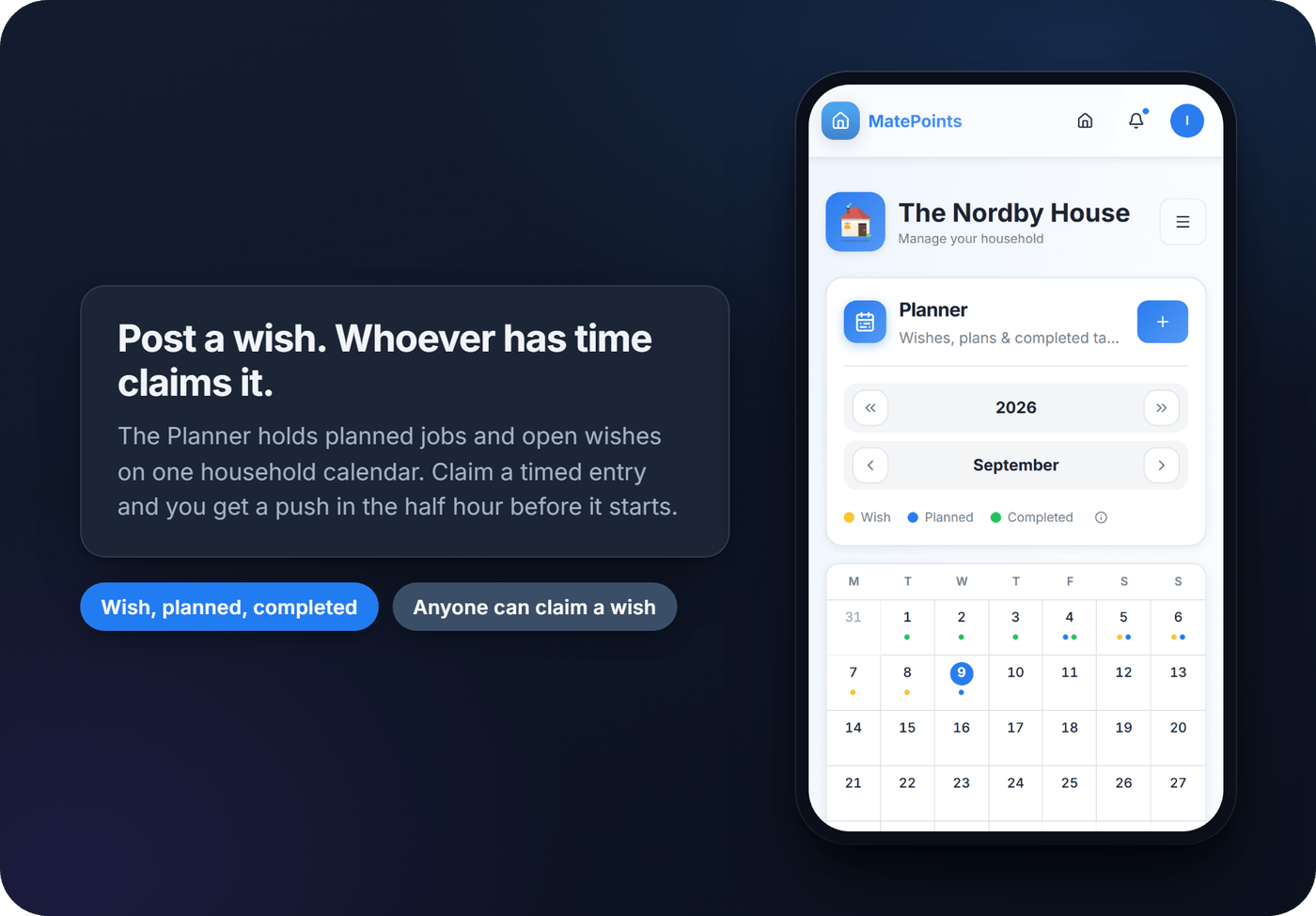
- Planner wishes anyone can claim. Claim a timed entry and you get a push in the half hour before it starts.
- Cheers, a one-tap cheer for a housemate, shown in the app and sent as a push notification.
There is a free tier to try it with your roommates. How household data is handled is on the privacy and security page.
Why clear rules plus incentives beat nagging
Points and rewards can help, but only on top of standards everyone already agrees on. Add them to a household that never defined "done", and you've built a system people can game instead of one that gets things clean. Treat the chart as a living document, not a contract carved in stone. Adjust it when someone's schedule changes. Rewrite it when a chore keeps getting skipped. The paper or app matters far less than the willingness to revisit it.
FAQ
What are the early signs of roommate chore problems?
Passive-aggressive texts about dishes, one person quietly redoing another's "finished" task, and supplies running out with nobody replacing them, usually well before an open argument.
How does a chore wheel work, and how often should it rotate?
Names sit on a fixed outer ring, chores on an inner disc. Turn the disc one notch a week and everyone moves to the next chore. Weekly is the usual cadence, so nobody is stuck with the bathroom for long.
Is there an app for roommate chores?
Yes, several. MatePoints gives each chore a point value, can hold completions for a housemate's approval, logs chores by NFC tag or QR code in a Pro-owned household, and ranks everyone by day, week, month or all time. It does not rotate or assign chores, or send reminders for ordinary ones, so keep a grid or wheel for the rota.
What is the most disliked chore among roommates?
Probably the bathroom. In a 2026 YouGov survey of US adults, 52% said they hate or dislike cleaning bathrooms, more than any other chore asked about. That was all adults, not just roommates, but rotate the bathroom explicitly either way.
What is the golden rule for splitting chores?
Rodsky's first Fair Play rule: "All time is created equal." Count everyone's hour the same, and put invisible work like restocking supplies on the list next to scrubbing the toilet.
Sources
- Nine in 10 young flat sharers say they've lived with a 'housemate horror', Barclays (Opinium research), October 2025
- ApartmentAdvisor Roommate Survey (2024), ApartmentAdvisor, April 2024
- Stuck doing all the household chores? This practical guide can help, Andee Tagle and Michelle Aslam, NPR Life Kit, 2022
- I Created a System to Make Sure My Husband and I Divide Household Duties Fairly. Here's How It Works, Eve Rodsky, Time, 2019
- Roommate Chore Chart, University of Florida Off-Campus Life, 2025
- The Science Behind Chore Wheels: Do They Work and Why?, Irrational Labs with PadSplit, October 2021
- Cleaning Habits are the Biggest Pandemic Roommate Pet Peeve for Renters, Rent.com, June 2021
- Managing Conflict in Shared Housing for Young Adults, Clark, Tuffin and Bowker, New Zealand Journal of Psychology, 2020
- How Americans feel about household chores, and dividing them, Taylor Orth, YouGov, February 2026