A weekly family meeting agenda that sorts the chores
A 20-minute family meeting agenda that sorts the chores: start with what got done last week, end with a name and a day next to every job.


A good family meeting agenda for chores fits in 20 minutes and does two things most agendas skip. It opens by looking at what actually got done last week, as facts rather than blame. And it closes with a name and a day next to every job for the week ahead. Below is the agenda, minute by minute, the reasoning behind each step, and the few rules that keep children coming back to the table instead of dreading it.
Why chores slip through most family meetings
Search for a family meeting template and you will find the same shape everywhere: appreciation, the calendar, old business, something fun. Chores get a slot, usually a short one. One widely shared template from Pabau (updated September 2026) gives its "chores and responsibilities review" two to three minutes and leaves the follow-up to "a shared calendar reminder between meetings".
That is fine for confirming who owns what. It misses the part that makes a chore system last: checking, every week, whether the jobs happened. Without that check, a plan made on Sunday has nobody looking at it by Thursday, and the next meeting starts from memory. Memory is where the arguments live.
How long should a family meeting be?
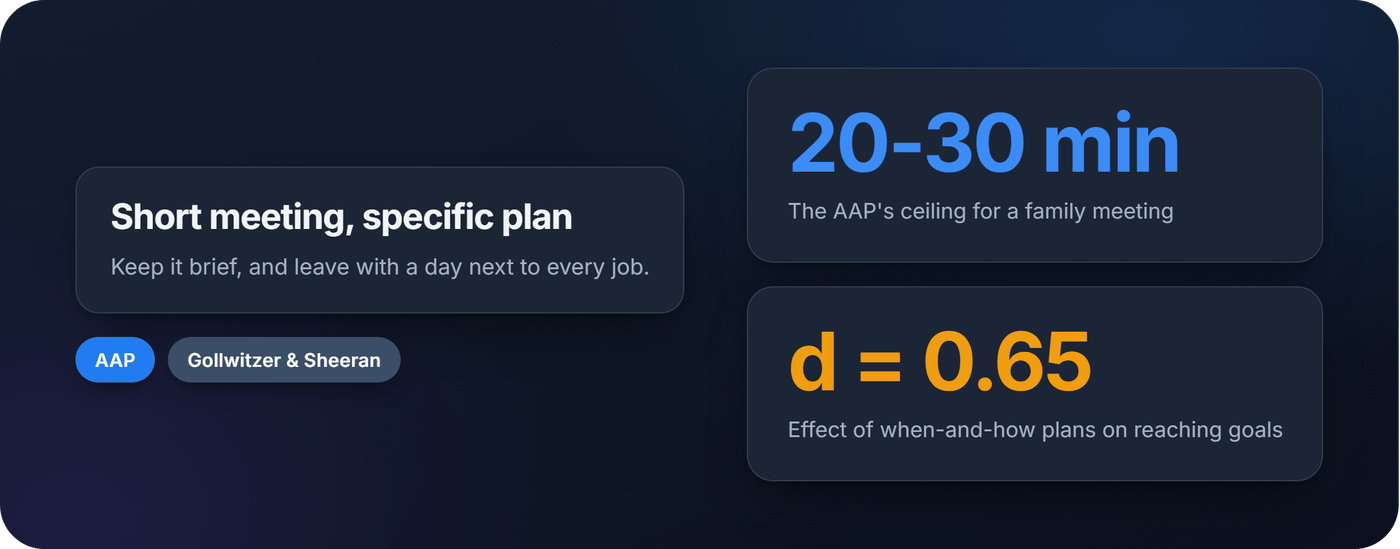
Shorter than you think. The American Academy of Pediatrics, on its parenting site HealthyChildren.org, says meetings "should last no more than 20 or 30 minutes unless your family wants to continue" (page updated 2022).
Expect to run over at first. Ruth Gyllenhammer, a mother who wrote up her family's weekly routine in 2024, says their goal is "15 to 20 minutes" and they "usually close out around the 30-minute mark". Aim for 20 and let the timer, not the mood, end it.
Pick one fixed slot and keep it. Routines are hard to hold when work is unpredictable: in a 2026 Capita/YouGov survey of 1,000 US parents, 43% said their work schedules make consistent routines hard, as EdSurge reported. A meeting that moves every week is a meeting that quietly stops happening. Sunday after dinner works for many families because the week ahead is still blank.
The 20-minute family meeting agenda
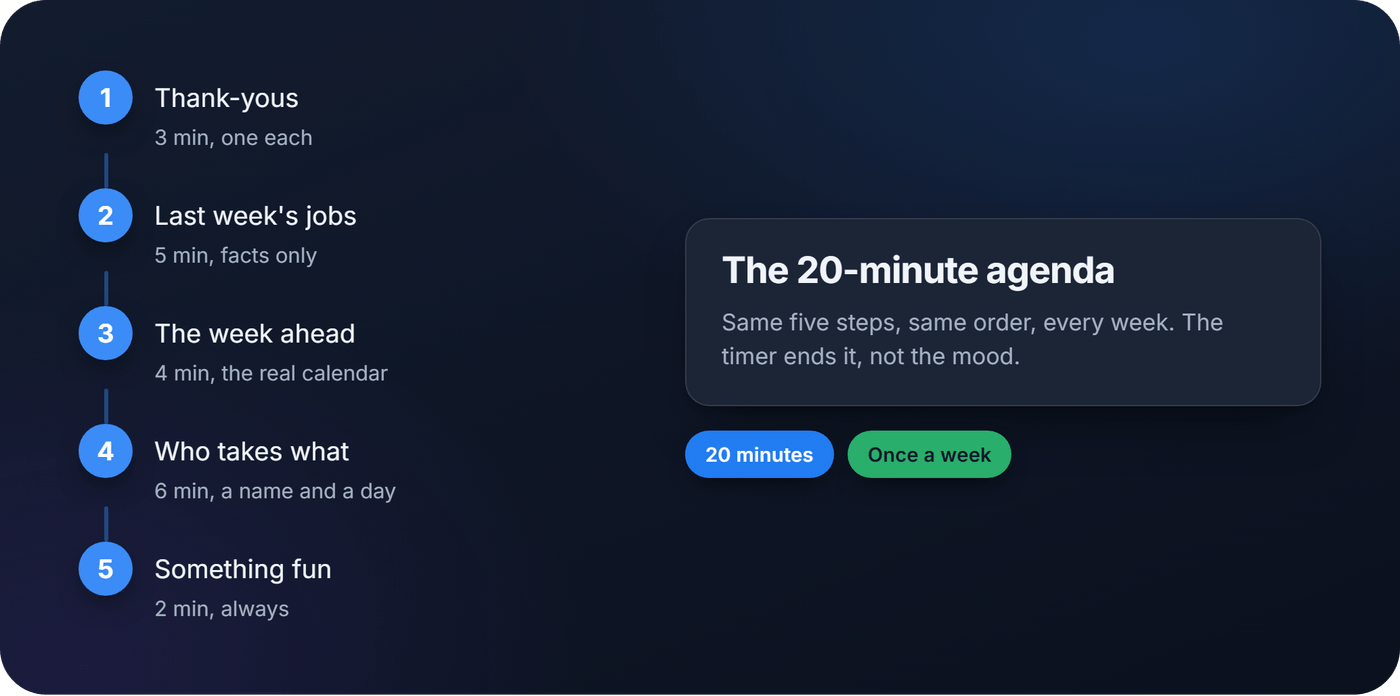
- Thank-yous (3 minutes). Everyone names one thing someone else did this week. Start here so the first voice in the room is a kind one.
- Last week's jobs (5 minutes). Read out what got done and what did not. Facts only. More on this below.
- The week ahead (4 minutes). Football on Tuesday, a late shift on Thursday, a birthday on Saturday. Jobs have to fit around real days.
- Who takes what (6 minutes). Every job for the week gets a name and a day before anyone gets up.
- Something fun (2 minutes). The pudding, a game, picking Friday's film. End on the part children look forward to.
Open with what got done, not who failed
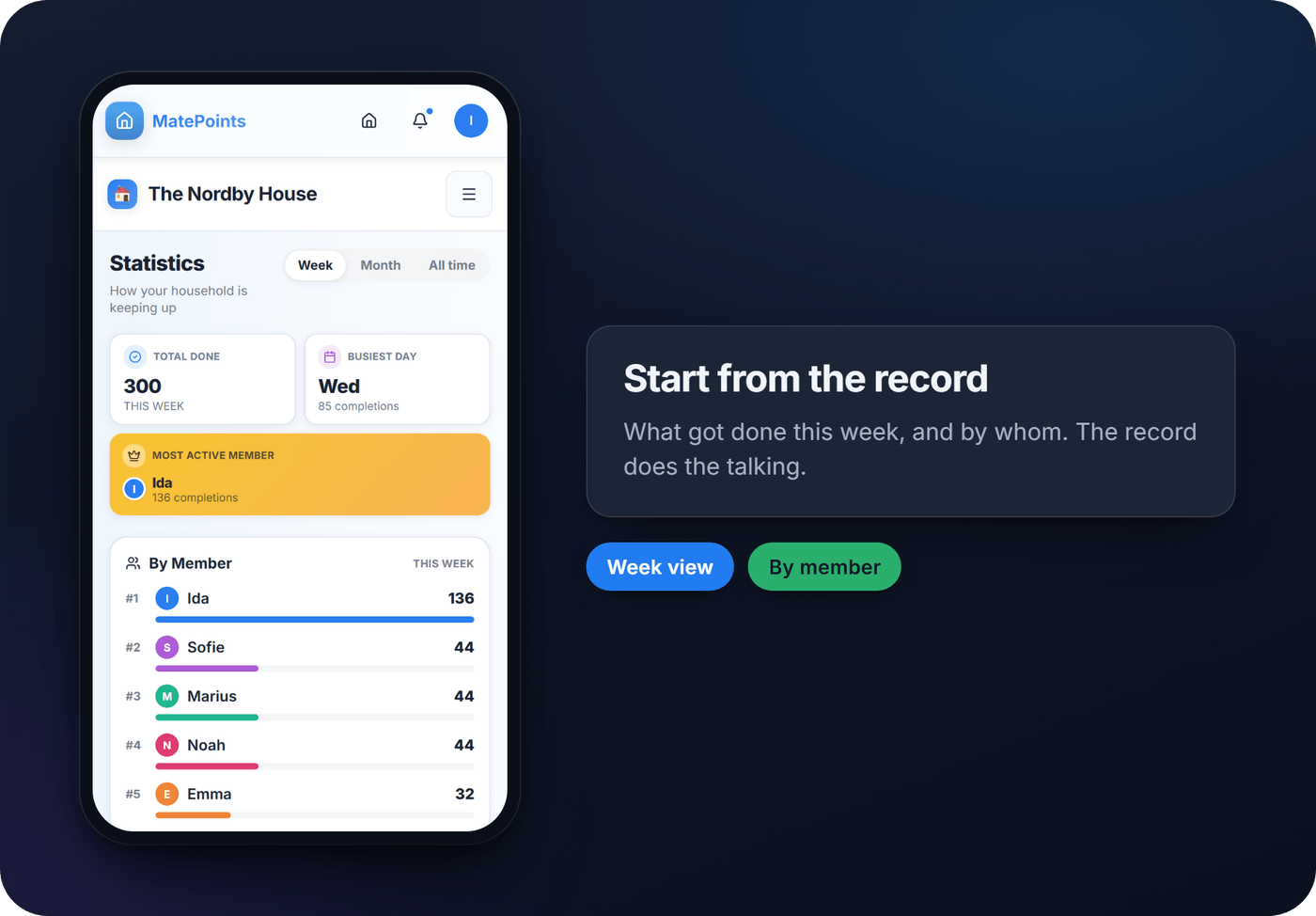
The AAP is blunt about this. The family meeting "is not a time or place to scold, punish, recall past mistakes"; those conversations belong somewhere else. The same page suggests keeping a record of "progress toward goals, new goals and agreements".
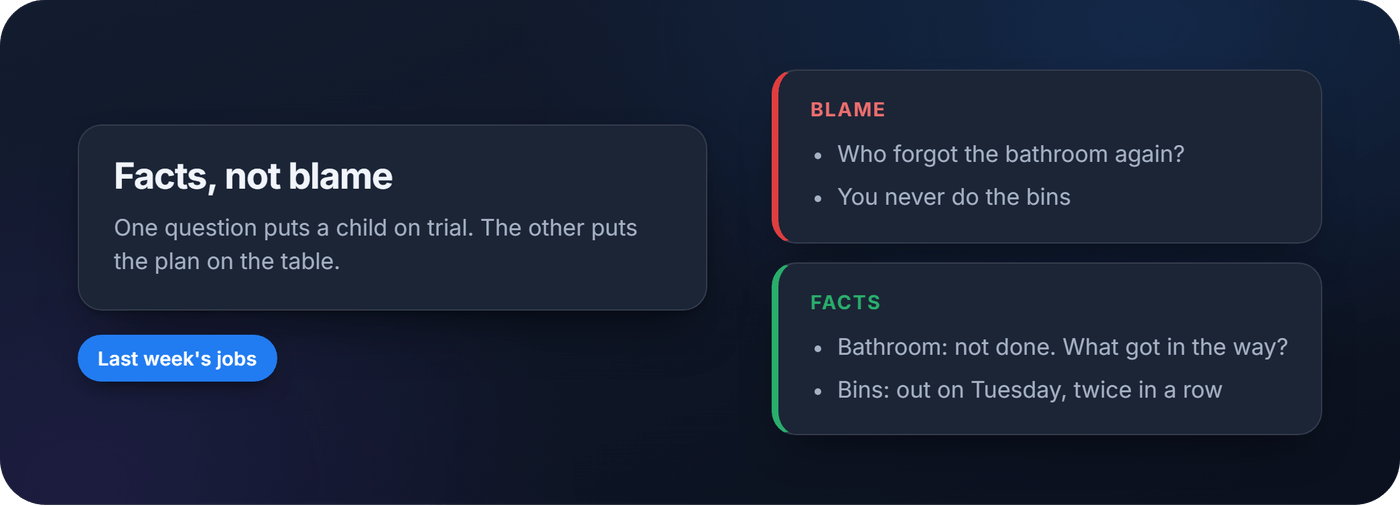
Those two pieces of advice fit together. A record lets you review last week without scolding anyone, because the record does the talking. Compare "Who forgot the bathroom again?" with "Bathroom: not done this week. What got in the way?" The first puts a child on trial. The second puts the plan on the table.
The answer to "what got in the way" is usually boring and useful. The job landed on swimming night. Nobody knew where the mop lived. Two people each assumed the other had it. Every one of those is a fix for this week's plan, not a mark against a person. When something did get done without a reminder, say so out loud. That counts as a thank-you too.
The record itself can be a tick list on the fridge or an app. What matters is that it was written down during the week, not reconstructed at the table. Our guide to chore completion tracking covers how to keep one that does not feel like surveillance.
End with a name and a day next to every job
"Can everyone help more this week?" is not a plan. "Noah takes the bins out on Tuesday" is. Before anyone leaves the table, every job for the week should have both.
There is research behind that rule. Psychologists call a plan that names when, where and how you will act an implementation intention. A 2021 meta-analysis by Wang, Wang and Gai in Frontiers in Psychology summarises the earlier review by Gollwitzer and Sheeran (2006): implementation intentions had "a positive effect on improving goal attainment", with a "medium to large effect size" (Cohen's d = 0.65). That research covers goals in general, from health to study, not chores or children specifically. The principle still carries: a job with a day attached is easier to start than a job with good intentions attached.
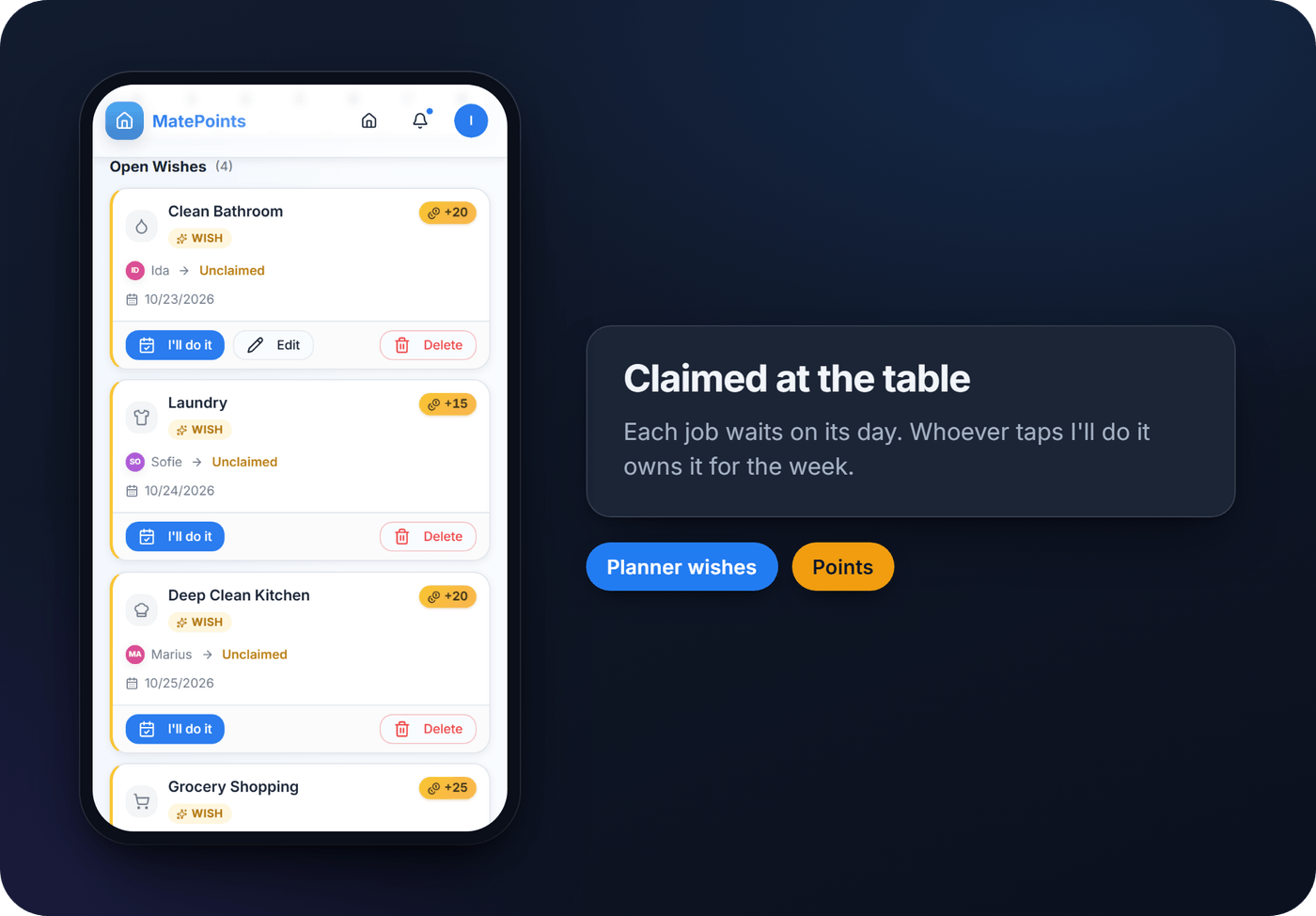
Let children choose rather than be assigned. Put the week's jobs on the table and let them claim in turn, rotating who goes first each week. A job someone picked is harder to call unfair. Keep the list matched to age, so a seven-year-old is not left with the oven; our list of age appropriate chores helps with that.
If your family uses MatePoints, this step happens in the Planner. A parent adds the week's jobs before the meeting as wishes, each on its own day, and at the table each child taps "I'll do it" on the ones they take. The wish moves to Planned with their name on it, and when it is done it lands in the household's history, ready for next week's review. The Planner is included in the free plan.
Rules that keep kids coming back
A family meeting only works if people turn up willingly. A few rules help.
- Keep the timer. Twenty minutes, then stop, even mid-topic. A meeting that always ends on time is one children stop resisting.
- Rotate the chair. Let a different person run the agenda each week, with a parent as timekeeper. Children take a meeting more seriously when it is sometimes theirs.
- No ambushes. Nothing new and serious gets raised at the table without warning. Discipline is a separate conversation.
- Same order every week. The predictability is the point. Nobody has to wonder what is coming.
- Always the fun bit. Even in a bad week. Especially in a bad week.

Points or pocket money can sit on top of this, but they are optional. In the same write-up, Gyllenhammer describes an earlier system of "each kid earning a point for a completed chore that could then be traded in for money or a treasure box", before the family moved to an allowance tied to assigned chores. If you want to try something similar, our guide to a chore points system explains how to set one up.
Where the meeting fits with the rest of your system
The meeting does not replace the other pieces. It is the weekly ritual that keeps them alive. A family chore contract sets the rules once. A recurring chores schedule decides which jobs come round each week. A family task board is where the week lives between meetings. The meeting is the twenty minutes where all three get checked against what actually happened, and adjusted.
Try it this Sunday. Write down last week's jobs as best you can, set a timer for 20 minutes, and do not let anyone leave until every job has a name and a day. If you want the list, the claiming and the record in one place, MatePoints is free to start.
Sources
- How to Have a Family Meeting, American Academy of Pediatrics, HealthyChildren.org, updated 2022
- A Meta-Analysis of the Effects of Mental Contrasting With Implementation Intentions on Goal Attainment, Wang, Wang and Gai, Frontiers in Psychology, 2021
- The Anatomy of a Family Meeting, Ruth Gyllenhammer, Substack, April 2024
- National Survey of Parents Identifies Barriers to Family Well-Being, Katie Dukes, EdNC via EdSurge, March 2026
- Family meeting agenda: Free template, topics, and how to run one, Pabau, September 2026