Positive reinforcement at home: 5 steps for tonight
Positive reinforcement at home, starting tonight: name what you saw, pick rewards that work, keep every caregiver consistent, then fade them out.

Positive reinforcement at home means adding praise, attention or a small reward right after a behavior you want to see again. Tonight, the move is simple: catch your child doing something right, name the exact behavior out loud, and pair it with a smile, a high five or a small token. This guide gives you five steps you can start before bedtime, the rewards that work, the mistakes that turn rewards into bribes, and how to fade them out.
This is everyday positive reinforcement parenting. For a points system for the whole house, see the behavior point system guide; for a young child's sticker chart, the reward chart for kids.
How positive reinforcement works at home
The mechanism is plain. Something your child wants follows a behavior, and the behavior happens more often. The CDC's parenting guidance puts it bluntly: any attention, whether positive or negative, given immediately after a behavior increases the likelihood of that behavior happening again (2026). That cuts both ways, which is the reason to aim your attention on purpose.
The alternatives do not hold up well. The American Academy of Pediatrics' 2018 policy statement on discipline found that spanking, yelling at and shaming children are minimally effective in the short term and not effective in the long term (Sege and Siegel, Pediatrics, 2018). Positive discipline at home starts with the opposite habit. UNICEF's parenting advice, from Oxford's Lucie Cluver, is to watch for when they're doing something good and praise them.
Effective reinforcement strategies come down to three things:
- Immediacy. The CDC says to make sure the reward comes immediately after the child does the behavior, and that quick rewards work best for toddlers and preschoolers. Not at bedtime, when you remember they were good earlier.
- Contingency. The reward only shows up because the behavior happened. If it shows up regardless, it is not reinforcement. It is just a gift.
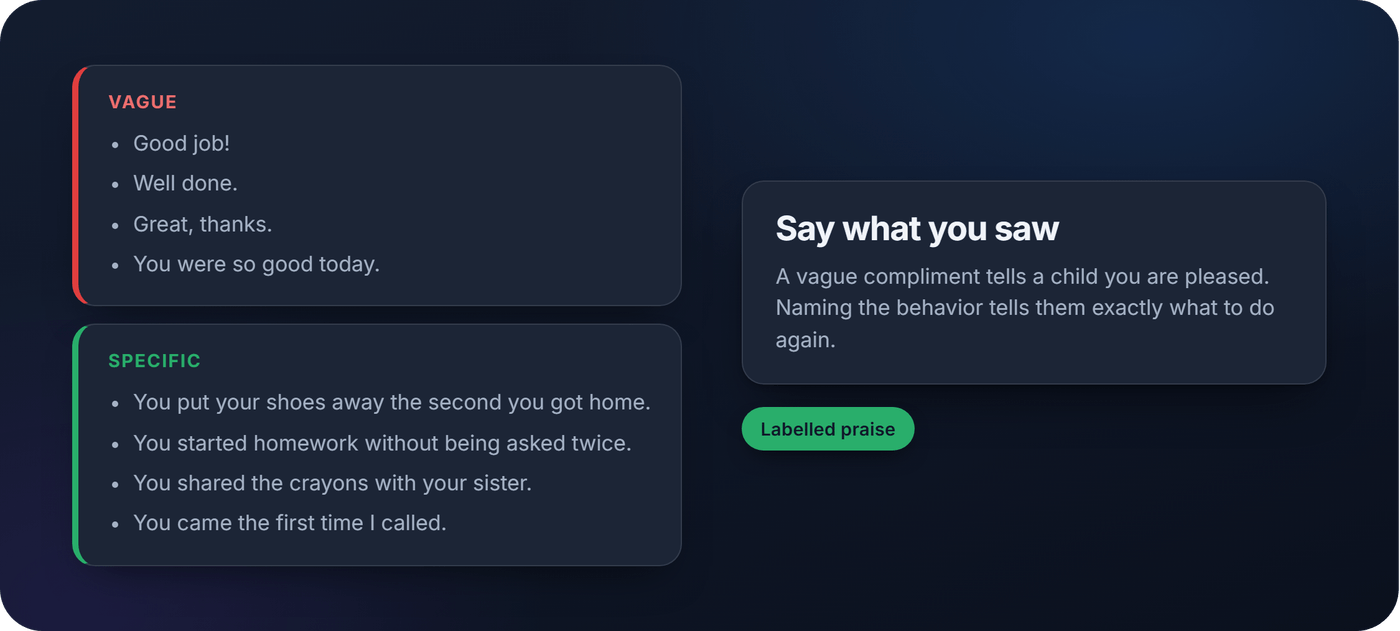
- Specificity. "Good job" tells a child you are pleased. Naming the behavior tells them what to repeat. The CDC calls this labelled praise ("I saw that you put your toys away!"). The Child Mind Institute (2026) agrees: spell out exactly what they are doing well.
One honest caveat. Praise is not magic on its own. A 2018 meta-analysis of 19 studies by Leijten and colleagues found that praise did not increase child compliance with instructions (PLOS ONE). Praise works best as one part of a plan: clear expectations, rewards agreed ahead, and the same response from every adult.
Pro Tip: With toddlers and preschoolers, "right away" really means right away. Praise in the moment, while they can still see what they did.
How to use positive reinforcement: 5 steps for tonight
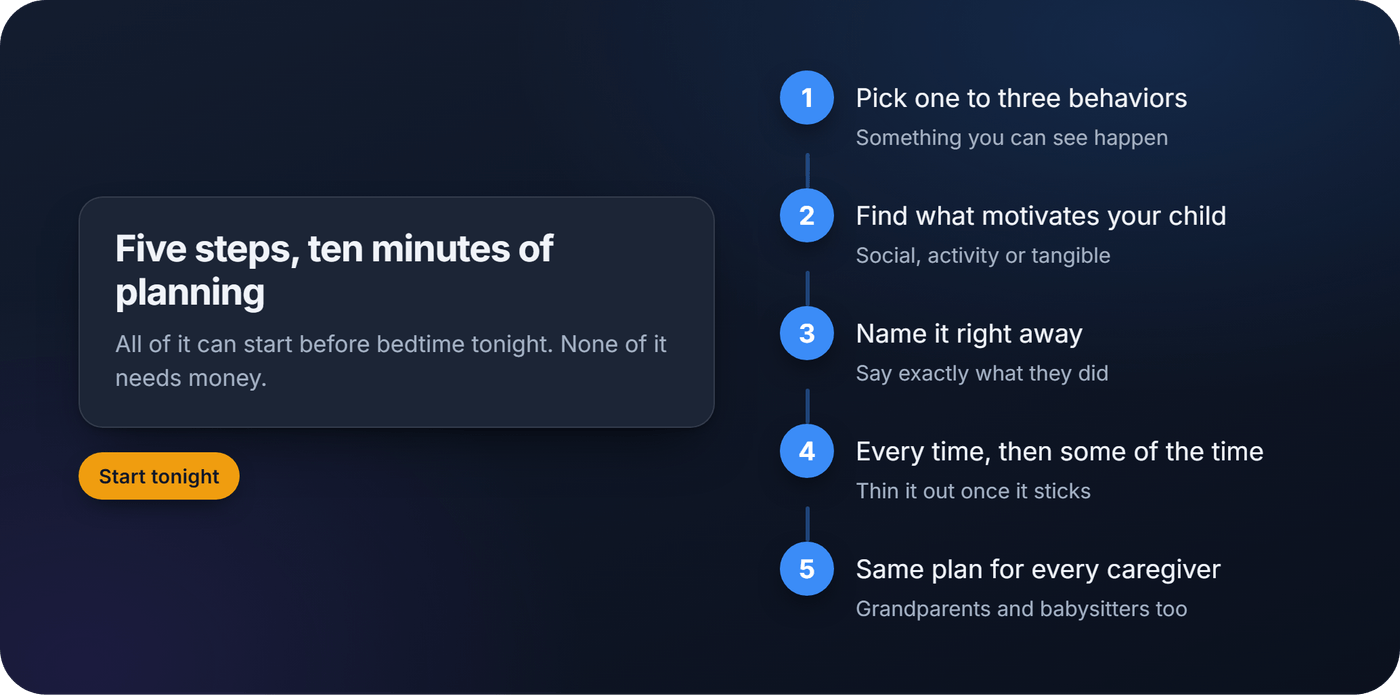
You do not need a course to start. Some guides call this reward-based training at home, which makes it sound mechanical. In practice it is mostly noticing. You need five steps and about ten minutes to plan them.
1. Pick one to three target behaviors and write them down. Not "be good." Something you can see, like "puts shoes in the bin after school" or "starts homework without being asked twice." If you cannot see it happen, you cannot reinforce it.
2. Figure out what actually motivates your child. Run a quick preference check: offer a choice between a sticker, five extra minutes of a favorite show, or picking the dinner side dish, and watch which one gets chosen without hesitation. Positive reinforcement rewards fall into three buckets:
- Social: praise, a hug, a high five.
- Activity: an extra story, choosing the film, a dance party in the kitchen.
- Tangible: stickers, small toys, a screen time token.
The best kids reward ideas sit in the first two. The CDC notes that social rewards are cheap or free and can be even more powerful than material rewards. If screen time is on your list, read what works and what backfires with screen time rewards first.
3. Nail the timing and the language. The moment you see the behavior, say what happened. "You put your shoes away the second you got home, that's exactly what I asked for" does far more work than "good job". Place2Be's advice for parents is the same: notice and name the wanted behaviour or effort, and praise it as soon as you see it.
4. Start continuous, then shift. For a brand-new behavior, reinforce it every time it happens. The CDC's rule for a new reward program is to reward your child often at the start. Once it is consistent, reward it some of the time (more below).
5. Get every caregiver on the same page. If one adult reinforces cleaning up toys and another ignores it, the behavior will not settle. Place2Be admits that with more than one adult in the family, it's not always easy to agree on how to notice and encourage effort. So write the plan somewhere visible, on the fridge or in a shared note, so grandparents and babysitters reinforce the same thing the same way. That is most of home behavior management, and most of creating a positive home environment: the same response, whoever is on duty.
Reward charts and token systems by age
A token system is a middleman between the behavior and the reward: your child earns stickers or points for the behavior, then trades them in later for something bigger. Raising Children Network notes that older children might like points instead of stickers, and that the novelty can wear off quickly.
Examples, not rules:
- Toddlers (2 to 4 years): One or two stickers earn an immediate small social reward, like an extra story or five minutes of dance-party time. Keep the gap between earning and cashing in as short as possible.
- School-age kids (5 to 10 years): Points on a paper chart work well. Five points might trade for 15 minutes of screen time, ten points for picking Saturday's family activity.
- Preteens and teens: Shift to privileges and choices, negotiated in advance, like a later curfew or picking the family's takeaway order.
Set the exchange rate low at the start so early wins come fast. Your child needs to feel the system works before a reward costs more. Rotate what is on offer every few weeks so nothing goes stale, and keep the reward menu where your child can see it. For a teenager, the points can live on a phone instead of the fridge.
Bribery and other reinforcement mistakes
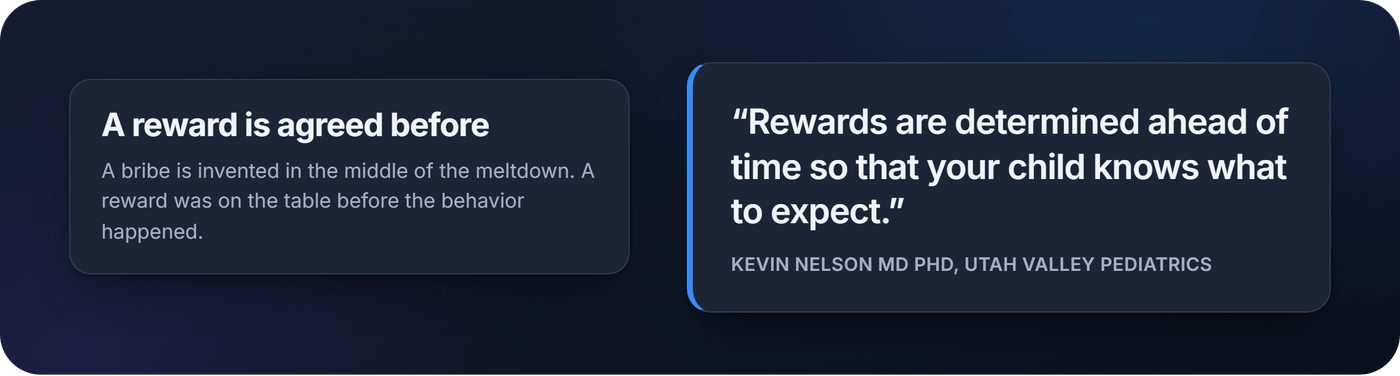
Reinforcement and bribery look alike from across the room, but timing gives them away. Reinforcement follows a behavior you defined as a goal before it happened. A bribe gets offered mid-meltdown to make it stop right now, which teaches your child that meltdowns are a reliable way to get a cookie.
Kevin Nelson, a paediatrician writing for Utah Valley Pediatrics, draws the line clearly: bribes aren't planned ahead of time and generally happen when you are in the middle of a crisis, while rewards are decided ahead of time so your child knows what to expect (2019).
Watch for these common traps:
- Praising inconsistently, so your child never learns which behavior earns the response.
- Reinforcing the wrong thing by accident, like giving attention to whining because it is faster than waiting for the calm request.
- Breaking a promise. Place2Be's rule is to always follow through with promised rewards, or your child will not trust you the next time you offer one.
- Defaulting to toys and screens for everything, instead of matching the reward to how hard the task actually was.
Fading rewards without losing the behavior
Once a behavior is solid, you do not need to reward it every time forever. Move from every time, to a predictable every few times, to now and then. As a general learning principle, behavior rewarded only some of the time fades more slowly once rewards stop, shown again in a 2023 laboratory study by Eric Thrailkill (Journal of Experimental Psychology).
There is a second reason to fade the tangible rewards and keep the praise. Deci, Koestner and Ryan's review of 128 experiments (Psychological Bulletin, 1999) found that expected tangible rewards undermined intrinsic motivation, more so for children, while positive feedback enhanced it. Praise is the reward you never have to take away.
- Stretch the gaps. Raising Children Network suggests phasing a chart out by increasing the time between stickers or points.
- Layer in natural rewards, like the pride of a finished job or a sibling noticing the tidy room.
- If a behavior slips, do not panic. Go back to rewarding every time for a week, then thin it out again.
- Expect a dip around reward changes. That is normal, not a sign the system failed.
Where a chore app fits
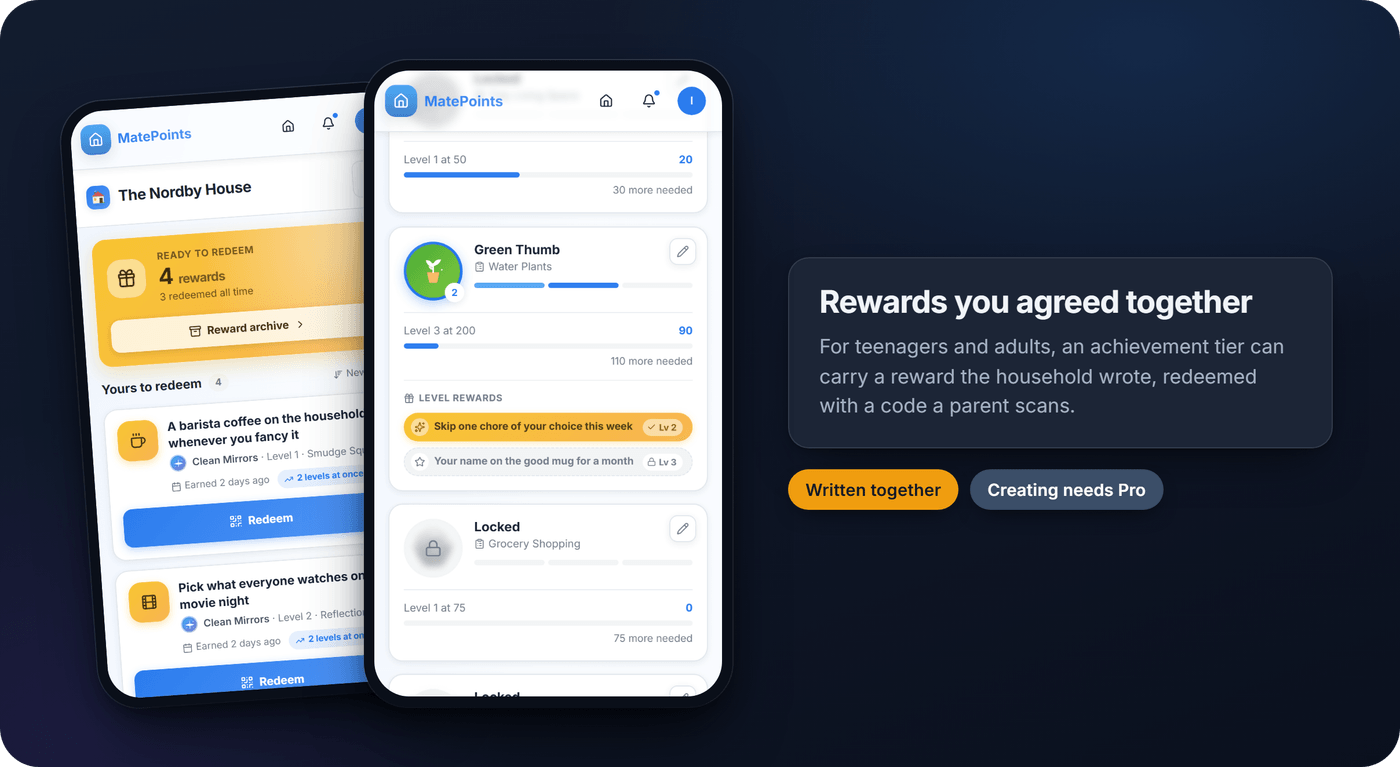
Praise has to come from a person, in the moment. No app does that part. Where an app helps is the chore side of reinforcement, and only for part of the family. MatePoints accounts start at 13 under our Terms, so a young child's chart stays on paper, kept by a parent. For teenagers and adults in the same house, it keeps the rules in one place:
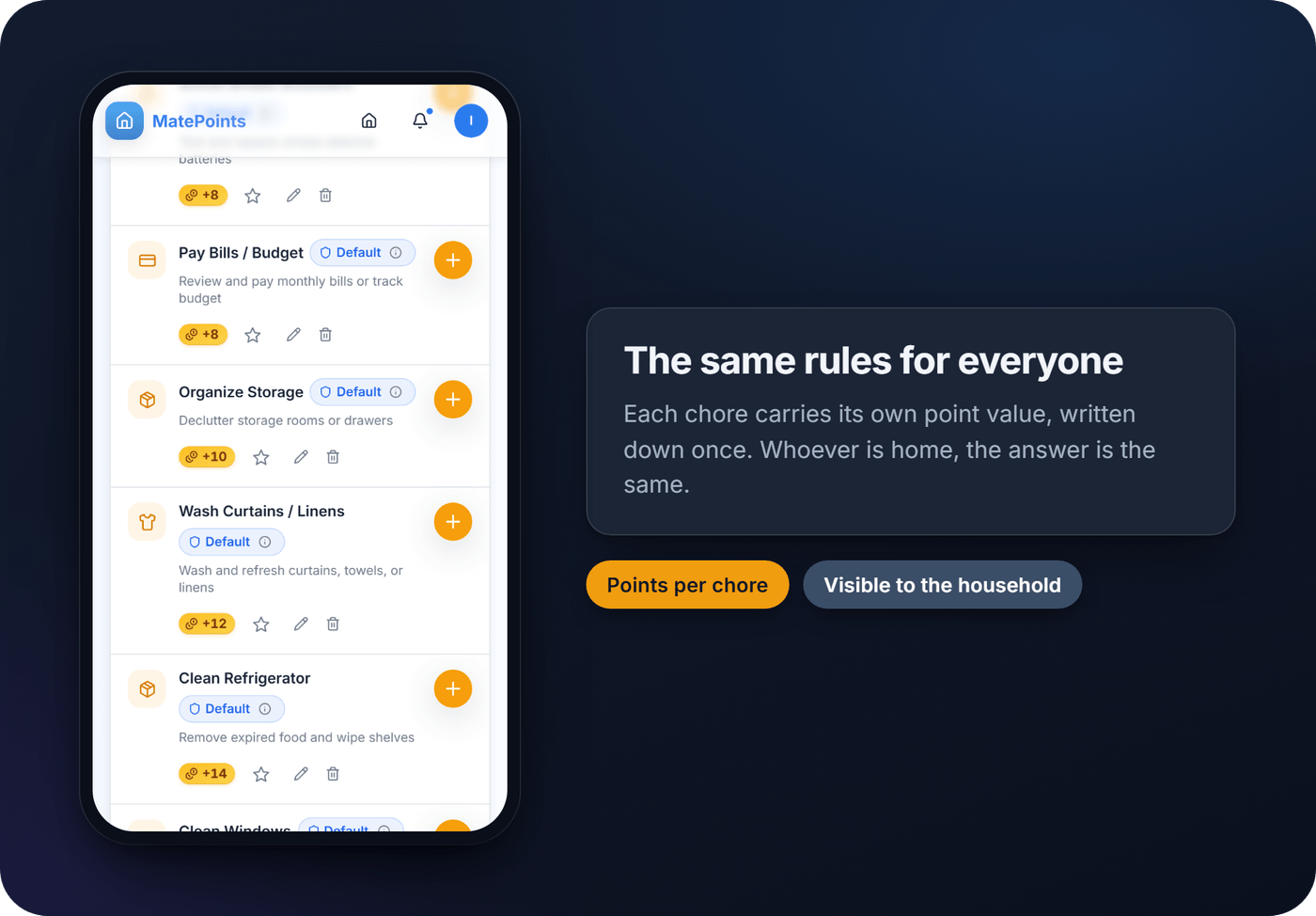
- Points per chore, set once and visible to everyone in the household. The same rules, whichever adult is home.
- Approval, so a teenager's chore can wait for a parent to confirm it. Points count once it is approved, and a rejection comes with a note.
- Cheers, a one-tap cheer on a housemate's profile, on top of saying it out loud.
- Achievements with rewards. Each achievement has three tiers on one chore, and each tier can carry a reward you agreed together, like choosing Friday's takeaway, handed over when a parent scans a single-use code. Creating achievements needs Pro; earning and redeeming rewards is free.
- NFC tags and QR codes at the spot, so a chore is logged when it is done. Creating them needs Pro, and a tap or scan only completes in a household with a Pro owner.
It does not track behavior that is not a chore, like coming when called, and points are never spent. There is no shop to trade them in, so an exchange-rate menu like the one above stays on paper.
A realistic note on progress and setbacks
Reinforcement does not produce a straight line. Some weeks the sticker chart works like magic; other weeks your child seems to forget it exists. That is not failure. That is how behavior change looks in a real house with real schedules.
Pick one small experiment this week: a three-day sticker chart for a single behavior, nothing bigger. Watch what happens before you decide the whole approach does not work. Those are the family positive reinforcement tips I would start with: one behavior, named out loud, rewarded right away, by everyone.
Marcus
FAQ
What is a good example of positive reinforcement?
Your child puts their toys away without being asked. You say straight away, "You put every toy back on the shelf, thank you," then let them pick the bedtime story. The reward follows the specific behavior right away, which is what separates it from a vague "good job" later.
How do I get my 5-year-old to listen at home?
Start with one or two behaviors you can see, like coming when called the first time. Reinforce every instance right away with specific praise or a small token at the start. The same response from every adult matters more than the size of the reward.
What are the types of positive reinforcement?
Social (praise, attention, high fives), activity (extra playtime, choosing the film) and tangible (stickers, small toys, points). Lean on social rewards for everyday behavior: they cost nothing and can be given often. Keep tangible ones for bigger, harder-won steps.
What is the difference between a reward and a bribe?
A reward is agreed before the behavior and given after it. A bribe is offered in the middle of the problem to make it stop, which teaches your child that the problem pays.
What are the downsides of positive reinforcement?
Done poorly, it slides into bribery. Leaning too hard on tangible rewards can also leave a child expecting a prize for everything, which is why fading toward occasional rewards and plain praise matters over time.
Sources
- Tips for Responding to Behavior, Essentials for Parenting Toddlers, CDC, reviewed April 2026
- Tips for Using Praise and Rewards, Essentials for Parenting Toddlers, CDC, reviewed April 2026
- Effective Discipline to Raise Healthy Children, Robert D. Sege and Benjamin S. Siegel, Pediatrics, American Academy of Pediatrics, 2018
- How to discipline your child the smart and healthy way, Lucie Cluver, UNICEF Parenting, undated
- The Power of Positive Attention, Katherine Martinelli, Child Mind Institute, updated May 2026
- Parenting behaviors that shape child compliance: A multilevel meta-analysis, Leijten, Gardner, Melendez-Torres, Knerr and Overbeek, PLOS ONE, 2018
- Using praise and reward with children, Place2Be Parenting Smart, undated
- Reward charts for kids: how they work, Raising Children Network, undated
- Child Bribes vs. Rewards, Kevin Nelson MD PhD, Utah Valley Pediatrics, 2019
- Partial reinforcement extinction and omission effects in the elimination and recovery of discriminated operant behavior, Eric A. Thrailkill, Journal of Experimental Psychology: Animal Learning and Cognition, 2023
- A meta-analytic review of experiments examining the effects of extrinsic rewards on intrinsic motivation, Deci, Koestner and Ryan, Psychological Bulletin, 1999