Behavior point system at home: what the research says
A behavior point system has over 50 years of research behind it. Here is what the studies found, and how to rebuild one for a shared home.

A behavior point system, what researchers call a token economy, gives each chore a point value, logs who finishes what, and links the points to rewards the household agreed on. The fastest way to start is a 15 to 20 minute household meeting where you pick your logging method and agree on your first three chores.
The idea has more than 50 years of research behind it. In 1972, psychologists taught two sets of parents to run a "home point system" for chores and bickering, and the parents rated all 21 behavior changes as improvements. The big reviews since come mostly from classrooms. The studies worth rebuilding at home come from houses full of adults.
Does a behavior point system actually work?
In classrooms, mostly yes. A 2016 meta-analysis by Soares and colleagues pooled 28 single-case studies and found a weighted effect size of 0.82. A 2022 review by Kim and colleagues found large effects across 24 studies from kindergarten to fifth grade. The honest caveat: a 2011 review by Maggin and colleagues found the research did not provide sufficient evidence to be deemed best practice under What Works Clearinghouse standards.
If you met points at a school, it was probably inside PBIS. Positive Behavioral Interventions and Supports is a tiered framework, not a points system. Acknowledging expected behavior is a Tier 1 practice, and many schools adopt a formal reinforcement system for it, of which points are one kind.
What the group-house studies found
In 1976, Feallock and Miller ran a point-based worksharing system in an experimental group house and tested its parts one at a time. Credits produced more work than no credits. Credits given only after a detailed inspection produced more work than credits handed out regardless. Rent reductions tied to credits beat rent reductions for everyone.
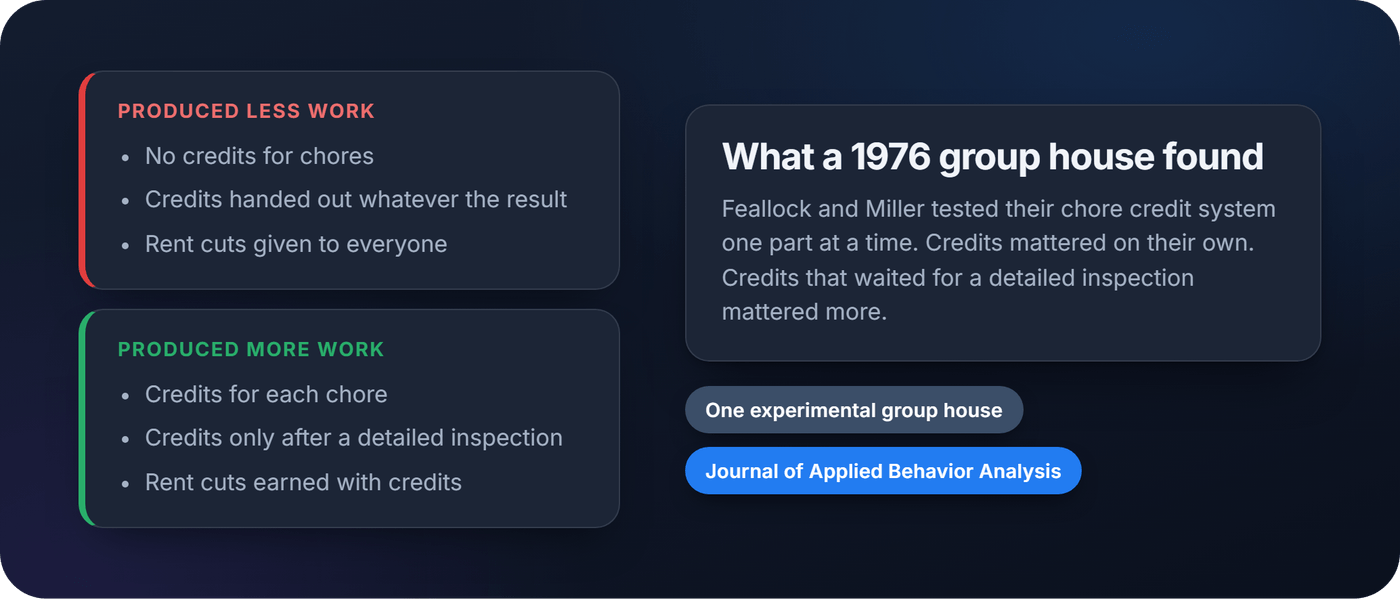
So the points mattered, and so did checking the work: a detailed inspection, not a glance.
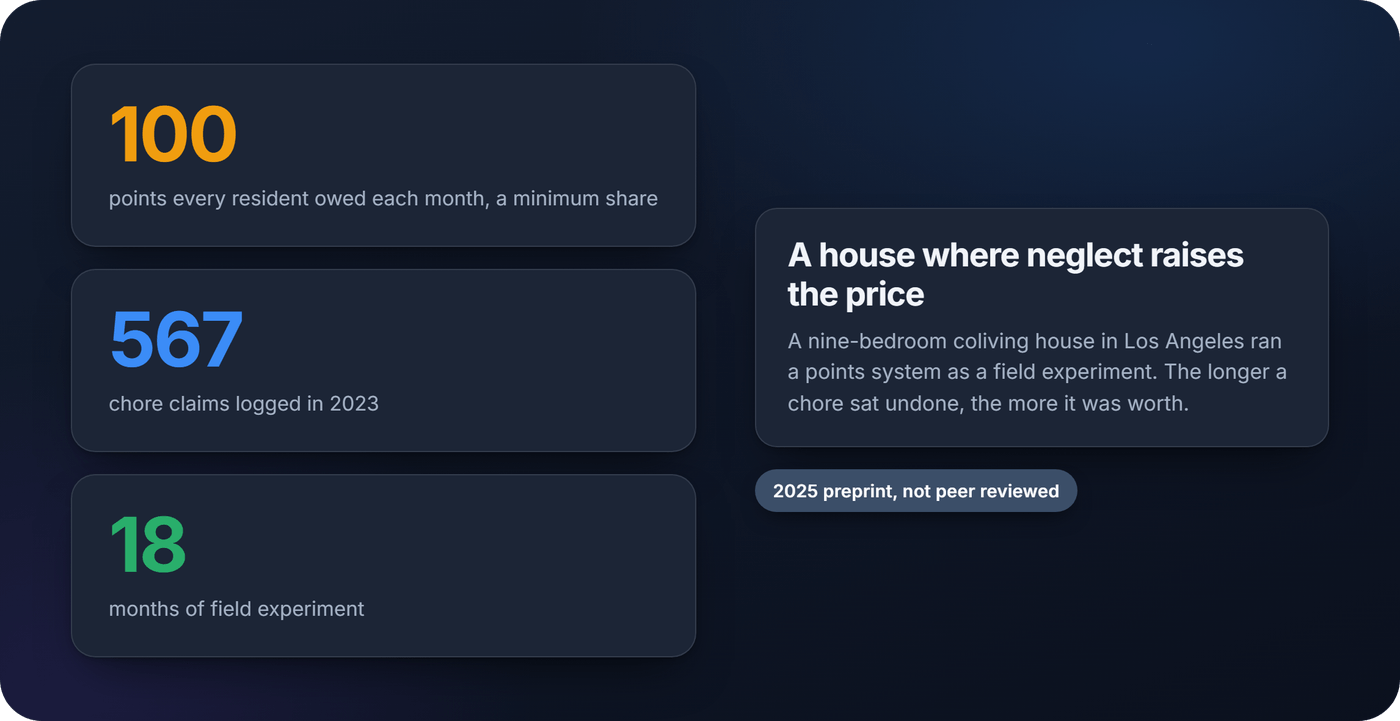
In a student housing co-op, members helped design the prompts, spot checks and rent reductions that kept resident staff on their tasks. Performance was still high at a five-year follow-up, and the authors suggest the members' part in the design helped it last. A 2025 preprint, not yet peer reviewed, describes a nine-bedroom coliving house in Los Angeles where every resident owed 100 points a month and a chore's value rose the longer it sat undone.
Not every household wants this. A 2019 study of young adults in shared households found rosters were often resisted as ineffective and a threat to autonomy. Households kept order with informal rules and strategies everyone agreed on. The fix is not to skip structure. It is to build the structure together.
How to implement behavior points in one session
A 2017 review by Ivy and colleagues splits every token economy into six parts, and only 18 of the 96 studies they reviewed, 19%, described all six completely. The steps below cover all six, marked in italics.
- Inventory every chore (target behavior). Walk the home room by room and list tasks by how often they happen and where they live. Count laundry, trash rotation and restocking separately.
- Agree on a definition of done (target behavior). For each chore, spend thirty seconds saying out loud what finished looks like. This step prevents more arguments than any point value ever will.
- Price each chore (the token, and how it is earned). Score time, difficulty and frequency, then multiply. A five-minute daily task should never outscore a monthly deep clean that takes an hour.
- Pick your logging method. Manual, NFC or QR, compared below.
- Set the rewards, their price and when they are handed over (backup rewards, what they cost, when exchanges happen). Make the exchange itself take under a minute.
- Run a two-week pilot. Treat it as a draft, and put the review meeting on the calendar before you start.
Pro Tip: Don't finalize point values until after the pilot. It is easy to underprice the chores nobody wants, like scrubbing the shower or taking out the trash on a cold night, and to overprice the quick, visible ones, like wiping counters.
A behavior point chart that feels fair
On frequency, the rarer the job, the more each round of it is worth. A five-minute dish load done daily might score 1 point. A fifteen-minute bathroom reset twice a week might score 3. A monthly deep clean of the fridge might land at 5. The formula isn't magic. It forces everyone to argue about the inputs instead of the final number.
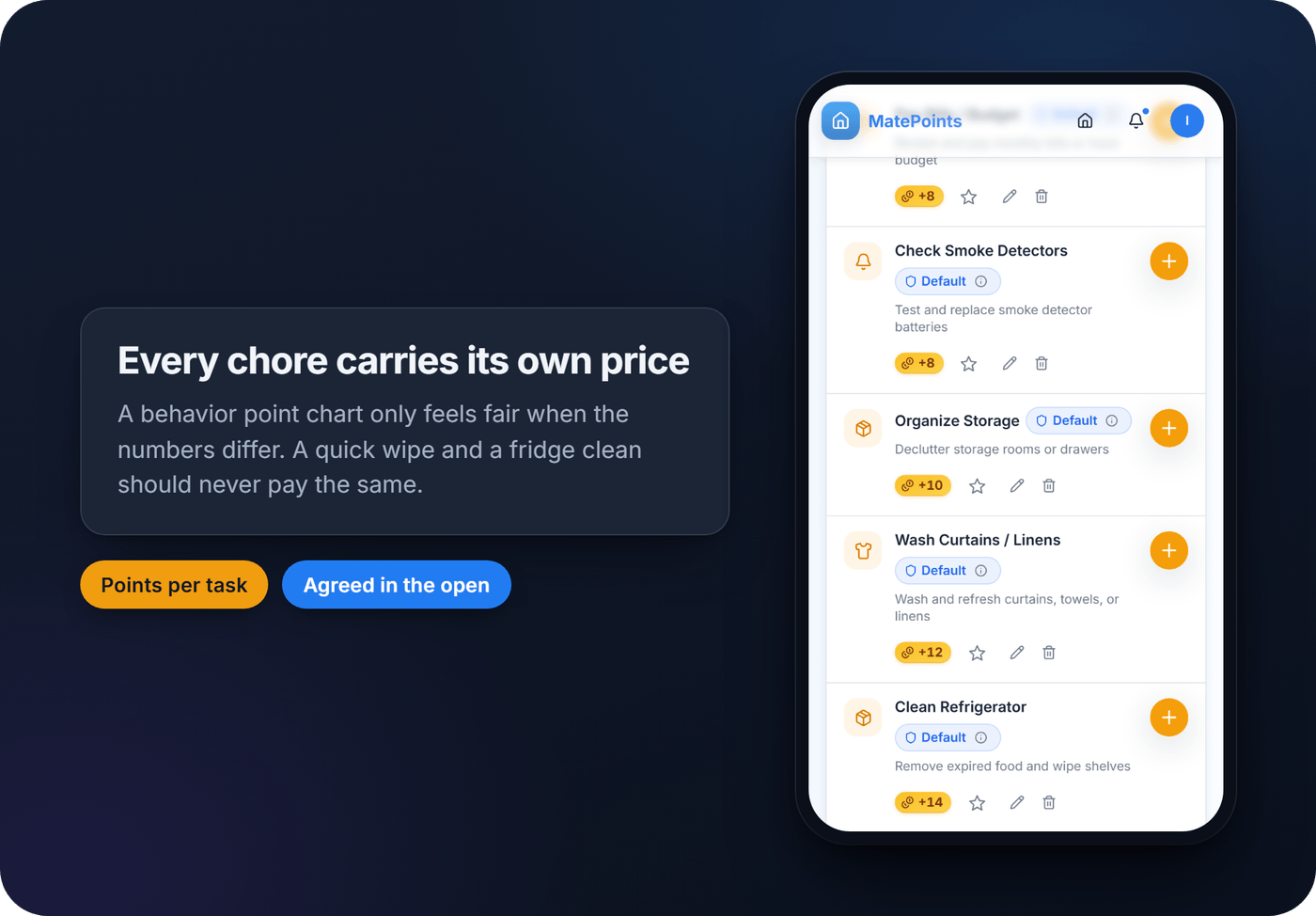
Then write a definition of done for each recurring chore:
- Dishes: washed, dried and put away, sink wiped, nothing left soaking overnight
- Bathroom reset: toilet, sink and mirror cleaned, trash emptied, damp towels replaced
- Bins: trash and recycling at the curb or chute, new liners in
- Floors: vacuumed or swept in all common areas, including under furniture edges
Add two standing rules from day one: swaps happen by mutual agreement and get written down, and values get reviewed monthly so nobody's task quietly doubles.
Should a missed chore cost points?
Taking points away is called response cost, and the evidence is more even than most advice suggests. In Iwata and Bailey's 1974 study of elementary special-education classes, earning and losing tokens were about equally effective, and students given the choice showed no pattern of preference. In Donaldson and colleagues' 2014 study of 12 first graders, both versions reduced disruptive behavior, and most children preferred losing tokens. Soares's meta-analysis found no difference in effect when response cost was included.
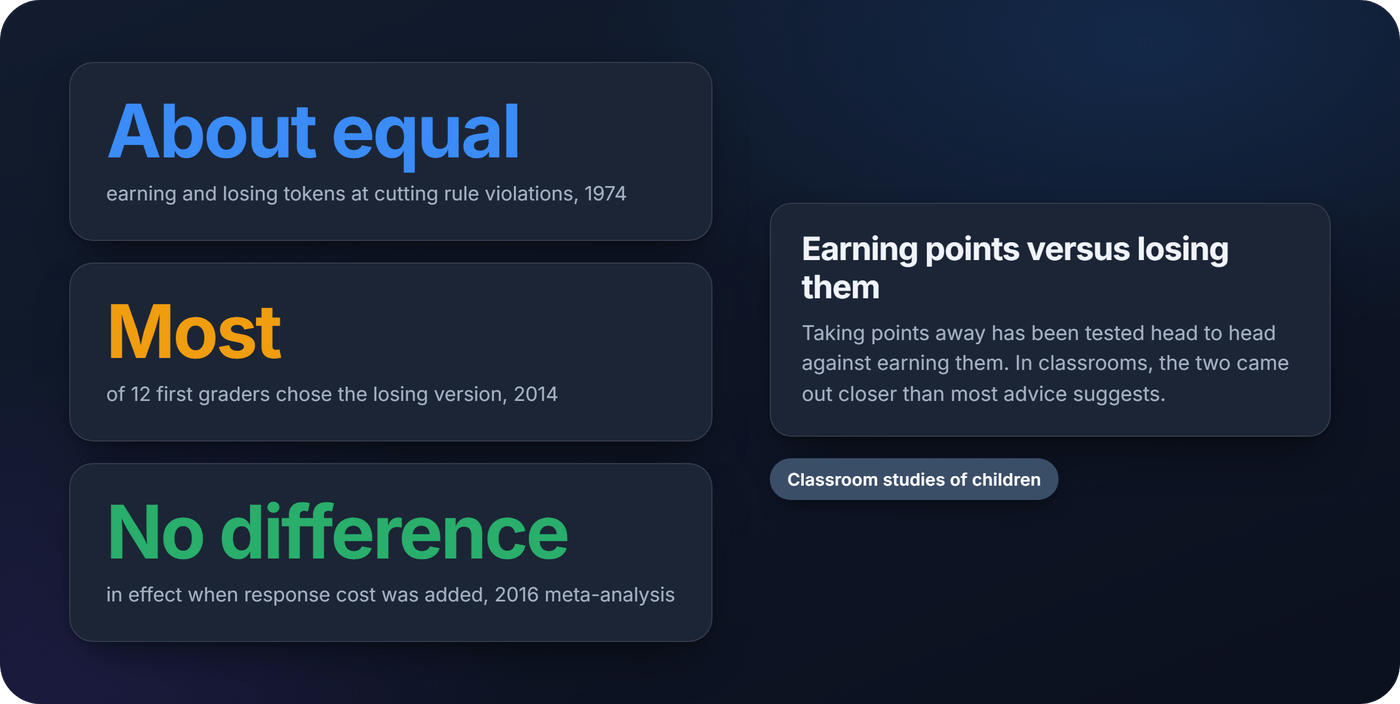
That is children in classrooms, so treat it as a hint. If your house wants a penalty, keep it small, agree it first, and never make it public shaming.
Manual, NFC or QR, or smart home?
- Manual: zero cost and zero setup, but it relies on honesty, and honesty fades once the novelty wears off
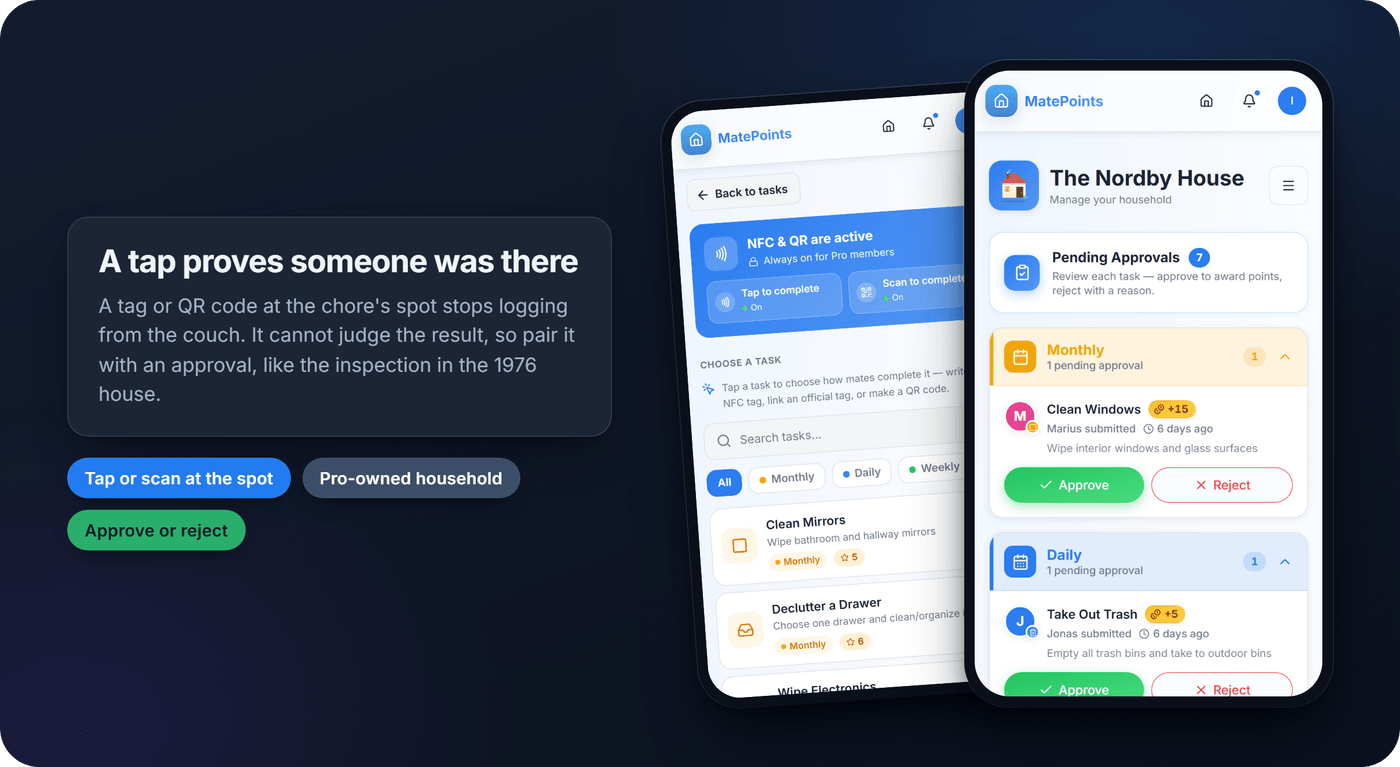
- NFC or QR: a tap or scan at the chore's location, so nobody logs "took out the trash" from the couch. Low cost, minimal privacy exposure
- Smart-home sensors: still research. A 2019 system by Winnicka and colleagues scaled rewards to how hard a task was for each person, but it is a prototype, not something you can install, and it raises real questions about who tracks what
A tap proves someone stood by the trash can. It does not prove the job was done well. That is the 1976 inspection finding again, so pair the tap with an approval by someone else.
Pro Tip: Start with tags on your three highest-friction chores only. Tagging every task on day one is how automation projects die before they start. Tags earn their setup in households of five or more people, or where compliance has already broken down.
Ready-to-use point schemes
- Couples: 20 points per person weekly, across 6 to 8 shared chores, with rewards like choosing dinner or a weekend activity
- Roommates: 15 to 25 points weekly per person depending on household size, with a shared reward pool for group treats like takeout night
- Families with kids: age-scaled point values, with rewards like extra screen time or a chosen weekend outing
Other rewards worth trying: first pick of the couch and remote for a week, or a skip-your-least-favorite-chore pass. Mix recognition in with the treats. Deci, Koestner and Ryan's 1999 meta-analysis found expected tangible rewards undermined interest while positive feedback raised it, though Cameron, Banko and Pierce found rewards for low-interest tasks increased it. Few people find the trash interesting.
The two-week pilot and the review rhythm
A point system that isn't reviewed becomes a point system that's ignored.
- Hold the first review at two weeks, before anyone builds up resentment over a mispriced chore.
- Move to monthly reviews once the pilot stabilizes, then quarterly.
- Agree a conflict script: state the disagreement, check the logged record, apply the agreed rule, move on.
- Set a monthly minimum share, like the 100 points each resident of the coliving house owed, so everyone knows what doing enough looks like.
- Use leaderboards to celebrate consistency, not to shame whoever is behind.
Point inflation happens quietly. Someone renegotiates their least favorite chore up by a point "just this once," and six months later the scoring bears no relation to effort. Treat every change as a group decision.
What this looks like in MatePoints
MatePoints covers several of the six parts. Each task carries its own point value. You log a chore in the app or, in a household owned by a Pro member, by tapping an NFC tag or scanning a QR code at its location. Completions can be held for approval, so points post only after someone has checked the work, and a rejection carries a note.
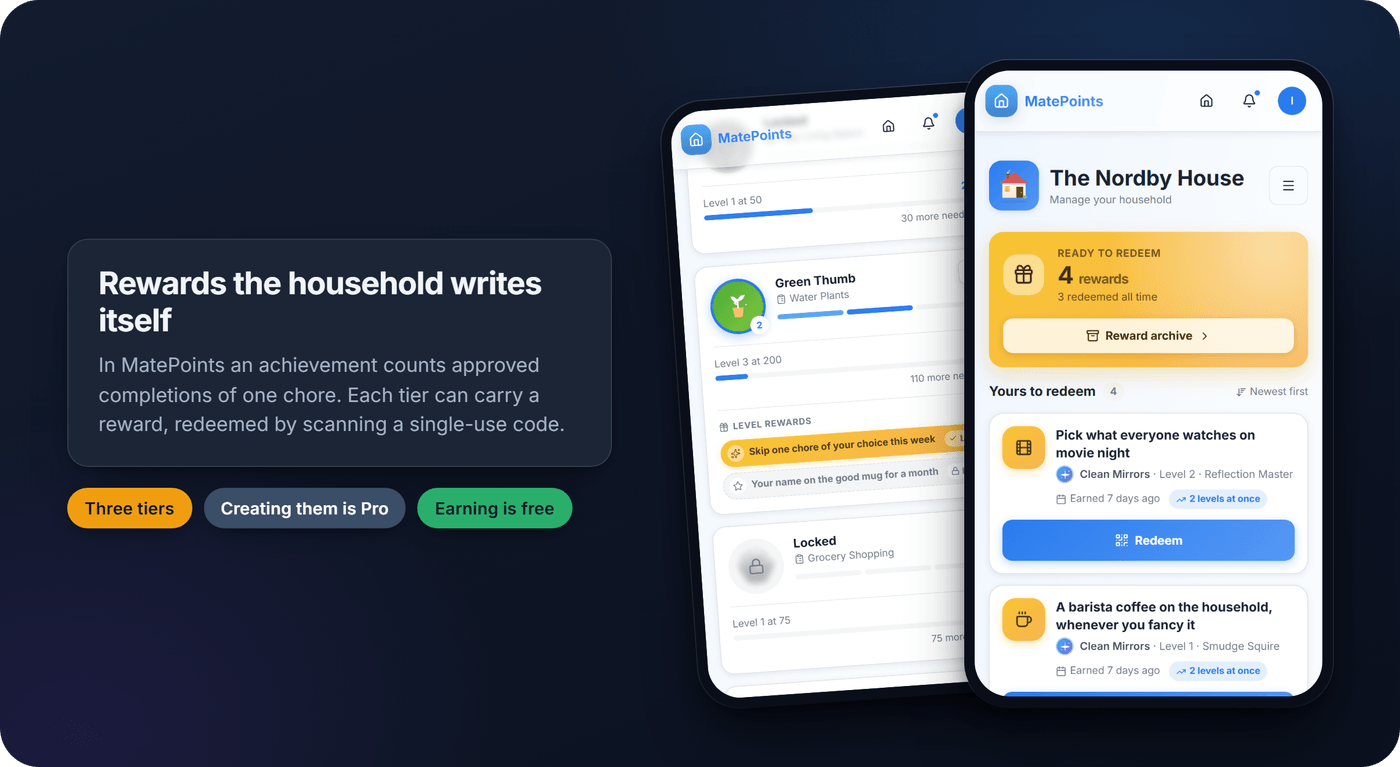
Rewards come through achievements rather than a shop. An achievement counts approved completions of one task, in three tiers, and each tier can carry a reward the household writes itself, like "skip one chore of your choice this week". An approver redeems it by scanning a single-use code, and the person who earned it cannot approve their own. Creating achievements and rewards is Pro; earning and redeeming them is free.
Two things it does not do. Points are never spent or deducted, so there is no reward menu bought with points and no response cost. And there are no smart-home triggers. How your data is stored and protected is on the privacy and security page.
To test it, create your household, invite your housemates, add your three highest-friction chores and run the two-week pilot.
FAQ
Do token economies work for adults? Most of the evidence comes from children, but two small studies involved adults. In the 1976 group house, points tied to an inspection got more work done. In the 1991 housing co-op, six resident staff did substantially more of their tasks under spot checks and rent reductions. Promising, not proof.
Should you take points away for a missed chore? You can. In classroom studies, losing tokens worked about as well as earning them. Keep any penalty small and agree it in advance.
How many points should a reward cost? No study gives a household number. Price everyday rewards so someone doing their normal share reaches one within a week or two. On the couples scheme above, that is 20 to 40 points.
How do you phase a point system out? Slowly. Long-term maintenance was a known obstacle in Kazdin's 1982 review of token economies. Space the exchanges further apart, keep the praise, and keep the definitions of done.
Start small
Start small, expect to adjust the first version within two weeks, and don't be afraid to loosen a rule that isn't working.
Sources
- The home point system: token reinforcement procedures for application by parents of children with behavior problems, Christophersen, Arnold, Hill & Quilitch, Journal of Applied Behavior Analysis, 1972
- Effect size for token economy use in contemporary classroom settings: a meta-analysis of single-case research, Soares, Harrison, Vannest & McClelland, School Psychology Review, 2016
- Systematic review and meta-analysis of token economy practices in K-5 educational settings, 2000 to 2019, Kim, Fienup, Oh & Wang, Behavior Modification, 2022
- A systematic evaluation of token economies as a classroom management tool for students with challenging behavior, Maggin, Chafouleas, Goddard & Johnson, Journal of School Psychology, 2011
- What is PBIS?, Center on PBIS
- Practice brief: Tier 1 student reinforcement systems, Center on PBIS, 2025
- The design and evaluation of a worksharing system for experimental group living, Feallock & Miller, Journal of Applied Behavior Analysis, 1976
- Participatory management: maintaining staff performance in a university housing cooperative, Johnson, Welsh, Miller & Altus, Journal of Applied Behavior Analysis, 1991
- Cybernetic governance in a coliving house, Kronovet, Frey & DeSimone, arXiv preprint, 2025
- Rosters: freedom, responsibility, and co-operation in young adult shared households, Clark, Tuffin, Bowker & Frewin, Australian Journal of Psychology, 2019
- Token economy: a systematic review of procedural descriptions, Ivy, Meindl, Overley & Robson, Behavior Modification, 2017
- Reward versus cost token systems: an analysis of the effects on students and teacher, Iwata & Bailey, Journal of Applied Behavior Analysis, 1974
- Effects of and preference for conditions of token earn versus token loss, Donaldson, DeLeon, Fisher & Kahng, Journal of Applied Behavior Analysis, 2014
- A multi-agent gamification system for managing smart homes, Winnicka, Kęsik, Połap, Woźniak & Marszałek, Sensors, 2019
- A meta-analytic review of experiments examining the effects of extrinsic rewards on intrinsic motivation, Deci, Koestner & Ryan, Psychological Bulletin, 1999
- Pervasive negative effects of rewards on intrinsic motivation: the myth continues, Cameron, Banko & Pierce, The Behavior Analyst, 2001
- The token economy: a decade later, Kazdin, Journal of Applied Behavior Analysis, 1982