Chore points system: a 20-minute setup that lasts
A chore points system you can set up in 20 minutes: 3 to 5 chores, a 1 to 5 scale, a three-tier reward menu, and a fix for when it stalls.

A chore points system gives each household job a number, so kids earn points toward rewards and the nagging turns into simple arithmetic. The version that lasts starts small: 3 to 5 chores, a 1 to 5 point scale, and rewards a child can reach within days, not weeks. Below is the 20-minute setup meeting, point values you can copy, a chore list by age, a reward menu, and what to do when the whole thing starts to stall.
How to set up a chore points system in 20 minutes
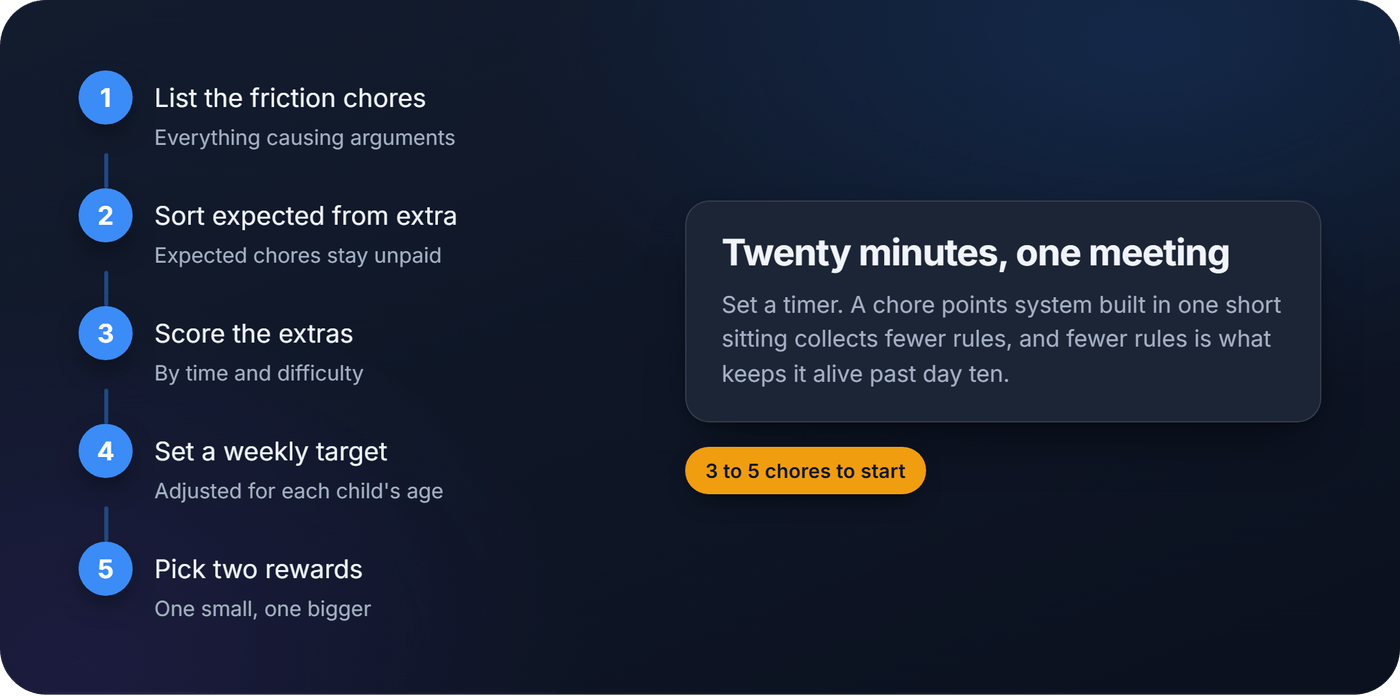
Most chore point systems die early because they launch too big: fifteen tasks, a 100-point scale and a spreadsheet nobody opens. Start smaller than feels necessary. Parentingpage recommends starting with three to five tasks, mixing daily ones (making the bed) with one or two weekly ones (vacuuming a room). At this stage, simplicity is the entire strategy.
Before you assign a single point, split the chores into two piles. Expected chores are things kids do because they live there: putting a plate in the sink, hanging up a coat. Extra-effort chores go beyond that baseline. Keeping points for the extra effort stops household work from feeling like paid labour for every single task.
Run your first setup meeting like this:
- List every chore currently causing friction in the house.
- Sort them into "expected" and "extra effort" piles.
- Give points to the extra-effort pile based on time and difficulty, not on how much you personally dislike the task.
- Set a weekly point target per child, adjusted for age.
- Pick one small reward and one bigger reward before the meeting ends.
A few ground rules keep the first month from wobbling:
- Points get logged the same day the chore happens, not "later".
- One parent owns the tracking, even if both parents hand out chores.
- Targets get revisited after two weeks, not locked in forever.
Pro tip: run the whole meeting with a timer. Twenty minutes is enough. A system built over a long weekend of planning tends to collect more rules than it needs, and extra rules are exactly what kills momentum by day ten.
Point scales and examples you can copy
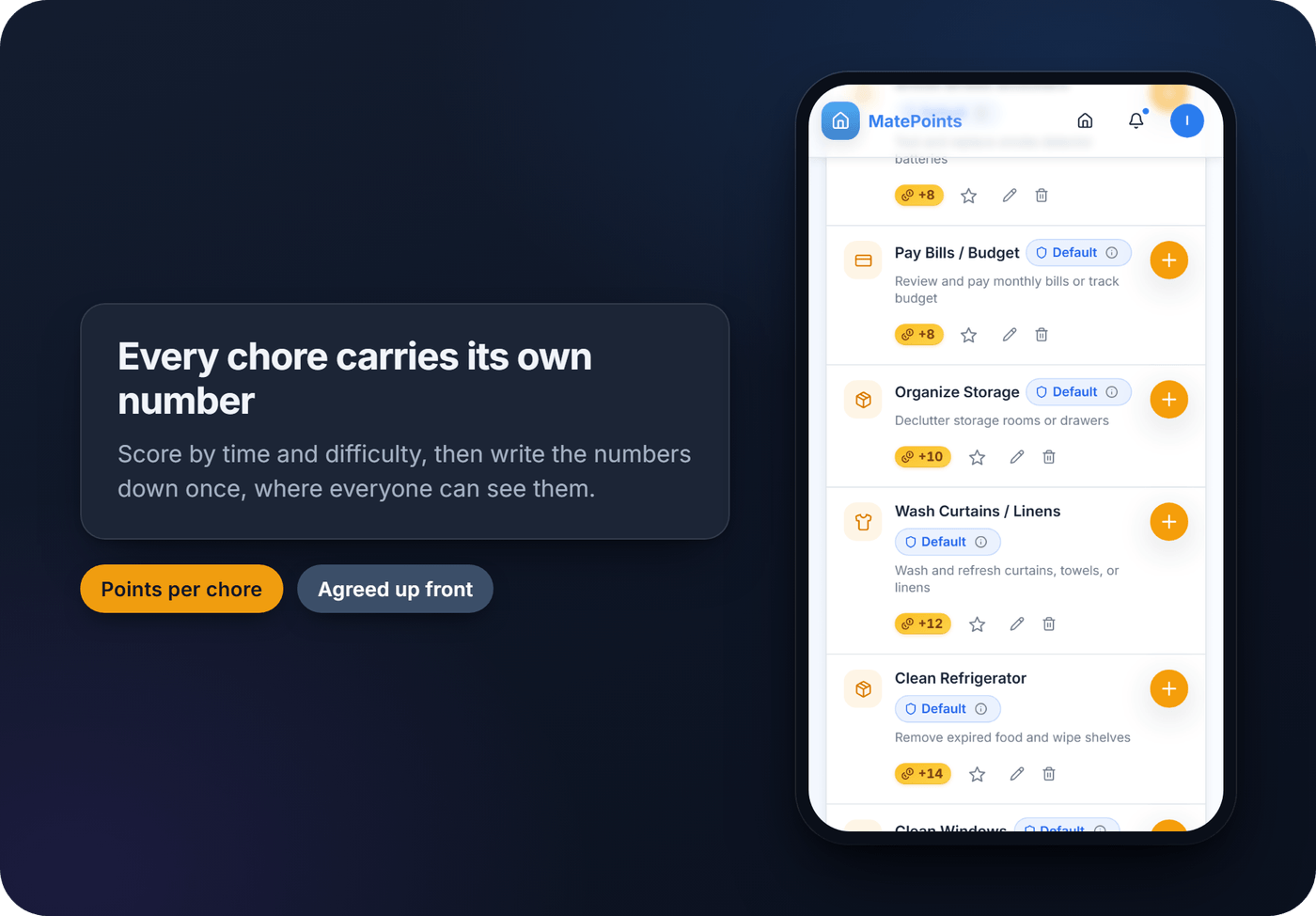
A 1 to 5 scale is the easiest template, and it is the range Parentingpage suggests because it "keeps the system easy to track and easy to trust". Sample values for point-based chores:
- Making a bed: 1 point
- Feeding a pet: 2 points
- Emptying the dishwasher: 3 points
- Vacuuming a room: 4 points
- Mowing the lawn or deep-cleaning a bathroom: 5 points
Use bonus points sparingly. On a paper chart, one optional idea is a streak bonus of 2 or 3 points for five days in a row of a chore done without a reminder.
Fairness across ages means younger kids get cheaper rewards too. If your teenager's target is 25 points a week, your seven-year-old's might be 12, with rewards priced to match.
Age-appropriate chores and example point goals
Match the chore to what a child can actually do, not to what their sibling does. A four-year-old and a fourteen-year-old have no business chasing the same weekly total. The chores below follow pediatrician Laura O'Connor's age-by-age list for Cleveland Clinic (2022). The weekly point goals are only an example, not a standard.
- Ages 3 to 5: caring for plants and pets, making the bed, cleaning up spills, putting light groceries away (example goal: 5 to 10 points a week)
- Ages 6 to 10: setting and clearing the table, loading the dishwasher, putting clothes away, vacuuming or sweeping, helping with meals (example goal: 10 to 20 points)
- Ages 11 to 14: yard work such as raking leaves or shovelling snow, helping look after a younger sibling (example goal: 20 to 25 points)
- Ages 15 to 18: making simple meals on their own, working through a weekly chore list (example goal: 25 to 35 points)
A house rule of thumb: promote a chore from supervised to independent after three correct completions in a row without help. Skip head-to-head comparisons between siblings of very different ages. Age-adjusted targets, or a separate children's chore chart for each child, stop the "why does she get more points than me" argument before it starts.
What chores do for kids, and what the research cannot say
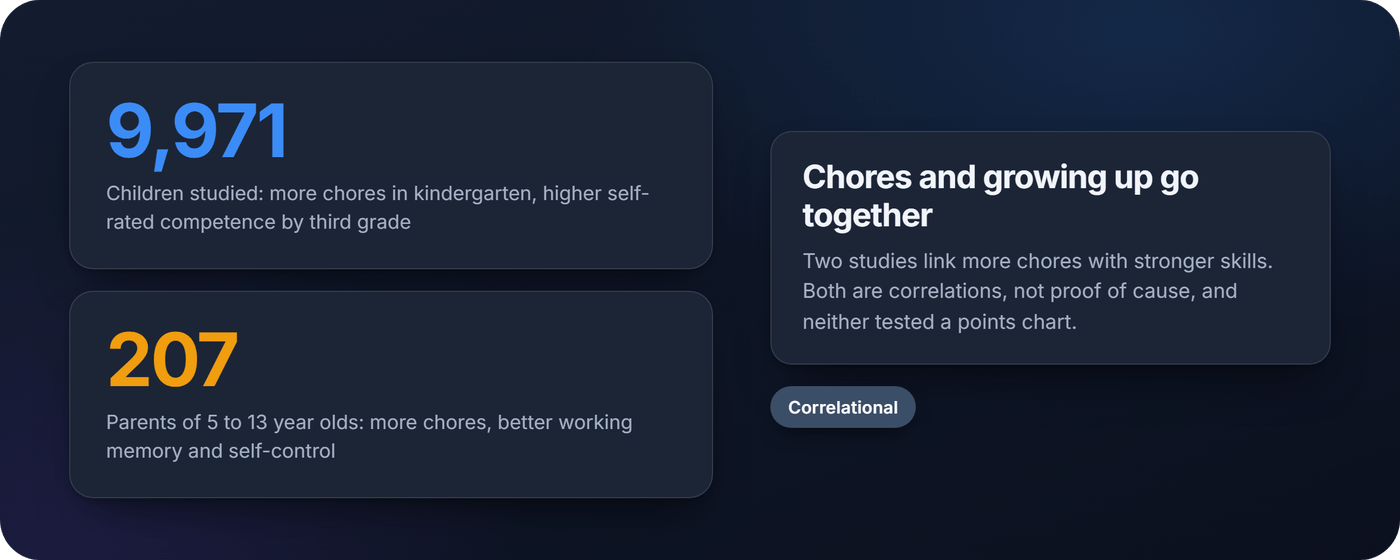
The case for chores is better than "the house gets cleaner". In a study of 9,971 children, those who did chores more often in kindergarten rated their own social skills, schoolwork and life satisfaction higher by third grade (White, DeBoer and Scharf, Journal of Developmental and Behavioral Pediatrics, 2019). A survey of 207 parents of 5 to 13 year olds found that children who did more chores scored better on parent-reported working memory and self-control (Tepper, Howell and Bennett, Australian Occupational Therapy Journal, 2022, as reported by Medical Xpress).
Both studies are correlational. Chores and these skills go together, which is not proof that chores cause them, and neither study tested a points chart. They are still a good reason to keep chores in a child's week.
Build a chore reward system kids actually want
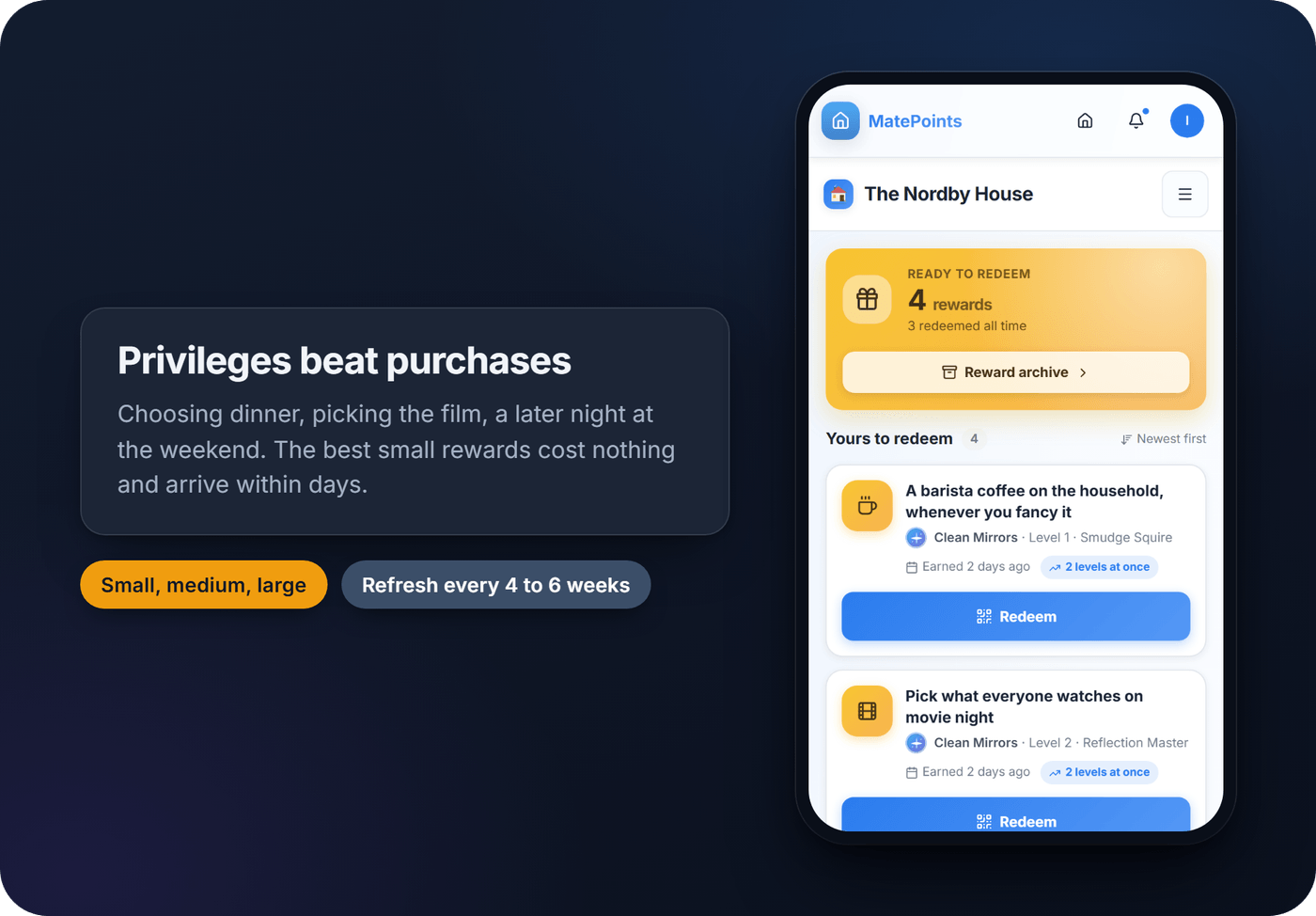
Price rewards in three tiers so points feel usable, not distant:
- Small rewards (5 to 10 points): extra screen time, choosing dinner, a favourite dessert
- Medium rewards (15 to 30 points): a film outing, a new book, staying up late at the weekend
- Large rewards (50 points or more): a sleepover, a toy they asked for, a day trip
The small tier has to arrive fast. Parentingpage puts it plainly: "If a reward takes three weeks of perfect chore completion to unlock, most kids will give up before they get there." The CDC's advice on reward programmes agrees: when you first start, reward your child often, and rewards that come right after the behaviour work best (reviewed 2026).
Mix privileges, experiences and small purchases rather than defaulting to cash, and let kids help write the list.
Pro tip: refresh the reward menu every 4 to 6 weeks. The same 10-point reward gets boring fast, and a stale menu is a quieter system killer than any missed chore.
Should reward points for chores turn into money?
This is the question behind most incentive systems for kids, and the honest answer is "not for everything". A 1999 review of 128 experiments by Edward Deci, Richard Koestner and Richard Ryan found that expected, tangible rewards reduced people's own interest in an activity, more so in children than in college students, while positive feedback increased it (Psychological Bulletin, 1999).
Those experiments mostly measured activities people already enjoyed, and few children enjoy scrubbing a bathroom. So the practical reading is narrow: keep the expected chores unpaid, put points on the extra effort, and keep praising once points arrive. Pocket money has its own article, allowance and chores, and the chore reward system guide helps you pick the kind of system that fits your house.
How to track chores without losing your mind
Paper charts work for a week. Spreadsheets work until someone forgets to update one. The weak point is rarely the point values. It is inconsistent logging, which erodes trust once a child notices their effort is not showing up anywhere.
Whatever you use, look for logging that takes seconds, a step where someone confirms the job before points count, and a history to settle disputes. For preschoolers, paper is still the right tool: Cleveland Clinic calls sticker charts a great way to show a task is done, especially followed by a small reward. Our reward chart for kids covers that version.
Whatever the method, hold a five-minute check-in each night. It keeps a chore chart from becoming background noise nobody reads.
Fixing a chore points chart that's losing steam
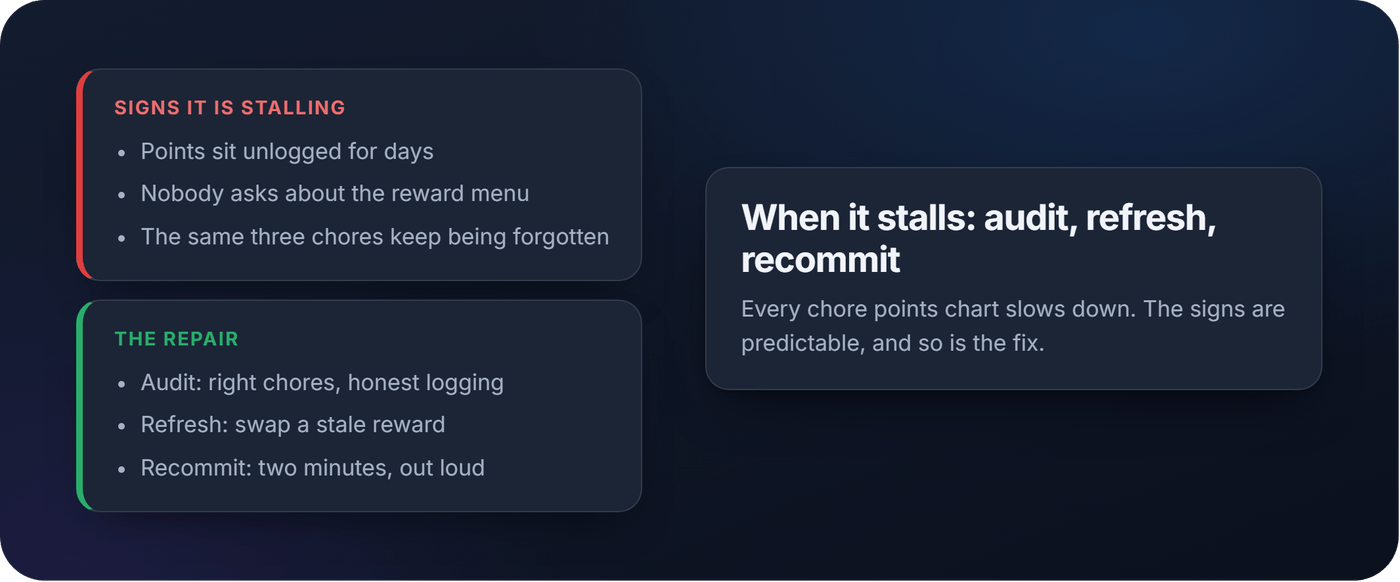
Every point-based system slows down eventually. The warning signs are predictable: points sit unlogged for days, a child stops asking about the reward menu, or the same three chores keep getting "forgotten". Run this three-step repair when that happens:
- Audit. Check that the chores are still right for their age, and that logging has actually been consistent, not just assumed.
- Refresh. Swap out at least one stale reward, and adjust the points for anything that has become harder or easier.
- Recommit. Hold a two-minute family check-in and say the current chore list and targets out loud.
If the audit shows logging is the real problem, that is a tracking failure, not a child failure. Tapping a tag or scanning a code removes that friction, and it is often the fastest fix.
Pro tip: if you have run the audit, refresh and recommit cycle twice in one season and it is still failing, the system is probably too complicated. Cut the chore list in half before you add a single new rule.
Why the best systems get out of the parent's way
The chore points systems that survive are not the ones with the cleverest point maths. They are the ones where logging effort drops close to zero. In my view, chore charts fail on the tracking far more often than on the parenting.
Automation earns its place here because it removes the one job nobody wants: being the household's chore auditor. A leaderboard sounds like a small gimmick, but friendly competition between siblings of a similar age costs nothing to set up. The trade-off families actually face is not rewards against responsibility. It is whether the system demands daily admin or runs quietly in the background.
Build for the second one. The first one usually collapses by month two.
Marcus
Run your chore points system on MatePoints
MatePoints is a chore management system that does the logging half for you, for teenagers (13 and up) and adults in the same house.
- Points per chore. A parent sets a value on each task, visible to everyone.
- Approvals. Turn on approval and a teenager's completion waits for a parent to confirm it. Points count only once it is approved; a rejection comes with a note.
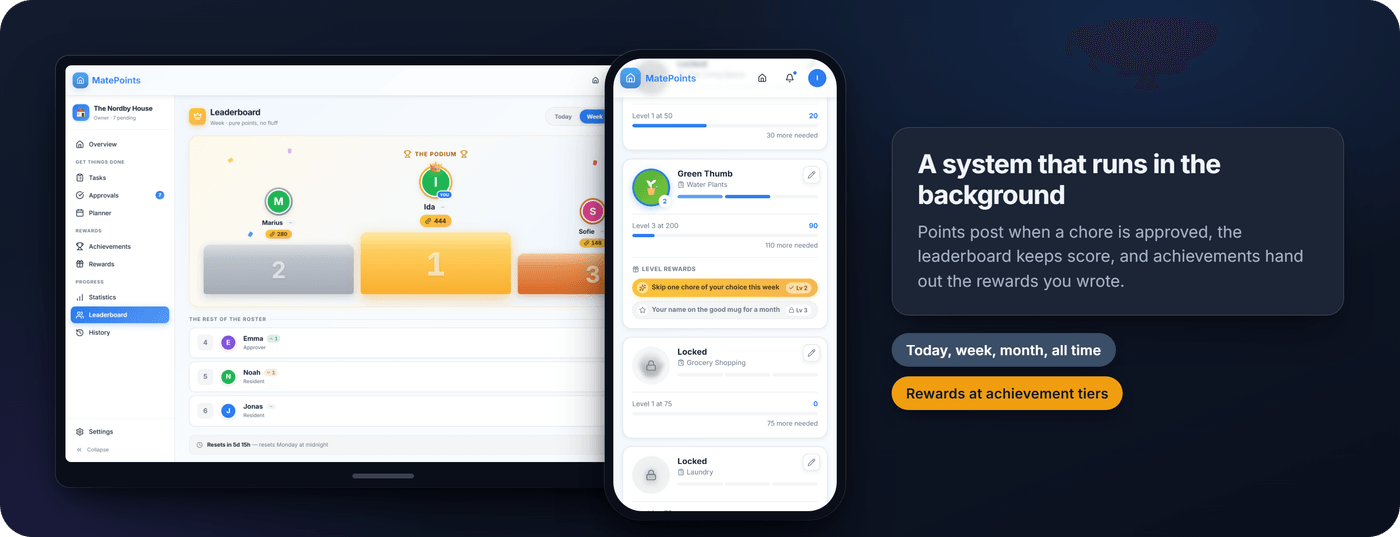
- Leaderboard and statistics. Rankings for today, the week, the month and all time, plus statistics per member, so you can compare each child with their own last week.
- Achievements with rewards. Each achievement follows one chore through three tiers, and each tier can carry a reward you write, like choosing Friday's takeaway. A parent scans the earner's single-use code to hand it over. Creating achievements needs Pro; earning and redeeming is free.
- NFC tags and QR codes. A tap or scan where the chore happens logs it. Creating tags and QR posters needs Pro, and taps work in a household with a Pro owner.
What it does not do: points are never spent, so a points-priced reward menu stays on paper (or becomes achievement tiers). There are no weekly point targets, and streaks are tracked but earn no bonus points. Our Terms set a minimum account age of 13, so a younger child's chart stays on paper, kept by a parent.
To try it with this week's chore list, start a free household.
FAQ
How many points should each chore be worth?
On a 1 to 5 scale, quick jobs like making a bed are worth 1 or 2 points, mid-effort jobs like emptying the dishwasher about 3, and big jobs like mowing the lawn or deep-cleaning a bathroom 4 or 5. Score by time and difficulty, not by how much you dislike the task.
What age should kids start a chore points system?
Children can help with simple chores from preschool age, and Cleveland Clinic lists jobs like caring for pets and making the bed for ages 3 to 5. At that age a sticker chart with a small, quick reward usually works better than points.
Should I pay my kids for chores?
Not for everything. Keep the chores that come with living in the house unpaid, and attach points or money to the extra effort. Research on rewards suggests expected, tangible rewards can reduce children's own interest, while praise tends to help.
Is there an app that can manage a chore points system?
Yes. MatePoints tracks points per chore, approvals, a leaderboard and achievements with rewards. Accounts start at 13, so it suits teenagers and adults; younger children do better on a paper chart.
How often should I change the reward menu?
Every 4 to 6 weeks is a good rhythm. Swap at least one reward whenever interest drops, and ask your kids which ones they would actually work for.
Sources
- How to Set Up a Chore Chart Point System Kids Will Actually Use, Jarrod Partridge, Parentingpage, undated
- Age-Appropriate Chores for Kids, Laura O'Connor MD, Cleveland Clinic, 2022
- Associations Between Household Chores and Childhood Self-Competency, White, DeBoer and Scharf, Journal of Developmental and Behavioral Pediatrics, 2019
- Children's chores improve brain function, Medical Xpress, June 2022, reporting Tepper, Howell and Bennett, Australian Occupational Therapy Journal, 2022
- Tips for Using Praise and Rewards, Centers for Disease Control and Prevention, reviewed April 2026
- A meta-analytic review of experiments examining the effects of extrinsic rewards on intrinsic motivation, Deci, Koestner and Ryan, Psychological Bulletin, 1999