What makes MatePoints unique?
Most chore apps track tasks and hand out points. MatePoints proves the reward actually changed hands — and works far beyond a family home.

If you have gone looking for a chore app recently, you already know the problem is not choice. There are dozens. They all show you a list, they nearly all hand out points, and most of them put a leaderboard somewhere.
So rather than claim MatePoints is the best chore app! A sentence every one of those apps also writes. This post does something more useful. Below is what the main alternatives genuinely do well, where they stopped short for the people who came to us, and the handful of things no other household task app we could find does at all.
Starting with the part most comparison articles leave out.
First, the honest part: what isn't unique
Plenty of what MatePoints does, other apps do too. Pretending otherwise would waste your time.
Points and levels are table stakes. Nearly every gamified chore app awards points per task. Nipto turns the week into a points match with a winner. Sweepy weights each chore by difficulty and ranks the household. Ours go from level 1 to 99 with a prestige reset after that, which is a difference of degree, not of kind.
Approval is not our invention either. Donetick already lets an admin approve a chore before it counts. If someone tells you MatePoints invented the idea that you should not mark your own homework, they are overselling it.
Nor are rewards, on their own. Chores for iOS attaches a reward to a chore that unlocks after a set number of completions. The concept of "do enough, get something" is well travelled.
Shared-house apps like Flatastic and Flatify have handled rotas and roommate fairness for years, and they do it well.
That is the category. Here is where MatePoints leaves it.
We only looked at the competition afterwards
An admission, because it explains why MatePoints is shaped the way it is.
It was not built by studying the other apps. It was built while deliberately avoiding them. The worry was simple: see a feature you like in someone else's product and you either copy it or spend the next year second-guessing whether you did. So MatePoints was written from scratch and improved release by release, by working out what a household actually needed rather than what the category already offered.
The comparing started after launch, and it started with users. People arrived saying things like "I used to use this other app, it does that better, but yours does this better" — so we went and installed the ones they kept naming. Not to copy them. To understand what our own users were describing.
Here is what we found. None of it is meant as a takedown: all three are good at what they set out to do, and each of them does something we do not.
Nipto — good energy, small box. Turning the week into a match is a genuinely clever way to get competitive siblings moving. But it is an app and only an app: you download it, and to finish a chore you open it, find the task and tap it. We found the navigation heavy going and the statistics thin once we wanted to know who had actually carried the month — and we could find no way to belong to more than one household. If you cook at your own flat and help at your parents' place, that is two accounts.
Donetick — powerful, and unapologetically for tinkerers. It is open source and self-hosted: you run it in a Docker container, set your own 32-character JWT secret, and get natural language task entry, round-robin rotation, webhooks and a REST API. For someone with a homelab it is superb, and we mean that.
It is also, by design, not for everyone else. Getting a household onto it means someone standing up a server. Mobile arrives through TestFlight or an Android APK. There is no simple "send your housemate a link" invite, and you are working within one group. Hand that to a residents' association committee of five neighbours and it will not survive the first meeting.
Chores — polished, but half the family cannot join. Its own site is clear about it: "Chores is available for iPhone and iPad running iOS 17 or later. An Android version is not currently available." If your household is split between iPhone and Android — most are — the shared system stops being shared. Its site also notes that "premium features like contribution statistics and rewards require an optional subscription", so the two things you probably wanted most sit behind the paywall.
One thing to say clearly before we carry on, because it is true and most comparison posts pretend otherwise: something is better in MatePoints, and something is better in each of these. That will always be the case. What follows is not a claim to have won, it is the list of things we could not find anywhere else.
MatePoints is a web app that installs from the browser, so the platform question never comes up. And a chore can be finished by tapping a sticker on the appliance, without opening anything at all.
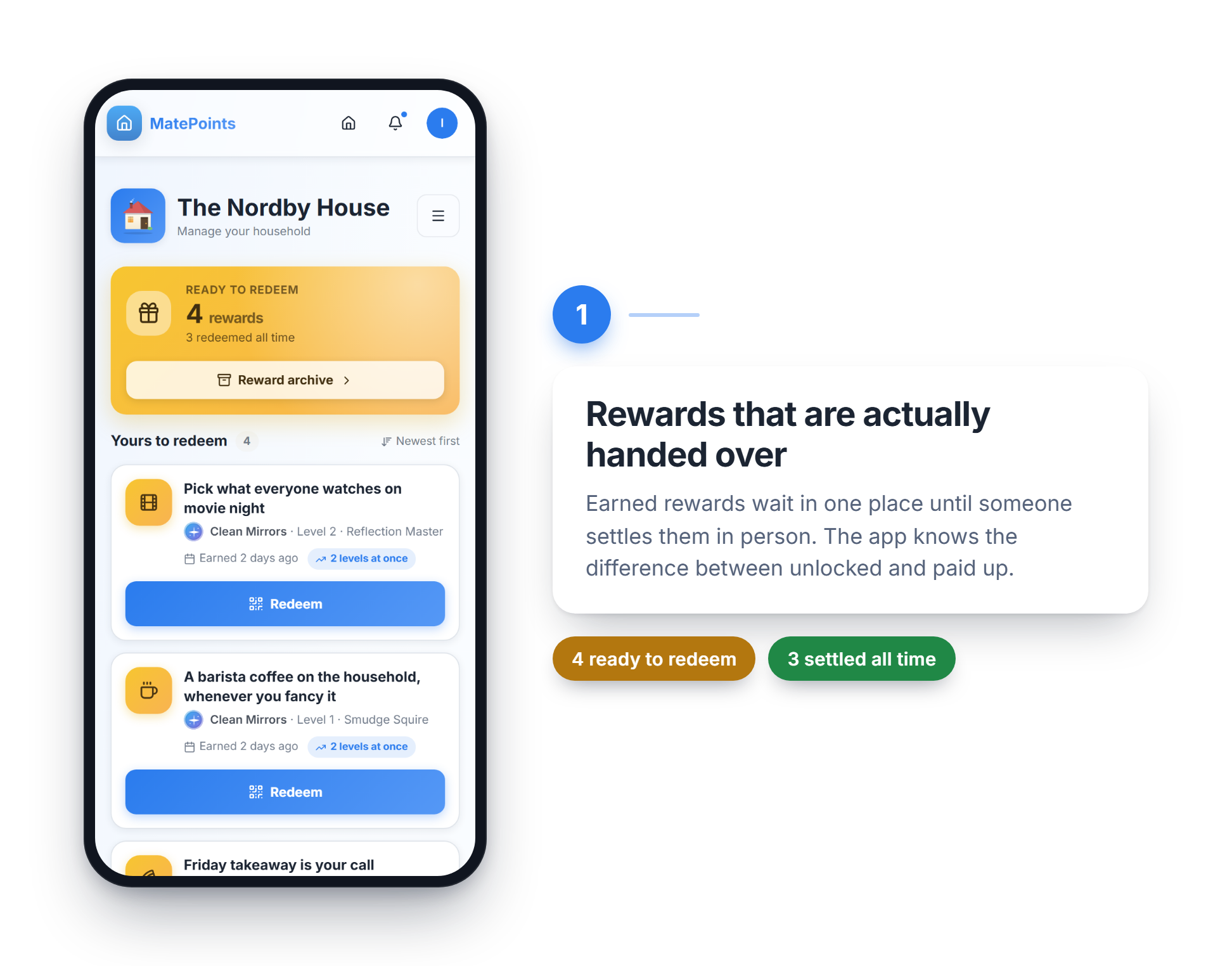
1. The reward gets settled, not just unlocked
This is the one that matters, and it is the reason MatePoints exists.
Every app above can tell you a reward has been unlocked. None of them can tell you it was ever handed over. The badge lights up, the notification fires, and then the app stops caring. Whether the takeaway was actually bought, whether the pocket money actually moved, whether the "you pick the film" was honoured — that lives in somebody's memory, and memories disagree.
We know this is a real gap because our own users built a workaround before we built the feature. Before MatePoints had rewards, households were renaming achievement levels to things like "Friday pizza pick" and treating the badge as an IOU. That works exactly once. Nothing recorded that the pizza had been bought, so nobody could tell an unlocked level from a settled one, and the person who owed it had no way to know whether they had already paid up.
So MatePoints added the missing step:
- The earner opens the reward and gets a one-time code, eight characters, shown as text and as a QR code.
- The code is alive for ten minutes and can be used once.
- It is stored only as a hash, so a leaked database cannot be replayed into free rewards.
- Someone who is not the earner scans or types it — an approver, in person, on their own device.
- The result is written to an append-only ledger. Deleting the achievement afterwards cannot rewrite what was already settled.
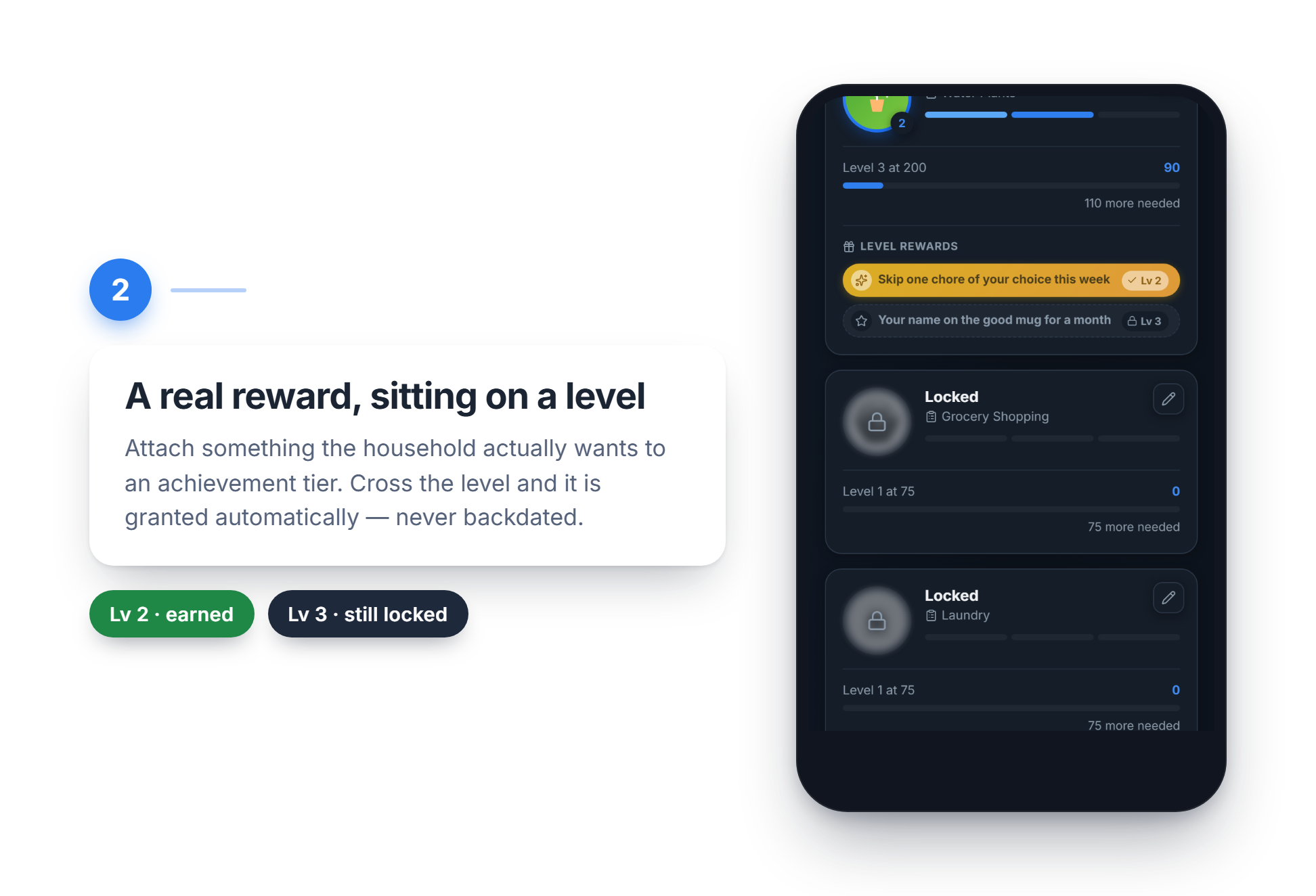
It takes about four seconds in practice. What it buys you is an end to the single most tedious argument in any shared home: did you actually get that, or are you asking twice?
One thing worth saying plainly, because the feature invites the opposite assumption: we supply the system, never the reward. A reward is free text your household typed in. We do not fund it, price it, deliver it or take a cut, and points have no monetary value outside your own group.
2. A chore is a claim until someone else accepts it
Points only mean something if they were earned. MatePoints treats a completed chore as a claim, not a fact, until a second person accepts it — the same reason nobody approves their own expenses at work.
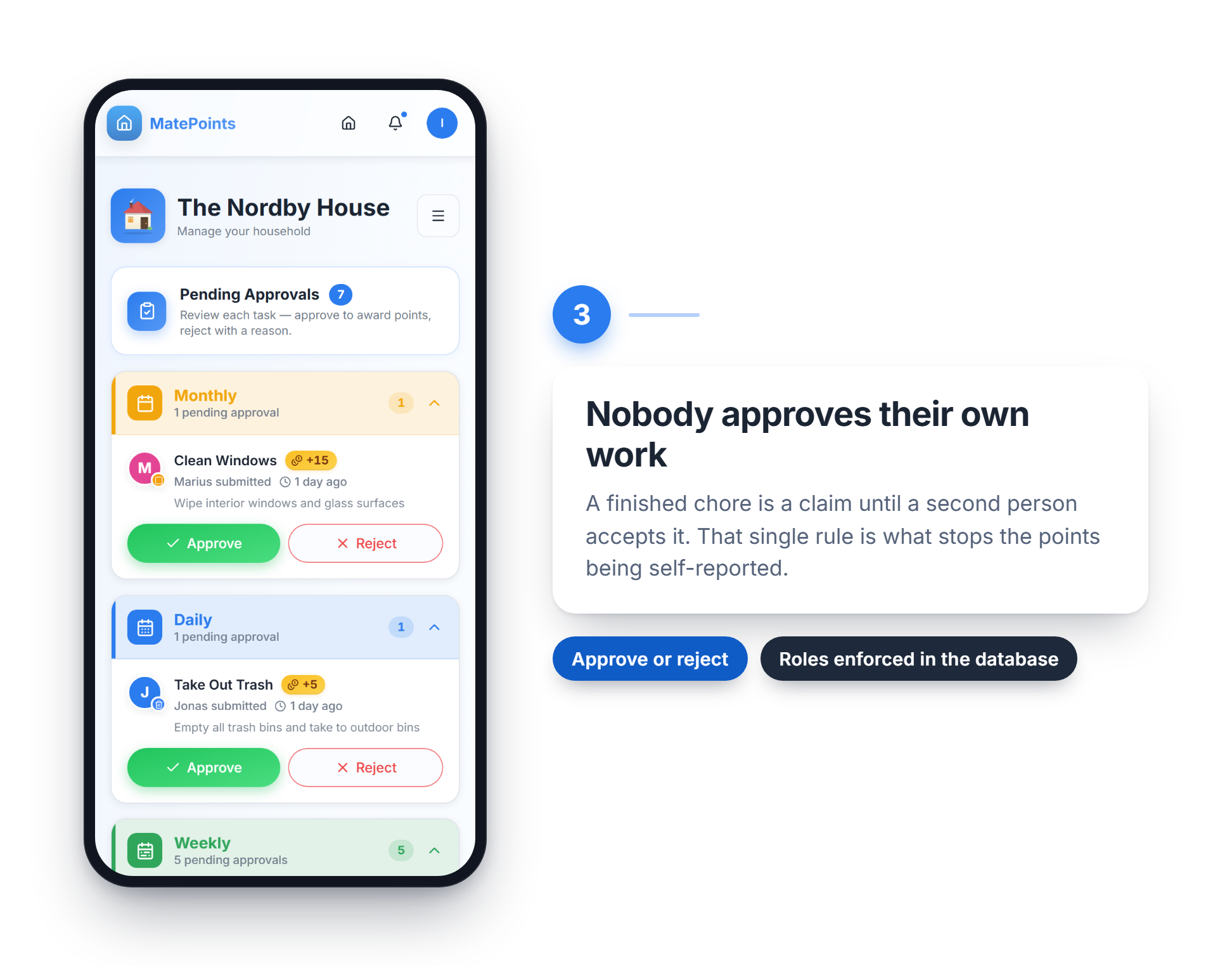
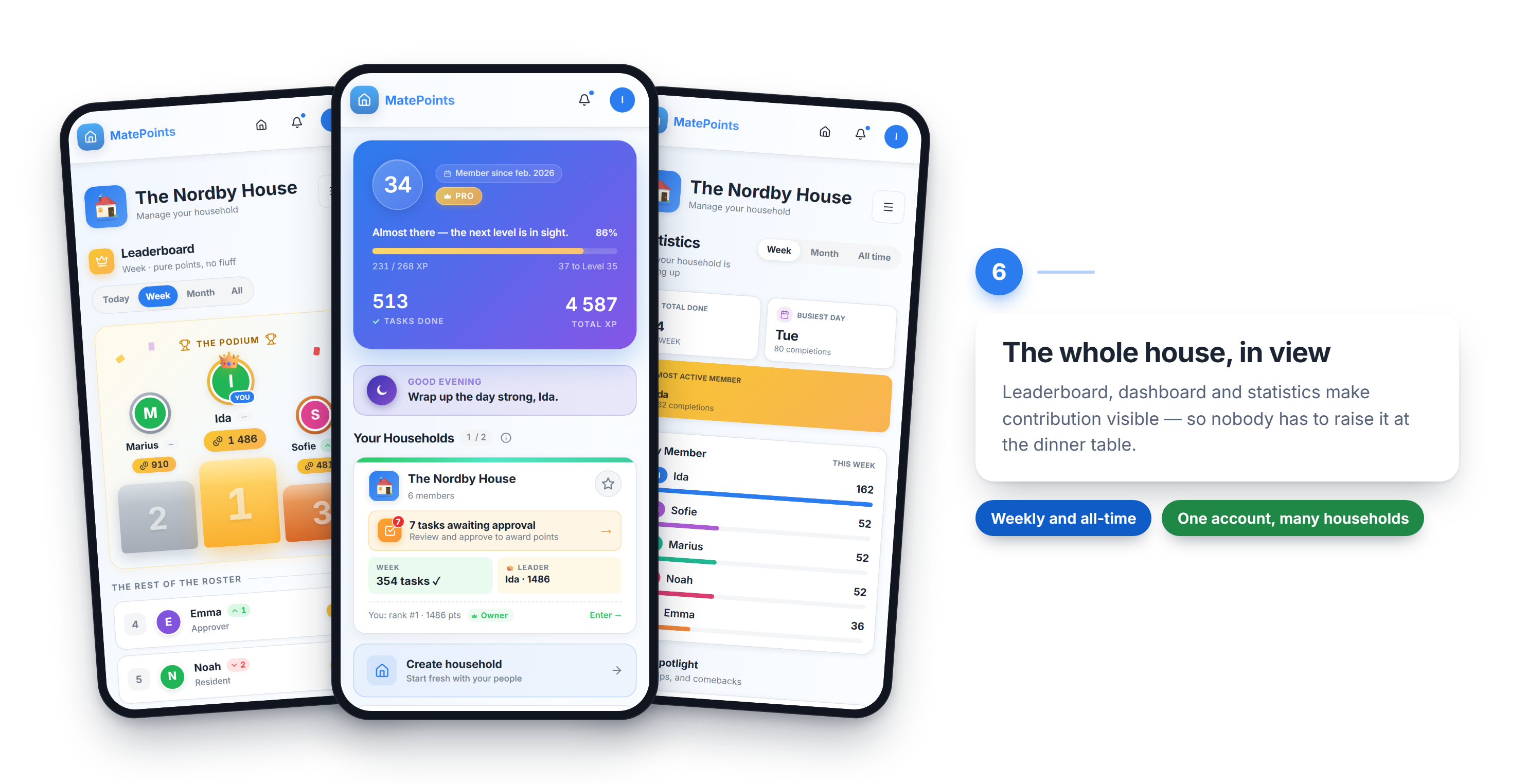
There are four roles, and each one contains the one below it: Resident completes chores and sees everything, Approver adds accepting or rejecting completions, Editor adds creating chores, achievements and rewards, and Owner adds settings, members and deleting the household.
The part that is genuinely unusual is where those rules live. They are enforced by PostgreSQL row-level security in the database, not by hidden buttons in the interface. The rules hold no matter how the app is reached.
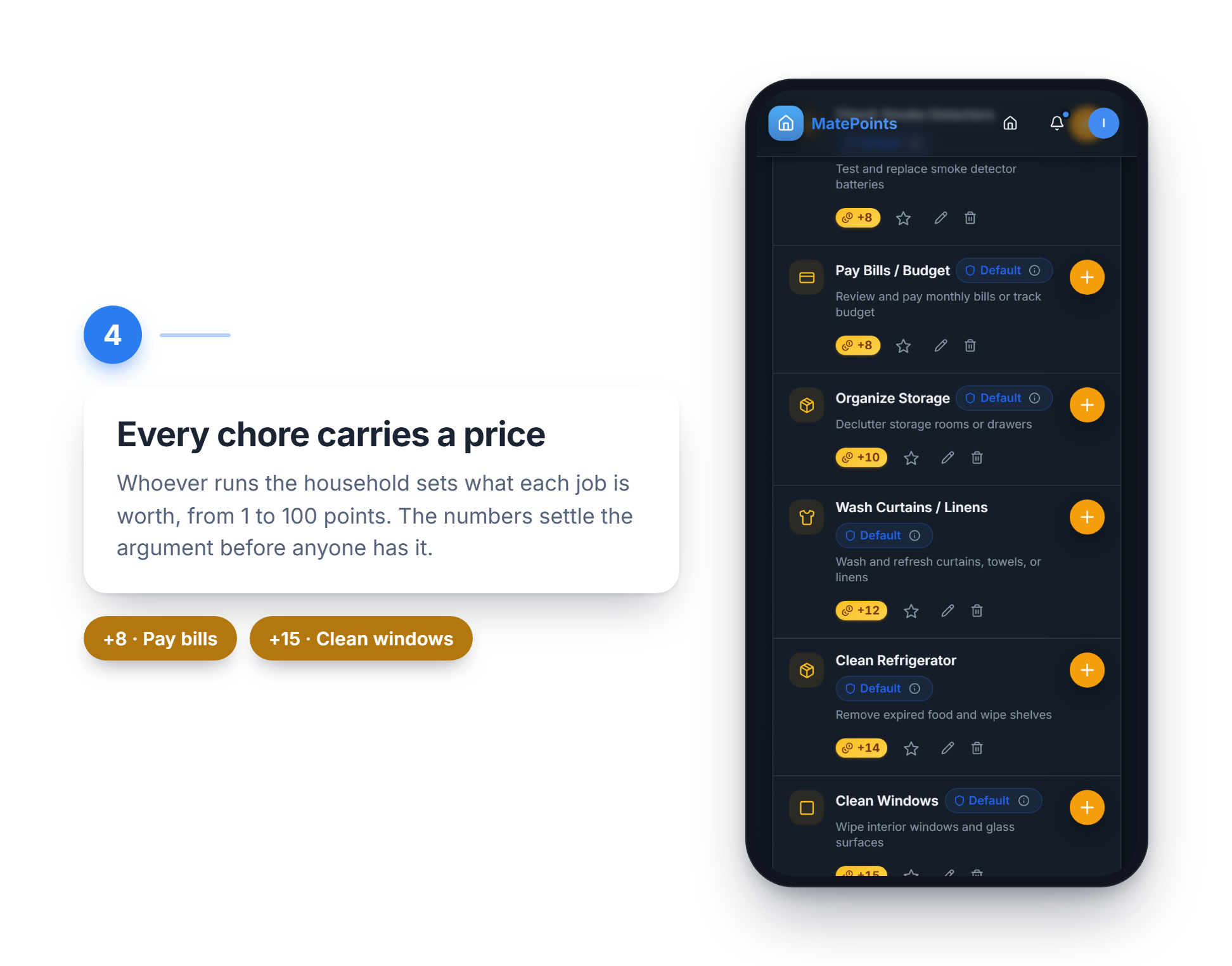
And chores carry a price, set by whoever runs the household, from 1 to 100 points. Raking the sandpit is not scrubbing the oven, and the numbers say so before anyone has to argue about it.
3. Tap a sticker where the chore actually happens
Here is the feature we were most surprised to find nobody else offering. We went looking for chore apps with NFC tap-to-complete and came back essentially empty-handed.
Any chore in MatePoints can be written to a blank NFC sticker or turned into a printable QR poster. Stick the tag on the dishwasher, the bins, the lawnmower, the noticeboard. Tapping it opens that chore's completion directly.
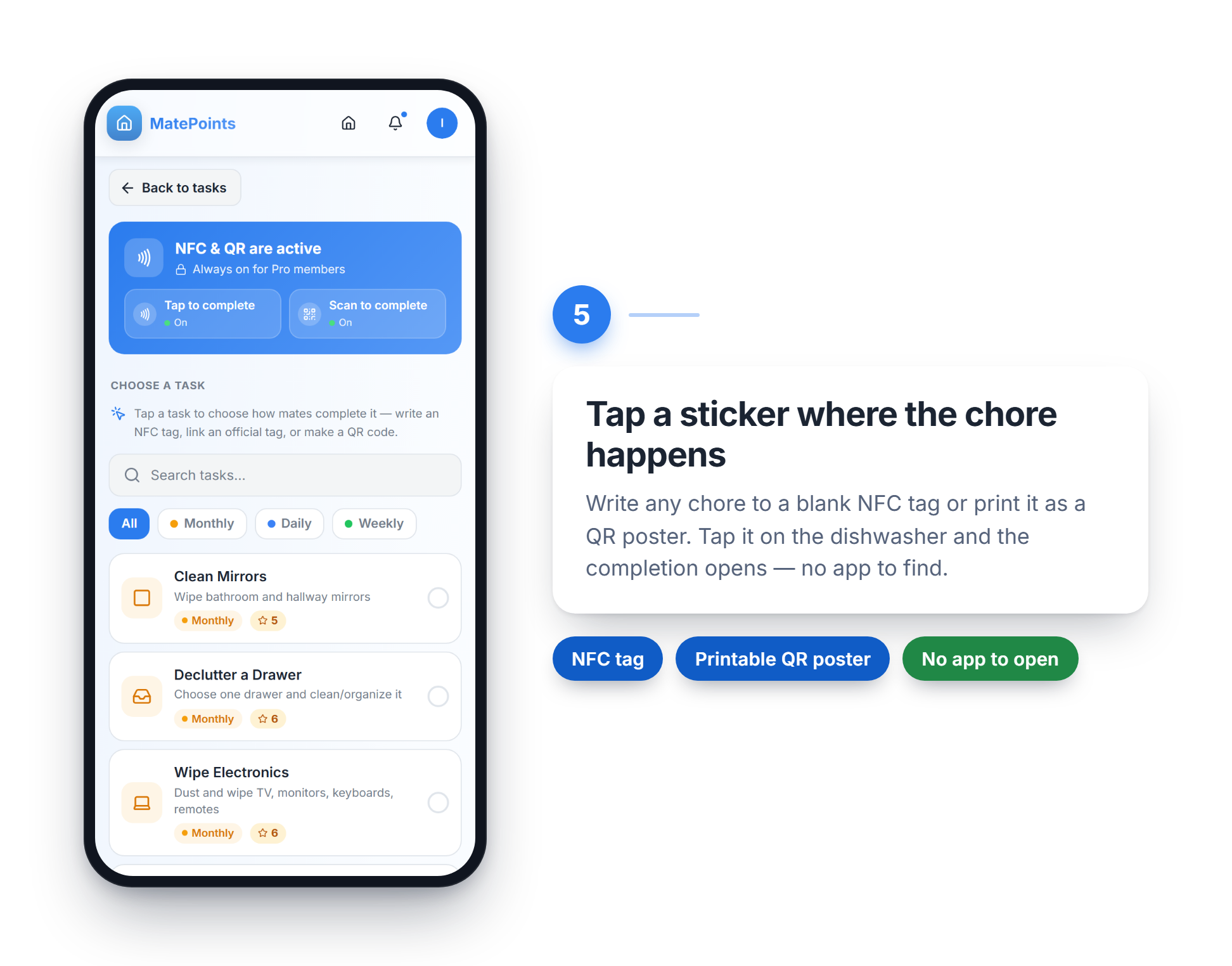
This sounds like a gimmick until you consider why chore apps get abandoned. It is almost never that people stop doing chores. It is that they stop logging them — you finish the job, your hands are wet, the phone is in another room, and by the evening you cannot remember what you did. A tag on the appliance removes that gap entirely. The QR version is generated as a branded poster carrying the chore's icon, name and point value, so a passer-by understands it without anyone explaining.
4. It is not only for families
Almost every app in this category is built for a family with children. That is a real market, but it is not the only group that shares work.
A household in MatePoints is any group with shared chores, uneven effort and no manager. That description fits a family, and it fits three other groups nobody is building for:
- Shared houses and flatshares — the hardest case, because nobody has authority over anyone. Making contribution visible does the work that an awkward conversation otherwise has to.
- Student housing — where the whole household turns over every term, and any system living in one person's head dies when they move out.
- Volunteer organisations — residents' associations, sports clubs and community groups that maintain shared grounds on unpaid effort, where the same few people always end up doing it.
That last one is where we are focusing next, and it needed no new features — just the same roles, points and rewards pointed at a different kind of group.
5. One account, several households
Most chore apps assume you belong to exactly one home. Plenty of people do not.
MatePoints supports several households on one account, so the same login covers the flat you live in, your parents' place at the weekend, and the residents' association you volunteer for. No second account, no switching apps, and separate leaderboards for each.
6. Free means free — and there is a reason we charge for something
The whole loop is free: chores, points, levels, prestige, achievements, leaderboards, and both earning and redeeming rewards. No advertising, no selling of data, and no credit card to start.
We are deliberate about the "and there is a paid tier" part, because the alternative has a track record. OurHome was, for years, the app people in this category loved — and it launched entirely free with no ads and no revenue model at all. Without revenue there was nobody to pay to keep it working. Households that had put years of their data into it found out what happens next.
A free product with no way to fund itself is not generous. It is temporary.
So MatePoints Pro exists, and it raises the ceilings rather than holding the basics hostage: more households, more members, more chores, the ability to create achievements and attach rewards to them, and the ability to create and manage NFC tags and QR codes.
And it is one subscription per household, not per person. Pro is bought by one member — usually whoever set the household up — and its household features unlock for everyone in that household. The other five people carry on for free and lose nothing.
This is worth checking before you commit to any app in this category, ours included: ask whether the subscription covers the household or the seat. It is the difference between one person paying and a family of five each being asked to, and it is rarely the first thing on the pricing page.
We build what people ask for
One more thing that is hard to put in a feature list. When someone tells us the app should do something, we look at whether it is possible and, more often than not, build it. Rewards themselves came from watching users fake them with renamed achievement levels.
That is a claim every product makes, so here is the checkable version: MatePoints has shipped 14 releases since May 2026 — a feature release roughly every two weeks — and the full history is public on the blog. Being a web app rather than a store app is part of why: a fix ships the moment it is ready, with no review queue in between.
7. It runs everywhere, with no app store in the way
MatePoints is a progressive web app. You install it straight from the browser — no store approval between us and a fix, updates the moment they ship, and the same app on a phone, a tablet or a desktop browser.
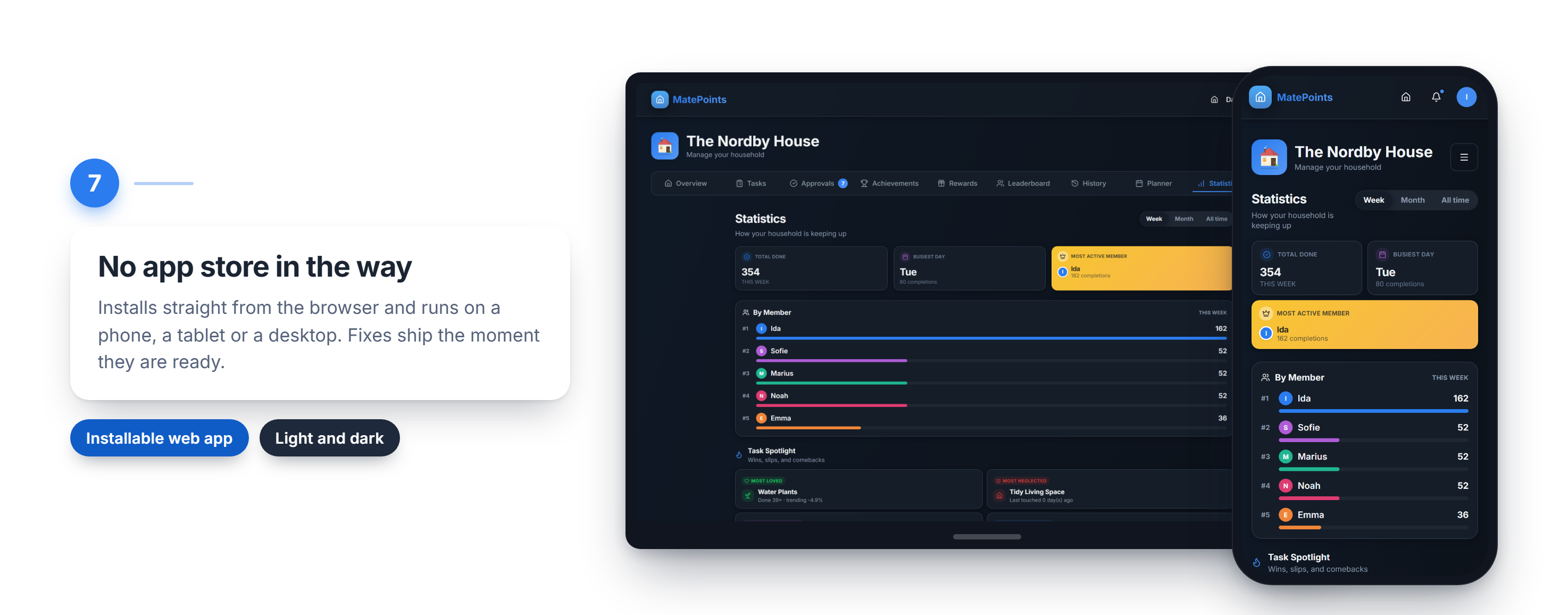
Every screen ships in light and dark, and the whole app is available in English and Norwegian. It is built by a Norwegian company under GDPR, with a real data export, and we are open about still being in beta.
When MatePoints is the wrong choice
No app is right for everyone, and you will find out eventually anyway.
Pick something else if the question is what to clean, not who cleaned it. Tody is built around how due a task is: it generates a prioritised list from how overdue each job has become, rather than holding you to a fixed rota. It has points and leaderboards too, but its real strength is deciding what deserves attention this week. If your household's problem is keeping a home genuinely clean rather than dividing the work fairly, Tody is better aimed at it than we are.
Pick something else if you want allowance paid in real money. Some apps in this space move actual funds — bank transfers, a prepaid card, the lot. MatePoints holds no money and moves none, by design. A reward here is whatever your household agreed it is.
Pick something else if you mainly need a family calendar. Cozi does shared calendars, meal planning and lists far better than we do, because that is what it is for.
And if your household genuinely has no friction, you do not need any of this. A whiteboard is fine.
MatePoints is for the case where effort is uneven, it is invisible, and the deals people make about it keep evaporating.
Try it in about two minutes
Create a household, add a few chores with point values, invite the people you live with, and set one reward on one achievement. That is the whole loop, and it is free.
- See how it works
- Create a free account — no credit card, just a username and email