A daily chore checklist your household will actually use
A daily chore checklist of six five-minute tasks, the rule for what belongs on a weekly list instead, and how to make it stick in a shared house.

A daily chore checklist works when it is short enough to finish. Six tasks, five minutes each, split between the morning and after dinner: make the bed, load or unload the dishwasher, wipe the counters and stovetop, sort the mail, do an evening tidy, and take out the trash if it is full.
That is the whole list. Nothing on it is deep cleaning. You are not trying to fix a mess — you are trying to keep today's mess from becoming tomorrow's project.
Writing the list is the easy half. In a house with more than one person in it, the hard half is that everybody already believes they are doing more than their share.
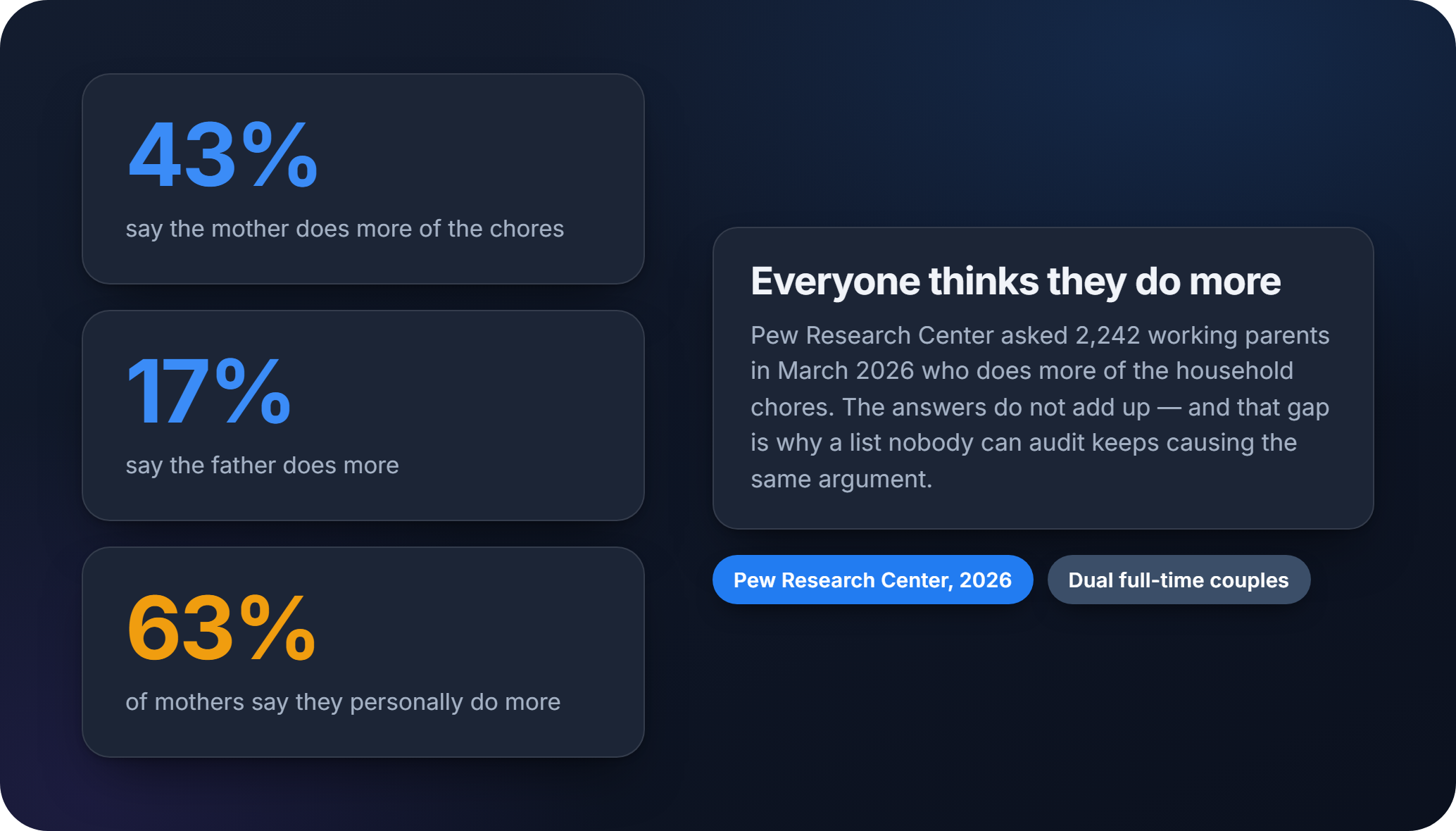
Pew Research Center put the question to 2,242 working parents in March 2026. Among couples where both partners work full time, 43% said the mother does more of the household chores and 17% said the father does. Ask the mothers on their own, though, and 63% say it is them.
Both people can answer honestly and still disagree, because nobody is keeping score. Each of them is remembering their own effort in detail and estimating everyone else's. A checklist on the fridge does not fix that. A checklist that records who ticked what does.
What belongs on a daily chore checklist (and what doesn't)
A chore list that actually gets used front-loads the tasks that prevent buildup, not the ones that fix it after the fact. That's the whole trick.
Here's a checklist that holds up across most households:
- Make the bed — sets a visual tone for the whole room and takes very little time.
- Load or unload the dishwasher — a key driver of kitchen order when done daily.
- Wipe counters and stovetop — a damp cloth after cooking beats a scrub session next week.
- Sort the mail — prevents paper piles from forming.
- Evening tidy — walk each main room, put stray items back where they belong.
- Take out the trash, if full — don't wait for it to overflow.
Run the quick tasks in the morning, before the day gets away from you, and save the evening tidy for after dinner when the day's clutter has actually accumulated. That split matters more than people think: morning tasks set the tone, evening tasks close the loop.
The rule underneath all six: nothing on a daily list should take longer than about five minutes. It's a house rule rather than a law, and a close cousin of David Allen's two-minute rule — if a job is small enough, scheduling it costs more than doing it. Anything that regularly runs long belongs on a weekly list instead.
Pro tip: do the dishes right after you use them, not "later." A pan left to sit takes far longer to deal with than one rinsed straight away — and testing on soaking suggests hours in the sink barely help, while a sponge on a still-warm pan does most of the work for you.
A room-by-room breakdown you can actually delegate
Splitting the checklist by room makes it easier to hand off tasks to kids, roommates, or a partner without anyone stepping on toes. Each of these fits inside the five-minute rule.
Kitchen
- Wash or load dishes
- Wipe counters and stovetop
- Sweep visible crumbs (full floor sweep is weekly)
- Empty trash if it's full
Bathroom
- Quick sink wipe
- Squeegee the shower if it was used
- One quick toilet swish
- Swap towels only if damp or visibly soiled
Bedrooms
- Make the bed
- Clothes into the hamper, not the floor
- Clear surfaces of clutter
Living room and entry
- Pick up stray items and put them back
- Fluff cushions and fold throw blankets
- Sort mail and shoes by the door
Laundry gets one simple rule: one load a day, started and finished, rather than a weekend marathon. Pets get a similarly short rule: feed, water, and a quick scoop or walk, nothing elaborate.
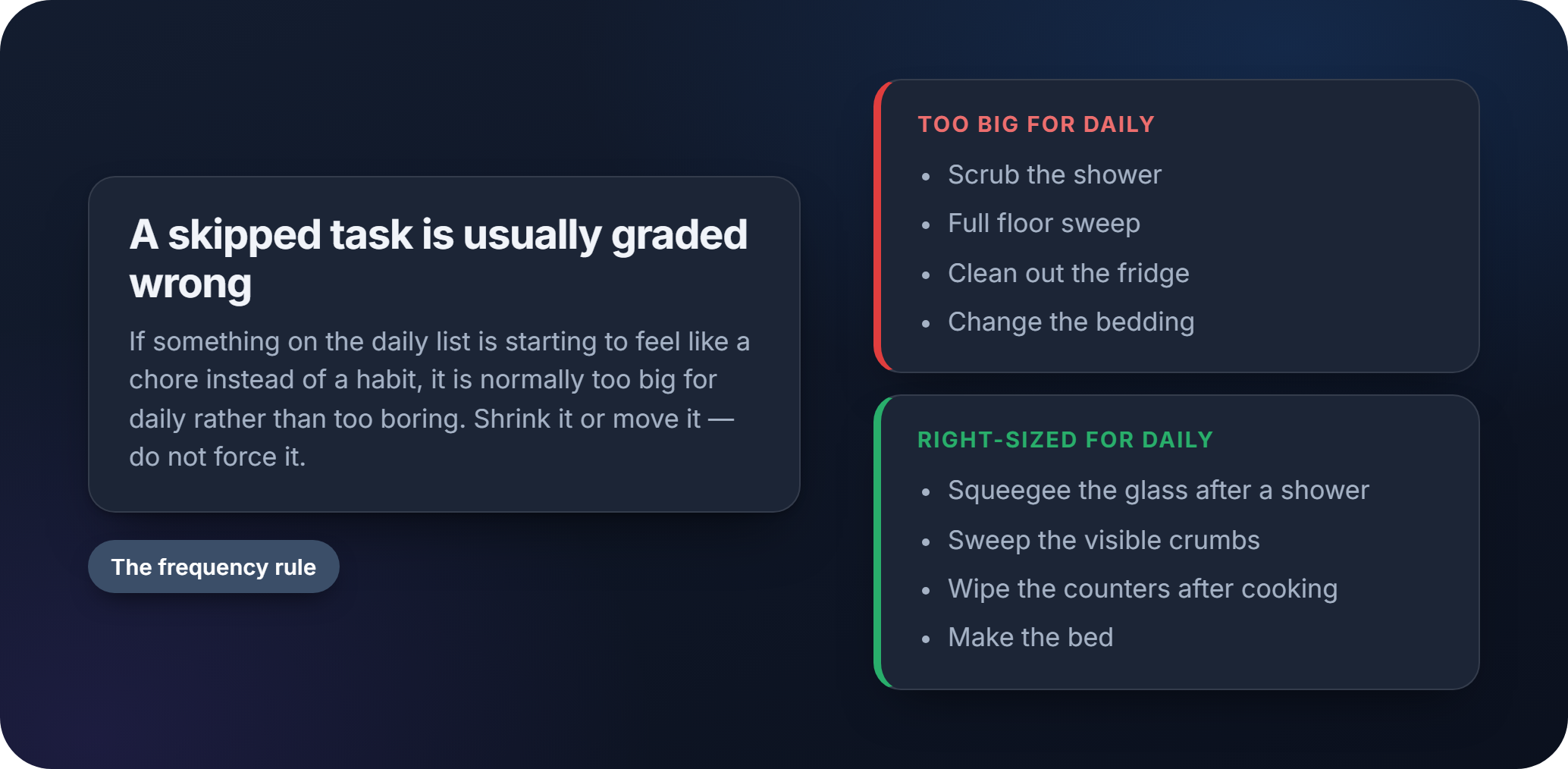
Grading tasks by frequency is the real engine behind all of this. Scrubbing the shower is a weekly job; running the squeegee across the glass every day is not, and it's what actually prevents the deep clean from becoming necessary in the first place. If a task on your list is starting to feel like a chore instead of a habit, that's usually a sign it's graded for the wrong frequency.
Format matters less than visibility. A printed list in a sheet protector on the fridge works. A dry-erase board works better if you adjust tasks often. A shared app earns its place when the people on the list are on different schedules, because it is the only version that can tell you what happened while you were out. Whatever you pick: one box per task, on a single sheet, split by time of day rather than by room.
Making the checklist stick, even with ADHD
The checklist that survives past week one is the one built around the household using it, not a generic template pulled off the internet. Scale it: a studio apartment doesn't need a "living room" line, and a family of five needs named assignments, not vague plural chores.
For ADHD-friendly households, keep the list short, visual, and time-boxed. Long, text-heavy charts get ignored; short ones with clear time boxes and an immediate check mark hold attention better. The idea underneath is externalising the executive function the brain isn't reliably generating on its own — putting the sequence and the timing into the environment instead of into memory. Set a five-minute timer per task, and tick each one as it lands rather than waiting for the whole list.
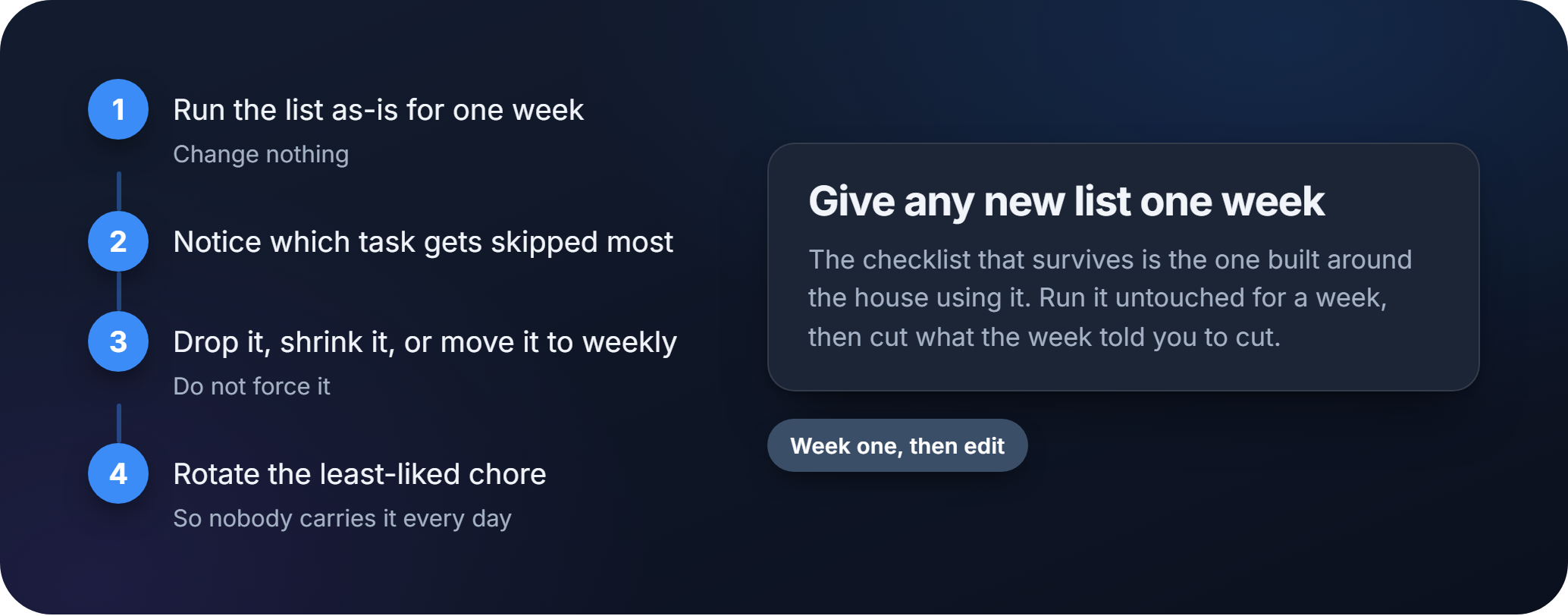
- Run the list as-is for one week without changing anything.
- Notice which task gets skipped most often.
- Drop it, shrink it, or move it to a weekly slot instead of forcing it.
- Switch to a dry-erase or digital format once you know what actually needs to flex.
- Rotate the least-liked chores (usually bathroom scrubbing or floor care) to a weekly or monthly cadence so no one carries the same dreaded task every single day.
Pro tip: assign chores by name, not by category. "Kitchen duty" is vague and easy to dodge. "Jamie loads the dishwasher after dinner" has an owner and a trigger, and it gets done far more often.
How a shared system keeps the habit alive
A checklist works right up until motivation dips, which is exactly where most paper charts fall apart. A shared system solves for that by adding two things a fridge door cannot: a record, and a reason to bother.
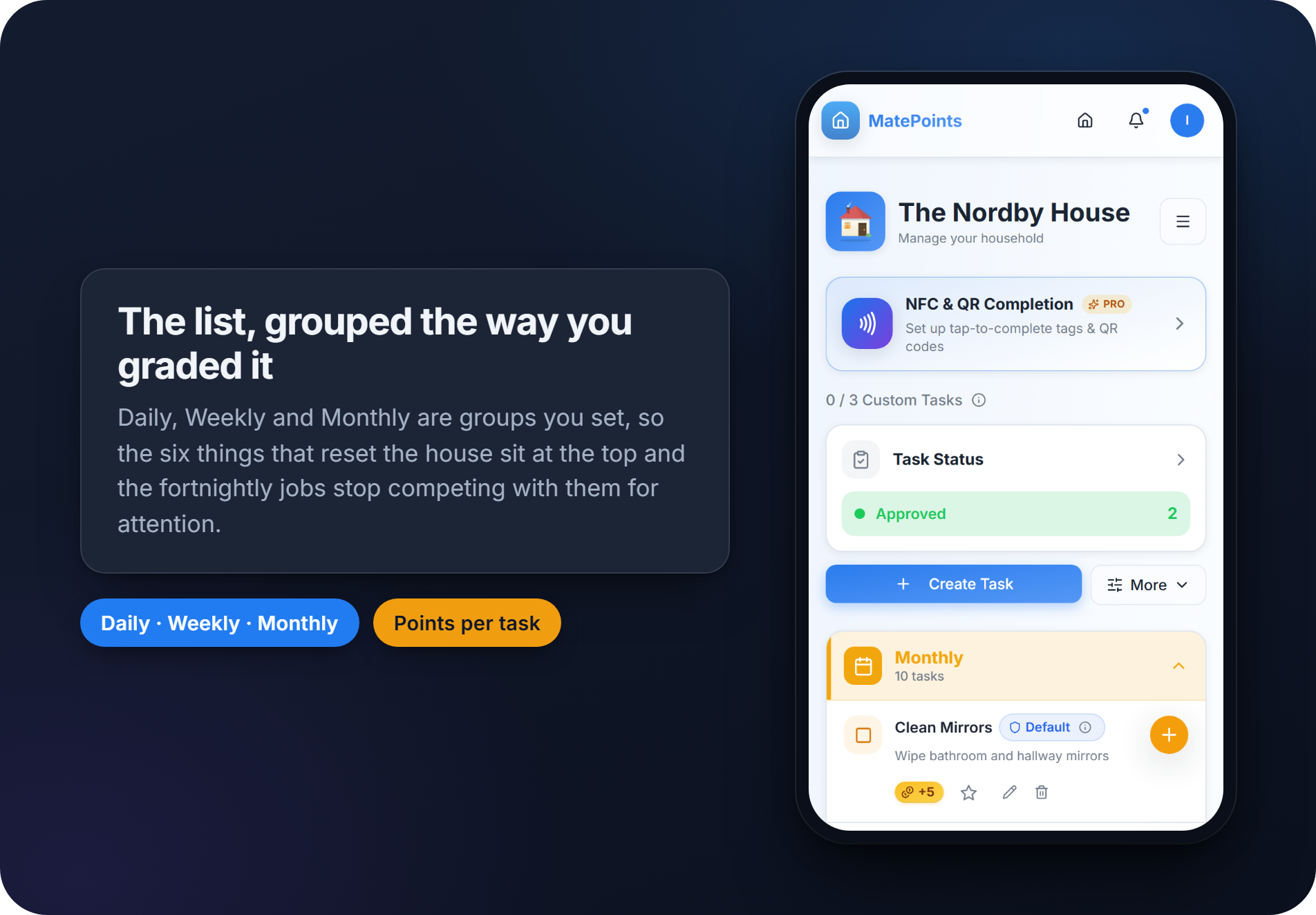
In MatePoints, the frequency grading from earlier becomes the structure of the list itself. Daily, Weekly and Monthly are groups you set, so the six things that reset the house sit at the top and the fortnightly jobs stop competing with them for attention.
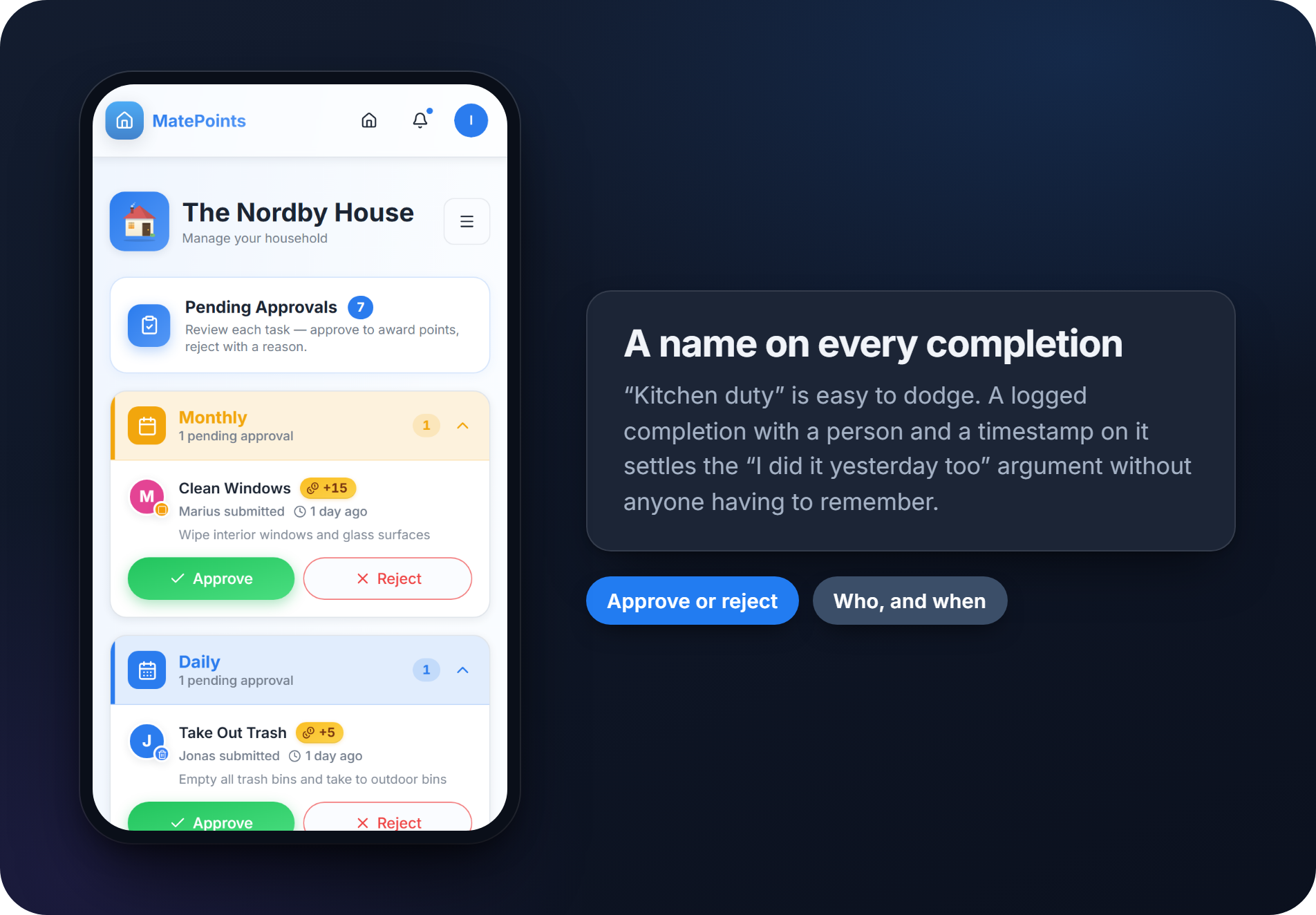
Every completion carries a name and a timestamp. That is the part a paper chart cannot do, and it is the answer to the perception gap this article opened with — "I did it yesterday too" stops being a matter of memory. An approver can confirm each one, or you can let tasks auto-approve and just keep the history.
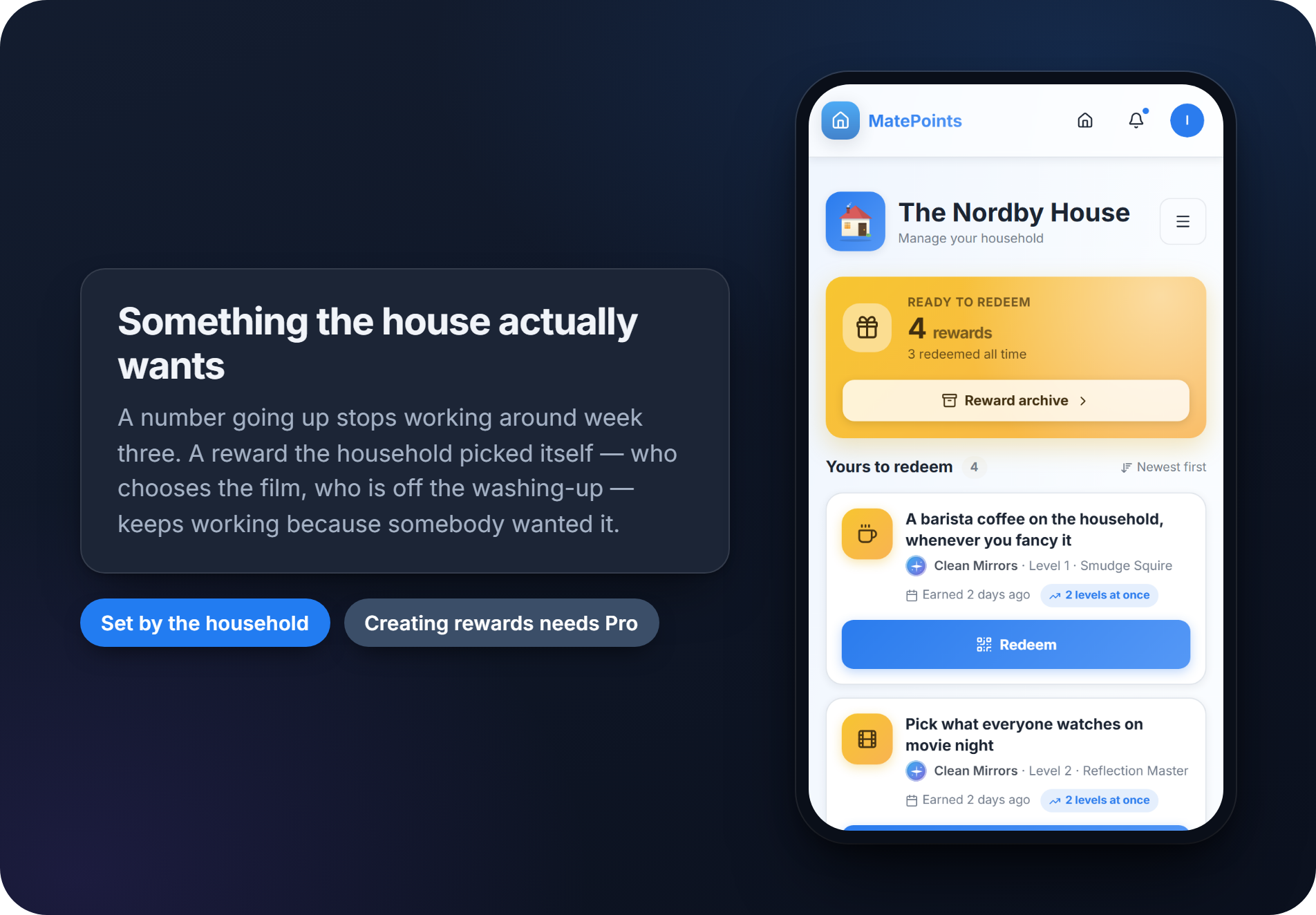
A number going up stops working around week three. A reward the household picked itself — who chooses the film, who is off the washing-up on Friday — keeps working because somebody actually wanted it.
A few things here need MatePoints Pro, and it's worth knowing which before you set up: creating achievements with rewards attached, running more than one household from a single account, and tap-to-complete, where a chore is finished by tapping an NFC tag or scanning a QR code stuck by the sink instead of opening the app at all. Logging chores, approvals and the full completion history are free for everyone. If you want the longer version of what the app does and does not do, we wrote an honest comparison against the alternatives.
What actually worked in my own house
Every version of a chore chart I've seen fail started too big: fourteen tasks, color-coded zones, a rotation wheel nobody could remember. The ones that lasted started with three tasks and grew only when those three became automatic. Give any new list seven days before judging it, and cut whatever isn't working rather than forcing it to stick.
— Marcus
Try it on your own daily reset
If your household has been through three paper charts and a whiteboard that nobody updates, the pattern is familiar: enthusiasm for a week, then silence. MatePoints is built for exactly that gap between good intentions and Tuesday-night follow-through, using points and small rewards instead of guilt to keep chores moving.
Setup takes about as long as making the bed. Create a household, add the five or six tasks from the checklist above, and invite the other people living there. Everyone logs completions from their own phone, and you can see what's getting done without asking anyone directly. Start a household and give it a week.
Sources
- The Ultimate Household Chores List (Care.com)
- How working parents divide family responsibilities (Pew Research Center, June 2026)
- The Two-Minute Rule (Getting Things Done)
- How long do your dishes need to soak? (Reviewed)
- The Chore List You Need to Be on Top of Household Tasks (Rinse)
- External supports for ADHD (Suzy Carbrey)