Allowance and chores: should you pay kids to help?
Should allowance be tied to chores? What the research actually found, what families pay in 2025, and the hybrid split most parents settle on.

Allowance and chores get tangled together in most households, and the tangle is usually what causes the arguing. The short answer most families land on is a split: a small allowance that isn't tied to anything, the everyday chores that come with living there, and a separate list of bigger jobs that do get paid.
The useful part isn't the split, though. It's the rules that stop you renegotiating it every night.
Should allowance be tied to chores? The three models
Every allowance system falls into one of three buckets.
Commission-based (paid chores) ties every dollar to a completed task. No chore, no pay. The upside is obvious: kids learn fast that money comes from work. The downside is just as real, and it has a name.
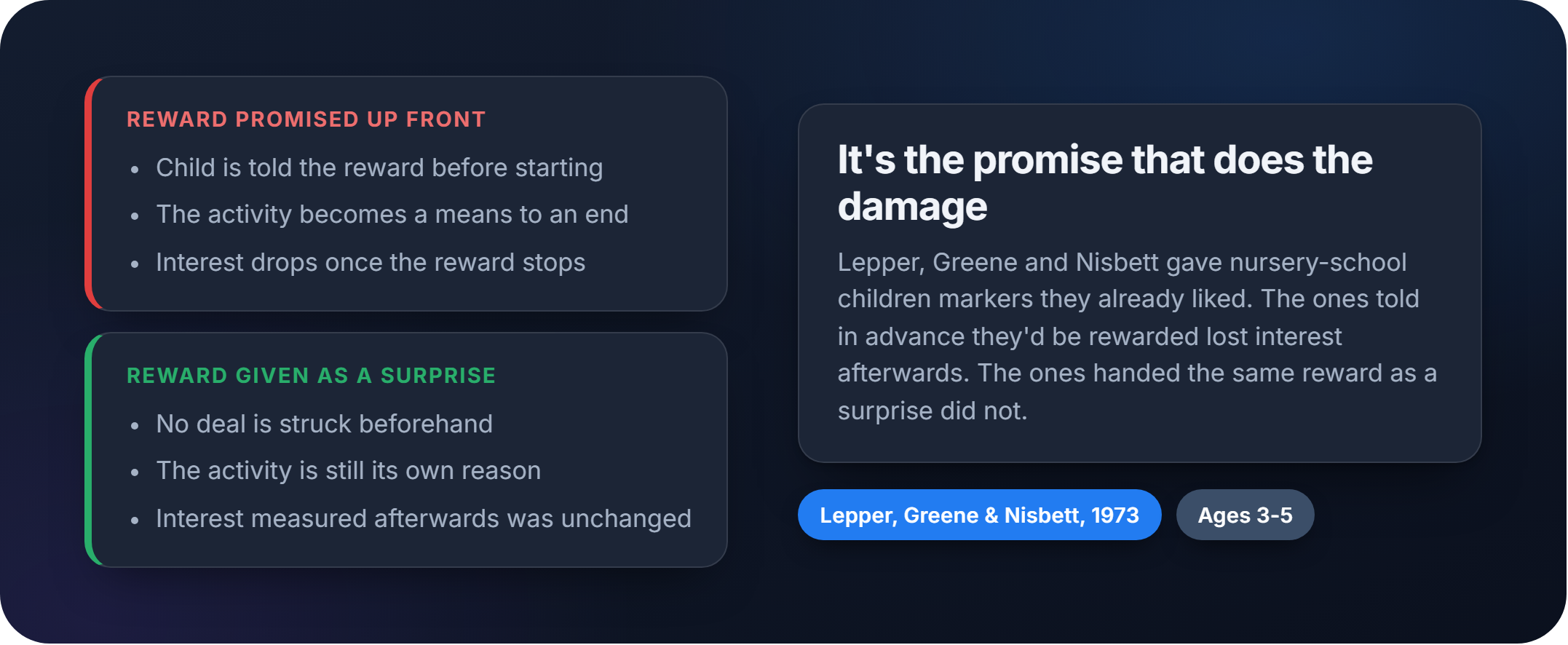
In 1973, Mark Lepper, David Greene and Richard Nisbett gave nursery-school children coloured markers they already enjoyed playing with. One group was told in advance they'd get a certificate for drawing. Another got the same certificate as a surprise, after the fact. A third got nothing.
Weeks later, only the children who had been promised the reward played with the markers less than before. The surprise group was unaffected. The effect has a clumsy name — overjustification — but the practical version is simple: it is the deal struck beforehand that does the damage, not the reward itself. Pay a child to do something they'd have done anyway, and you can buy out the reason they were doing it.
That's the real argument against paying for everyday chores. It isn't that paying is mean. It's that you can spend money to make the free version stop working.
Unconditional allowance hands over a set amount regardless of chores. It's the cleanest way to teach budgeting, saving, and giving, since the money isn't muddled up with performance. The tradeoff is that kids don't connect income with effort at all.
Hybrid blends the two: a modest base allowance for money lessons, plus paid extras for jobs beyond normal family duties. It covers both goals and costs you a little more setup.
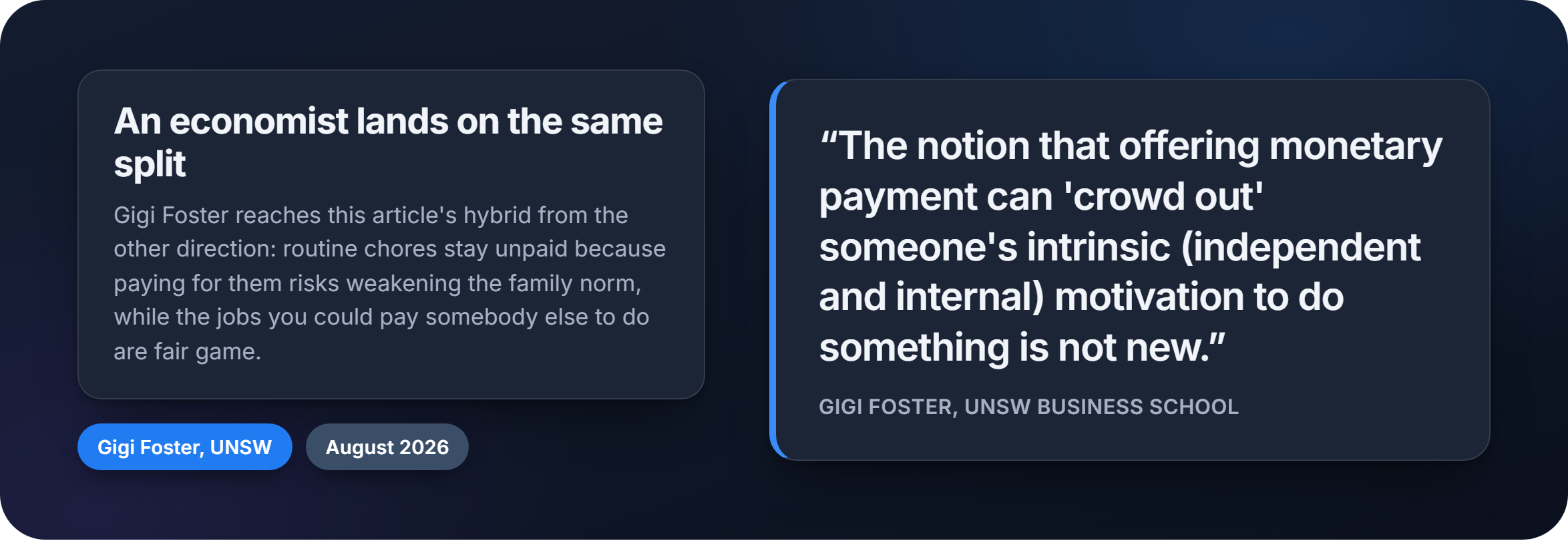
The hybrid is also where the economics lands. Writing for UNSW in August 2026, Gigi Foster argues that paying for routine chores risks weakening the family norm that gets them done for free — and that payment is better reserved for "special jobs" you could have paid somebody else to do, with regular pocket money treated as a teaching tool rather than wages.
When should kids start earning chores for allowance?
Age changes everything about how this system should look, and starting too early with commission pay is one of the most common mistakes parents make.
- Ages 4 to 7: Unpaid, expected chores (putting away toys, feeding a pet) alongside a small unconditional allowance. The goal isn't a work ethic yet — it's the idea that money exists, has value, and gets divided into spend, save and give.
- Ages 8 to 12: The full hybrid. Base allowance and expected chores stay, and now you add optional paid extras like washing the car or clearing the garage. This is also the age for jars, envelopes, or a simple savings account.
- Ages 13 to 17: Expand the paid opportunities and start layering in real budgeting. Some teens can handle a delayed payout, where bigger jobs pay monthly instead of weekly — which is how actual paychecks work.
Watch for the signal to level up: a child who finishes chores without reminders for a few weeks, or starts asking about saving for something specific, is ready for more responsibility or a longer payment cycle — not just a higher rate.
How much allowance should you pay, and how often?
Numbers matter less than consistency, but you still need a starting point.
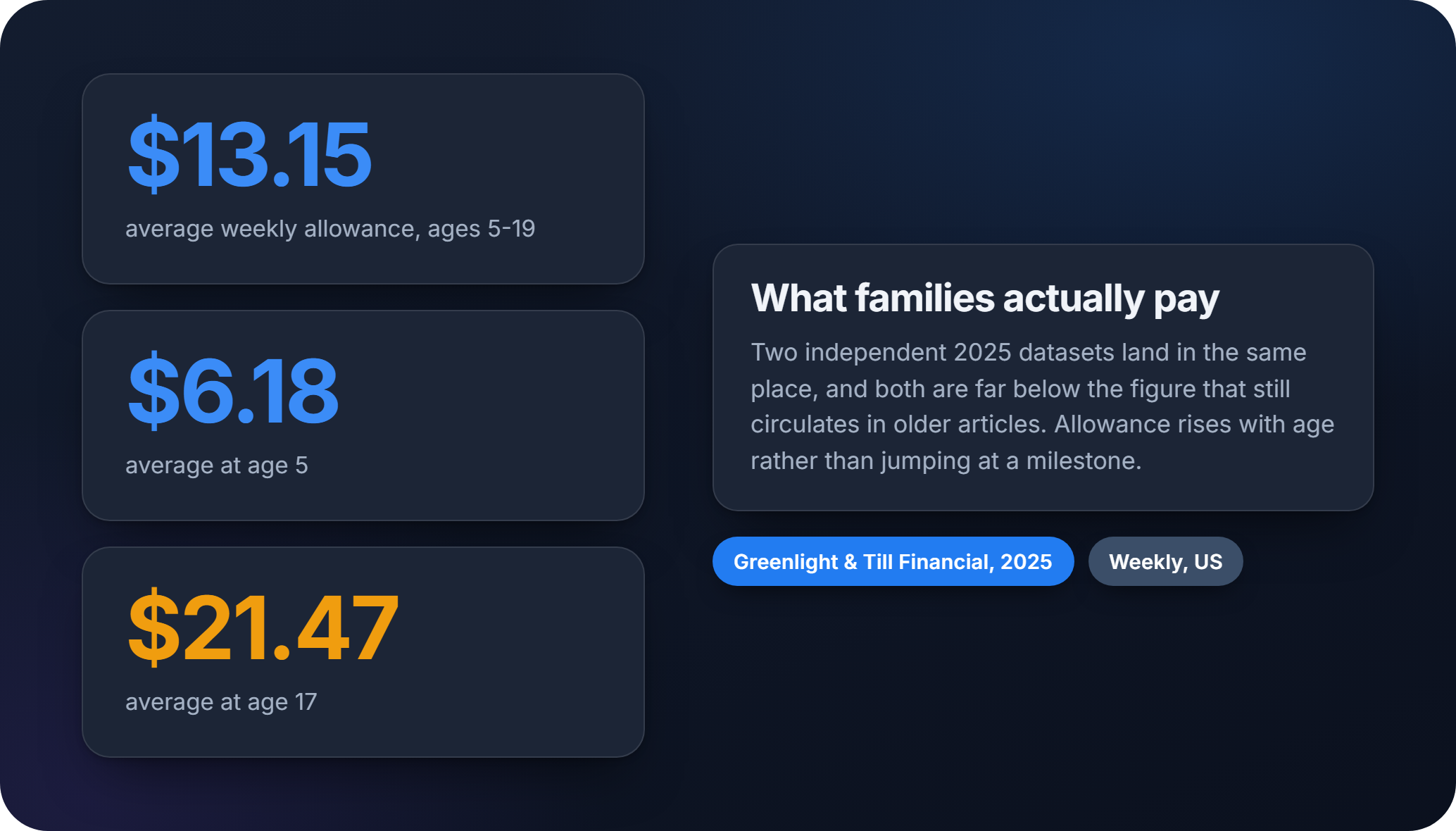
Two independent 2025 datasets agree on the shape. Across families using Greenlight, the average weekly allowance for ages 5–19 was $13.15, rising steadily with age — $6.18 at five, $21.47 at seventeen. Till Financial's 2025 figures from 9,135 US families put the mean at $17 and the median at $10.
If you've read that the average is $30 a week, that figure is from 2019 and has been repeated ever since. Treat these as a sanity check rather than a target: tie the base allowance loosely to age, and price paid extras on a separate scale for effort and time.
- Set a weekly cap on paid extras so allowance doesn't spiral into a full-time job
- Pay on a fixed day every week or every two weeks, no exceptions
- Keep the base allowance separate from discipline. Don't dock it for grades, attitude, or unrelated behavior problems
A pre-set pay scale you write down once, by age or task, removes the nightly negotiation that wears parents down and lets kids plan toward a savings goal instead of haggling for a dollar more.
Which chores are expected, and which get paid?
Draw a clear line before you ever hand out the first payment, or you'll spend months renegotiating.
Expected, unpaid chores cover anything tied to being part of the household: making your bed, clearing your own dishes, basic hygiene tasks, and anything related to safety, like putting away shoes so nobody trips. These don't get paid because they're membership dues, not jobs.
Paid extras are the special, occasional, or skill-building tasks: washing windows, organizing the garage, yard work, tutoring a sibling, or anything you'd otherwise pay a neighbor kid or a service to do.
Pro tip: when a paid job is done poorly, require a redo to the agreed standard instead of paying a reduced amount. A redo policy trains quality standards far better than a deduction, because a partial payment still tells kids sloppy work is profitable.
What actually keeps the system fair
Paper charts hold up well for young kids, who respond to a sticker or a checkmark they can physically see. Digital tracking starts to earn its place once kids can check their own progress, and especially in households juggling several kids or several kinds of chore.
Whatever format you choose, the enforcement rules matter more than the tool:
- Pay on the exact day you promised, every time. Late payments teach kids the system isn't real.
- Apply the same consequence for a missed expected chore every time, not just when you're annoyed.
- Use the redo policy for paid work that doesn't meet the standard instead of arguing over partial credit.
- For siblings, keep pay scales identical for identical jobs at the same age. Different ages can have different rates, but never let one kid feel underpaid for the same task.
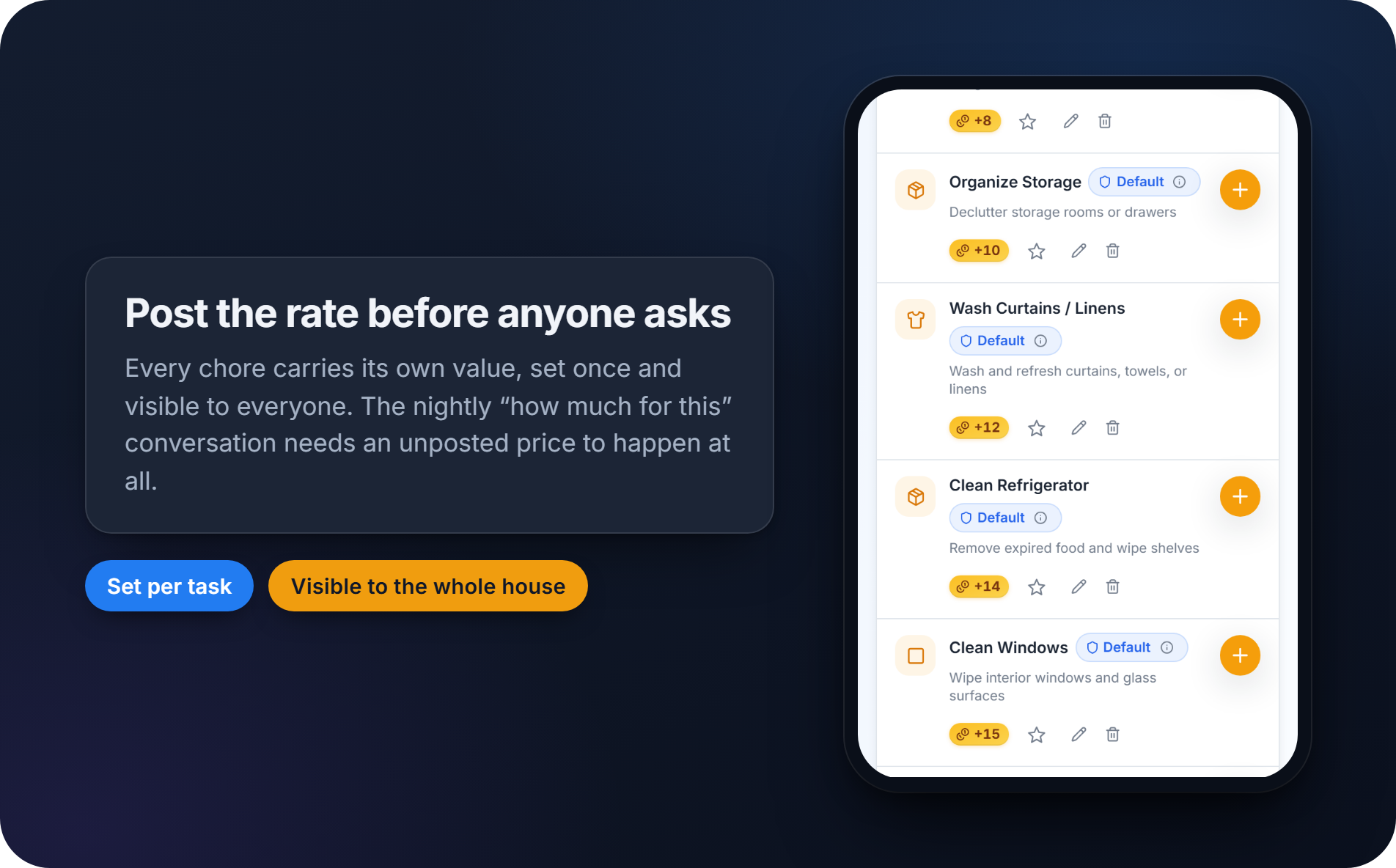
Whatever you use, the thing that ends the haggling is a posted rate. In MatePoints, each chore carries its own value, set once and visible to everyone in the household, so "how much for this one" has already been answered before it gets asked.
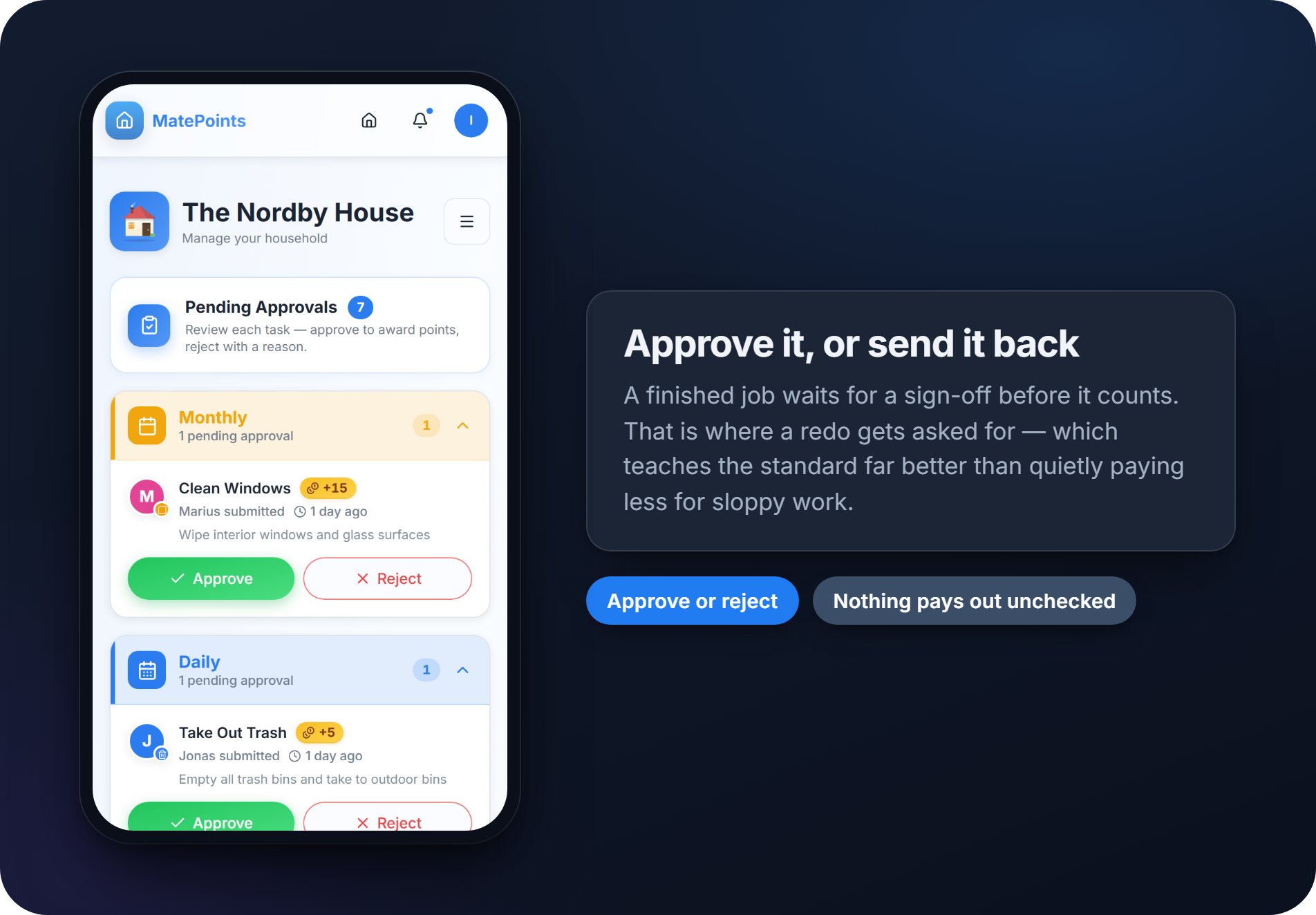
The second half is the sign-off. A finished job waits for an approver before it counts, which is exactly where a redo gets asked for rather than argued about. Everything is logged with a name and a time, so sibling parity is checkable instead of a matter of opinion.
One thing to be clear about: MatePoints doesn't handle money. Points are gameplay, not currency, and we never hold or move any of it. The app keeps the ledger and runs the approval step. If your house decides eighty points is this week's pocket money, that's your arrangement, settled however you settle it now.
Teaching money skills: the give, save, spend split
Allowance only teaches money management if you build the lesson in on purpose. The classic three-way split — give, save, spend — gives kids a simple mental model for every dollar that comes in.
Don't agonise over the percentages. An even three-way split is a fine start for young children, and most guidance suggests moving the save share up as kids get older and start aiming at bigger goals. The ratio matters far less than the fact that every payment gets divided at all, in front of them, every time.
- Goal charting: have kids draw or track progress toward a specific purchase
- Comparison shopping: send them to compare two options for the same item and explain their pick
- Short-term saving challenges: a four-week goal builds the save muscle faster than a distant one
The Consumer Financial Protection Bureau's youth education resources back the hands-on approach: goal-setting and savings-tracking teach money skills more effectively than lectures do. Age 10 to 12 is a reasonable point to add a debit card or savings app, so digital tracking feels normal before real financial independence arrives.
Post the rates once, and stop negotiating
If your household has been through three paper charts and a whiteboard nobody updates, the pattern is familiar: enthusiasm for a week, then silence. The fix isn't a better chart — it's deciding the two things people argue about before anyone is standing in the kitchen arguing about them.
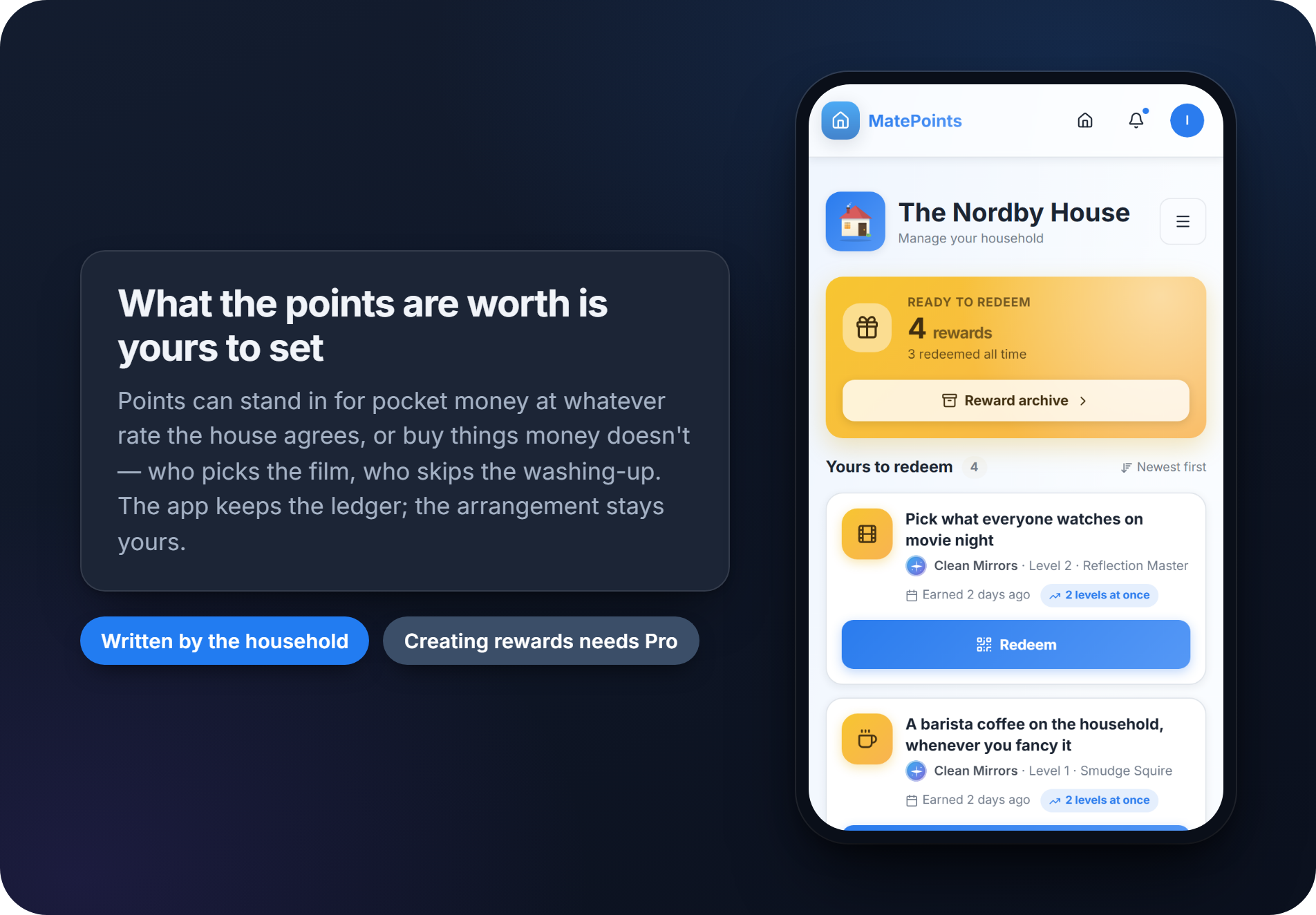
Rewards get written by the household, so points can stand in for pocket money at whatever rate you agree, or buy the things money is awkward for — who picks the film, who's off the washing-up on Friday. Setting up a household, the chore list and the approval queue is free; creating achievements with rewards attached, and running more than one household from a single account, need MatePoints Pro. If you want the longer version of what the app does and doesn't do, we wrote an honest comparison against the alternatives.
One launch conversation where the kids help set the rates, a chart everyone can see, and a payday that never moves. None of it is complicated. The consistency does the work.
Sources
- Chores or no chores? The economic psychology of giving kids pocket money — Gigi Foster, UNSW, August 2026
- Undermining children's intrinsic interest with extrinsic reward — Lepper, Greene & Nisbett, Journal of Personality and Social Psychology, 1973
- Average weekly allowance by age — Greenlight, 2025
- Youth financial education — Consumer Financial Protection Bureau
- A parents' guide to chores and allowance — Union Bank & Trust