The Christmas mental load: who owns what this year
Share the Christmas mental load before December: nine categories, one owner each from idea to done, one evening in November and a weekly check-in.


The Christmas mental load is the second job that lands on top of the house every December: the gift list, the cards, the food order, the travel, who goes where on which day. Most of it falls to one person by default, and most of it stays invisible until it is late. This guide turns it into a plan you can set up in one evening in November: nine Christmas categories, one owner for each from idea to done, and a fifteen-minute check-in every week of December.
Who carries Christmas now
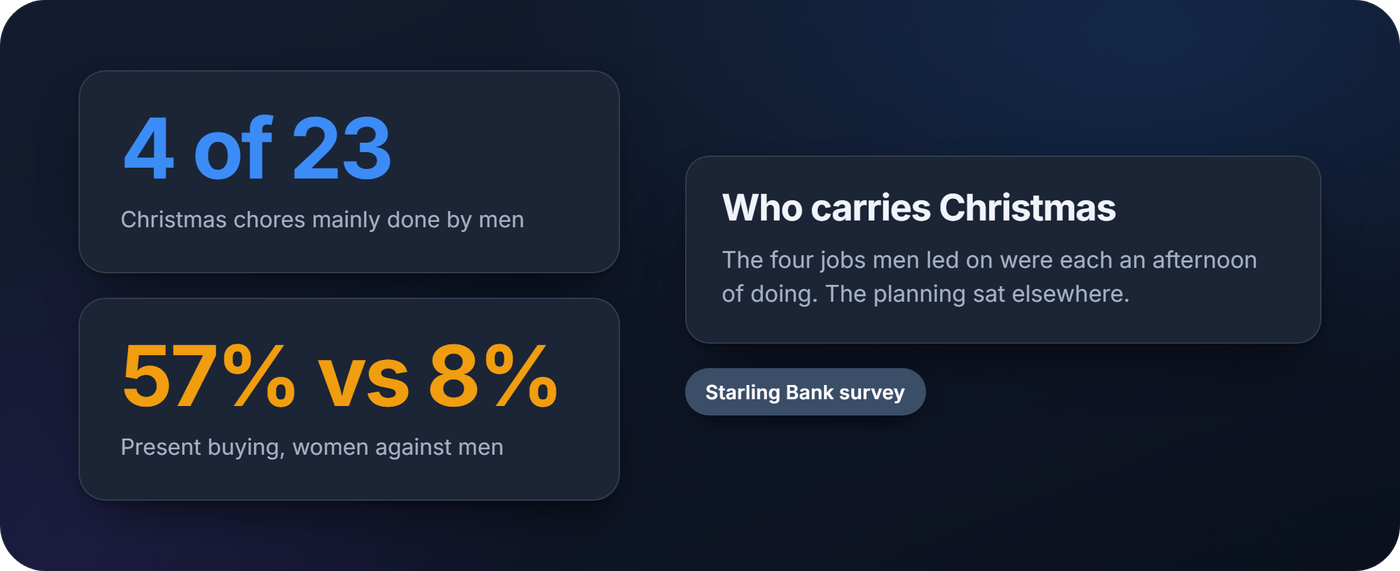
The default split is lopsided. In a survey for Starling Bank, reported by Yahoo News UK in December 2023, men were mainly responsible for just four of 23 Christmas chores. Present buying was seven times more likely to fall to women (57% against 8%). Wrapping split 58% to 10%, and planning and buying the Christmas meal 51% to 12%. The article gives no sample size, so read the exact numbers loosely. The shape is hard to miss.
Look at the four jobs men led on: carving the turkey, getting rid of the tree, washing up after Christmas dinner and untangling the fairy lights. Each one is an afternoon of doing. None of them needs planning in November.
The pressure is rising too. In the APA Healthy Minds Poll released in November 2025, 41% of US adults said they expected more holiday stress than the year before, up from 28% in 2024. In Calm's poll of 1,000 mothers in October 2025, 59% named the mental load of constant planning and scheduling as a source of stress.
For the wider picture of what the mental load is and how researchers measure it, start with how to share the mental load. This article is narrower: Christmas, this year, starting now.
Helping is not owning
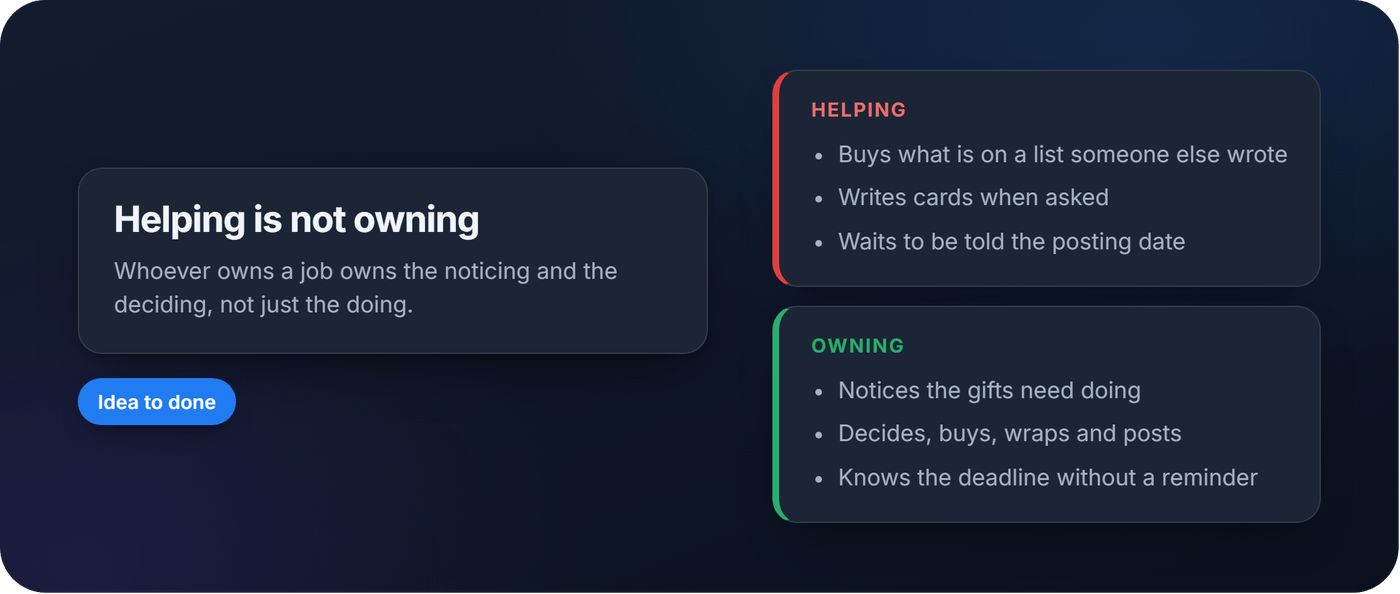
Most couples already share Christmas in one sense. One person writes the gift list and the other buys what is on it. One person notices the cards have not gone out, and the other writes a few when asked. The doing is split. The noticing, deciding and chasing stay with one person.
Eve Rodsky's Fair Play system draws that line clearly. In a 2019 interview with Ms. Magazine, she described the aim as "one person will conceptualize, plan and execute (CPE)" each task. Brian Page, a Fair Play facilitator, applies it to the holidays in a December 2025 piece for Modern Husbands: "whoever owns a task owns all three stages."
That is the whole idea. If you own the cards, you notice they need doing, decide who gets one, buy them, write them and post them. Nobody has to remind you, because the reminding is part of the job.
The nine Christmas categories
Split Christmas into areas big enough to own, not into errands. Here is a list to start from. Merge or cross out whatever does not apply to your household.
- Budget. Agree the total, then keep an eye on it through December.
- Gifts. The list, the buying, the wrapping and anything that needs posting.
- Cards and messages. Who gets one, writing them, the last posting day.
- The main meal. The menu, the food order, the shopping, the plan for the day.
- Hosting and travel. Beds for guests, tickets or fuel, who drives.
- The family calendar. Which day you spend where, and telling everyone.
- Decorations. The tree up and down, the lights, the boxes back in the loft.
- Kids' events. School concerts, costumes, teacher gifts, the class party.
- After Christmas. Returns, thank-yous, the tree out, the leftovers.
One category, one owner. The other person can help, and asking for help is not handing the category back. Aim for an even share of the load rather than an even count: gifts for a large family can outweigh three small categories. For a fuller way to weigh a split, see dividing household chores.
The handover evening in November
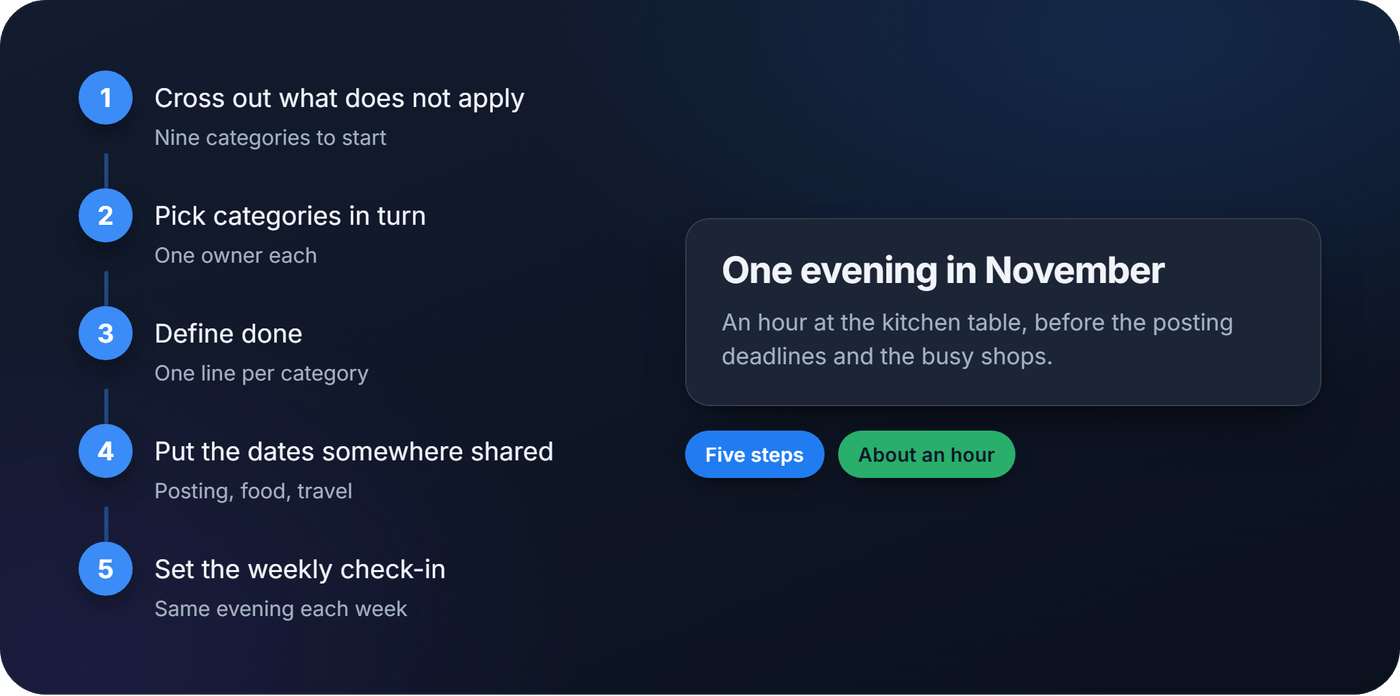
Pick one evening in early November, before the posting deadlines and before the shops fill up. Erin Pash, a licensed marriage and family therapist, told mindbodygreen in November 2024 that couples should "find a time to sit down and map it out", covering "your budget, who you're buying for, who will handle which gifts, and of course, your family calendar." Her tip for clashing priorities: write yours down in order, and "you each have to at least do your partner's top two."
An hour is enough:
- Read the categories aloud and cross out what does not apply.
- Take turns picking categories until every one has an owner.
- Each owner says what done looks like, in one line. "Cards posted by 12 December" is a standard. "Sort the cards" is not.
- Each owner puts their key dates somewhere shared: the last posting day, the food order, the travel booking.
- Agree a time for the weekly check-in.
Then let go. Psychologist Stacey Dankner Lessans makes the point bluntly in Motherly (updated 2022): "If you delegate and also then micromanage what you have delegated, you are not actually reducing your stress." If the presents are wrapped differently from how you would do it, they are still wrapped.

Put every date where both of you can see it
The categories can live in your heads. The dates cannot. A paper calendar on the fridge works, and so does a shared phone calendar. What matters is that the posting deadline is visible to both of you, so the owner does not carry it alone and the other person never has to ask.
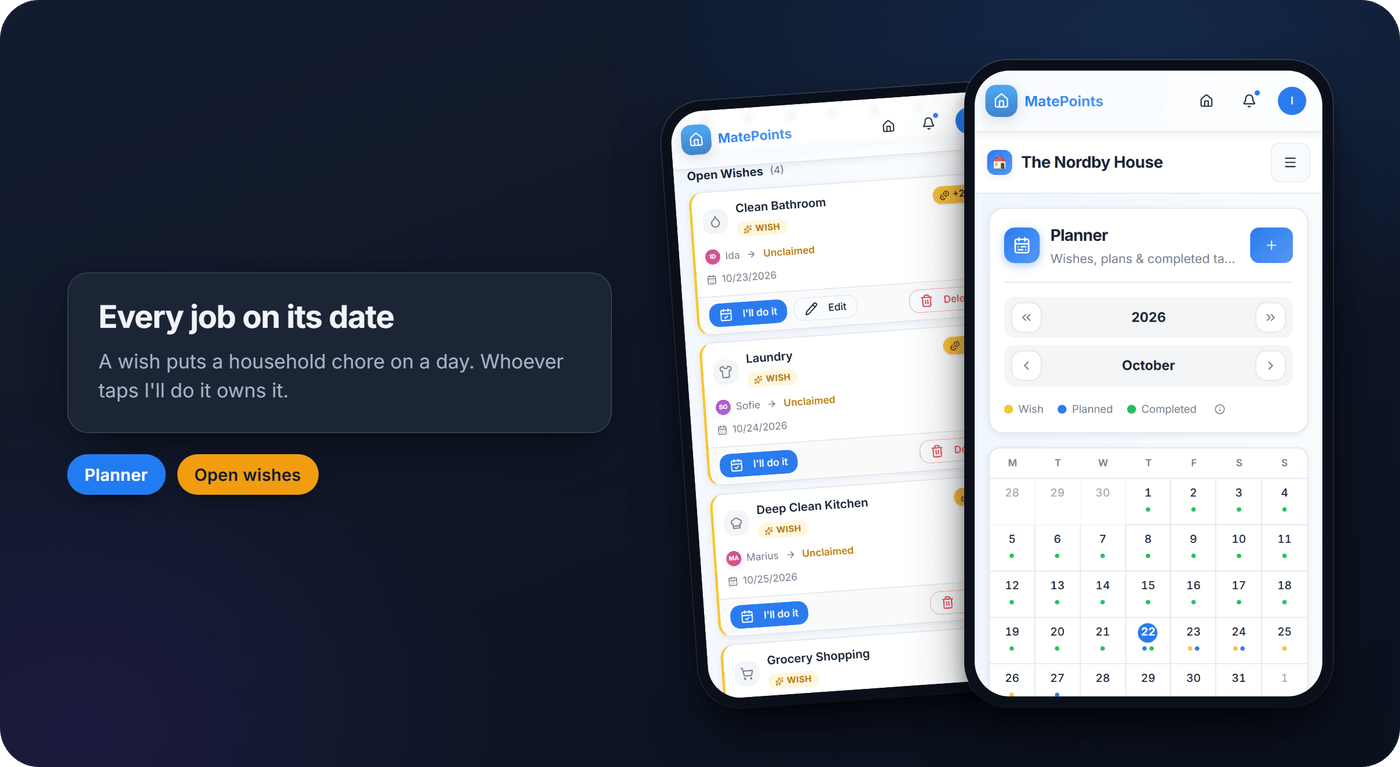
If your household uses MatePoints, the Planner does this job. Add the Christmas jobs as household tasks, then put each one on its date as a wish. Everyone else in the household gets a notification, and whoever taps I'll do it owns that job for the day. The category owner claims their own jobs straight away. Anything left open is a visible request for help, not a reminder somebody has to deliver in person. The free plan is enough to start, so begin with the jobs that have a hard date.
The December check-in
Brian Page suggests a weekly holiday check-in in the same Modern Husbands piece: fifteen minutes on "schedules, worries, money decisions, and emotional stressors." Dankner Lessans also recommends several check-ins through the season. Keep yours short and on the same evening each week:
- Each owner: what is done, and what is next.
- The dates coming up in the next seven days.
- Anything nobody owns yet. Give it an owner.
- The budget, in one sentence.
- One thing the other person handled without being asked.
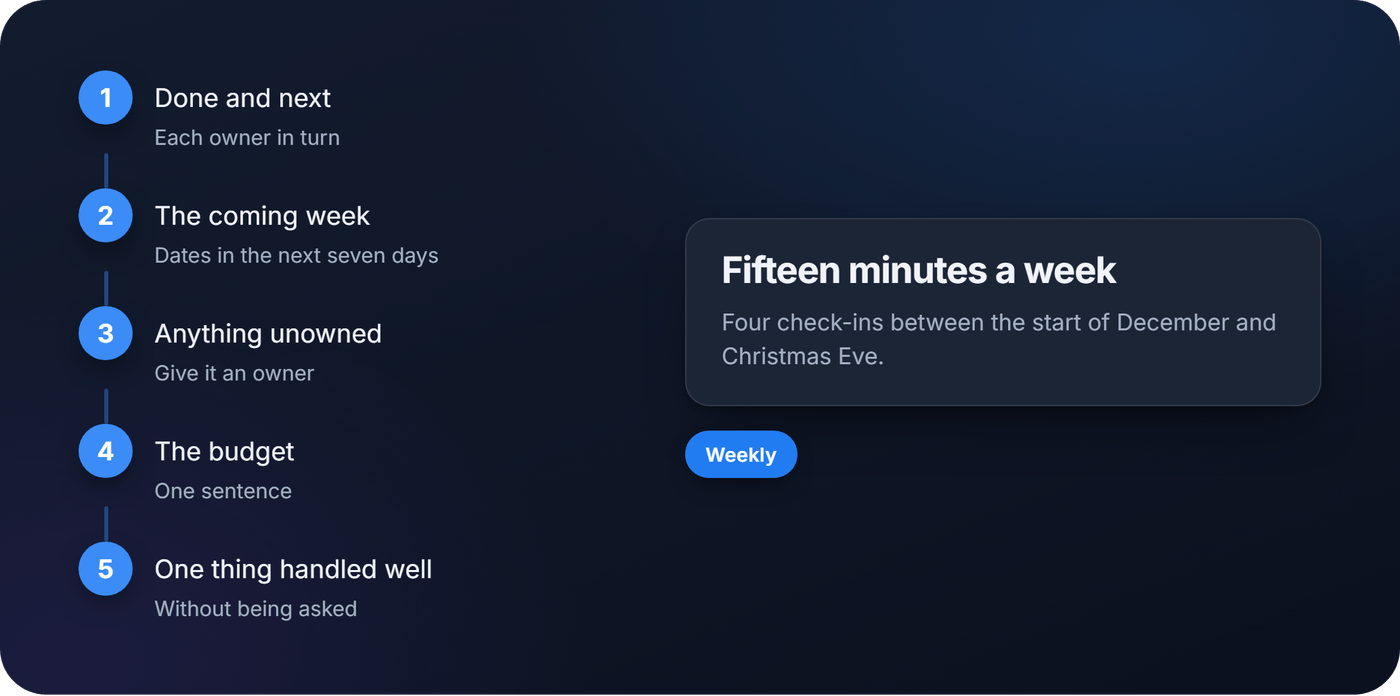
Four check-ins between the start of December and Christmas Eve is enough. The last one is the most useful: it is where the after-Christmas category gets remembered before everyone is too tired to think about it.
If Christmas has already started
Maybe the gifts are half bought by the time you read this. Hand over the rest of the category anyway, but hand over a list, not a memory: who is done, who is left, what was already ordered. A category handed over without its list is still half yours.
Hosting Thanksgiving first? Our Thanksgiving chore list gives the meal the same treatment, and the owners you pick in November carry straight on into December. And if anyone at the table thinks this is a lot of fuss over a few presents, the case for counting this work as work is in the value of unpaid housework.
Start this weekend
The Christmas mental load does not shrink by being shared out in December. It shrinks when each part of it has an owner in November. Write the nine categories on a piece of paper, pick an evening, and take turns.
If you want the dates in one place both of you can see, MatePoints is free to start. Put the first Christmas job in the Planner as a wish tonight, and see who claims it.
Sources
- Men manage just four out of 23 tasks during Christmas, Starling Bank survey, Yahoo News UK, December 2023
- Americans are More Anxious than Last Year About the Upcoming Holidays, APA Healthy Minds Poll, American Psychiatric Association, November 2025
- Calm is helping all "not calm" parents make it through the holidays, Calm, 2025
- Eve Rodsky Wants Feminist Partners to Play Fair, Lisa Niver, Ms. Magazine, October 2019
- How to Balance Emotional Labor and Mental Load in a Marriage: Holiday Edition, Brian Page, Modern Husbands, December 2025
- The Mental Load Amps Up A Lot Around The Holidays, Sarah Regan, mindbodygreen, November 2024
- 9 ways mamas can share the mental load this holiday season, Stacey Dankner Lessans, Motherly, updated November 2022