Roommate agreement: write a chores clause that works
Roommate agreement chores, written to hold: a fill-in clause, what done means for the bathroom, kitchen and bins, missed jobs and a review date.

Most roommate agreement chores sections say one thing: we share the cleaning. Then they stop. That line feels fair on the day you sign it and settles nothing three weeks later, when the bathroom is grim and everyone thinks it was someone else's turn. This guide gives you the rest of the clause: a fill-in version you can copy, a written standard for the bathroom, kitchen and bins, what happens when a job is missed, and a date to review it.
Why "we share the cleaning" is not a chores clause
Look at the templates that rank for this. June Homes' free roommate agreement template, for example, says that "each roommate agrees to share the responsibilities of cleaning and maintaining the residence" and then offers an attached schedule or cleaning together "at a designated time". Zumper's guide goes a step further and tells you to "clearly state the consequences if a roommate neglects their chore duties", suggesting fines or penalty chores. Neither says what clean looks like.
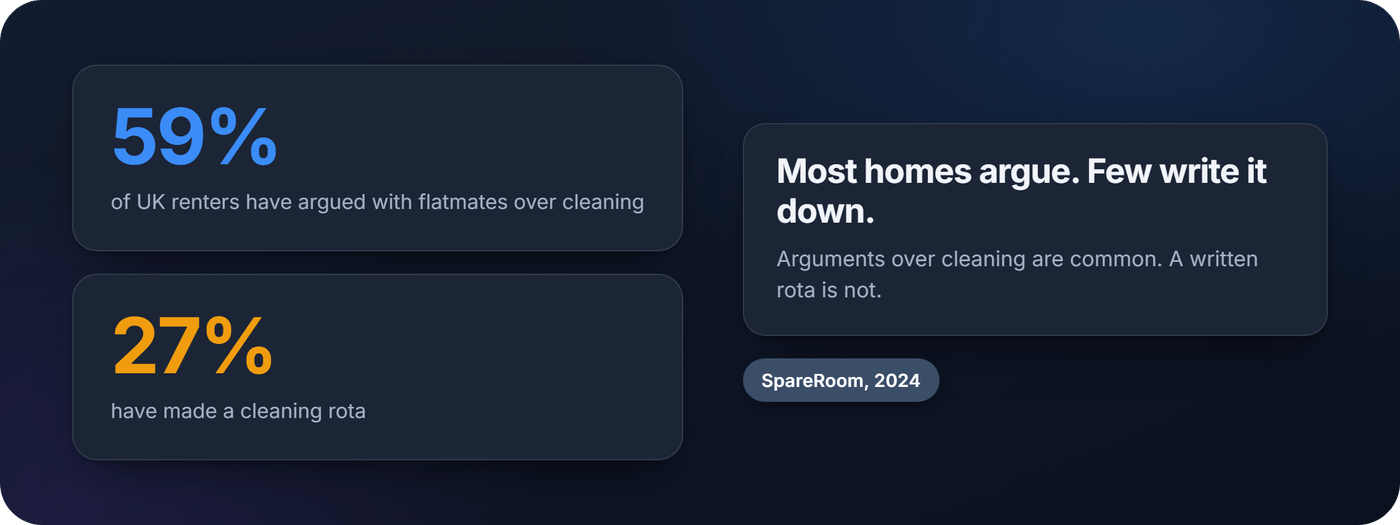
That gap is where the arguments live. In 2024 data from SpareRoom, reported by Property Reporter, 59% of UK renters said they had argued with flatmates over cleaning. Only 27% had made a cleaning rota, and 28% had no system at all. StorageCafe makes a similar point: in its 2026 guide to living with roommates, 60% of roommates cite cleanliness as the biggest source of conflict, ahead of noise at 36%.
The five parts of a chores clause that works
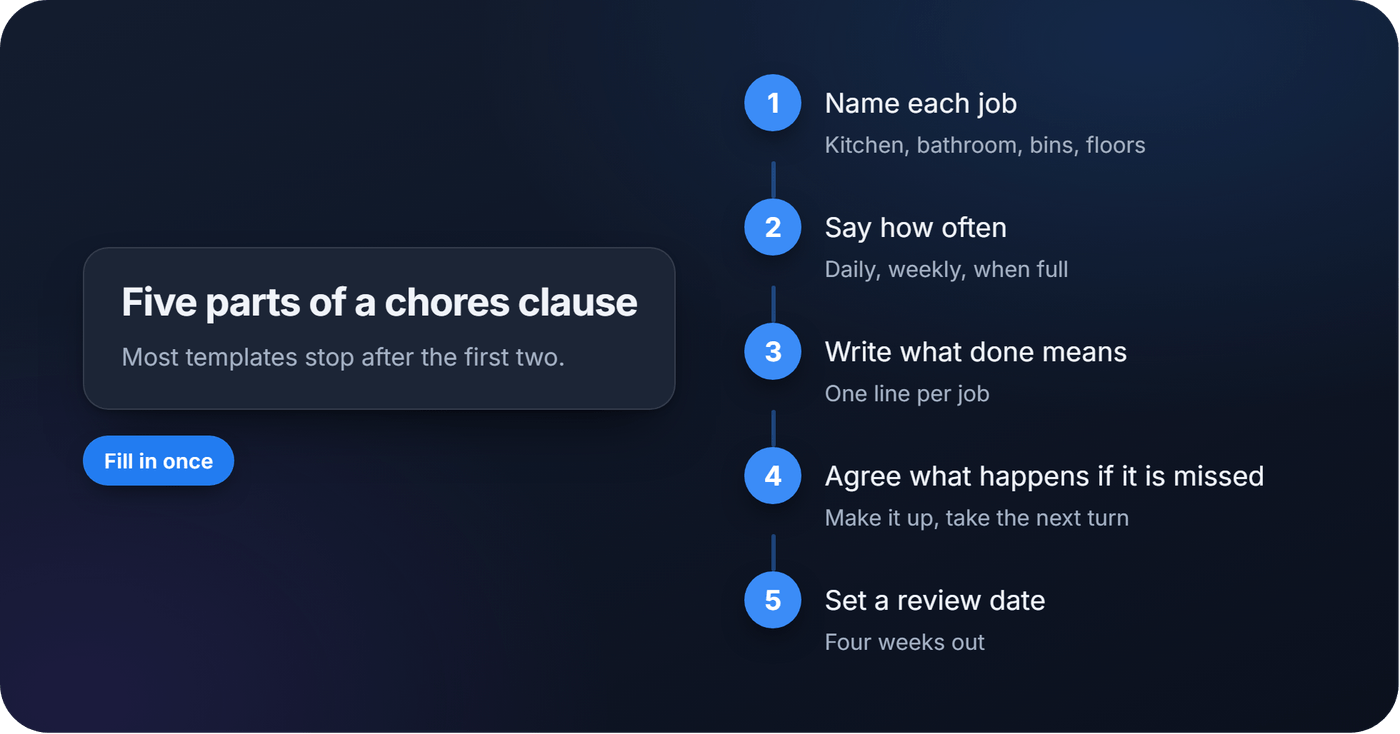
A clause that holds up answers five questions. Most templates answer the first two.
- Which jobs? Name each shared job: kitchen, bathroom, bins, floors, recycling. Bedrooms stay out of it. Zumper's template makes the same call: each person cleans their own room.
- How often? Daily, weekly, or "when full". Write it next to the job.
- What does done look like? One line per job. This is the part nobody writes, and the part that ends most arguments.
- What happens when a job is missed? Agree it now, while nobody is annoyed.
- When do we review it? A date, not "if something comes up".
A fill-in chores clause you can copy
Paste this into your agreement and fill in the brackets together. Keep the standards in a short list underneath, so you can change them without rewriting the agreement.
Chores. We share the cleaning of the kitchen, bathroom, living room and hallway. Each of us cleans our own bedroom.
- Jobs. [Job] is done [how often] by [name], or on a rota that rotates every [week] in this order: [names].
- Done means. A job is done when it meets the standard in the list below.
- Swaps. If you can't do your job, swap it with someone before it is due and tell the others.
- Missed jobs. If a job is missed, the person who missed it does it within [48 hours] and takes the next turn of it too.
- Checking. [Name, or whoever is next on the rota] checks shared jobs. If a job is not done to the standard, they say what is missing.
- Review. We review this clause on [date, about four weeks from today] and every [three months] after that.
Treat the clause as what it is: an agreement between housemates, built on trust. It works because everyone helped write it and signed it, not because anyone can force it.

Write down what "done" means: bathroom, kitchen, bins
Here are three example standards. Change the details to suit your home, but keep each one short enough to check in ten seconds.
Bathroom, weekly. Toilet cleaned inside and out. Sink, taps and mirror wiped. Shower or bath rinsed and wiped down. Floor mopped. Bathroom bin emptied.
Kitchen, daily. Your own dishes washed, or in the dishwasher, before bed. Hob and counters wiped. Sink empty. Once a week, whoever has the kitchen also clears out-of-date food from the shared fridge shelves.
Bins, when full. Emptied when full, not when overflowing. A new bag goes in straight away. Recycling sorted. Bins out on collection night and back in the next day.
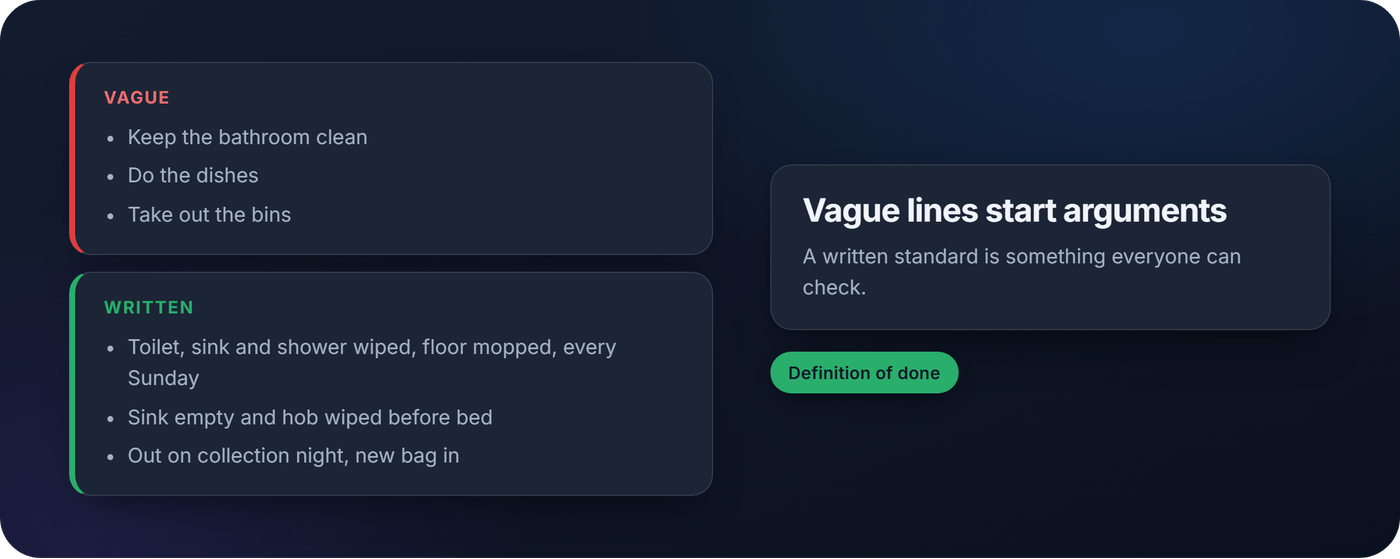
A standard is not a judgement on anyone's habits. It just means two people with different ideas of clean are checking against the same line. For more on why a written "done" matters, see our guide to weaponized incompetence and chores.
What happens when a chore is missed
Jobs will be missed. Exams, late shifts and flu happen. A clause that treats every miss as a crisis will be ignored by week three.
Keep the rule simple and proportionate. A missed job is made up within a set time, and the person who missed it takes the next turn too, so the cost lands on them rather than the rest of the house. Zumper mentions fines as an option. Think hard before you add money: it turns a cleaning question into a debt, and a debt between flatmates is harder to settle than a dirty hob.
If the same job keeps being missed, the clause has done its job by making that visible. That is the moment for a calm conversation, not a new rule. Our guide on how to talk to a messy roommate covers what to say and what to bring.
Who checks that a job is done
The clause above names someone to check. That sounds formal, but it removes the worst part of shared cleaning: the silent inspection where everyone judges and nobody says anything.
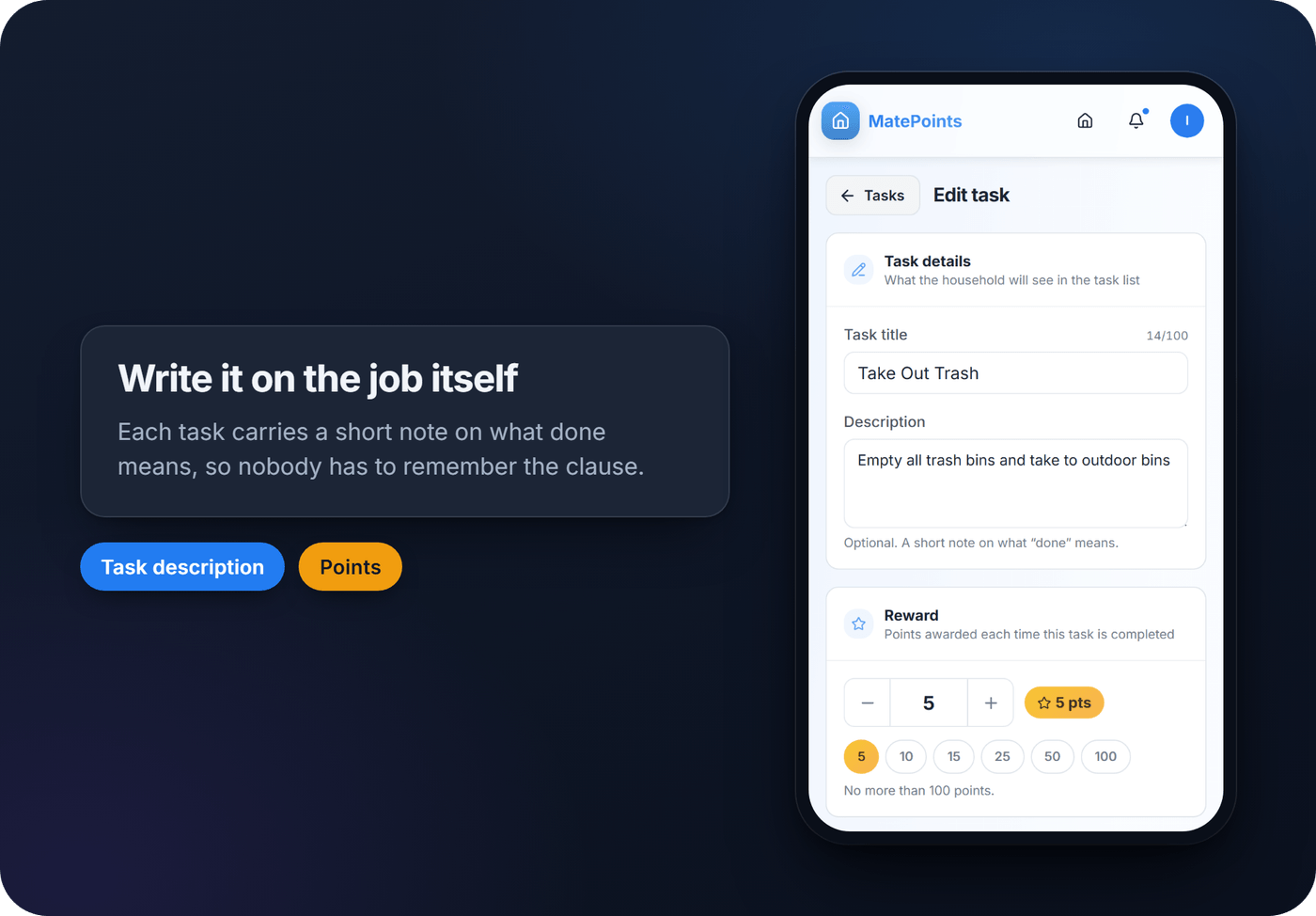
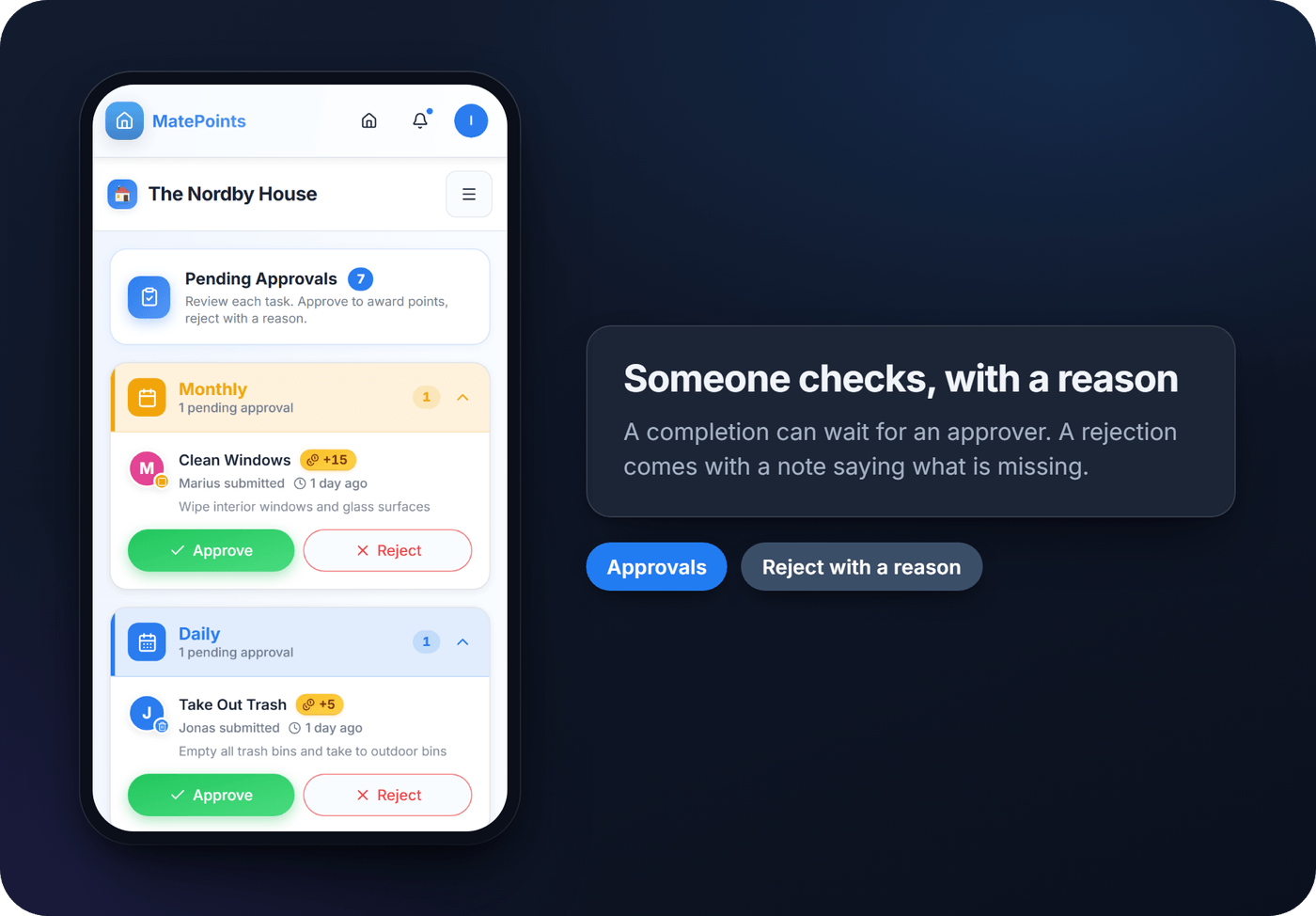
If your home uses MatePoints, this part is built in. Each task has a short description of what "done" means, so the standard sits on the job itself. A completion can wait for an approver: anyone with the Approver, Editor or Owner role can approve or reject it, and a rejection needs a reason, which the person who did the job sees on their Task Status page. "Mirror still streaky" is easier to hear than a sigh.
The same queue shows every pending job at a glance, grouped and with its points, so checking takes a minute rather than a walk round the flat.
Put a review date in the clause
The first version of your clause will be wrong somewhere. The bathroom standard is too strict, the bins rota ignores who leaves the house first, or someone's timetable changed. A review date turns that from a broken agreement into a planned edit.
Put the first review about four weeks after you sign. Sit down for ten minutes and ask three questions. Which jobs keep getting missed? Which standard is unclear? Is the split still fair? Change the list, keep the clause, and set the next date.
Running the rota itself is a separate job from writing the clause. Our roommate chore chart has two templates you can use for that, a rotation grid and a chore wheel.
Write it once, then let it run
A good chores clause is short. It names the jobs, says how often, says what done looks like, says what happens when a job is missed, and says when you will look at it again. Most of the arguments it prevents never happen, because the answer is already written down.
If you want the standards, the checking and the record in one place, MatePoints is free to start. Add your shared jobs, write what done means on each one, and use approvals so every completion gets a second pair of eyes.
Sources
- Free Roommate Agreement Template with Guidelines, June Homes, 2025
- Roommate Agreement Template, Zumper, October 2023
- Majority of UK renters hit with cleaning-related deposit deductions, SpareRoom data, Property Reporter, June 2024
- How to Make Living with Roommates Work in Real Life, Maria Gatea, StorageCafe, May 2026