Achievement badges for chores: designing ones people chase
Achievement badges change behaviour when each one is a contract, not a sticker. The five fields to settle, and how to spot a badge that stopped counting.

An achievement badge in a chore app is a marker awarded when someone hits a defined target: a number of completions, a first crack at the job nobody wants, a level passed. It is not a certificate and not a scout patch — it is a row in a log, triggered by a tap, a scan or a check-off, and it shows up on a profile where the rest of the household can see it.
Whether it changes anything depends almost entirely on what it certifies. A badge for "logged in five times" teaches nothing. A badge for "deep-cleaned the bathroom three weekends running" teaches consistency.
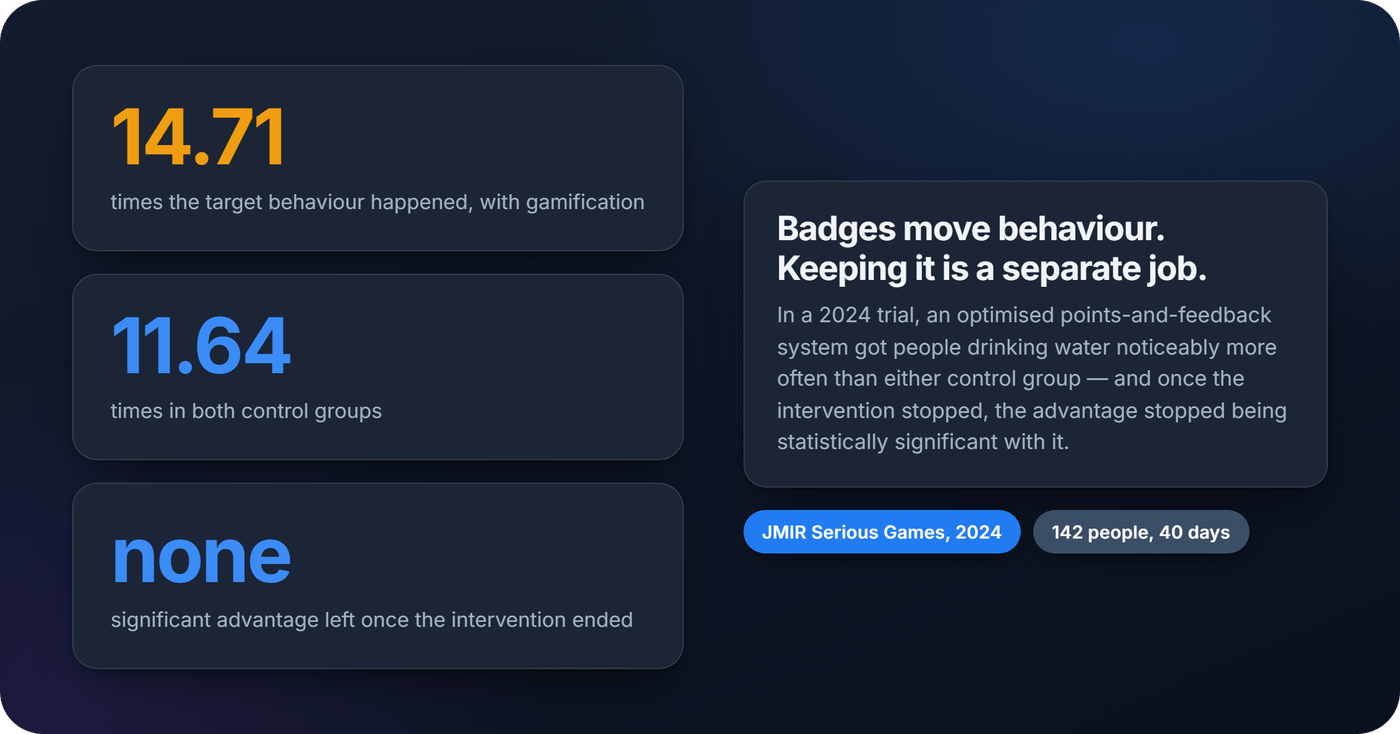
Badges do move behaviour, and there is decent evidence for it. In a 2024 study in JMIR Serious Games, Lieder and colleagues gave 142 people a points-and- feedback system tuned to a mathematical model and measured how often they drank water over 40 days. The gamified group enacted the behaviour a mean of 14.71 times against 11.64 in both control groups. It was water rather than washing-up, and the participants were recruited online rather than living together — but the mechanism is the one a chore badge uses.
The same paper carries the warning. Once the intervention stopped, the authors report, "the additional benefits of reinforcement ceased to be statistically significant". Badges are good at moving behaviour while they are running. Keeping it afterwards is a separate job, and no badge design solves it for you.
What a badge actually certifies
The most useful research here is not about badges in general but about which game elements meet which psychological need. Self-determination theory holds that motivation depends on three: competence, autonomy and relatedness. An experiment by Sailer, Hense, Mayr and Mandl separated the elements and tested them against each other.
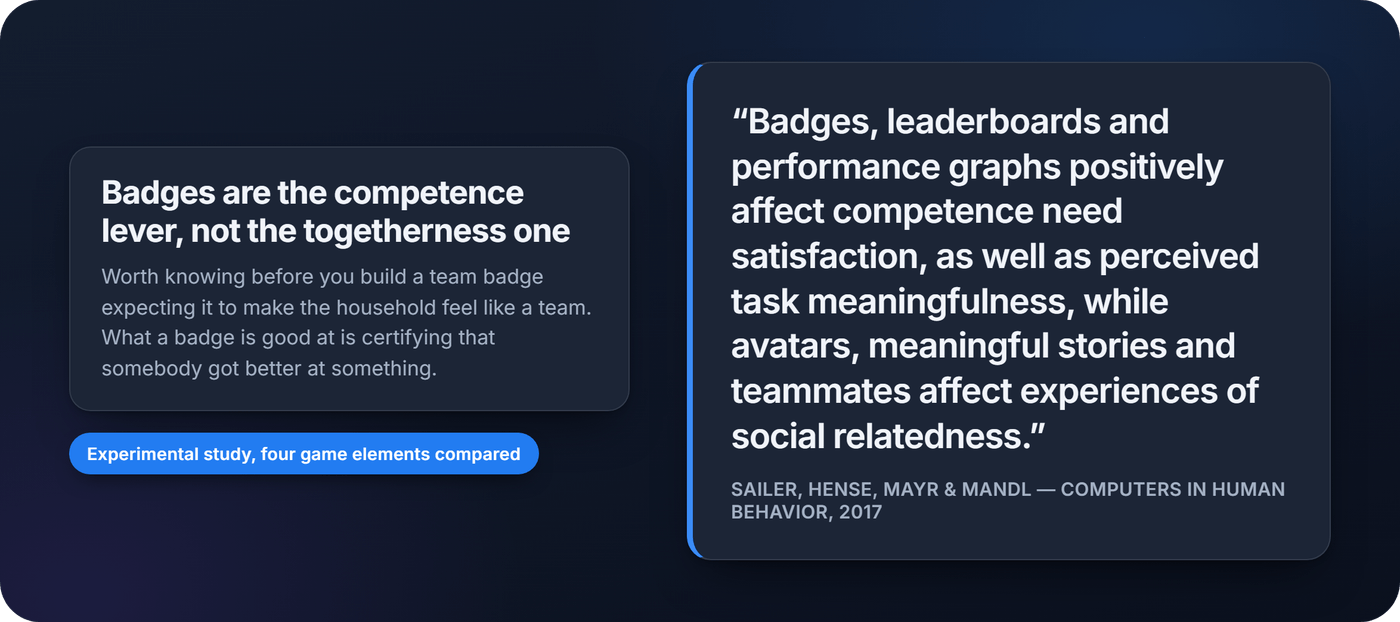
Their finding is specific, and it is worth reading before you design anything: badges, leaderboards and performance graphs affect competence and perceived task meaningfulness, while avatars, meaningful stories and teammates are what affect social relatedness.
So a badge is a competence instrument. It is not the thing that will make a household feel like a team, and a "team badge" built in the hope that it will is being asked to do a job the evidence says it does not do. That does not make shared goals a bad idea — it means the togetherness has to come from somewhere else, and the badge has to certify that somebody actually got better at something.
Autonomy is the other one worth guarding. Force a badge system on an adult housemate and you can undercut exactly the motivation you were trying to build. Let people opt into optional badges, or pick which chores they want to chase, rather than mandating a single ladder everyone climbs.
Write the badge like a contract
Scavify's gamification guide has the right phrase for this: treat each badge like a mini-contract. If a household member cannot tell exactly what earns it, the badge has already failed. Five things have to be settled before it goes live, and settling them afterwards is how arguments start.
- What it certifies. A behaviour, named as a behaviour. "Does their share" is not a badge. "Cleaned the bathroom" is.
- The exact number, and the ladder above it. Five completions, twenty, fifty. Then the next rung, and the one after. Not one threshold — a climb.
- What counts as done. Whether a tap logs it outright, or another member has to approve it. This is the field people skip, and it is the one that decides whether the badge means anything.
- Who hands it over. For anything with a payout, it should not be the person who earned it. Self-award is how a system quietly stops being evidence of anything.
- What it pays. Decided before the badge goes live. A badge that unlocks nothing is a sticker, and a payout invented after the fact is a negotiation.
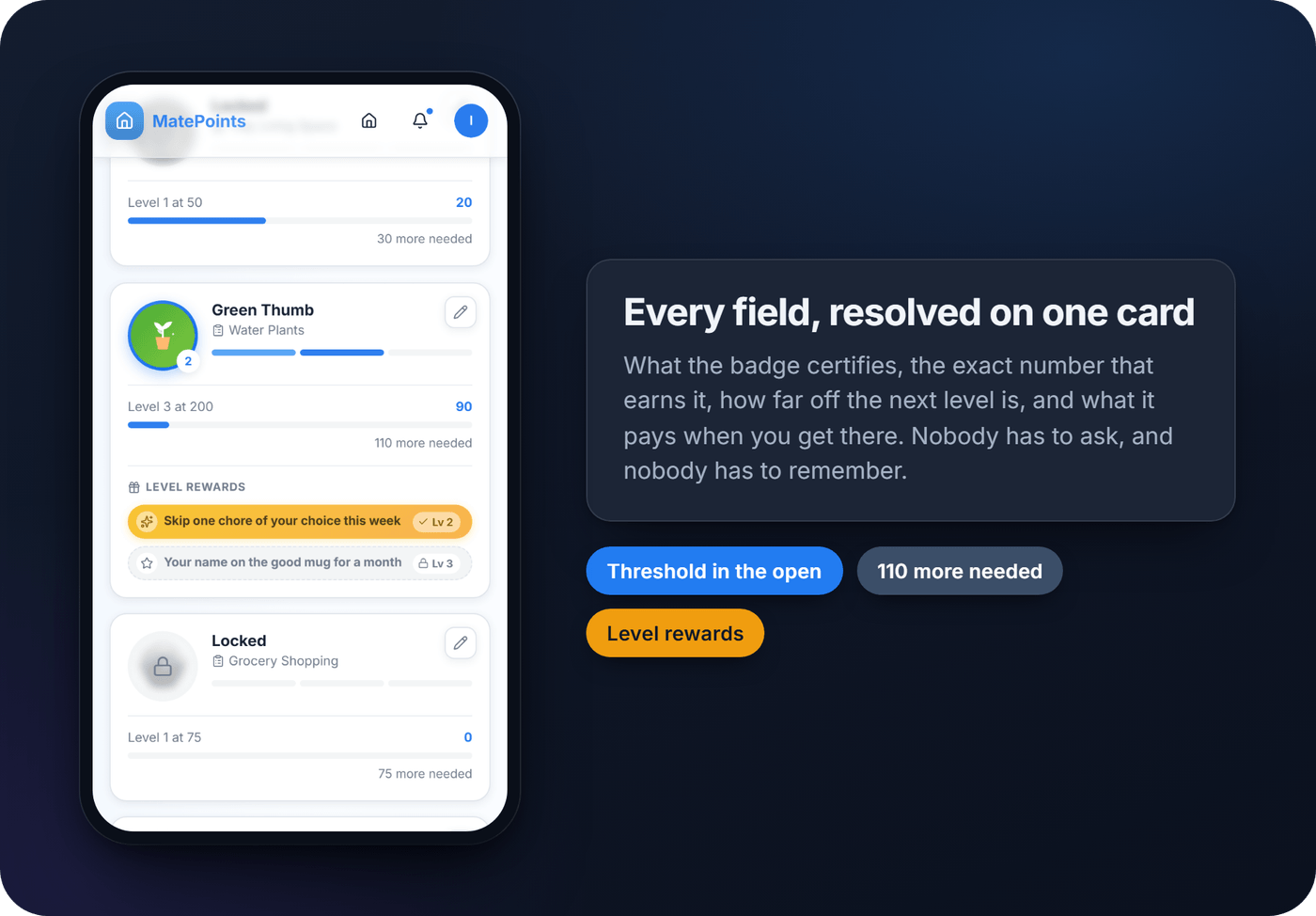
Threshold design matters as much as the fields. Shorten the path to the first badge so a new member sees progress before they lose interest, then make each one after it a little more demanding. A visible ladder beats a flat wall, and the gap between rungs is the only lever you have for pacing. Shorten it further still if anyone in the house has ADHD — a delayed payoff barely registers against an immediate one, and a first badge fifty completions away is a delayed payoff.
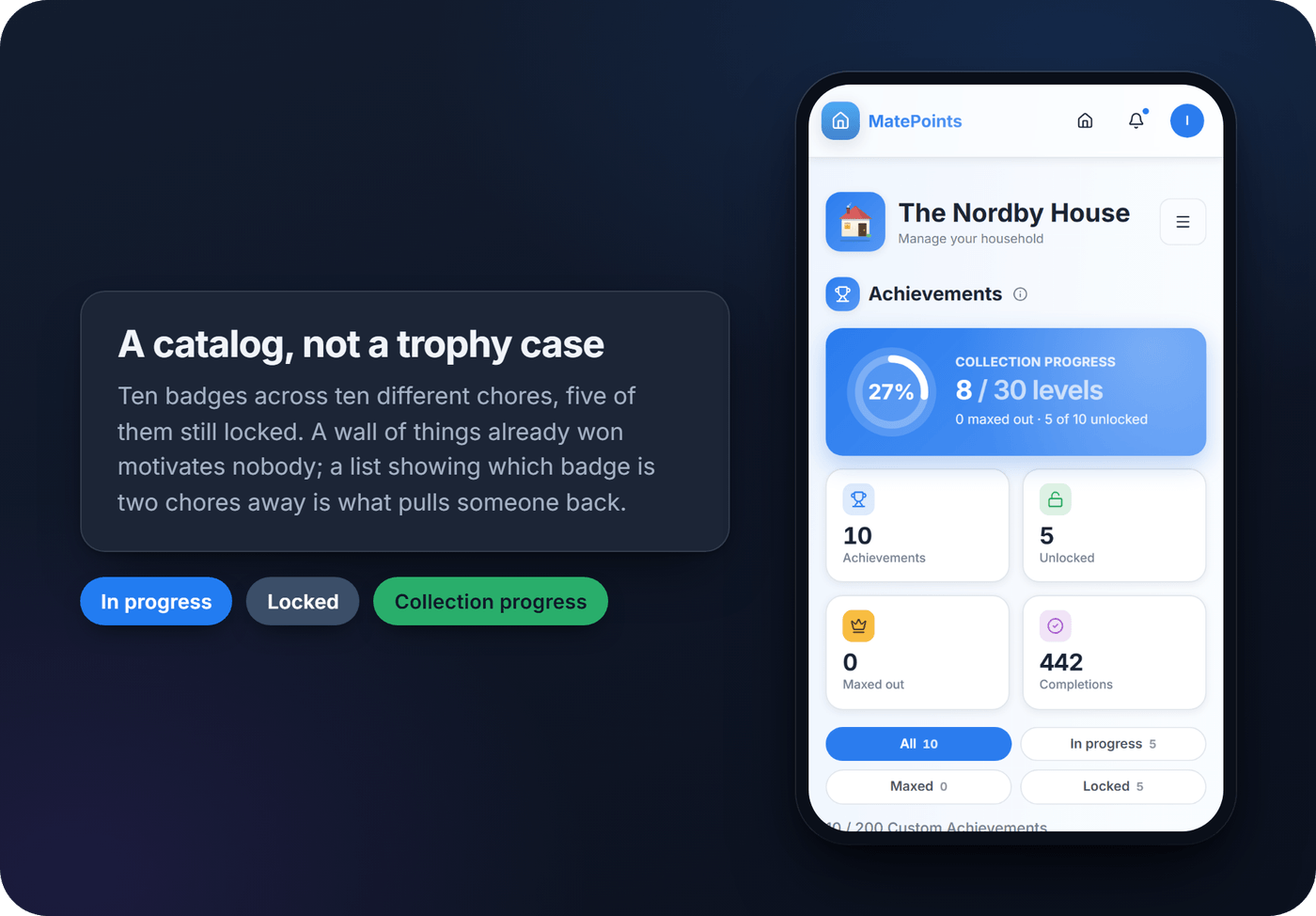
Pro tip: Show the closest unlock on each member's view, not just the badges already earned. "Two more and you're there" pulls people back to finish something. A trophy case of things already won does not.
Pilot a new badge with a couple of people first, then look at how the awards actually landed after a fortnight before rolling it out to the whole house.
Badge types that fit household chores
Not every badge has to work the same way, and a varied catalogue covers more reasons to care at once. That is not just a hunch: a diary and interview study of 81 university students using Khan Academy and Codecademy found that people functionalise badges in nine distinct ways that only partly match what the theory predicted — the same badge motivates different people for different reasons.
- Milestone badges — one-time, like "first deep clean" or "100 chores logged". Best for early momentum.
- Streak badges — consecutive days or weeks, like a seven-day dish streak. These need a grace period, or one bad Tuesday wipes out a fortnight.
- Competency badges — verified by another member, for jobs with a quality bar rather than a count.
- Team badges — a shared goal for the household or a pair of housemates. Useful, but see the section above about what a badge can and cannot do socially.
- Seasonal badges — tied to a stretch of time, like a spring-cleaning push, which refresh novelty without permanently growing the catalogue.
Rolling it out, and spotting badge inflation
Launching a full catalogue at once confuses more than it motivates. Pick three behaviours you genuinely want to change, narrow to the two that matter most right now, write their contracts, and run them for two to four weeks while you watch who earns what. Set the visibility rules early — whether badges show on a shared board or stay private — and review quarterly, retiring the ones nobody chases any more.
Then watch four numbers: completion rate, whether people are still using the thing, average points per active member, and how the badges are distributed. That last one is the tell. If one person holds every badge, the thresholds are too easy for them and too hard for everyone else.
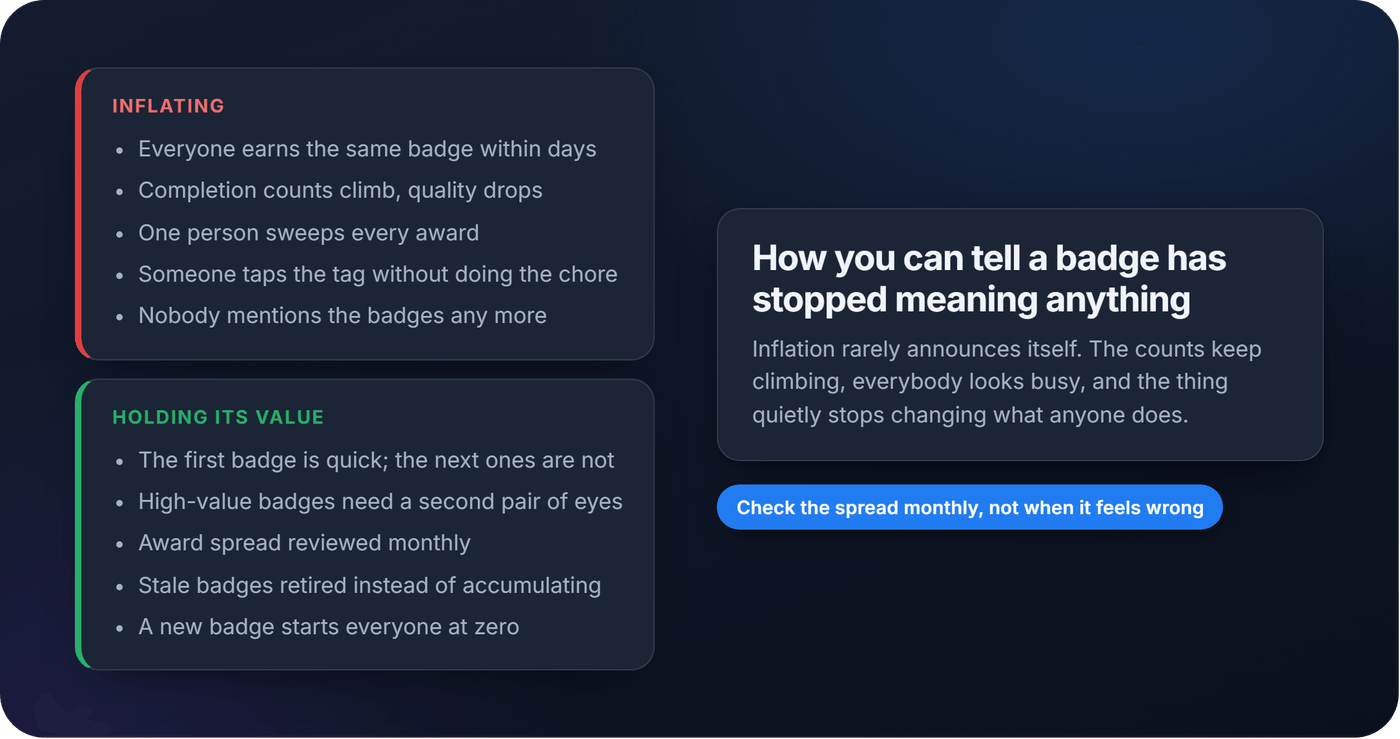
Badge inflation does not announce itself. Everyone earns the same badge within days; completion counts climb while the actual quality of the work drops; somebody starts tapping a tag without doing the chore. Counts alone can look healthy right up until the system has stopped changing what anyone does, which is why the number to watch is behaviour, not badges earned.
The structural defence is worth building in from the start: a badge created today should not be earnable with work done last month. If a new badge can be satisfied by history, everyone unlocks it the moment it appears and it never means anything to anybody.
What this looks like in MatePoints
MatePoints calls these achievements, and an achievement is attached to one specific chore with three levels above it — bronze, silver and gold, each with its own art, title and threshold. That shape settles several of the five fields for you:
- Criteria are a count of completions of that chore, and the database refuses to save a ladder that does not climb: level two has to need more than level one.
- Evidence is the approval state. Only approved completions count toward a level, so whatever your household decided counts as done is what the badge certifies. Logging can be a tap or a scan for daily jobs, which needs a household owned by a Pro member.
- The issuer is enforced rather than suggested: a reward has to be handed over by an approver or owner who is not the person who earned it.
- What it pays is a reward attached to a level, granted the moment somebody crosses it. Pick the film, a barista coffee, Friday takeaway — whatever the household actually wants, which is worth keeping varied for the same reason a reward menu should not be all screen time.
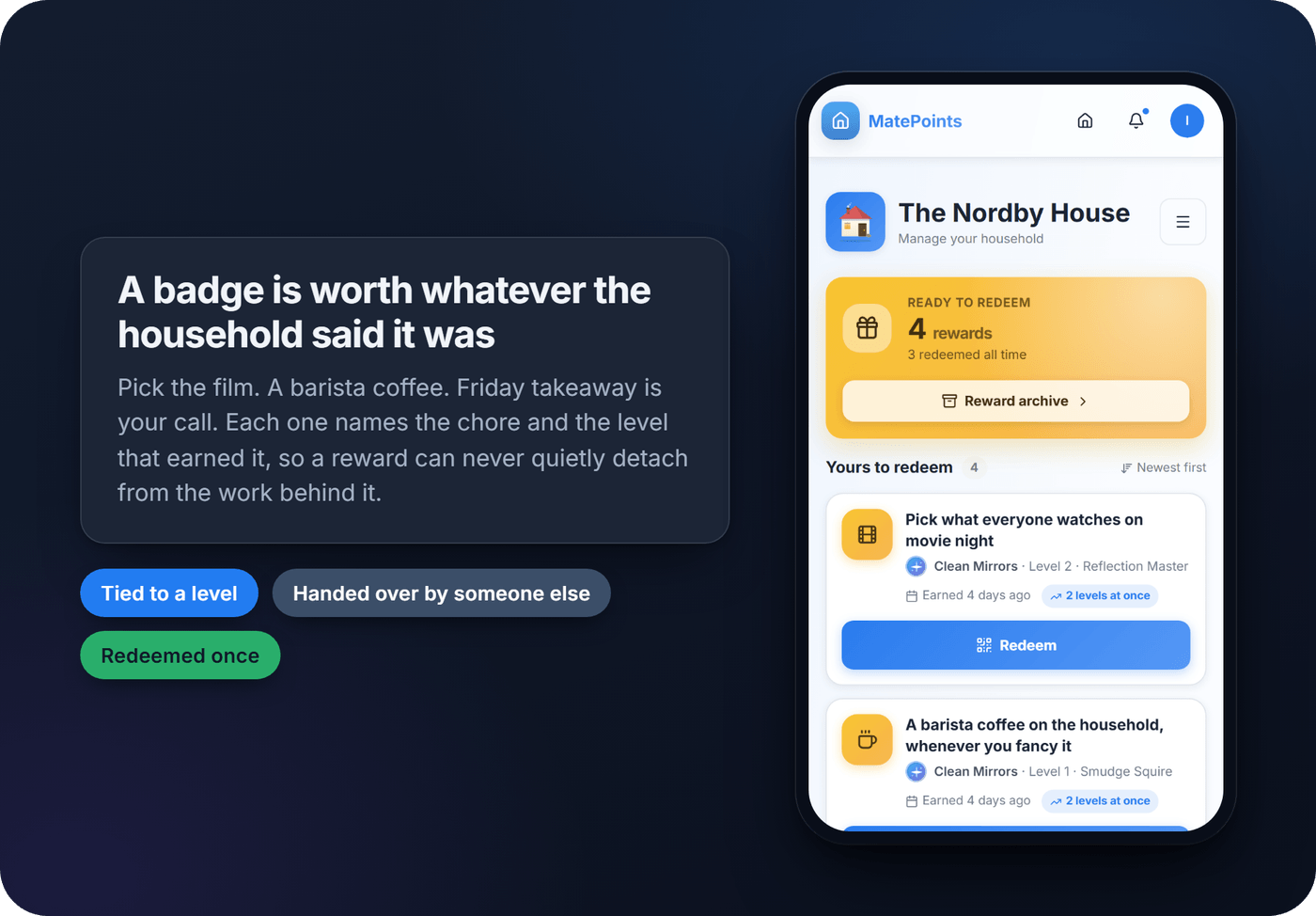
Two things are worth knowing before you plan around it. Completions logged before an achievement was created never count toward it, and a reward added to a level later does not pay out retroactively unless you explicitly grant it — so a new badge genuinely does start everyone at zero, which is the anti-inflation rule above, built in. And creating your own achievements is a Pro feature; Free households get the default set.
The honest limit: because criteria are a count of completions of one chore, the milestone and competency badges above map onto it directly, and streak, team and seasonal badges do not. Those are still good ideas. They are just not things you can express in MatePoints today.
What I'd fix first
The most common mistake is launching a dozen badges at once with fuzzy criteria, then wondering why nobody chases them. The fix is almost always the same: cut the catalogue down, shorten the first win, and show people exactly how close they are to the next one. Badges should certify what the household actually values, not turn the place into a single-winner competition.
Sources
- How gamification motivates: An experimental study of the effects of specific game design elements on psychological need satisfaction — Sailer, Hense, Mayr & Mandl, Computers in Human Behavior, 2017
- Gamification of Behavior Change: Mathematical Principle and Proof-of-Concept Study — Lieder, Chen, Prentice, Amo & Tošić, JMIR Serious Games, 2024
- Collecting Pokémon or receiving rewards? How people functionalise badges in gamified online learning environments in the wild — van Roy, Deterding & Zaman, International Journal of Human-Computer Studies, 2019
- Gamification badges: types, examples and design guide — Scavify