ADHD chore system: build one that survives a bad week
An ADHD chore system runs on immediate points, chores small enough to start, and cues where the job happens. How to build one, and fix it when it stalls.

An ADHD chore system works when it stops asking the brain to supply what it is not supplying. Three things carry almost all of the weight: chores small enough to start without a plan, a reward that lands the second the job is logged, and a cue sitting exactly where the chore happens. That combination works for kids, for teens, for adults, and for a household running all three at once.
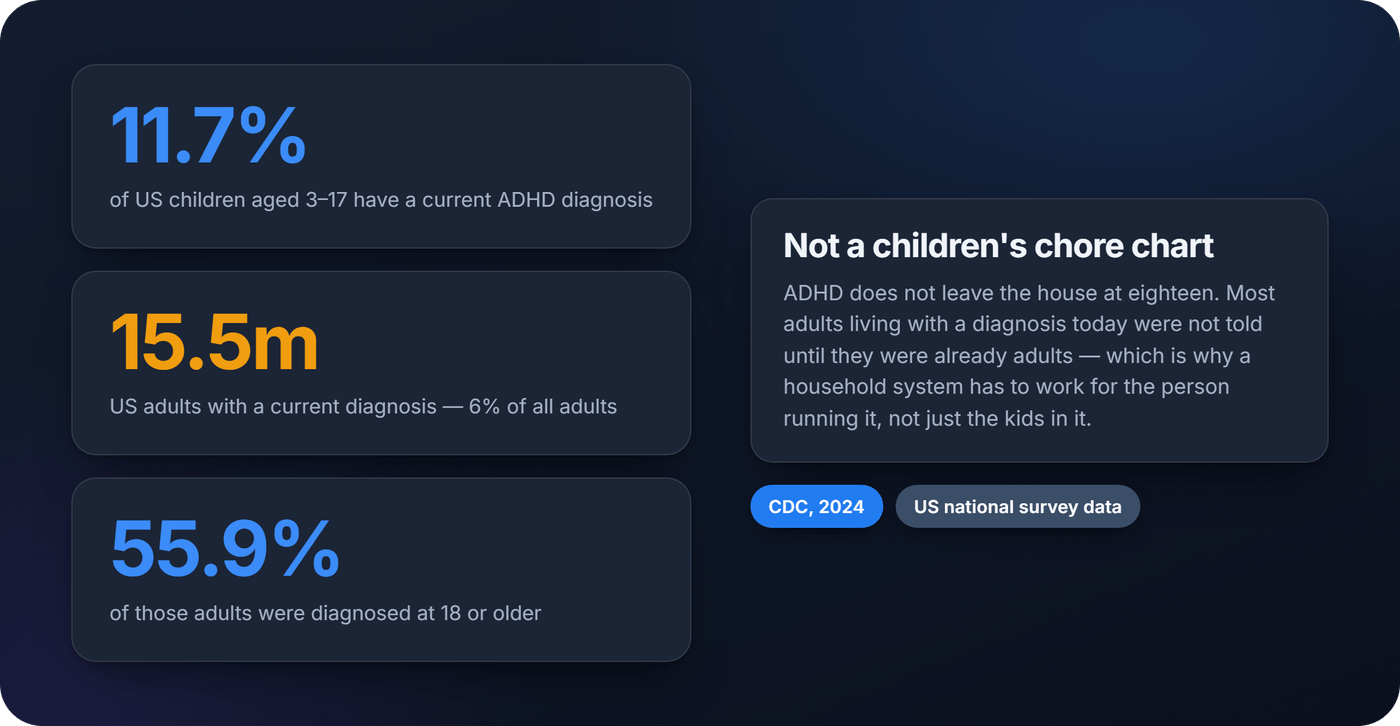
Worth being clear who this is for. CDC survey data from 2024 puts 7 million US children aged 3–17, or 11.7%, on a current ADHD diagnosis; among adults it is 6.0%, roughly 15.5 million people, and 55.9% of them were not diagnosed until they were 18 or older (CDC, MMWR, October 2024). Most writing on ADHD and chores is addressed to a parent managing a seven-year-old. In plenty of houses, the person building the system has ADHD too.
What makes an ADHD chore system work
Most chore charts fail for a predictable reason: they assume the brain using them processes rewards the way a neurotypical brain does. It doesn't. A 2024 study in NeuroImage: Clinical found that people with ADHD show lower sensitivity to reinforcement, especially for positive feedback. A separate meta-analysis by Marx, Hacker, Yu, Cortese and Sonuga-Barke found they also choose a small immediate reward over a larger delayed one far more often than controls.
Put the two together and you get the design rule. A gold star at the end of the week means almost nothing. A point that shows up the second a task is logged means a lot.
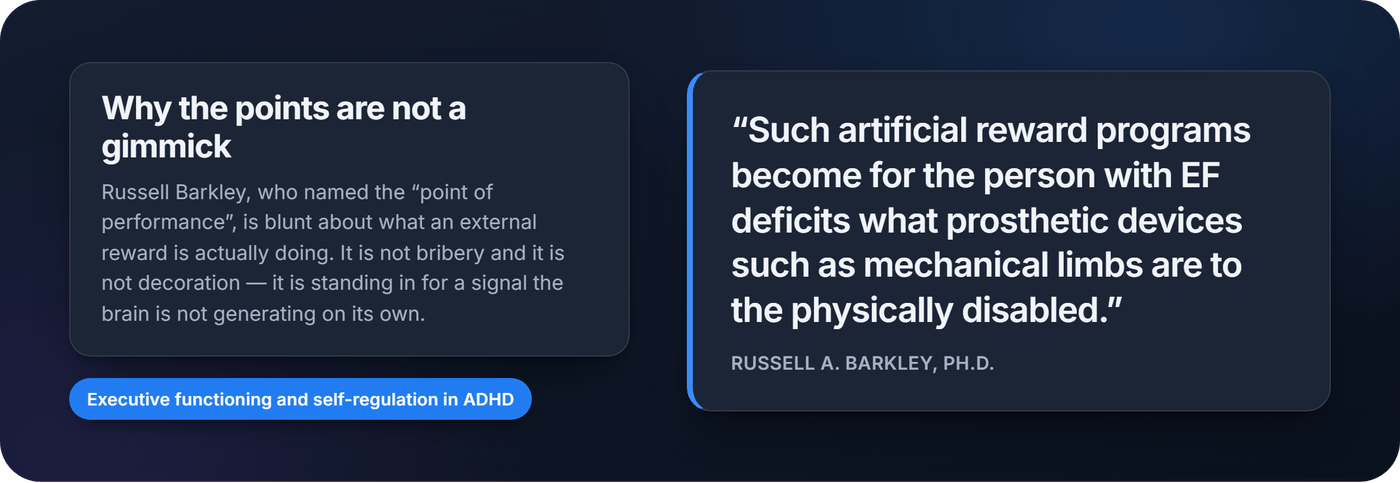
Russell Barkley, the psychologist who named the "point of performance", is blunt about what a token system actually is. Where a task carries little immediate consequence of its own, he writes, artificial rewards may be needed throughout it, and "such artificial reward programs become for the person with EF deficits what prosthetic devices such as mechanical limbs are to the physically disabled". The points are not a bribe and not a gimmick. They stand in for a signal the brain is not generating on its own.
A few design principles carry the rest:
- Immediate reinforcement. CHADD's guidance is to "give rewards quickly and often" while a skill is still new, and to reward "effort rather than success" — not just clean completion.
- Micro-tasking. Three or four specific, checkable items per block. Barkley's fix for a working memory that drops things is to externalise them into something physical outside your head.
- Point-of-performance cues. A card taped to the hamper beats a list in a notebook across the room. CHADD's Attention magazine put it plainly: a child may regulate their behaviour very well in a therapist's office and not at all at home or at school. The help has to be where the problem is.
- Time-based blocks. Ten to fifteen minutes on a timer keeps a chore from feeling infinite.
- Rotating rewards. A token economy tends to die when the payout never changes. Swapping the incentive every few weeks costs nothing and is worth trying before you conclude the system has failed.
Pro tip: Put the reward menu somewhere visible, not in your head. If the token has to be redeemed on request, half the payoff disappears before it is claimed.
How to set up an ADHD chore system this week
You don't need a perfect system on day one. You need a small one that survives contact with a real Tuesday.
- Pick one or two starter chores, not ten. ADDA's guidance on building an ADHD cleaning routine is to break a habit into micro-steps and build consistency before adding more. Attach each chore to something that already happens daily — brushing teeth, leaving for school — so it inherits an existing routine instead of needing its own.
- Break the chore into micro-steps and define "done." "Clean your room" is not a task, it's a category. "Put five items of clothing in the hamper" is a task. Define what finished looks like in a sentence a seven-year-old, or a distracted adult, could check against.
- Set up instant tokens and a small reward menu. Points, poker chips or stickers, redeemed the same day against something concrete — fifteen minutes of a show, or picking dinner.
- Use a timer and log completion somewhere visible. A chart on the fridge, a jar of marbles or an app all work, as long as the log lives at the point of performance and not in a drawer.
- Run it for seven days before judging it. ADDA's framing is that the schedule assuming willpower is the one that fails; the version that works is flexible, visible and expects some days to get skipped.
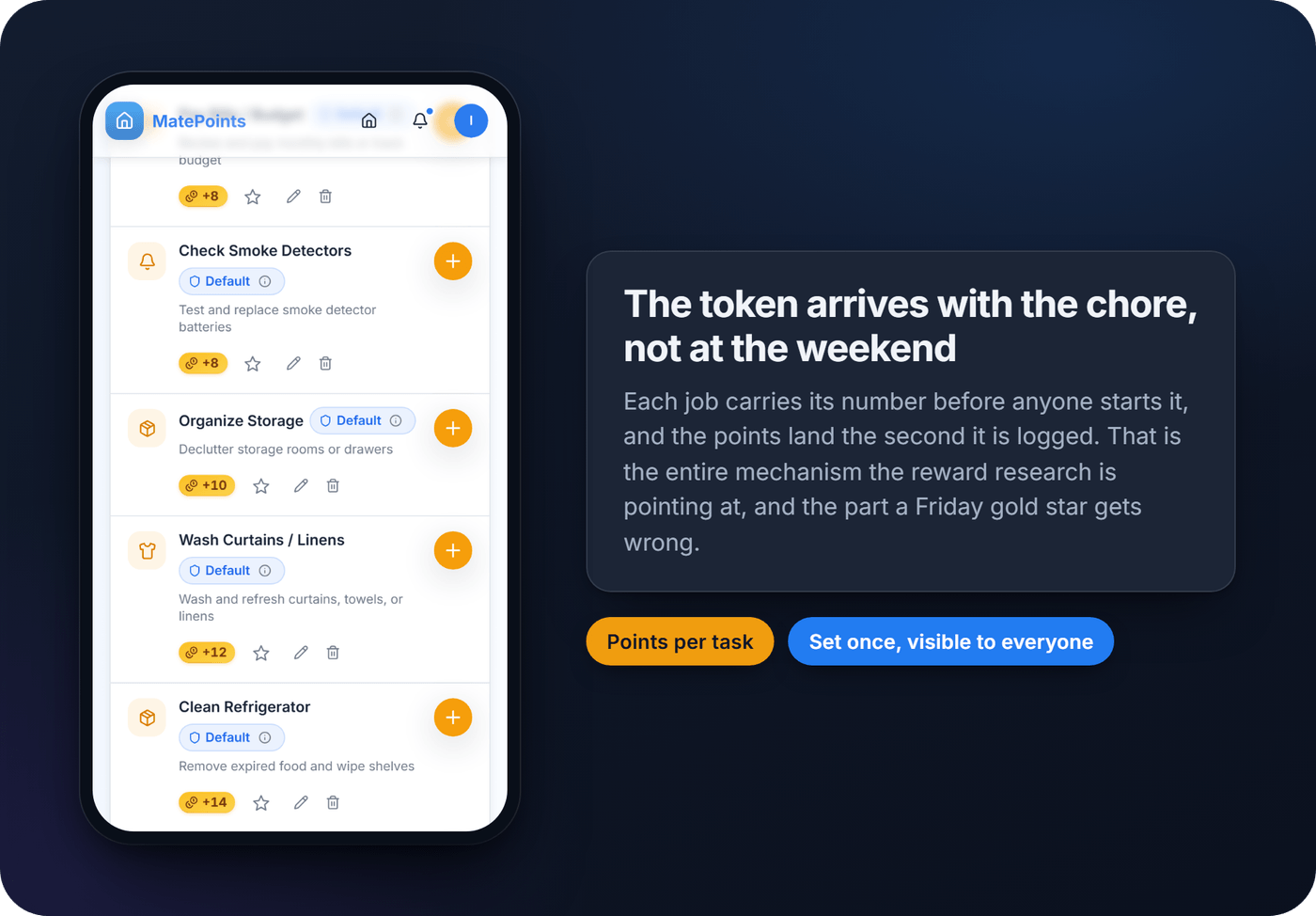
Pricing matters more than it looks. If every chore is worth the same, the number stops carrying information and a sixty-second job competes on equal terms with a twenty-minute one. Setting the values once, in the open, also ends the nightly negotiation about what a chore is worth.
After the week, look at the count rather than the feeling. Four days out of seven? Three? Write it down at the time — a judgement made at the end of a hard week is not a measurement of the week.
Two things to check before you add a third chore:
- Was the reward actually claimed each time, or did it get forgotten?
- Did the task ever need more than a few seconds of planning to start?
If either answer is no, fix that first — adding scope to a shaky system just multiplies the shakiness. A daily chore checklist is a reasonable place to find the next one or two, once the first ones hold.
Kids, teens, adults: what changes
The mechanics stay the same across ages. What changes is autonomy, and how the reward gets delivered.
For kids, picture prompts do more work than written lists, especially for early readers or kids with co-occurring dyslexia. Tokens should be tangible and immediate: a sticker or a poker chip dropped in a jar the second the task is checked, not a promise redeemed at bedtime.
For teens, tokens work better converted into privileges they actually want — screen time, a later curfew, choice of weekend activity — negotiated through a short written agreement rather than a parent's verbal reminder. Letting them pick their own reward menu matters more here than at any other age; autonomy is the incentive as much as the reward is. It is worth knowing that screen time works differently from other rewards and should not be the only currency on the menu.
For adults, the point-of-performance cue is usually a phone alarm or a habit stacked onto something already automatic — coffee brewing, leaving for work. What a parent's prompt did for a child, another person usually has to do for an adult: a partner, a housemate, or a coach. Practices built around accountability and routine rather than clinical treatment, like Molded Fortitude Consulting's self-mastery coaching, work on exactly that — the structure that holds when the week gets heavy. The goal also shifts. It stops being full completion and becomes a defined "bare minimum clean" that keeps a space livable on a bad week.
For couples and roommates, the system needs neutral language and token values that both people agree feel fair before anyone starts logging anything. Otherwise the whole thing reads as one person grading the other.
Why the system stalls, and how to fix it
Every chore system breaks eventually. The fix depends on which way it broke.
- Initiation failure — the chore never starts. Shrink the first step further than seems necessary, add a sensory cue like a timer sound, or remove the planning step entirely.
- Incomplete tasks — started but never finished. Tighten the definition of "done" and add a check-in around the halfway mark of the time block.
- Reward fatigue — motivation fading even though the system runs fine. Rotate the menu, add an occasional mystery prize, or let the person choose their own reward that week instead of assigning it.
- Household conflict — frustration building between the person tracking and the person doing. Drop any punitive framing. CHADD is unambiguous that "punishment is less effective for changing behavior", and renegotiating expectations calmly repairs a stalled system faster than enforcing the original one harder.
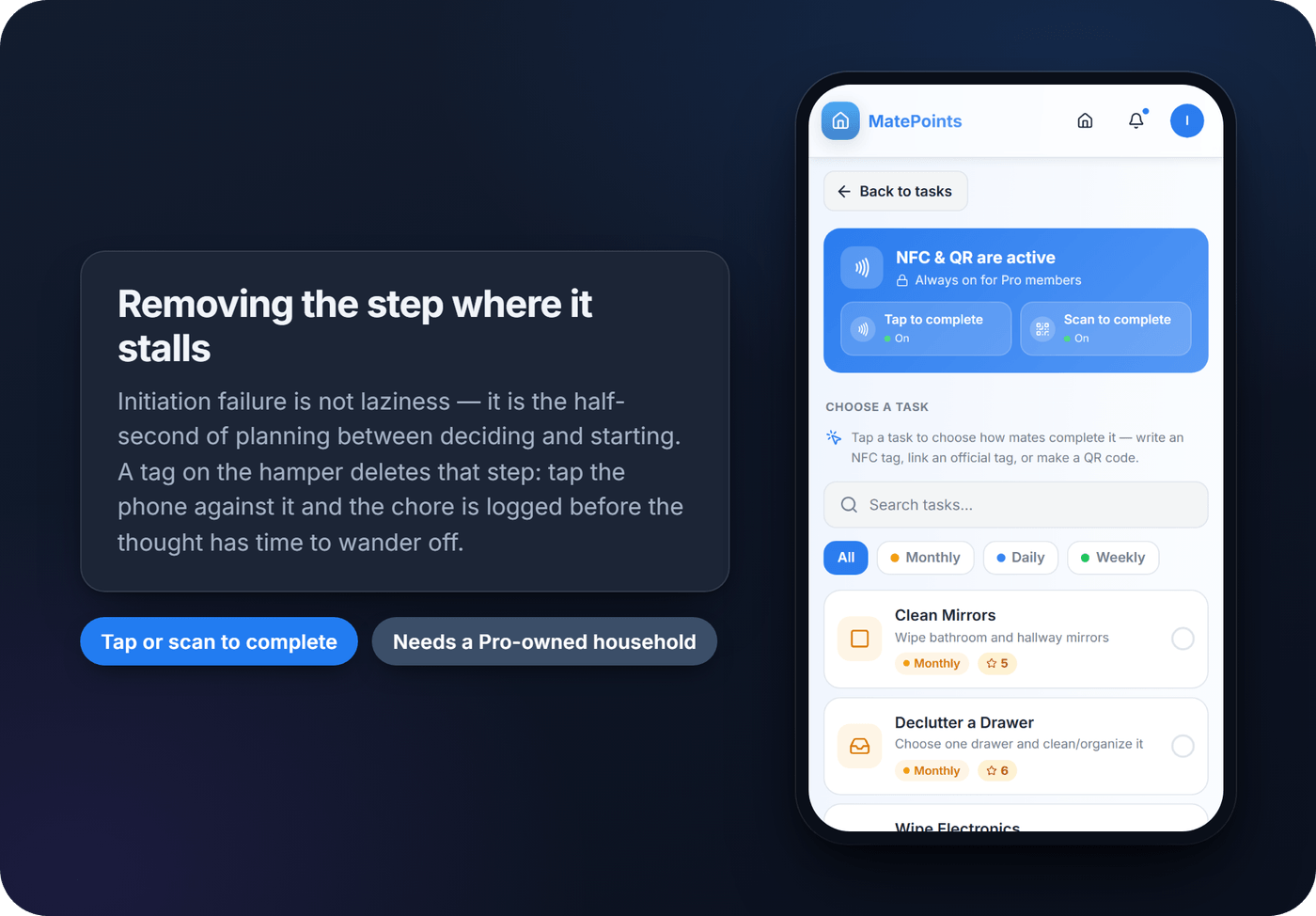
Initiation failure is the one worth attacking hardest, because it is the most common and the least like laziness. The gap is the half-second of planning between deciding to do something and starting. A tag or a QR code stuck on the thing itself closes it: tap a phone against the hamper and the chore is logged before the thought has time to wander off. In MatePoints that is tap-to-complete, which needs a household owned by a Pro member — after that anyone in the house can tap, Pro or not.
Pro tip: When a system stalls, change one variable at a time. Swapping the chore, the reward and the schedule simultaneously makes it impossible to tell which fix actually worked.
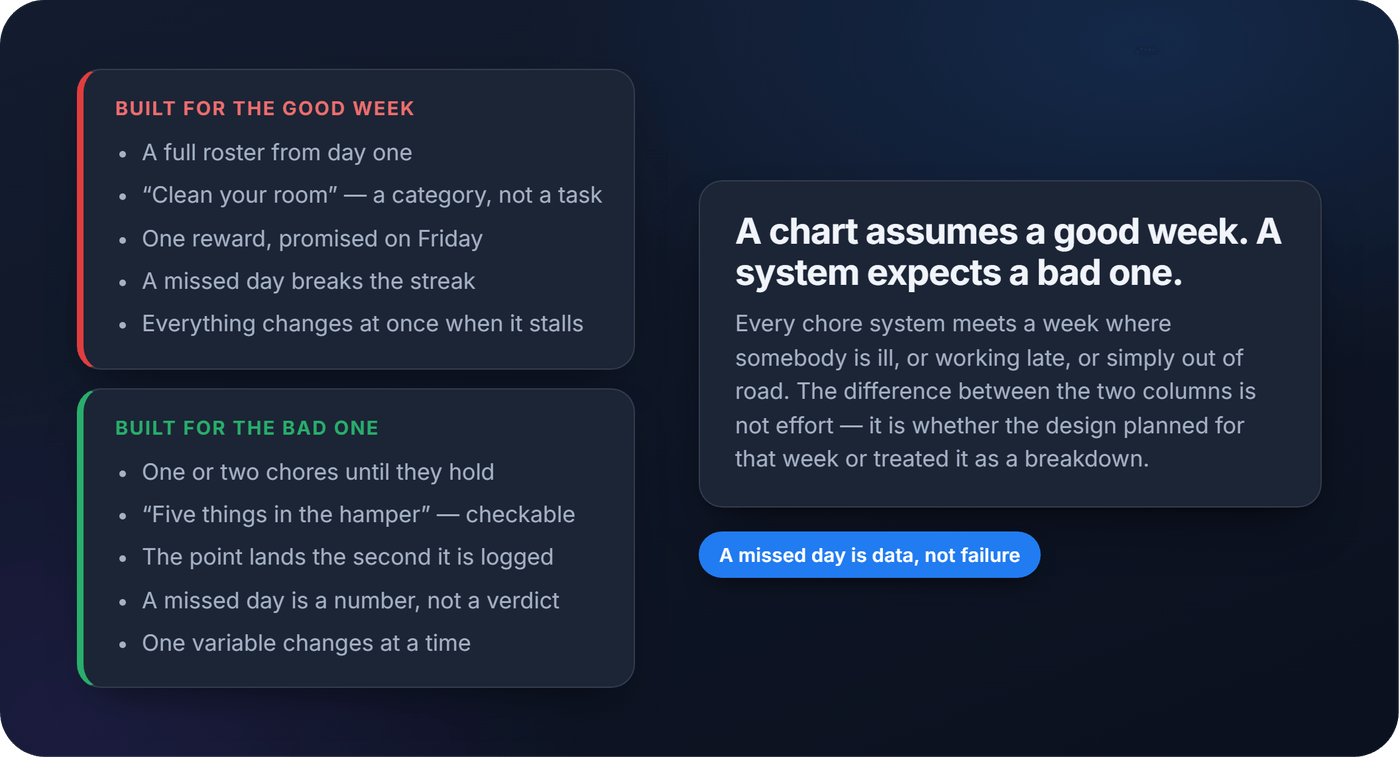
All four failures share one root, and it is a design choice made on day one: a missed day either costs you a number or costs you the whole streak, and which of those it is was decided before anybody missed anything.
If none of these fixes hold after a few honest attempts, that is a signal worth taking seriously rather than a personal failure. A clinician familiar with ADHD can address what a chart alone cannot.
When an app does the remembering
Everything above runs perfectly well on paper. What an app changes is who has to remember. MatePoints maps onto the same four ideas fairly directly:
- Points replace delayed praise with the immediate feedback the reward research points to.
- NFC tags and QR codes log a chore the instant it is finished, removing the executive-function step of remembering to update a list later. Creating them needs a Pro-owned household.
- Custom rewards — takeaway, a chosen show, a special outing — work as an exchangeable menu rather than a single fixed prize. They attach to achievements, which are a Pro feature.
- Leaderboards and statistics turn a household's chore history into something visible, which is the only way to tell whether completion is actually climbing.
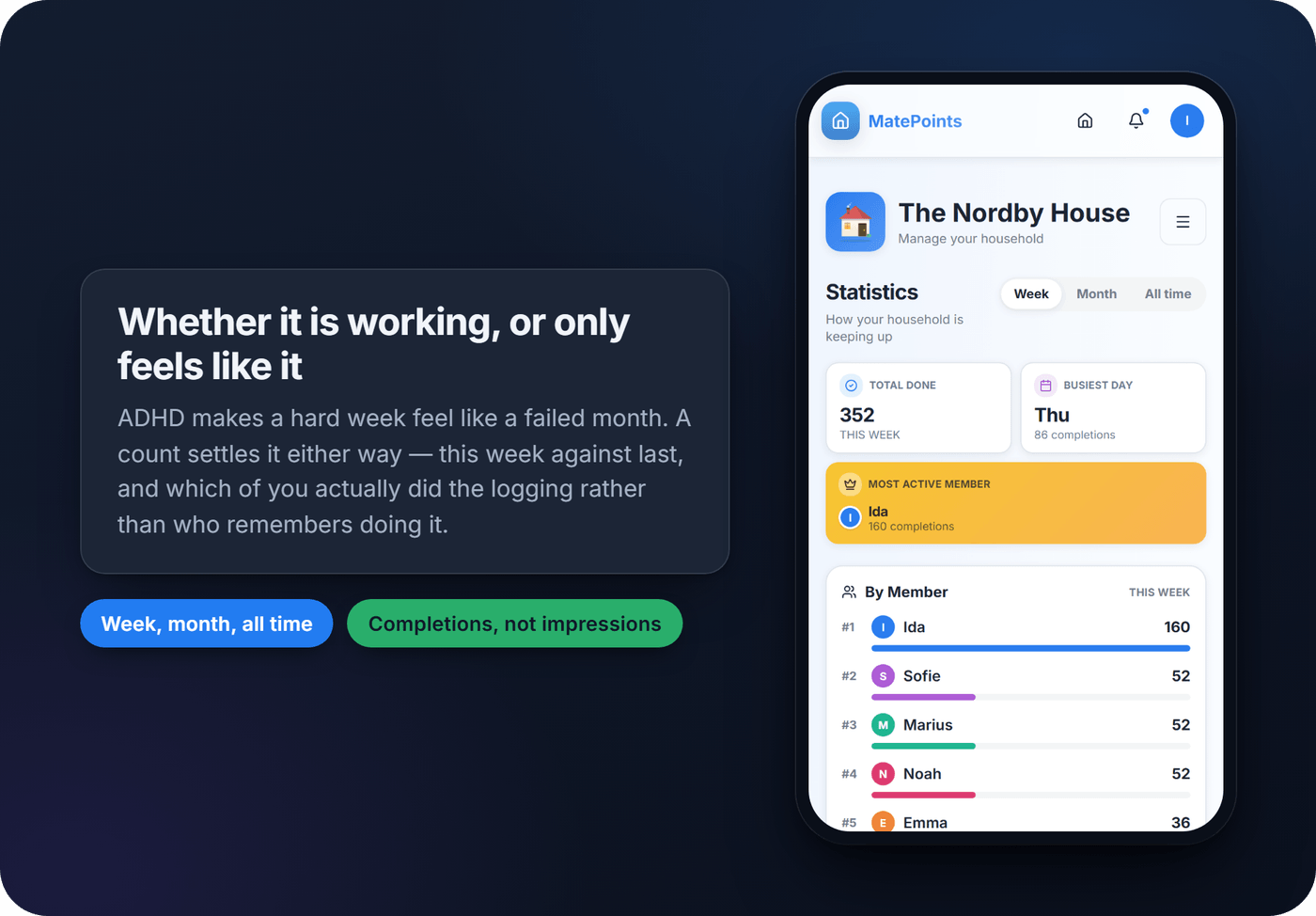
That last one earns its place for a specific reason. ADHD makes a hard week feel like a failed month, and a count settles it either way. Week against month against all time, and who did the logging rather than who remembers doing it.
A chart on the fridge only works if someone remembers to look at it. A tag on the hamper does the remembering for you.
An app makes a system easier to run consistently. It is not a treatment, and a household where chores are a standing source of conflict needs a conversation more than it needs better tracking. If you want to know how completion data is handled before connecting a household, the security page covers it.
Start tonight, not on Monday
Every rigid chore chart I have seen fails the same way: it assumes a good week is the baseline and treats a bad week as a breakdown. The systems that actually last treat a missed day as data, not failure, and reward the attempt as much as the result.
Try this tonight if you want proof it works faster than a full overhaul. Set a ten-minute timer and challenge yourself, or your household, to clear one table. Nothing else. Log it the second it is done. That is the whole system in miniature, and it usually tells you more about what will stick than a week of planning would.
Sources
- Data on ADHD in children — Centers for Disease Control and Prevention, 2024 survey data
- Attention-Deficit/Hyperactivity Disorder Diagnosis, Treatment, and Telehealth Use in Adults — Staley et al., CDC MMWR 73(40), October 2024
- The Important Role of Executive Functioning and Self-Regulation in ADHD — Russell A. Barkley, Ph.D.
- Impaired flexible reward learning in ADHD patients is associated with blunted reinforcement sensitivity — Aster et al., NeuroImage: Clinical, 2024
- ADHD and the Choice of Small Immediate Over Larger Delayed Rewards: A Comparative Meta-Analysis — Marx, Hacker, Yu, Cortese & Sonuga-Barke, Journal of Attention Disorders, 2021
- How rewards and punishment work for children with ADHD — CHADD
- Interventions at the Point of Performance: The Power of Play — Mark Katz, Ph.D., CHADD Attention magazine
- Why working memory fails and how to bolster it — Steph Alexander, ADDitude, 2026
- How to Create an ADHD Cleaning Schedule You'll Actually Stick To — ADDA, Attention Deficit Disorder Association