How to split chores after a new baby
How to split chores after a new baby: list every job, give each one an owner, offset the night feeds and check in weekly, before resentment sets in.


A new baby adds hours of work to every week and quietly rewrites who does what. Most couples expect to share it equally. Many don't, and the resentment tends to start in the first tired months, when nobody has the energy to talk about it. This guide shows how to split chores after a new baby: what the research says happens, a five-step plan you can make before the birth, and how to keep it fair as the baby's needs change.
What couples expect, and what happens
In a well-known Ohio State University study, Claire Kamp Dush and Jill Yavorsky followed 182 dual-earner couples through their first baby. Before the birth, the couples split the chores about evenly and expected the extra work to be shared equally too. The time diaries told a different story. As reported by Newser and Fox News, the new parents' work rose by about 10 hours a week for the men and about 21 hours a week for the women.
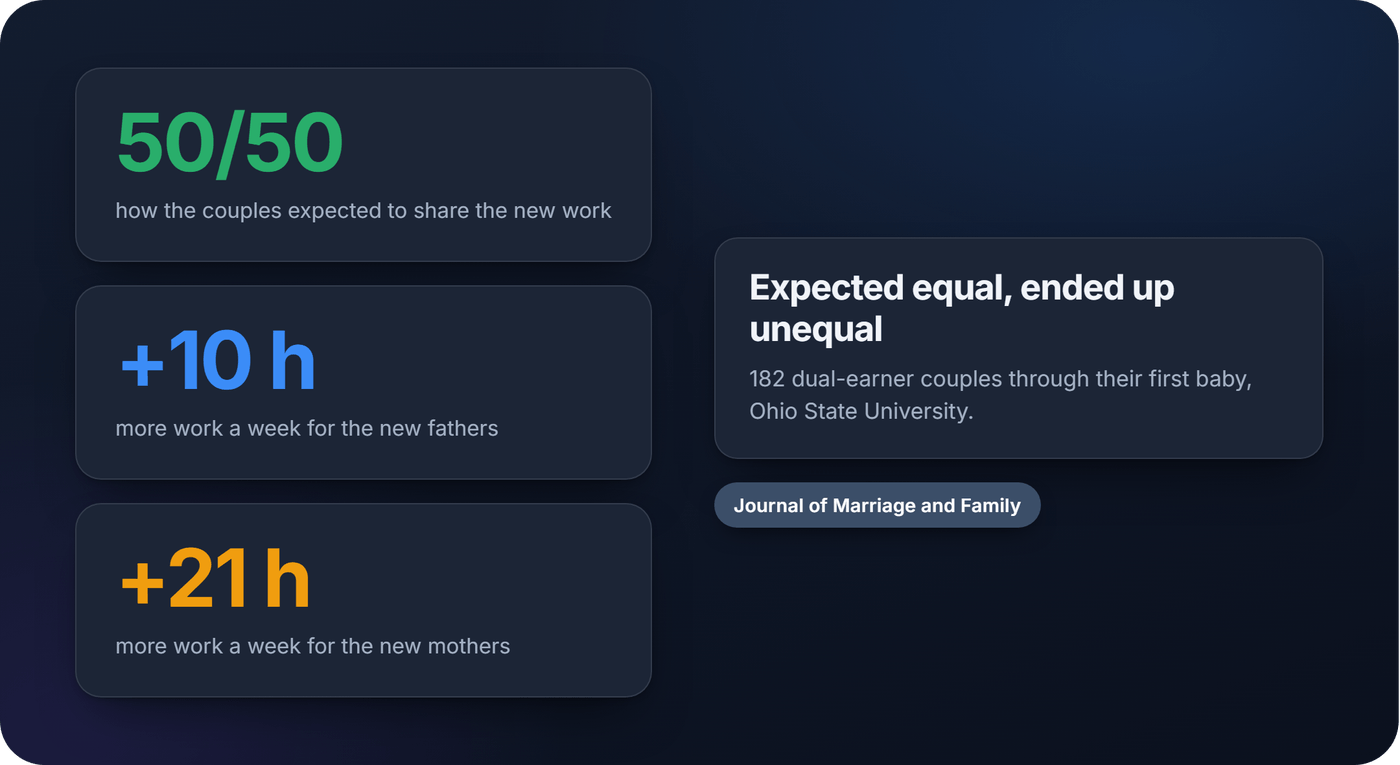
The study is from 2015, and many couples share more evenly today. But the pattern still shows up wherever new parents talk. A Mumsnet thread from March 2026 starts with a mother 30 weeks pregnant who doesn't want "to end up doing the housework, the organising, and the majority of baby care". A thread from July 2026 is the after: a mother of an eight-month-old writing "I am doing EVERYTHING".
None of this needs a bad partner. When nobody decides the split, it falls to whoever is home more, wakes up first or notices first. That is usually the parent on leave, and it often stays that way after leave ends.
Make the plan before the birth
Couples coach Aaron Steinberg told NPR's Life Kit that "the division of roles and responsibilities is the biggest difficulty that parents face" when a baby comes home. The fix is to decide it while you are both still sleeping.
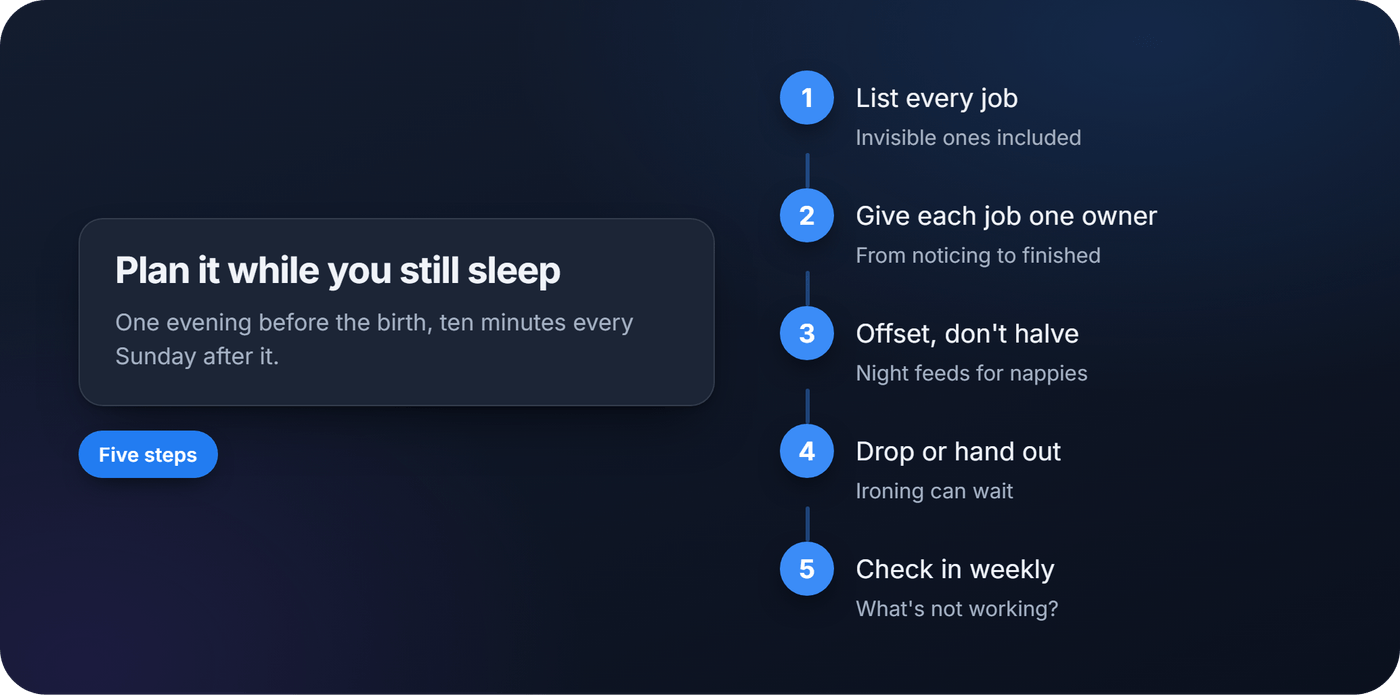
1. List every job, including the invisible ones
Write down everything that keeps the house running now, then add the baby jobs. Perinatal therapist Shy Porter, also speaking to Life Kit, suggests getting specific: "Do we both go to the pediatric appointments? What happens if the baby is sick at day care, who leaves work?" Include the thinking jobs: ordering nappies before they run out, booking checkups, tracking feeds.
2. Give each job one owner
Shared jobs tend to become nobody's job. Give each one a single owner, who does it from noticing to finished. Owning "nappies" means checking the stock and ordering more, not just changing them when asked.
3. Offset the heavy jobs, don't halve them
A strict 50-50 split rarely works with a newborn. Porter's example: "If I'm up breastfeeding multiple times a night, maybe you are on diaper duty." Whoever carries the night feeds should carry less of something else, like the morning routine, the cooking or the laundry.

4. Decide what to drop or hand out
You will not keep up the old standards for a while, and that's fine. Agree which jobs can slide (ironing, deep cleaning) and which can go to family or friends. Porter describes one couple who set up a rota of relatives, so they "just referred to the sheet and gave someone a call."
5. Check in once a week
Steinberg warns that the common mistake is assigning tasks and then "never talking about it again." A baby changes every few weeks, and so does the work. Ten minutes on a Sunday to ask "what's not working?" catches a slide before it becomes a fight.
Keep a list, not a score
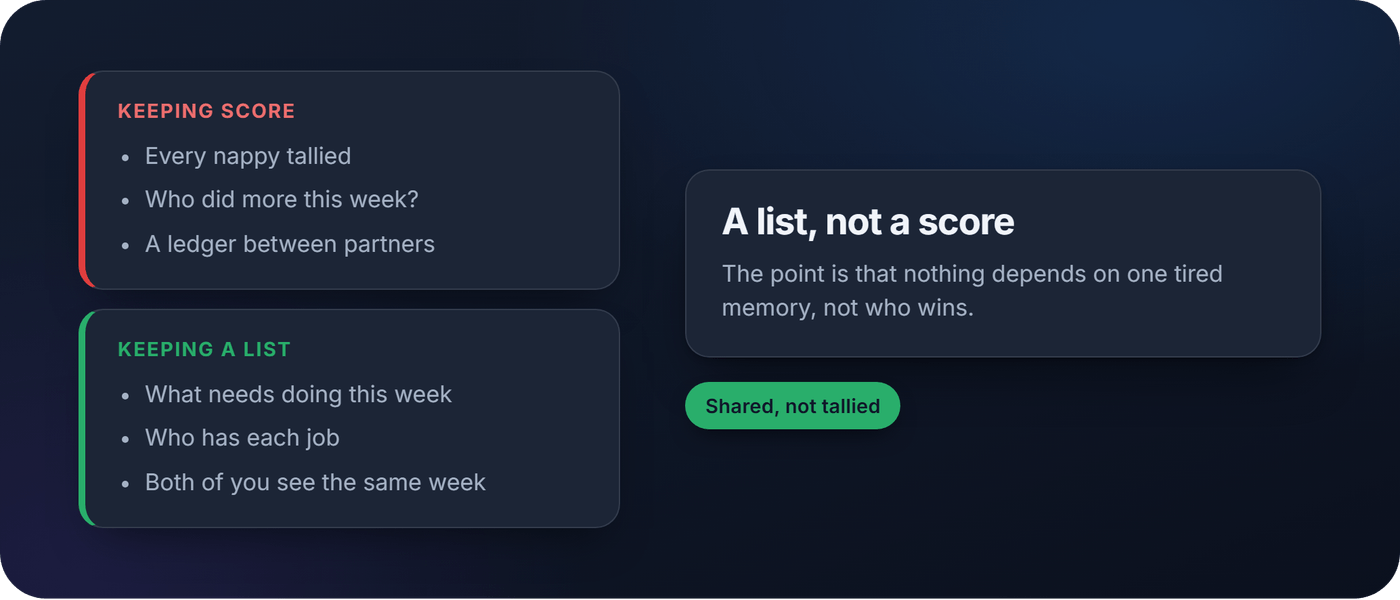
Steinberg has one more warning: don't keep score. Tracking every nappy turns a partnership into a ledger, and that breeds resentment of its own. As he puts it, "It all comes out in the wash."
That is a fair point, and it is worth separating two things. Keeping score means tallying who did more, to win. Keeping a shared list means both of you can see what needs doing this week and who has it, so nothing depends on the tired memory of the person who usually notices.
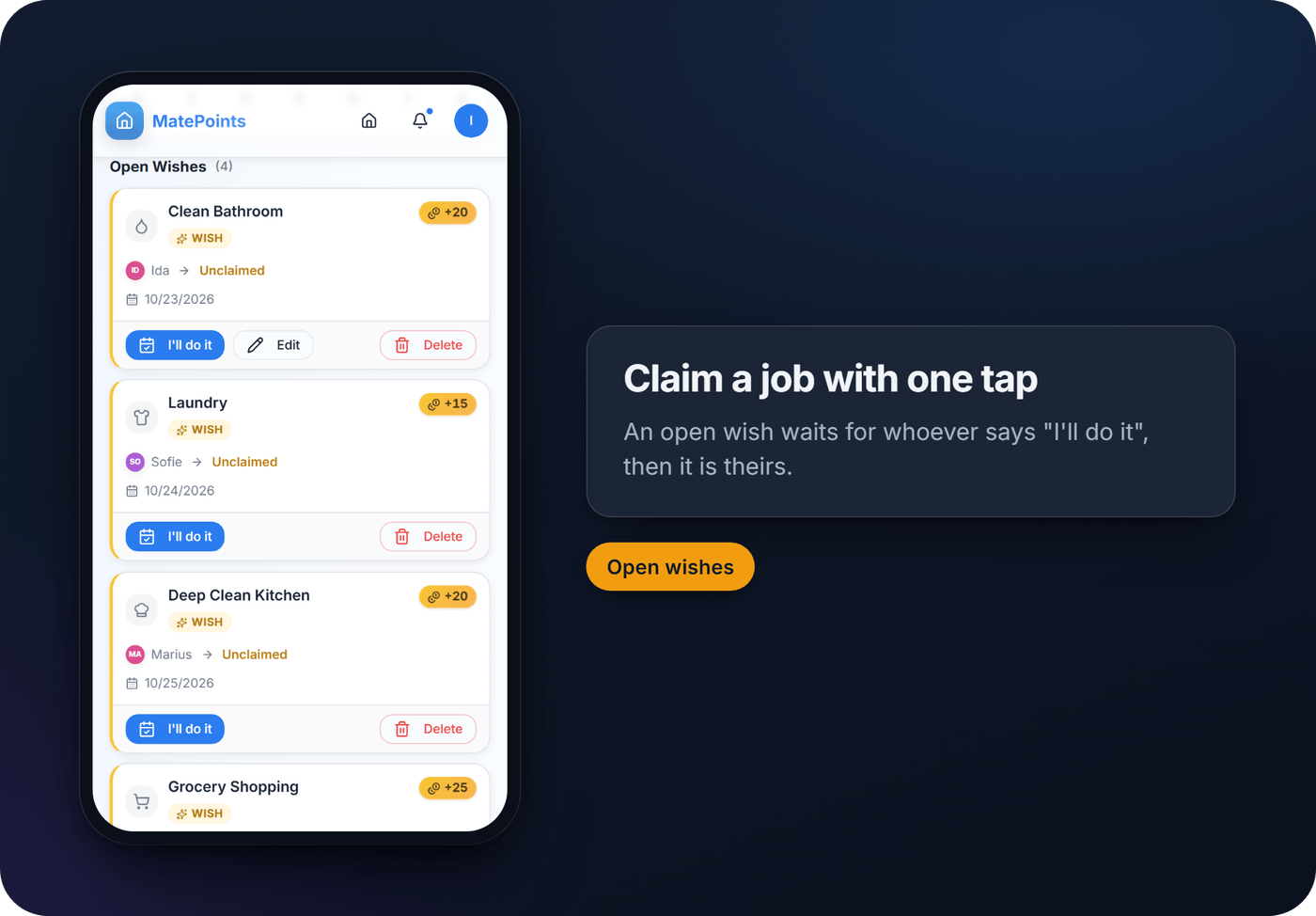
The planner in MatePoints is built for the list side. You put a job on a date in the household calendar. A job you mark as planned is yours. A job you add as a wish is open for either of you to claim with one tap, and the rest of the household is told it is there. Give a job a start time, and whoever has it gets a reminder shortly before, so the job doesn't live in one person's head.
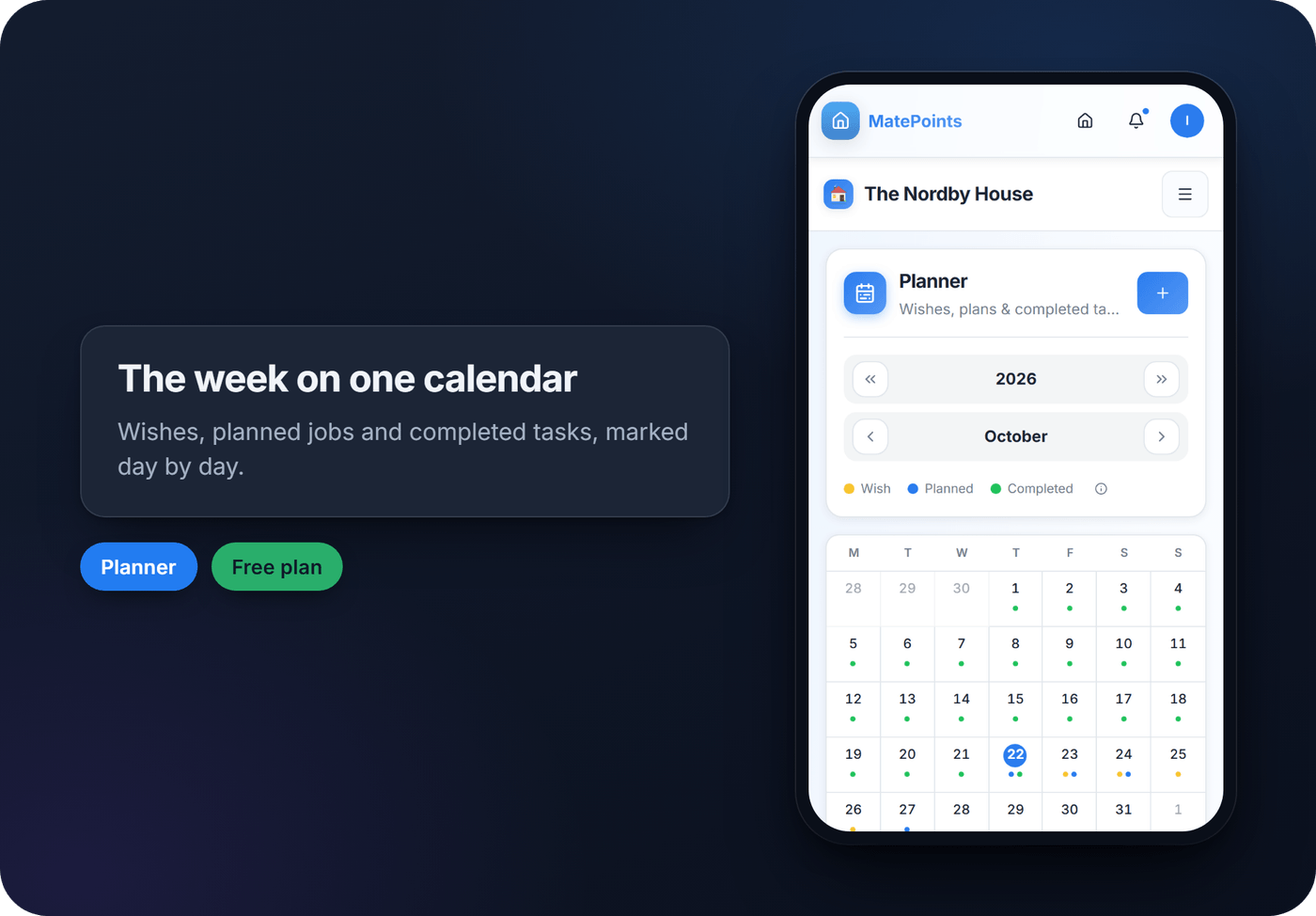
At 3 a.m. neither of you will remember whose turn it was to order nappies. The calendar will. And when the Sunday check-in comes, you are both looking at the same week, not two different memories of it.
Start before the baby arrives
The best time to split chores after a new baby is a few weeks before it comes. Make the list on a quiet evening, give every job an owner, and agree the Sunday check-in. Expect to change it. For a deeper look at the planning work that new parents often carry alone, read how to share the mental load, and for a full household audit, dividing household chores walks through it step by step.
If you want the list in one place you can both see, MatePoints is free to start.
Sources
- Here's what happens when a working couple has a child, Newser via Fox News, May 2015
- Caring for a newborn is a team sport. Here's how to share the load, Andee Tagle, NPR Life Kit via KUNC, August 2024
- 30 weeks pregnant and feeling like I run the whole house alone, Mumsnet, March 2026
- Resenting partner after baby, Mumsnet, July 2026