Siblings say chores aren't fair? Weigh them by effort
Fair chores for siblings of different ages: stop counting jobs and weigh them by effort instead, so "it's not fair" has a real answer at last.


"It's not fair. She only has to feed the cat." If you have more than one child, you have heard some version of this. The older one does more and says so. The younger one does less and still says it's unfair. The trouble is that most families count chores, and chores are not the same size. This guide shows how to make chores fair for siblings of different ages by weighing them by effort, so "it's not fair" finally has an answer you can point to.
Fair and equal are different things
Parents ask this all the time. In a Mumsnet thread from October 2023, a parent of a 17-year-old and two girls aged 13 and 10 asks "which approach (es) are fair in terms of chores and children with a reasonably wide age range?" The options they list are the ones most families try: more chores for the older ones, the same chores for everyone, or the same chores and the same pocket money for all.
The Mount Sinai Parenting Center puts the answer in one line: making things "fair" doesn't mean making things the same. Its advice is to give each child the same chance to succeed, even when the steps they need are different.

For chores, that means a 13-year-old and a 7-year-old should not do the same jobs. But they should both put in a fair share of effort, for their age. The question is how to measure it.
Why counting chores feels unfair
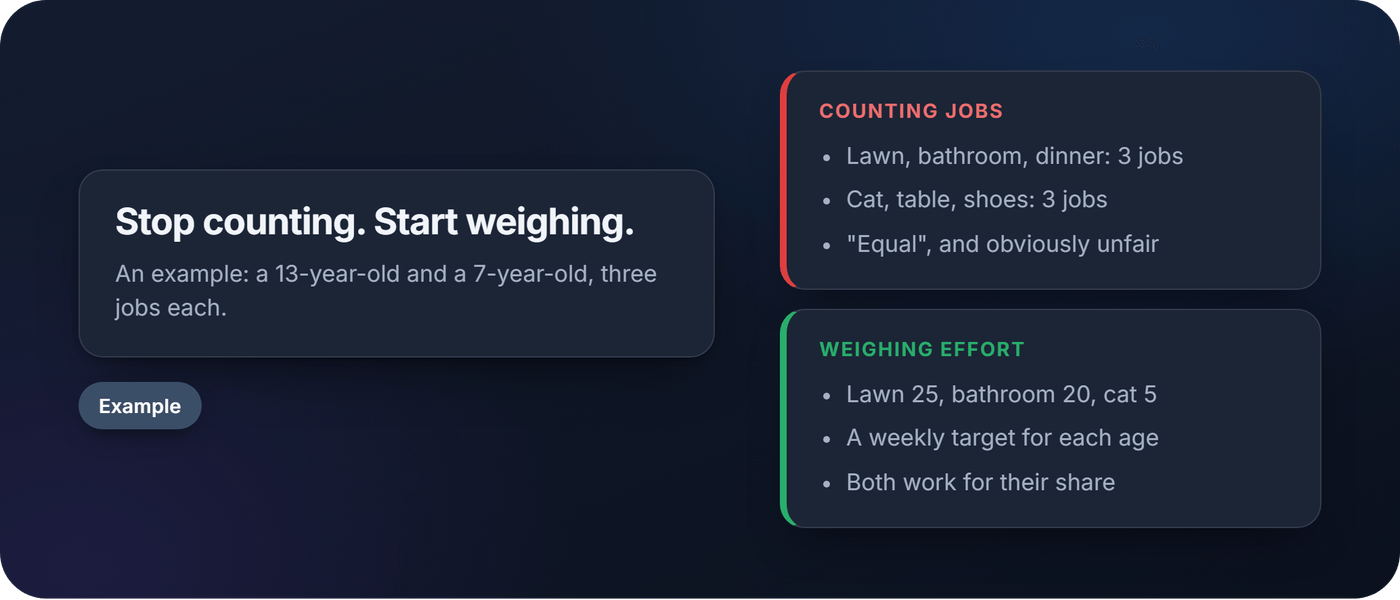
Picture two siblings, each with three chores a week. The 13-year-old mows the lawn, cleans the bathroom and cooks dinner on Thursday. The 7-year-old feeds the cat, sets the table and puts their shoes away. Three each. Perfectly equal, and obviously unfair.
Now flip it. Give them the same three jobs each, and the 7-year-old struggles with the lawn while the teenager finishes the cat in ten seconds. Equal again, and unfair the other way.
Counting jobs fails because a job is not a unit. Effort is. Advice columnist Meghan Leahy, answering a parent whose eldest felt she was the only one who cleaned, suggests family meetings that break chores into steps so each child works at a level that suits their age. Weighing jobs by effort is the same idea, made countable.
How to weigh chores by effort
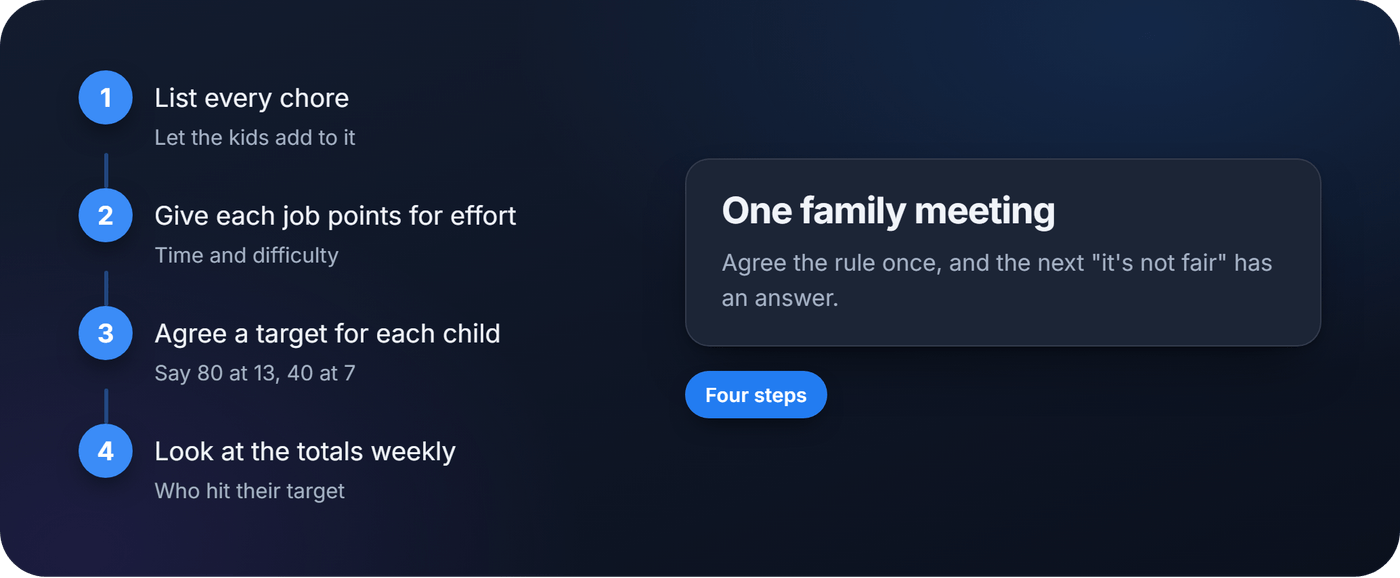
Here is a setup that takes one family meeting and works for most ages from about five up.
1. List every chore
Write down the jobs the children could do, from the tiny to the big. Let them add to the list. Kids often name jobs you forgot.
2. Give each job points for effort
Score each chore by how long it takes and how hard it is. Feeding the cat might be 5 points. Emptying the dishwasher 10. Cleaning the bathroom 20. Mowing the lawn 25. Agree the numbers as a family. The arguing you do here is the arguing you won't do later.

3. Agree a weekly target for each child
This is where age comes in. A 13-year-old might aim for 80 points a week and a 7-year-old for 40. The younger child can reach their target with lots of small jobs. The older one can do a few big ones. Both work for it, and both can see the rule.
4. Look at the totals once a week
Sit down together on a Sunday and look at who hit their target. Not who did the most. A child who hit their target did their share, whatever their age. Adjust a score if a job turned out harder than you thought.
Keep the score where everyone can see it
Points only settle arguments if everyone trusts the count. In MatePoints, each chore is a task with a point value you choose. When a child finishes one and a parent approves it, the points go to them. The leaderboard shows everyone's total for today, the week or the month.

One honest note. A leaderboard ranks people, and a 7-year-old will rarely beat a teenager on raw points. So use the totals to check targets, not to crown a winner. "You both made your target" is the line that ends the argument. If your younger child minds the ranking, keep the weekly look at totals between you and each child.
What about pocket money and the basics?
Two questions come up in almost every family that tries this.
Should the points mean money? That is up to you. The Mumsnet parent above weighed three versions: more chores and more money with age, the same chores with more money for the older ones, or the same of both. Weighing chores by effort works with any of them. If you do link points to money, link it to the target, not the raw total, so the younger child isn't paid less for working just as hard. For the wider debate, allowance and chores sets out both sides.
Do the basics count? Many families keep a few jobs outside the system: clearing your own plate, putting your clothes in the basket, keeping your room liveable. One reply in that same thread suggests exactly this, everyday basics that nobody gets paid for, plus bigger extras that earn. It keeps the points for real help with the house, and it stops a child asking how many points it's worth to flush the toilet.
The answer to "it's not fair"
When the next "it's not fair" comes, you have something better than "because I said so". You can show the points, the targets and the totals, and the rule you all agreed. For more on fitting chores to each age, read age-appropriate chores, and for the bigger picture of a points-based home, see how a chore points system works. Rotating jobs between siblings is covered in the family chore chart guide.
Hold the family meeting this weekend. If you want the points counted for you, MatePoints is free to start.