Automated achievements and reward fatigue
Automated achievements lift household cooperation fast and then fade. Here is what the research says, and how to design badges that keep meaning something.

Automated achievements are badges or point rewards that land the moment a chore is verified, without anyone logging, approving or remembering to hand out credit. Tap a tag on the washing machine, or get a completion approved, and the badge appears. They are very good at raising cooperation in a household for a few weeks. What they are not good at is staying interesting, and almost every guide on the subject skips that part.
Here is the evidence, including the inconvenient half, and what to do about it.
What the research actually found
Start with the finding that should change how you design these.
In a 2004 study in the Journal of Personality, Mireille Joussemet and colleagues gave children a deliberately boring task and compared two ways of introducing it: offering a reward, or supporting the child's autonomy by explaining why it mattered and acknowledging that it was dull. Autonomy support produced positive effects, and rewards produced none across either study, measured on how the children felt about the task, how much value they saw in it, and whether they kept doing it when nobody made them.
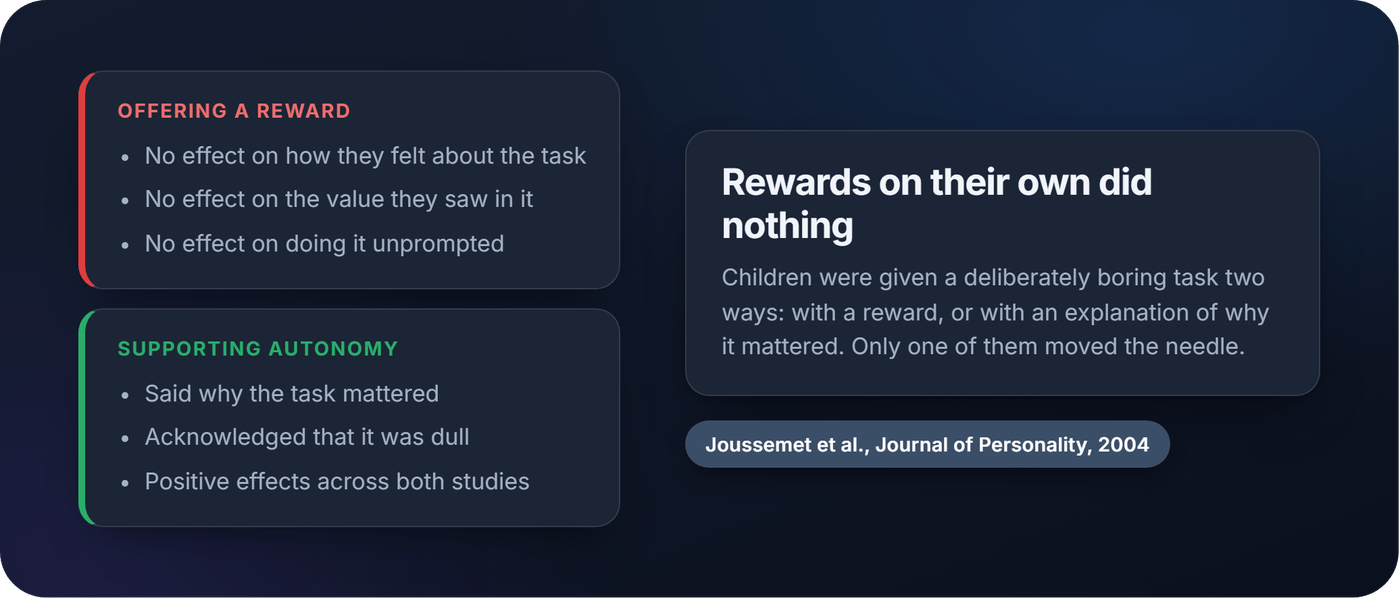
That is not an argument against points. It is an argument against points on their own, which is what most chore apps ship.
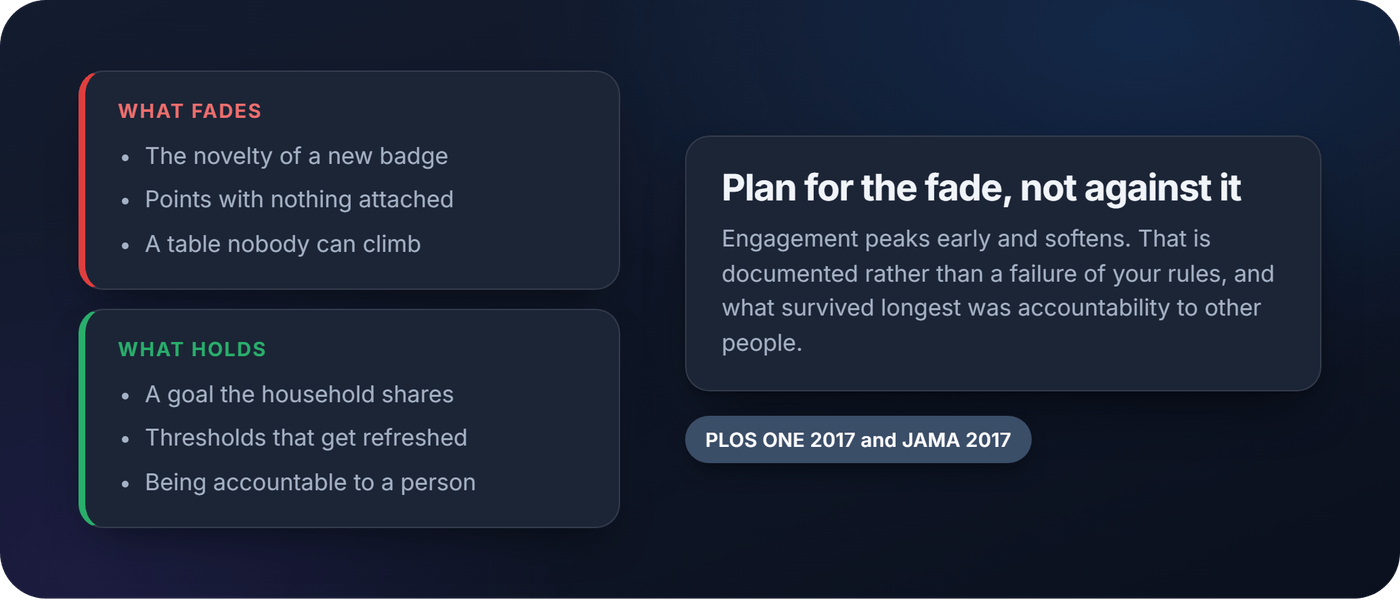
The wider picture agrees. A systematic review in PLOS ONE covering 15 studies and 10,499 participants found gamification increased engagement in 12 of them, and also that the positive effect appeared to lessen over time because badges and points "wear off after a short period of novelty".
One trial did hold on to part of the gain. In the BE FIT study in JAMA Internal Medicine, 94 families competed in teams for twelve weeks and hit their goal on 53% of days against 32% for the control group. Twelve weeks after the game was switched off they were still ahead, 44% against 33%. The mechanic that survived was accountability to other people.
So: fast lift, predictable fade, and a partial hold when other humans are involved. Design for that curve rather than against it.
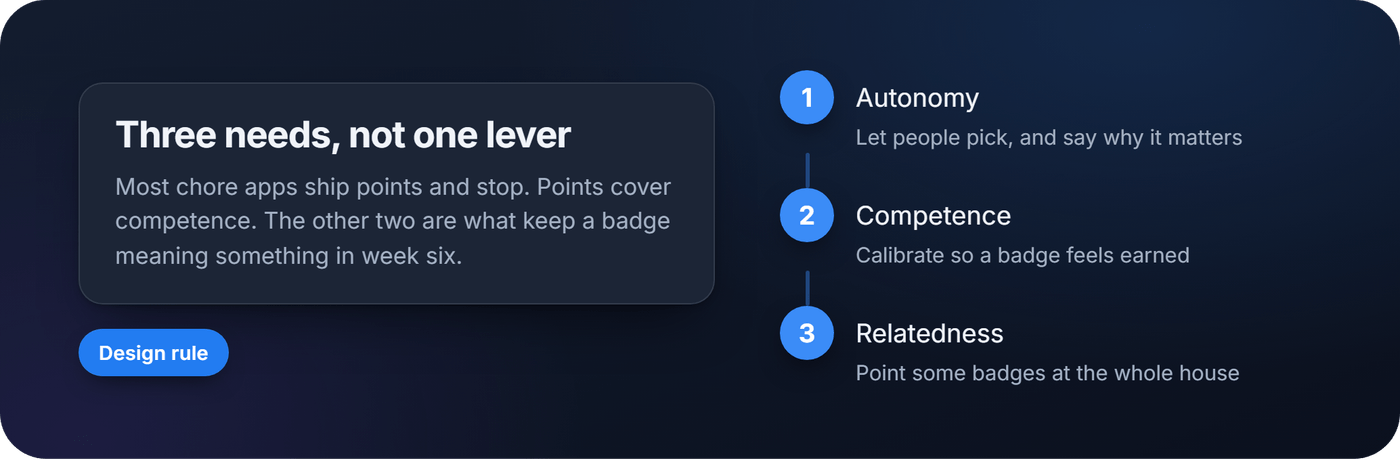
Design around three needs, not one lever
The framework that keeps coming up is self-determination theory, and it names three things people need before a task feels worth doing.
Autonomy. Let people pick which chores they take, where that is possible, and say why a task matters instead of assigning it by decree. This is the one Joussemet's study actually measured, and the one badge systems ignore.
Competence. Calibrate difficulty so a badge feels earned. "First solo dinner cooked" means something. "Logged in today" does not, and a household notices the difference within a week.
Relatedness. Point at least some achievements at the household rather than the individual. A shared streak the whole house is keeping alive does more for cooperation than five parallel scoreboards, and it is the closest thing to what made BE FIT hold up.
A small rewrite makes the point. "You get 10 points for doing the dishes" is a transaction. "Dishes done means we all get the kitchen back tonight" is the same reward attached to a reason. The second one keeps working when the points stop being exciting. There is more on this in our guide to positive reinforcement at home.
Setting them up
Start with the chores and what they are worth. Price by unpleasantness rather than by the clock. Scrubbing a bathroom outranks wiping a counter even when both take ten minutes.
Pick thresholds you would actually celebrate. Five days of dish duty in a row. A full rotation completed on time. The first time somebody takes the bins out without being asked. Mix frequent small milestones with occasional stretch ones, so there is always something near and something worth aiming at.
Decide what a badge pays, if anything. A badge can be its own reward, or it can carry a payout. Where it pays, keep routine chores non-monetary: extra say in the weekend, choice of film, a skipped turn. The American Academy of Child and Adolescent Psychiatry's guidance on chores recommends a reward chart alongside positive feedback, and notes benefits from including chores in a child's routine from about age three. It says nothing about paying for them, which is worth noticing given how many chore apps assume cash.
Add the leaderboard last. Get chores, thresholds and rewards working first. A ranking bolted onto a system nobody trusts yet just gives people something new to argue about. If you want the mechanics of scoring itself, our behaviour point system guide covers it.
What goes wrong
Missed check-ins. A tag in an awkward spot gets skipped, a QR sticker peels off. Always keep a way to log a chore by hand, from day one, so a hardware failure never becomes an argument about whether the job was done.
Fairness rows. Almost always about who priced the chores. Rotate which jobs carry bonus achievements, and let the household argue about the prices before the system starts rather than after.
Reward fatigue, which is the one people misread. When completion rates slide in week three while the point values have not changed, that is not laziness. It is the fade the PLOS ONE review describes, arriving on schedule. The fix is not more points. It is refreshing the thresholds, rotating which chores carry bonuses, and leaning harder on the shared goals than the individual tally.
One more, quietly: if a chore's completion rate drops right after you add a leaderboard, the leaderboard is the problem. Public comparison backfires fast in a mixed household, and the person at the bottom every week is the first to stop playing.
An honest take
Automated achievements are scaffolding. They make effort visible and they give someone a reason to start. They do not make a person care about the household, and a badge cannot carry a conversation about someone feeling overloaded.
Heavy payouts for routine chores can quietly teach a child that helping out is a job with a price attached, which is the opposite of what most parents want. Keep the money for occasional jobs outside the rotation, keep the badges for the things worth noticing, and let autonomy do more of the work than the point total does. And keep the logging short. A system that takes five taps to record one chore loses people, whatever the badge at the end looks like.
Marcus
How achievements work in MatePoints
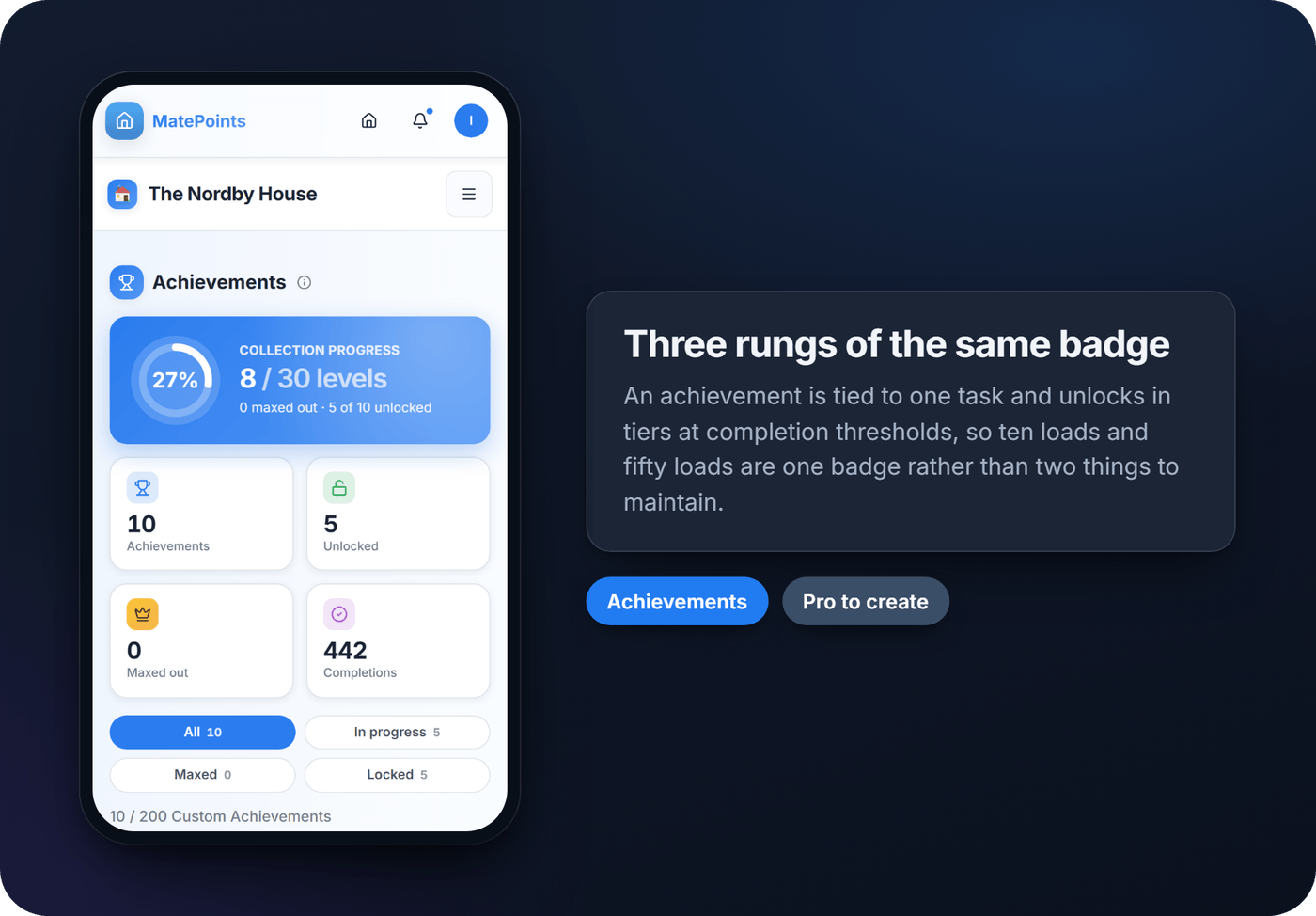
An achievement in MatePoints belongs to a household and is tied to one of its tasks. It has three tiers, each unlocking at a number of completions of that task, so "ten loads of washing" and "fifty loads of washing" are two rungs of the same badge rather than two separate things to maintain. Progress is recorded automatically when a completion is approved, which means the badge and the approval queue cannot drift apart.
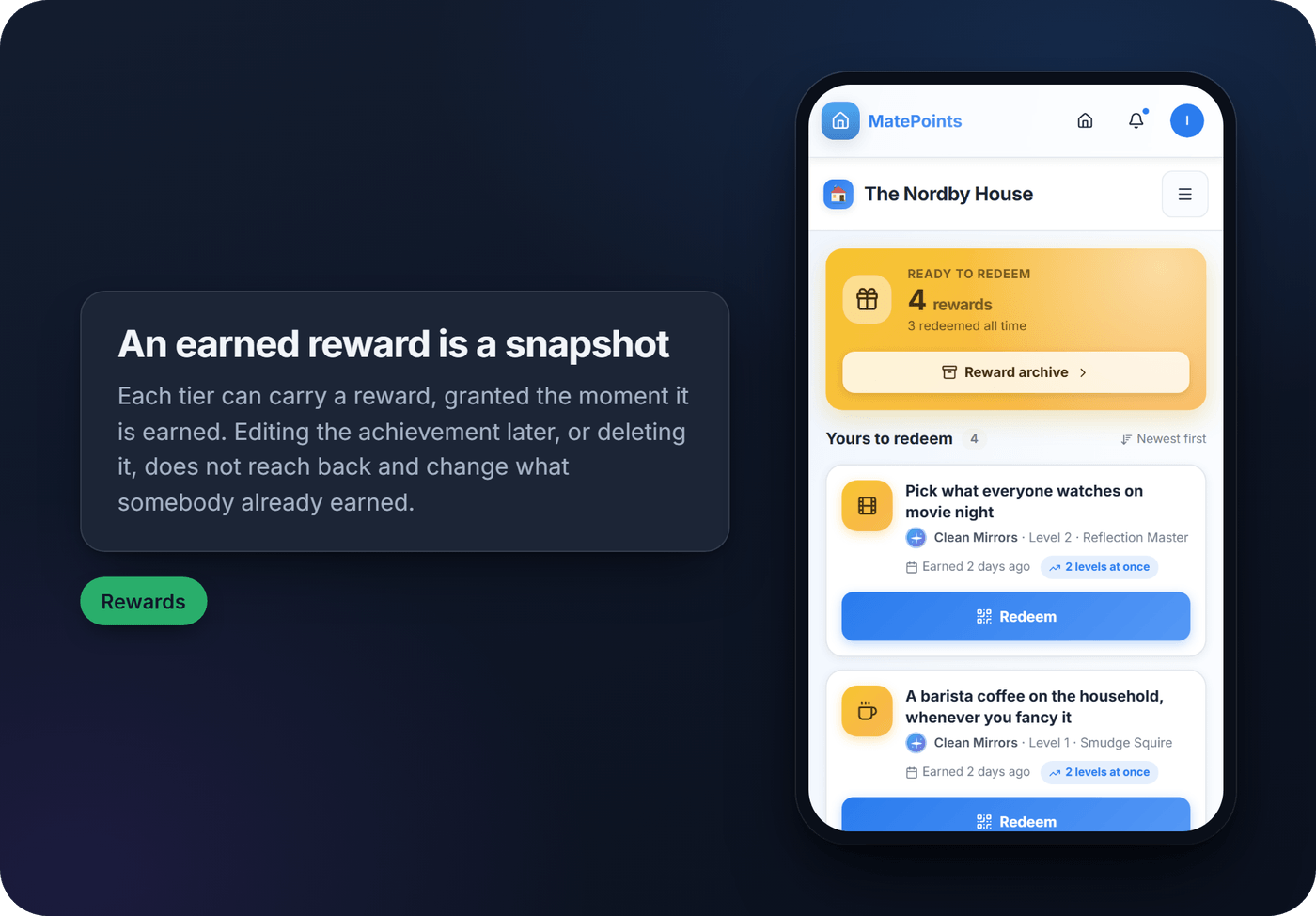
Each tier can carry a reward, granted the moment the tier is earned. Rewards are free text, so a payout can be a lie-in or the good chair rather than cash. An earned reward is a snapshot: editing the achievement later, or deleting it, does not reach back and change what somebody already earned.
Creating and editing achievements is a Pro feature. On the free plan you can delete them but not create them, and the free plan still covers tasks, points, approvals, statistics and the leaderboard. MatePoints does not read smart plugs or sensors, so nothing detects a chore on its own: a completion comes from a person, a tap or a scan. The Subscription page shows the current limits for your account.
Sources
- Introducing Uninteresting Tasks to Children: A Comparison of the Effects of Rewards and Autonomy Support, Joussemet, Koestner, Lekes and Houlfort, Journal of Personality, 2004
- Does gamification increase engagement with online programs? A systematic review, Looyestyn et al., PLOS ONE, 2017
- Effect of a Game-Based Intervention Designed to Enhance Social Incentives to Increase Physical Activity Among Families, Patel et al., JAMA Internal Medicine, 2017
- Chores and Children, Facts for Families No. 125, American Academy of Child and Adolescent Psychiatry, updated 2018
FAQ
What counts as an automated achievement?
A badge or reward that is granted the moment a chore is verified, rather than being handed out by someone keeping score. The verification can be a tap, a scan, or an approval from whoever holds that role in the household.
Do chore badges keep working?
They lift cooperation quickly and the effect fades, which is documented rather than a failure of your rules. Plan to refresh thresholds and rotate which chores carry bonuses, and point some achievements at the household rather than the individual.
Should children be paid for chores through an app?
Keep routine chores non-monetary and save money for occasional jobs outside the rotation. AACAP's guidance recommends a reward chart with positive feedback and does not tie chores to payment at all.
Why did completion drop after we added a leaderboard?
Because public comparison discourages whoever sits at the bottom of it. Try a shared household goal instead, or a table that resets each week so a bad run does not follow someone forever.