Chore incentives for adults: a 2 to 4 week pilot
Chore incentives for adults work best as a short pilot. Pick four chores, price them by effort, run it for a fortnight, and measure before you scale it up.

Chore incentives for adults fail for a different reason than they fail for children. Adults do not need convincing that the bins need emptying. They need the argument about who emptied them last to stop. That is a measurement problem before it is a motivation problem, which is why the fix is a short pilot with a baseline rather than a new rota.
Pick four to six chores, price them by effort, run it for two to four weeks, and decide afterwards whether it earned its place.
Why adults argue about this at all
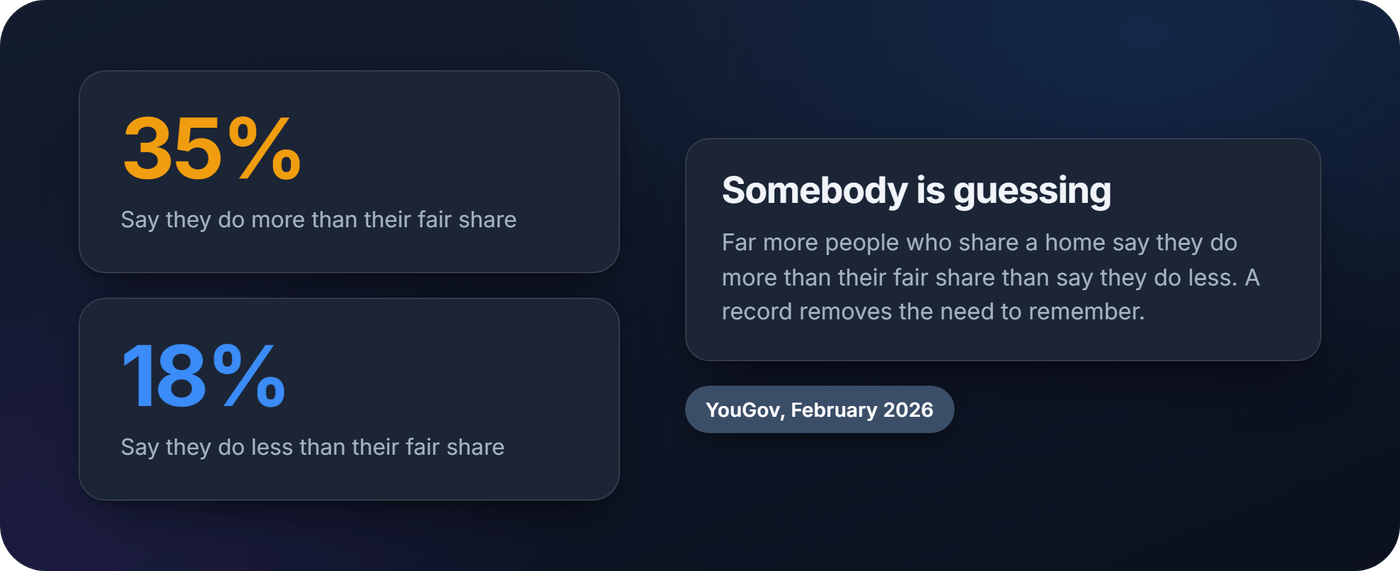
Two numbers set the scene. In a February 2026 YouGov survey, 35% of Americans who live with other people said they do more than their fair share of household tasks, and only 18% said they do less. If everyone were judging accurately those figures would be close together. Somebody in most households is guessing.
The gap is not only perception. The UK's Office for National Statistics found that in autumn 2023, women spent 3 hours 37 minutes a day on unpaid work and men 2 hours 43 minutes, a difference of 54 minutes, down from 1 hour 12 minutes in 2020. Real, and narrowing.
A points system does not settle who is right. It removes the need to remember, which is usually what the argument was actually about. If your household has not had that conversation yet, settle who does more first and treat this article as what comes after.
Set the pilot up in an afternoon
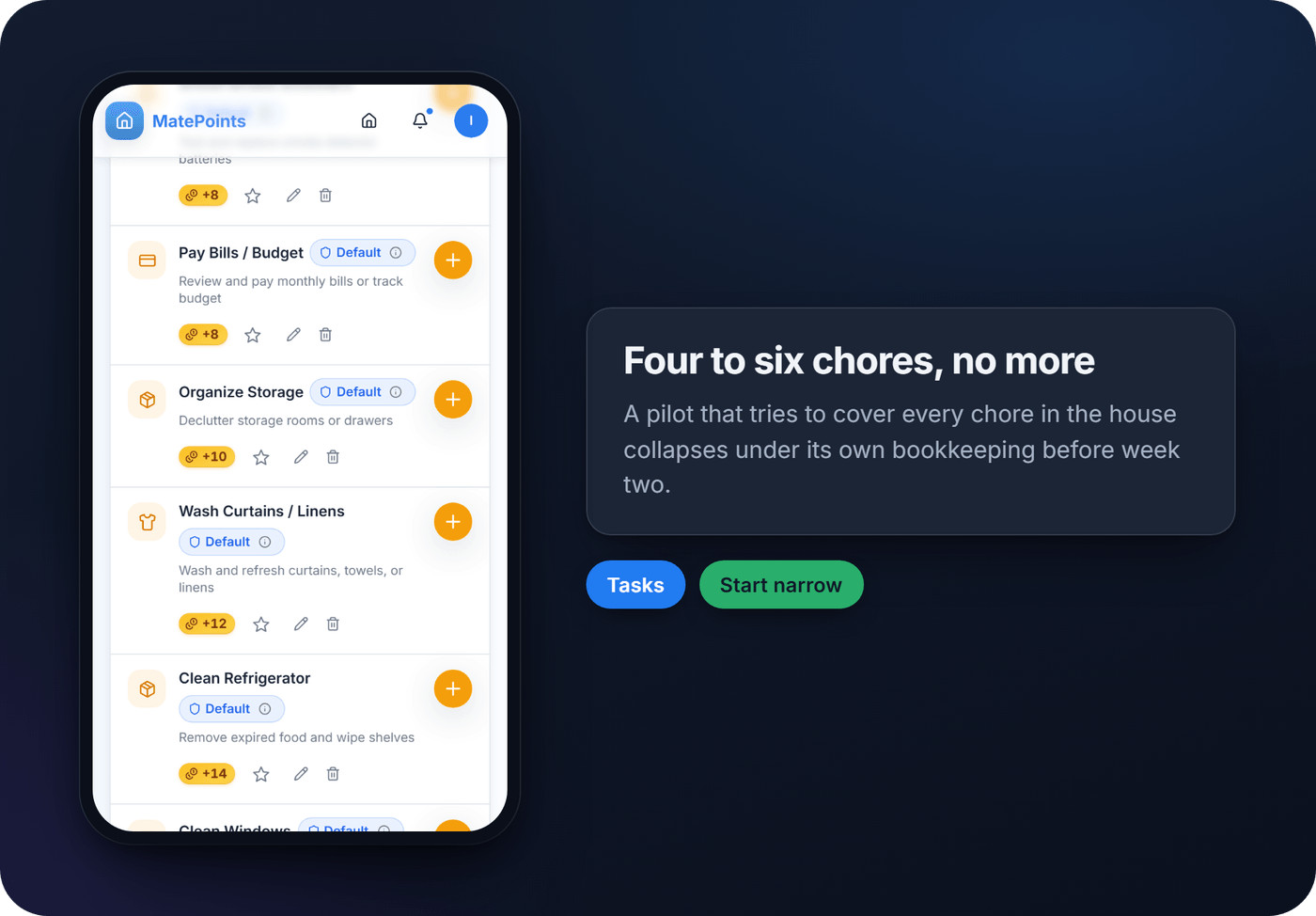
Pick four to six chores. Frequent, visible to everyone, and roughly comparable. Do not load the pilot with one person's least favourite job, because then you are testing that grievance rather than the system.
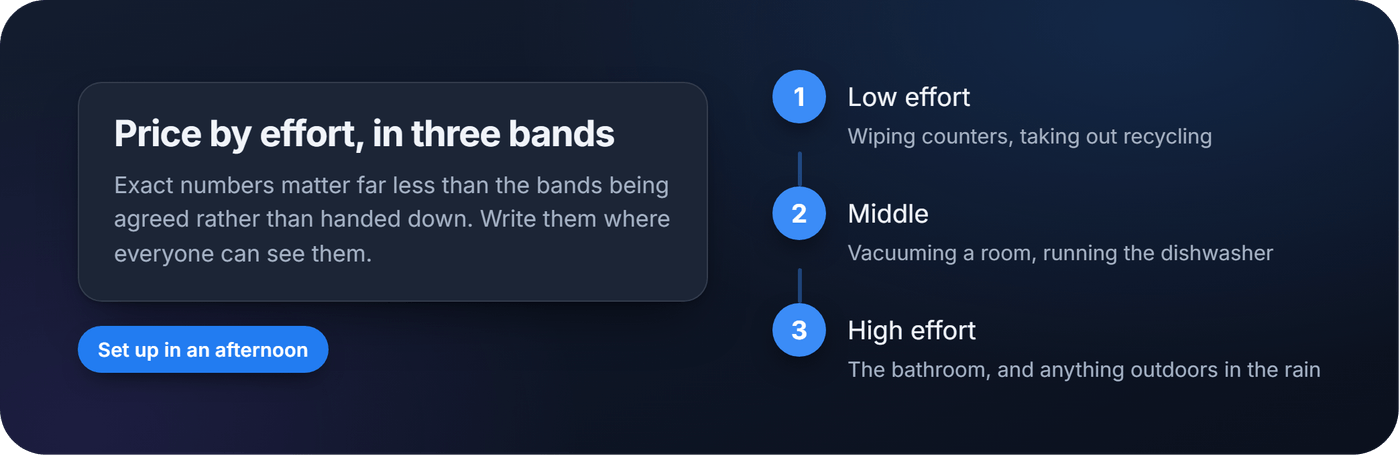
Price by effort, in three bands. Low effort for wiping counters and taking out recycling. Middle for vacuuming a room or running the dishwasher. High for the bathroom deep clean and anything outdoors in the rain. Write the bands down where everyone can see them. Exact numbers matter far less than the bands being agreed rather than handed down.
Build two reward tiers. Something small that redeems often, like first pick of the film or being driven to the station. Something larger that needs pooled points, like a takeaway the house shares. The small one keeps the loop turning; the large one is the reason to keep going.
Name an approver, and give disputes a deadline. One person confirms completions, with a 24 to 48 hour window to contest a rejection. Cap it at 48 hours. Longer and the disputes pile up faster than anyone wants to clear them, and the approval step becomes a chore of its own.
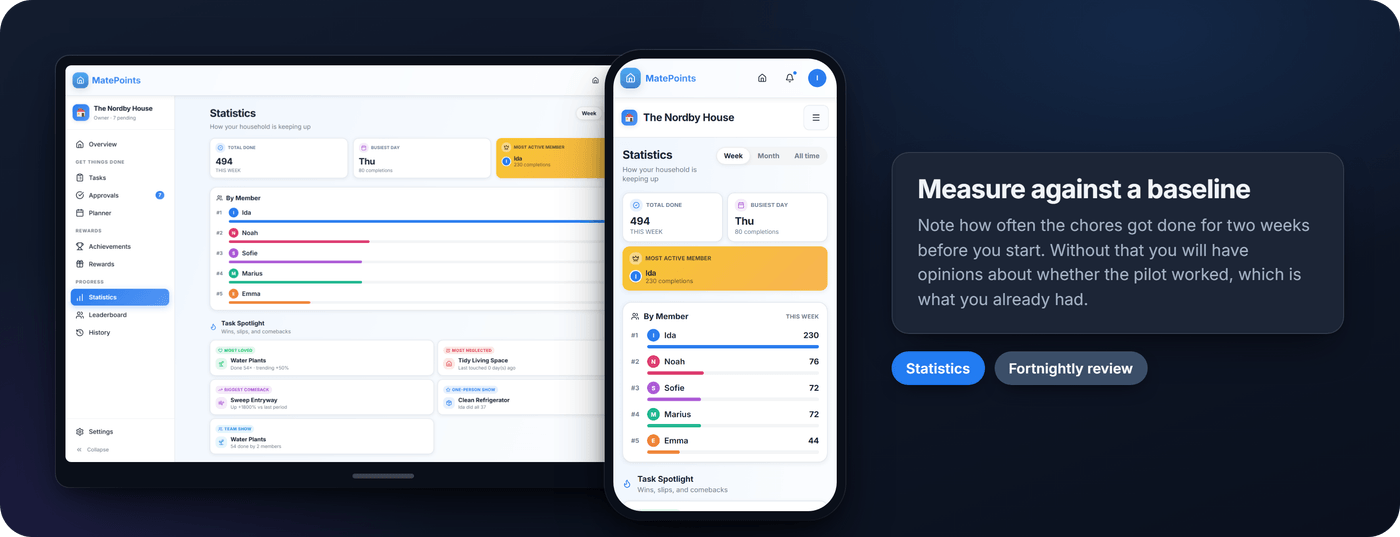
Take a baseline. For the two weeks before you start, just note how often the chores actually got done. Without it you will have opinions about whether the pilot worked, which is what you already had.
Use micro leaderboards, not a permanent table
This is the part most chore apps get wrong for adults.
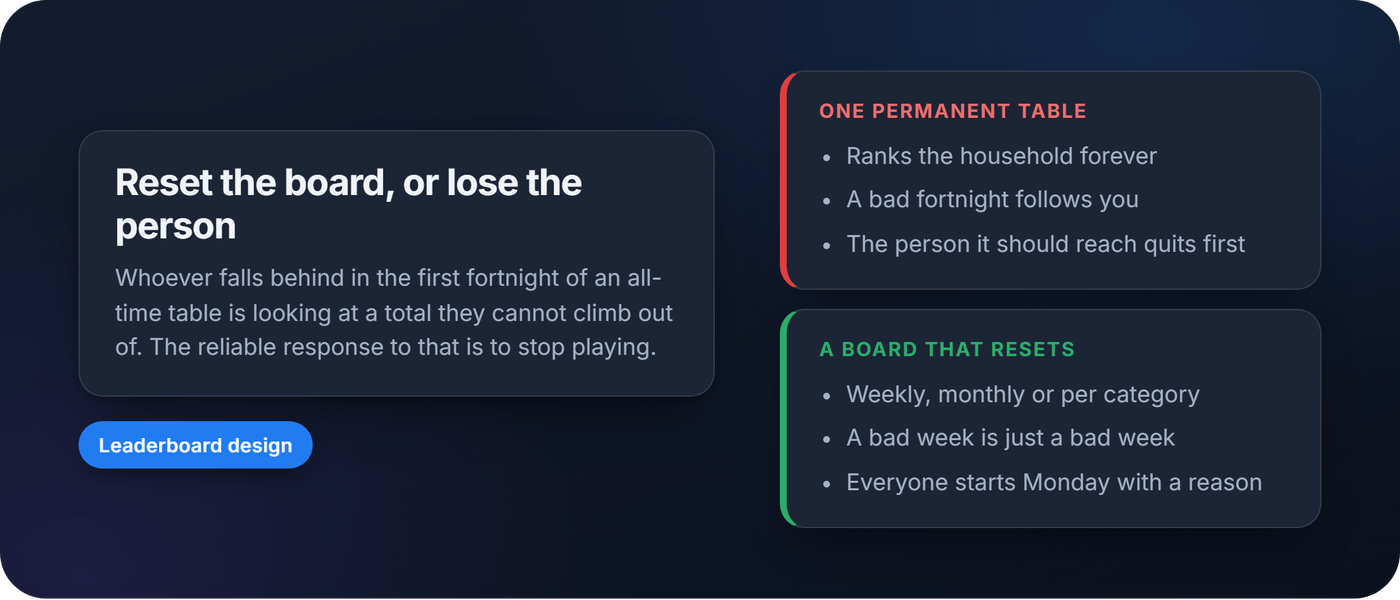
A single all-time leaderboard ranks the household permanently. Whoever falls behind in the first fortnight is looking at a total they cannot realistically climb out of, and the reliable response to that is to stop playing. The person it demotivates is exactly the person the system was bought to reach.
A micro leaderboard resets: weekly, monthly, or per category of chore. A bad week is a bad week rather than a permanent position. Everyone starts Monday with a reason to bother.
The same logic applies to how loud you make it. Quiet, individual progress tends to preserve goodwill better than announcing the standings to the whole house. If two people are close, resist the urge to narrate it.
What to measure, and when to stop
Five numbers tell you almost everything:
- Completion rate, against your baseline.
- Who is still logging in week three.
- Average points per person, which exposes a chore priced wrongly.
- Redemption rate. Points nobody spends are points nobody wants.
- Quiet drop-off. The person who stops logging without saying anything is the signal that matters most, and the one no dashboard shouts about.
Change one thing at a time. Add the leaderboard, or change the reward, not both. Give each change two full cycles before deciding it worked, and set a stop rule in advance: if drop-off rises instead of completion, end the experiment rather than letting it run on inertia.
Expect the novelty to fade, because it does. A systematic review in PLOS ONE covering 15 studies and 10,499 participants found gamification raised engagement in 12 of them and that the effect appeared to lessen over time. What partly survived in the BE FIT trial in JAMA Internal Medicine, where 94 families competed in teams for twelve weeks, was accountability to other people: they hit their goal on 53% of days against 32% for the control group, and were still ahead twelve weeks after the game stopped, 44% against 33%.
The lesson for a household of adults is that the points are the excuse and the housemates are the mechanism. Design for the second one.
Autonomy is the thing to protect
Adults resent being managed by an app more than children do, and there is evidence about why. In a 2004 study in the Journal of Personality, Joussemet and colleagues compared introducing a deliberately boring task with a reward against introducing it with autonomy support, meaning an explanation of why it mattered and an acknowledgement that it was dull. Autonomy support produced positive effects, and rewards produced none.
In practice that means letting people claim chores rather than being assigned them, agreeing the prices as a group, and keeping at least one reward that a single person can redeem alone without negotiating with the house. Whether you are two people or five, the roommate version and the couples version of this problem differ less than you would think.
The honest trade-off
Faster logging costs you some verification accuracy. An approval step buys the accuracy back and costs somebody's time. Transparency about who did what creates accountability, and the same transparency can feel like being watched if it is designed carelessly.
There is no version of a shared chore system with no friction in it at all. The goal is to put the friction in the right place: easy to log, harder to fake, and never so exposed that a bad week becomes a public event.
Marcus
Running the pilot in MatePoints
MatePoints covers the whole pilot. You create a household, invite the people in it, and give each chore a point value. Completions go through an approval step, so credit comes from a person rather than on trust. Roles decide who can edit chores and who can approve them, which keeps the approver from being the only person setting prices. The leaderboard shows the period rather than only an all-time total, which is the micro leaderboard idea above. Statistics and task history give you the numbers for the fortnightly review, and rewards are free text, so a payout can be a lie-in rather than cash.
Tap-to-complete with an NFC sticker or a QR poster is a Pro feature to set up, and it needs a Pro owner in the household before a tap will complete anything. Once it is set up, everyone can use it, including free members. The free plan runs the pilot perfectly well without any of that: chores, points, approvals, statistics and the leaderboard are all included.
MatePoints does not connect to smart-home devices, so nothing detects a chore on your behalf. The Subscription page shows the current limits for your account.
Sources
- How Americans feel about household chores and dividing them, YouGov, February 2026
- Time use in the UK, 23 September to 1 October 2023, Office for National Statistics
- Does gamification increase engagement with online programs? A systematic review, Looyestyn et al., PLOS ONE, 2017
- Effect of a Game-Based Intervention Designed to Enhance Social Incentives to Increase Physical Activity Among Families, Patel et al., JAMA Internal Medicine, 2017
- Introducing Uninteresting Tasks to Children: A Comparison of the Effects of Rewards and Autonomy Support, Joussemet, Koestner, Lekes and Houlfort, Journal of Personality, 2004
FAQ
Do chore incentives actually work for adults?
They raise completion while they are running, and the effect fades as the novelty does. The part that lasted longest in the research was accountability to other people rather than the points themselves, so build the social side in deliberately.
How long should a pilot run?
Two to four weeks, with a baseline taken beforehand and a success criterion agreed in advance. Any shorter and you are reading noise; any longer and nobody remembers what you were testing.
What is a micro leaderboard?
A ranking that resets, weekly or by chore category, instead of running forever. It stops whoever falls behind early from being stuck at the bottom permanently, which is the fastest way to lose them.
How should chores be priced?
By effort and unpleasantness rather than by the clock, in three bands. Agree the bands as a household rather than handing them down, and expect to re-price after the first fortnight.