Reward ideas for teens: freedom beats stickers
Reward ideas for teens that actually land: trade in freedom and access, price the chores first, pay fast, and let your teenager write half the menu.

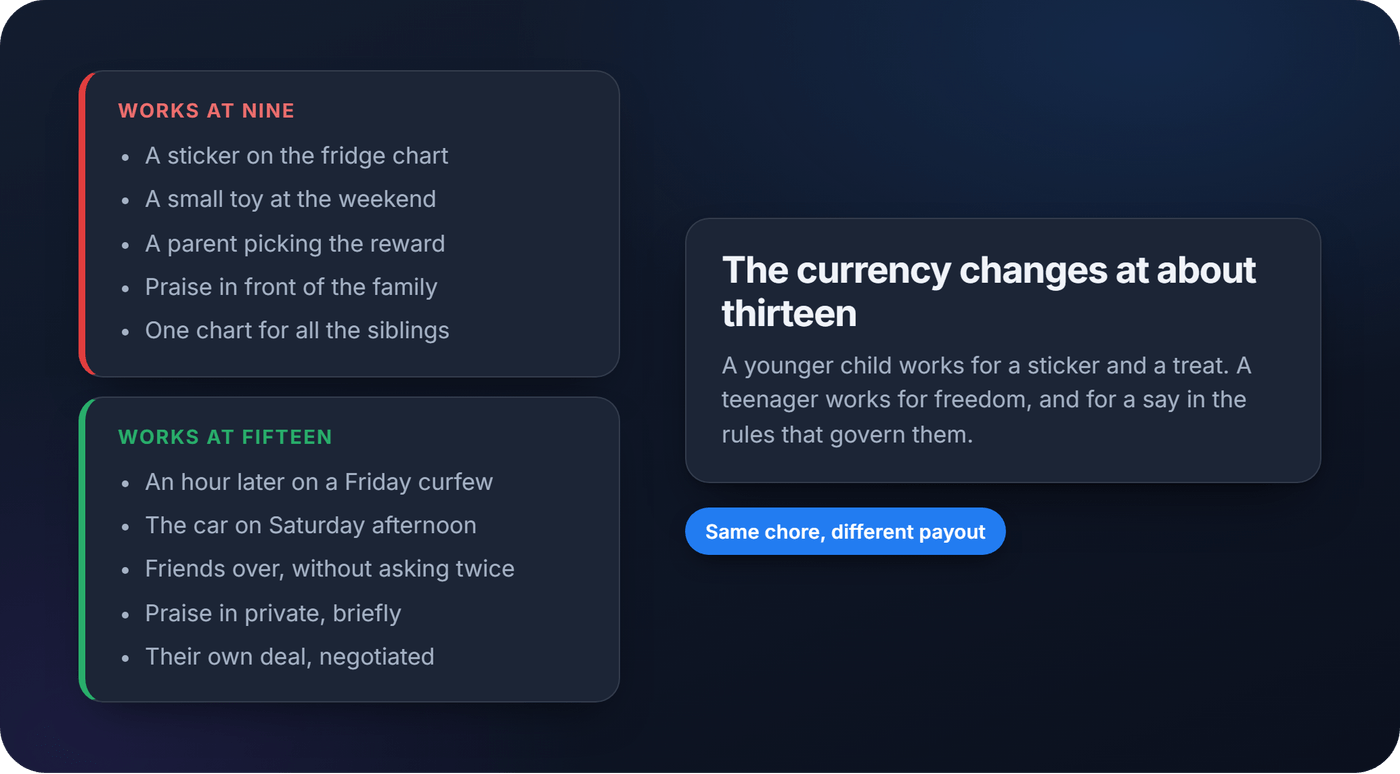
Most reward ideas for teens fail for one reason: they were designed for a nine year old and scaled up. A teenager will not work for a sticker, and by fifteen not for a small toy either. They will work for freedom. A later curfew, the car on Saturday, friends in the house without negotiating it twice. Here is the menu, then the part the listicles skip: how to price it, how fast to pay, and how to keep it alive past week three.
Why the currency changes at thirteen
Sensitivity to rewards rises through the early teens and peaks in the middle of them, while the self-control that would let a teenager ignore a reward matures years later. Laurence Steinberg summarises the evidence in The Teenage Brain: Sensitivity to Rewards (Current Directions in Psychological Science, 2013). A well-aimed reward has more pull at fifteen than at nine. A badly aimed one gets ignored completely.
The aim is what changes. A younger child is happy to be given something. A teenager is busy becoming a person who decides things, so the reward that lands is the one that hands them a decision.
Reward ideas for teens, grouped by what they cost you
Start here, then cut it down with your teenager.
Free, and mostly about freedom
- An hour later on the Friday or Saturday curfew
- Friends over on a school night, agreed in advance
- The car for an afternoon, fuel included
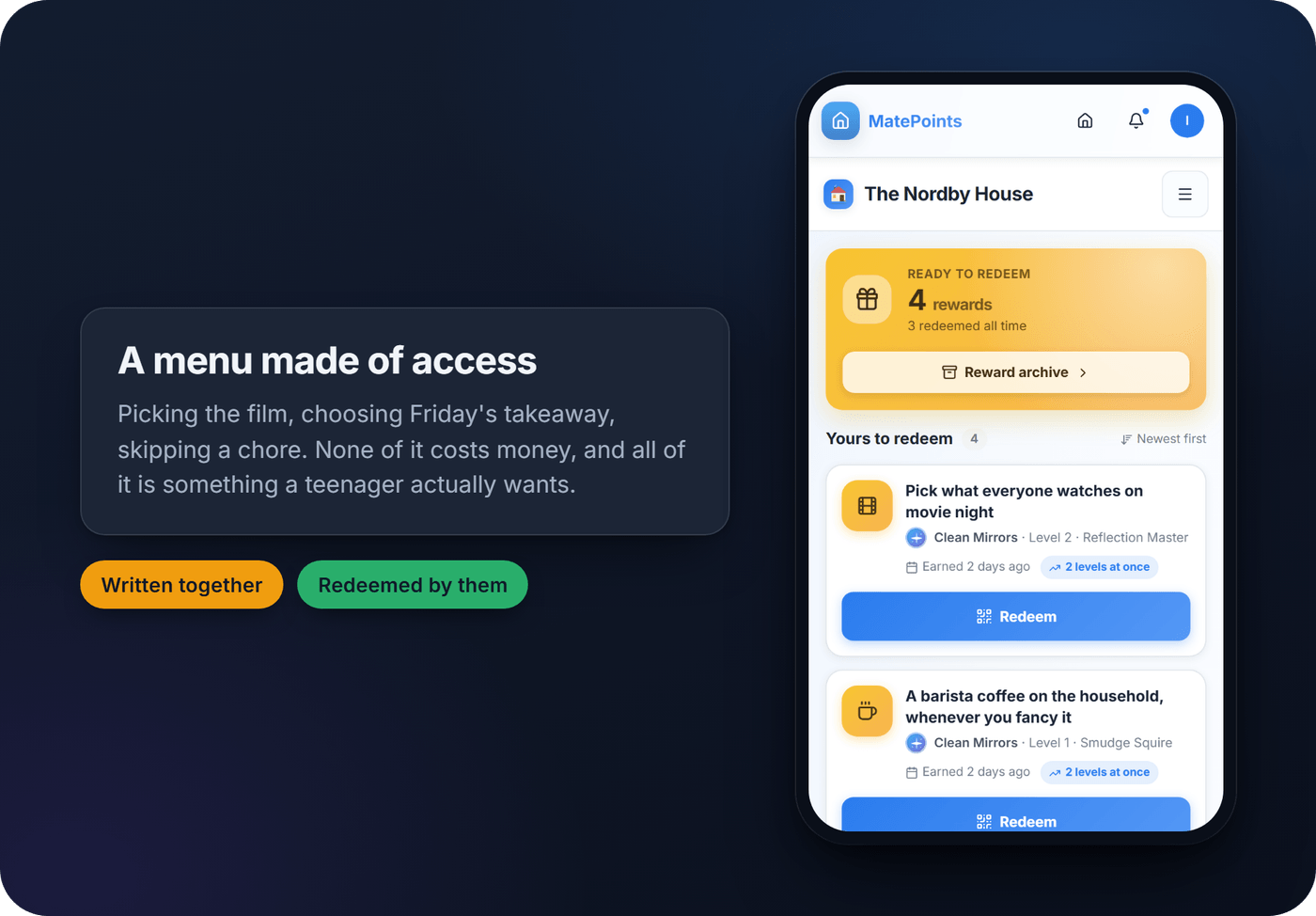
- Choosing the family film, with no veto from anyone else
- Choosing Friday's takeaway
- Skipping one chore of their choice this week
- A later phone cut-off on a Friday
- One "no questions asked" pass on a chore they hate
Small spends
- Their coffee order on the way to school, twice a week
- A takeaway delivered for them and one friend
- A game or an in-game item at the weekend
- Cinema ticket, plus a ticket for a friend
- Paying for a month of their own subscription
Worth saving up for
- Driving lessons, one lesson per milestone
- A concert or match ticket
- A phone upgrade brought forward
- Money towards a bike, a board, an instrument
- Their own bank card with a monthly allowance attached
If money is part of the mix, separate it from the daily chores. We looked at how to keep the two apart in allowance and chores.
What the reward is competing with
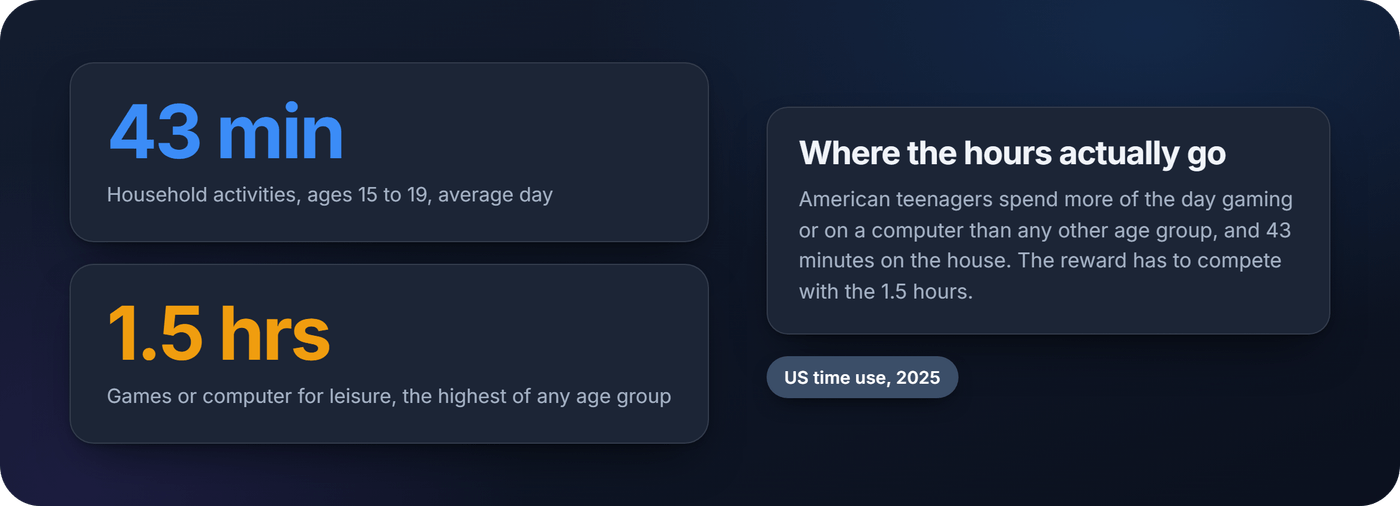
In 2025, American 15 to 19 year olds spent an average of 43 minutes a day on household activities, and 1.5 hours a day playing games or using a computer for leisure, more than any other age group (Bureau of Labor Statistics, American Time Use Survey, released June 2026).
Your ten points for emptying the dishwasher compete with that. It is the whole argument for rewards made of access: an hour of extra freedom on Friday is worth something to a sixteen year old that a trip to the shops is not. If the reward on your list is screen time itself, read what works and what backfires first.
Price the chores before you set the rewards
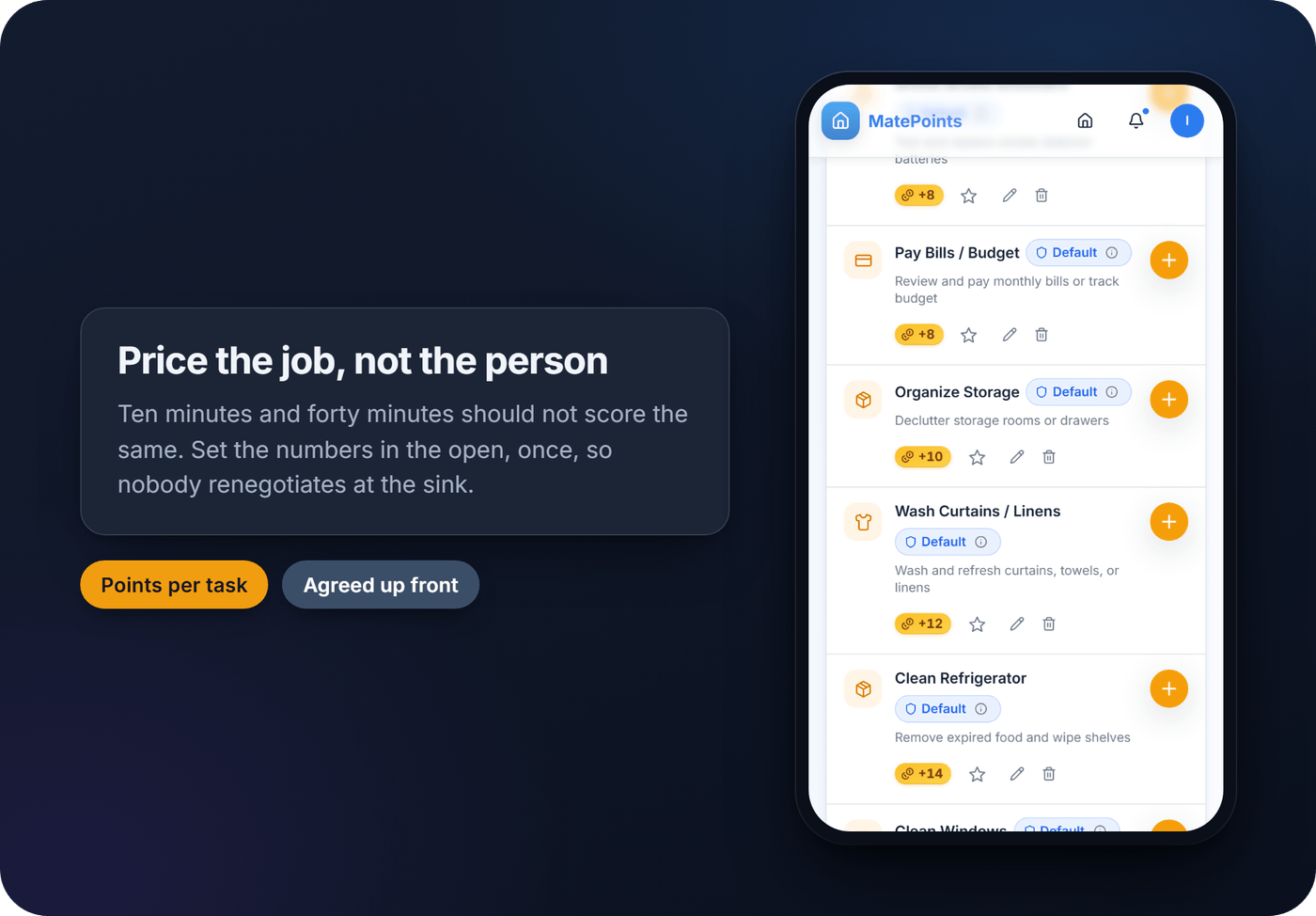
A menu without prices turns every chore into a negotiation. Write the numbers down once, in the open, and let them argue with the list rather than with you. Three rules keep it honest:
- Price by effort, not by who does it. Forty minutes of bathroom scores more than five minutes of dishes, whoever picks it up.
- Keep some chores unpaid. The American Academy of Pediatrics is blunt about the baseline: make sure your teen knows the work within the home is as valuable as the work outside it, and a part-time job after sixteen is not a reason to stop contributing.
- Do not raise the price mid-week because something went undone. That teaches them to wait you out.
The same page makes the capability argument better than most parents manage mid-argument: if your teen can operate a smartphone, they can work out a washing machine, an oven and a dishwasher.
Pay fast, and keep one reward near
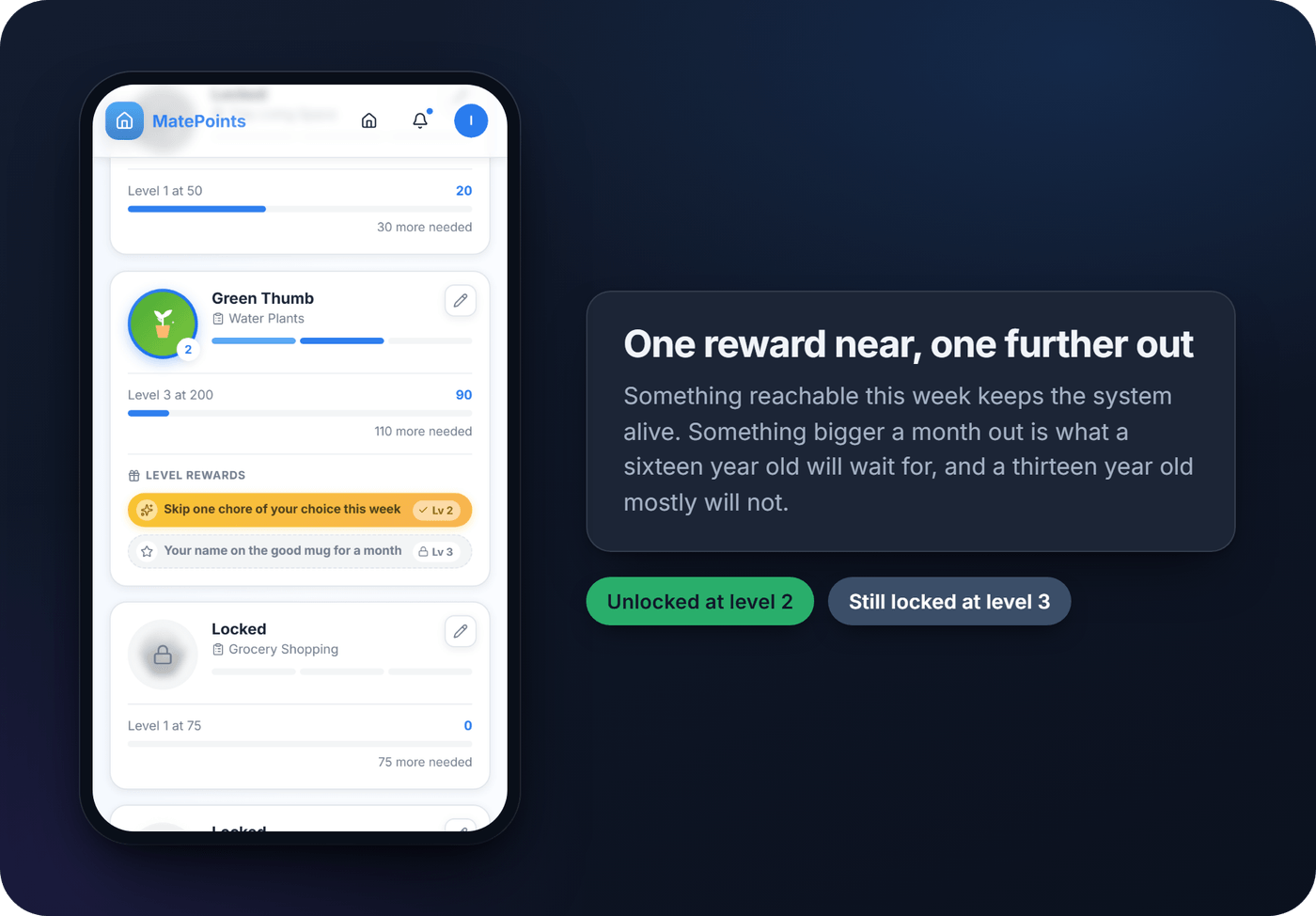
Teenagers are not all the same distance from a delayed reward. Across 622 Dutch adolescents aged 12 to 17, preference for a larger delayed reward over a smaller immediate one increased with age (Lee, de Groot, Boschloo, Dekker, Krabbendam and Jolles, Frontiers in Psychology, 2013). A seventeen year old can hold out for a concert ticket in November. A thirteen year old mostly cannot, and a system built only on the far reward is dead by half term. So run two tiers: one reward reachable inside a week, one worth a month of work.
Who the reward is for matters too. In a 2024 neuroimaging study of adolescents aged 14 to 17, willingness to wait was highest when the reward was for themselves, lower for a friend, lowest for a stranger (van Rijn et al., Developmental Cognitive Neuroscience). A shared family reward is a weaker lever than something that is theirs alone.
Set it up in one conversation
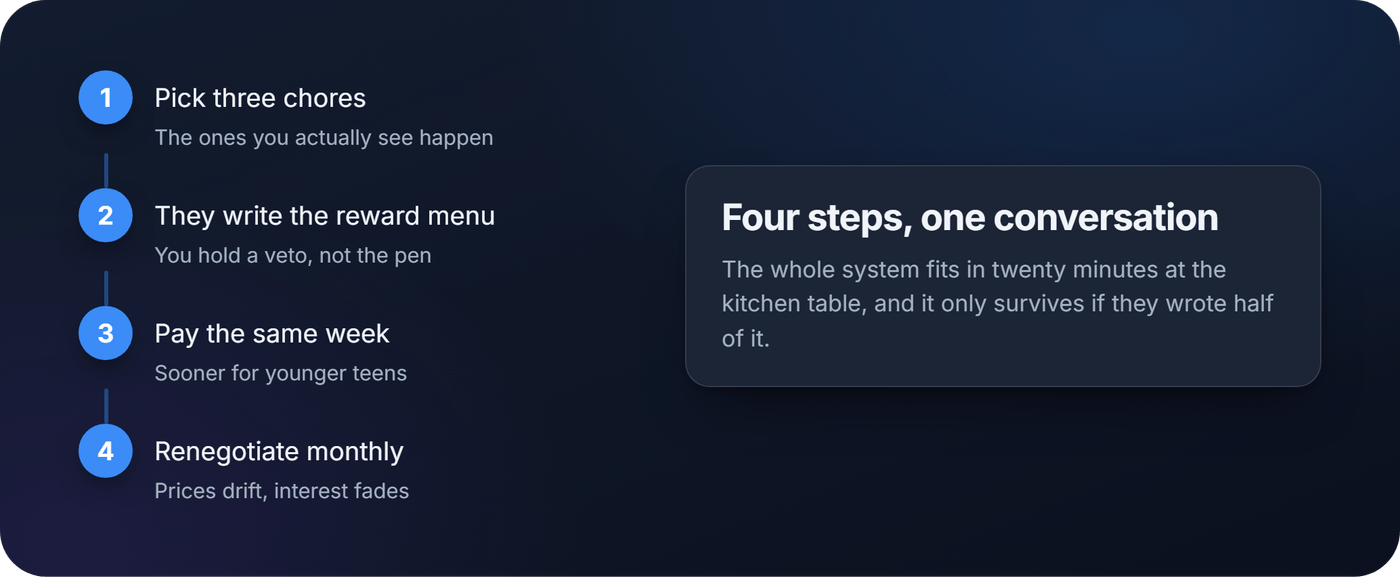
Twenty minutes at the kitchen table, and they hold the pen for half of it.
- Pick three chores, the ones you can actually see happen. Not "help more".
- They write the reward menu. You keep a veto, not the pen. A reward you chose for them is a reward you will have to sell every week.
- Agree the prices and the payout day, then leave both alone for a month.
- Renegotiate monthly. Interest fades, prices drift, and a system nobody revisits quietly stops being real.
Handing over that much of the design is not a soft touch. A 2024 study of adolescents found that parental autonomy support predicted higher satisfaction of their psychological needs, which in turn predicted stronger academic motivation (Frontiers in Psychology, 2024). Control gets compliance while you are in the room. Autonomy is what keeps working when you are not.
What backfires
- Taking back a reward already earned. It ends the system's credibility in one move, and you cannot buy it back.
- Inventing a reward mid-argument. That is a bribe, and they will price the next argument accordingly.
- Paying for everything. Once every contribution has a price, the unpaid ones stop happening.
- A public scoreboard with siblings on it. A teenager who cannot win stops playing. Compare them against their own last week.
- A list that would fit on a sticker chart. Younger children are a different job: see our reward chart for kids.
Where MatePoints fits
MatePoints runs the boring half: what each chore is worth, who did it, and what has been earned.
- Points per chore, set by you, visible to everyone in the household.
- Approval, so a chore counts when a parent or an older sibling confirms it, rather than on the honour system.
- Achievement rewards, where the freedom menu lives: reach a level on a chore and the reward you wrote together becomes redeemable. Creating them needs Pro.
- Tap to complete with an NFC tag or a QR code on the thing itself, in a Pro-owned household.
It does not track curfews, hand out pocket money or watch a phone, and our Terms set a minimum account age of 13, so a younger sibling's chart stays on paper. For the wider setup, start with the chore reward system guide, or homework reward system if study time is the real battleground.
Start this weekend
Pick three chores. Ask your teenager for five rewards they would actually work for, and cross out only the ones you genuinely cannot do. Price the chores in front of them, pay the first reward inside a week, and diarise a date a month out to argue about the prices again.
FAQ
What are good rewards for teenagers?
Access and autonomy first: a later curfew, the car, friends over, choosing the film or the takeaway. Then small spends they picked themselves. Agree everything before the chore, never during the argument about it.
How do I motivate a teenager who says they do not care?
Ask them to price the menu instead of proposing one. Indifference is usually aimed at your list rather than at rewards in general, and letting them write it is the cheapest fix available.
How often should a teen reward system pay out?
Keep one reward reachable inside a week and one a month away. Thirteen year olds live on the near tier; sixteen year olds will wait.
Does positive reinforcement still work for teens?
Yes, with two changes. Praise goes private and stays short, because an audience turns it into a performance. And the reward has to be one they chose.
Should I pay my teenager for chores?
Some chores, at most. Keep a baseline of unpaid contributions that come with living in the house, and attach rewards to the extra.
Sources
- The Teenage Brain: Sensitivity to Rewards, Laurence Steinberg, Current Directions in Psychological Science, 2013
- American Time Use Survey 2025 Results, US Bureau of Labor Statistics, released June 2026
- Household Chores for Teens, Shelly Flais MD FAAP, American Academy of Pediatrics (HealthyChildren.org), updated February 2024
- Age and educational track influence adolescent discounting of delayed rewards, Lee, de Groot, Boschloo, Dekker, Krabbendam and Jolles, Frontiers in Psychology, 2013
- Delay discounting in adolescence depends on whom you wait for, van Rijn et al., Developmental Cognitive Neuroscience, 2024
- Academic motivation in adolescents: the role of parental autonomy support, psychological needs satisfaction and self-control, Frontiers in Psychology, 2024