Recurring chores schedule: a 20 to 30 minute daily plan
A recurring chores schedule that holds: a 20 to 30 minute daily reset, one focus area per weekday, monthly jobs slotted in, and a rotation that is fair.

A recurring chores schedule works when no single day carries the whole house. Run a daily reset of 20 to 30 minutes, split between morning and evening. Give each weekday one focus area for the deeper work, capped at 30 to 45 minutes, so weekends stay open. Fold monthly and seasonal jobs into a weekly slot instead of cramming them into weekday routines. Then give every task an owner, rotate the chores nobody wants, and keep the plan somewhere everyone can see it, so nobody has to ask what's left.
This is the whole rhythm. For just the short daily list, see our daily chore checklist.
Why a recurring chores schedule beats a Saturday blitz
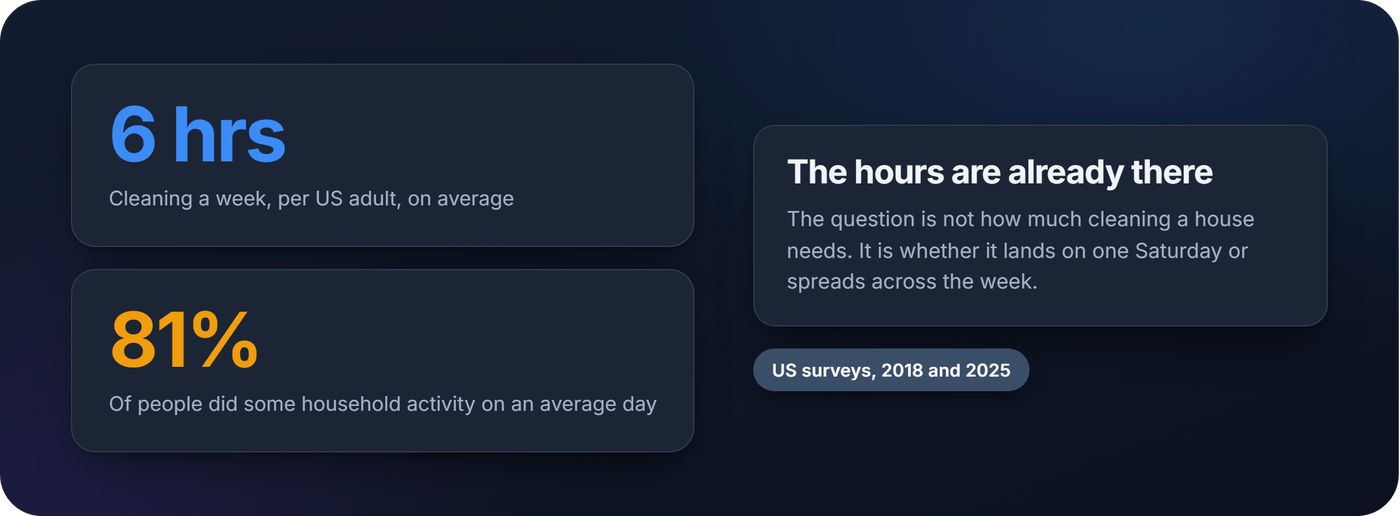
American adults spend about six hours a week cleaning their homes, and more than a quarter (28 percent) spend over seven, according to an American Cleaning Institute survey from 2018. Government time-use data tells a similar story. In the American Time Use Survey for 2025, the US Bureau of Labor Statistics found that 81 percent of people did some household activity on an average day, and housework alone, meaning cleaning and laundry, averaged 0.56 hours a day, about half an hour.
The difference between a household that feels calm and one that feels like a constant argument usually isn't the hours worked. It's how they get distributed. Cram six hours into a Saturday and you'll dread Saturdays. Spread the same hours across the week in short sessions, and no single day carries the weight. That's the entire logic behind a recurring chores schedule: smaller, predictable chunks beat one big miserable block.
The math is kinder than it sounds. A 20 to 30 minute daily reset plus five weekday focus sessions of 30 to 45 minutes lands close to the ACI's six hours, and that is before you split it between the people who live there.
Short daily sessions also stop buildup, so the weekly tasks take less time, and predictable timing turns chores into habit instead of a fresh decision every day.
The daily chore checklist: a morning and evening reset
Daily tasks should pass one test. The daily cleaning checklist from 101 Planners puts it well: a daily task should take under three minutes, need no setup, and stop its weekly version from becoming twice as hard. The same guide sizes the whole daily routine at 15 to 30 minutes. If a chore needs supplies you have to dig out, it belongs on the weekly list.
A solid daily list looks like this:
- Wash or load dishes right after meals, not hours later.
- Wipe down kitchen counters and the stovetop once in the evening.
- Tidy the common areas before bed.
- Make beds in the morning. It takes a couple of minutes and changes how a bedroom feels all day.
- Take out the trash or recycling if the bins are full.
Split these across two windows rather than one long block. A morning pass (beds, a quick counter wipe) takes 5 to 10 minutes. An evening pass (dishes, common areas) takes another 15 to 20. That totals 20 to 30 minutes a day.
Pro Tip: Attach the evening reset to something you already do, like brushing your teeth or locking the front door. A meta-analysis of 94 tests by Peter Gollwitzer and Paschal Sheeran (2006) found that specific "if this, then that" plans had a medium-to-large effect on reaching goals. "When I lock the door, I wipe the counter" is one.
A weekly chore schedule with one focus area a day
One focus area per day, 30 to 45 minutes at most, is the method behind the weekly cleaning schedule from Refresh Routine (Sarah Mitchell, 2026). Instead of cleaning the whole house on Saturday morning, you tackle one category at a time. A sample weekly cleaning timetable:
- Monday: Bathrooms (toilets, sinks, mirrors, tub or shower).
- Tuesday: Floors (vacuum, sweep, mop across the whole home).
- Wednesday: Kitchen deep clean (fridge wipe-down, stovetop detail, cabinet fronts).
- Thursday: Bedrooms (dusting, laundry sorting, a closet reset).
- Friday: Living spaces (shelves, surfaces, straightening).
- Weekend: Light catch-up or a monthly task, kept short.
Scale the timing to your home. A studio might clear bathroom day in 15 minutes; a four-bedroom house with two bathrooms could need 45.
Batch where you can. Do all the bathrooms back to back and you set up the supplies once, and setup is often the slowest part of a chore.
Monthly and seasonal jobs: give them a weekly slot
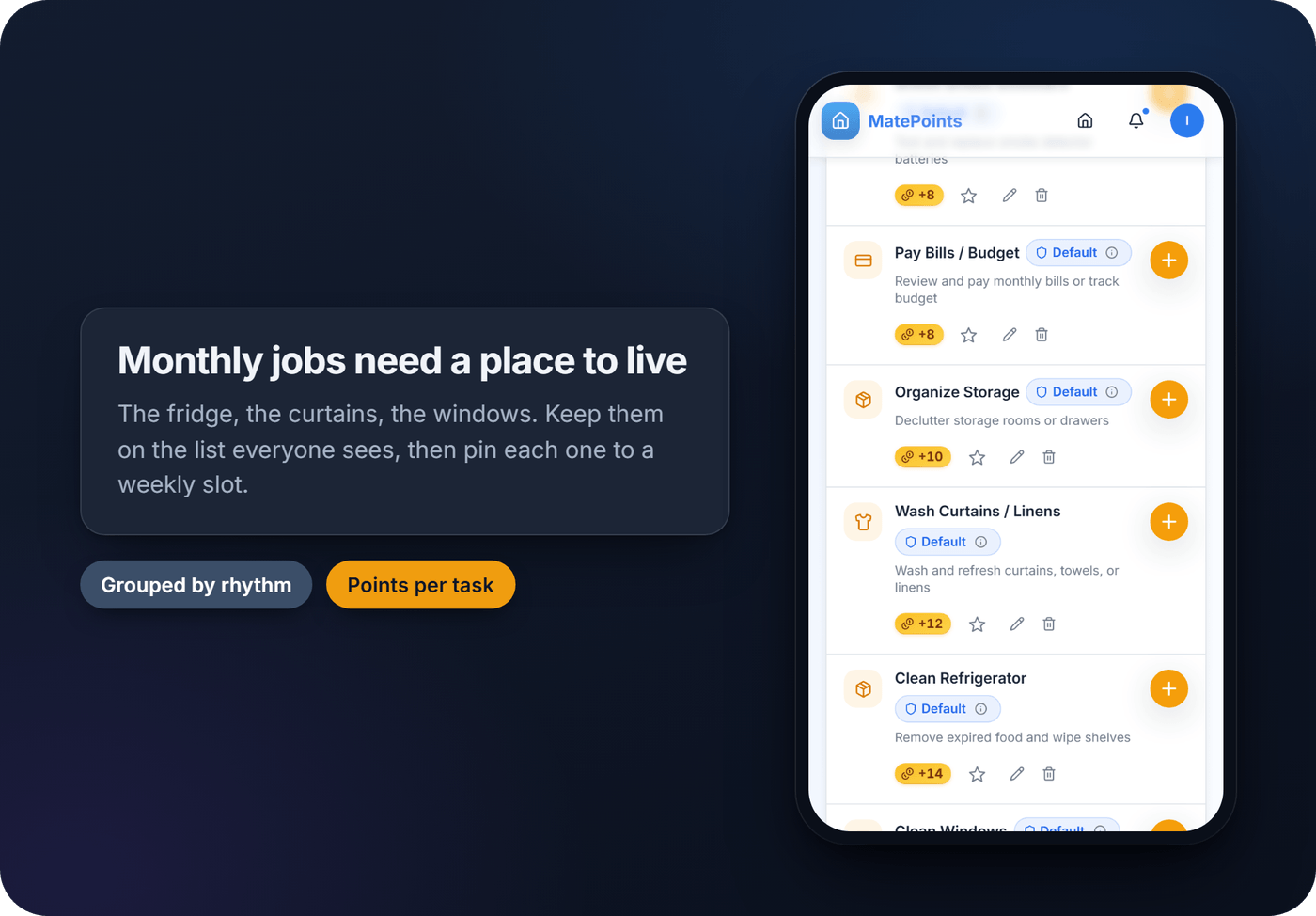
Some tasks don't fit a weekly rhythm at all, and that's fine. They just need their own slot instead of vanishing. A basic home maintenance schedule includes:
- Replacing or cleaning the HVAC filter.
- Vacuuming out air vents and behind large appliances.
- Deep cleaning the oven.
- Wiping down baseboards and door frames.
- Rotating mattresses or washing pillow protectors.
- Testing smoke detectors and checking the pantry for expired food.
The easiest way to keep these from piling up is to attach each one to an existing weekly slot. If Wednesday is kitchen day, the oven deep clean lands on the first Wednesday of the month. For bigger seasonal jobs like gutters or windows, reserve a weekend block once a quarter. That keeps the schedule from ballooning into something nobody wants to look at.
How to organize chores into a schedule in four steps
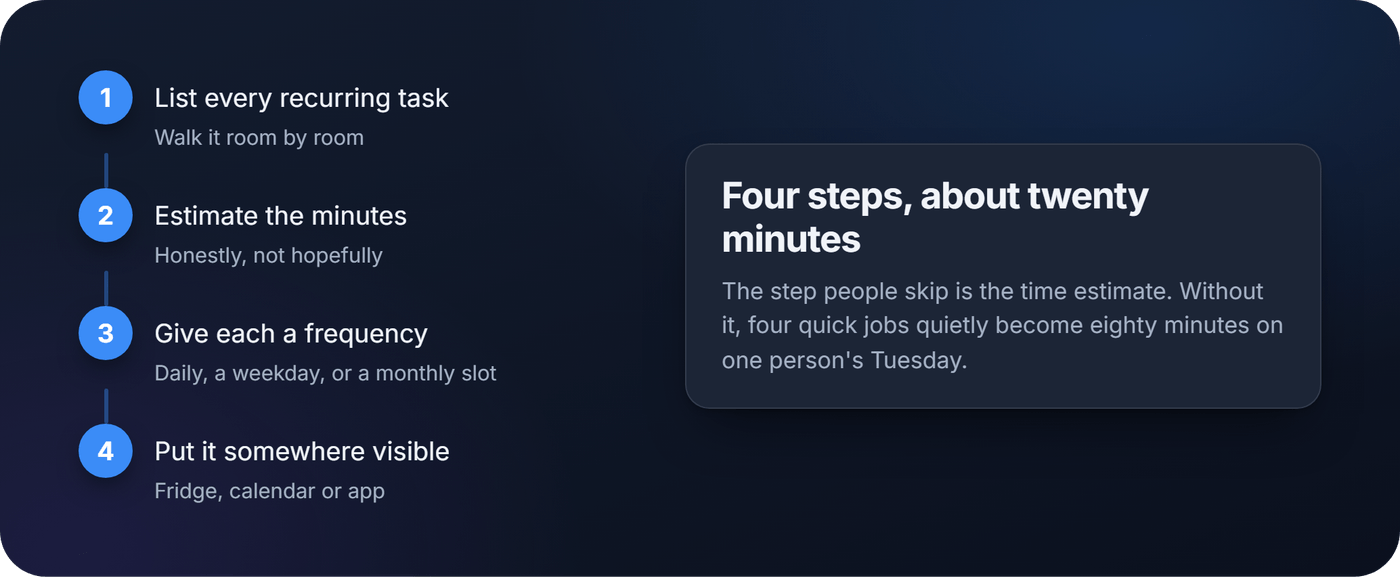
Setting one up doesn't take a planning session. It takes four short steps and about 20 minutes.
- List every recurring task you can think of. Walk room by room. Dishes, laundry, floors, trash, bathrooms, pet care, yard work, all of it.
- Estimate minutes per task. Be honest. A "quick" vacuum that actually takes 25 minutes gets written down as 25, not 10.
- Give each task a frequency. Daily tasks go in the morning and evening windows. Weekly tasks get one weekday each. Monthly tasks attach to an existing weekly slot.
- Put it somewhere visible. A printed chart on the fridge, a shared calendar with recurring events, or a household app all work, as long as everyone can see it without asking.
The step people skip is step 2. Without the time estimate, you end up giving four "quick" 20-minute tasks to one person on one day. That is 80 minutes they didn't sign up for.
Assign it fairly: owners, rotation and the odd/even week
Fairness breaks down when ownership is vague. A task without a name next to it either doesn't get done or one person quietly absorbs it every week. Give every recurring task a clear owner and its rough time, written where everyone sees it.
Then rotate the jobs nobody wants. There is no mystery about which ones those are. About half of Americans (52 percent) hate or dislike cleaning bathrooms, more than any other chore in a YouGov survey of 2,230 US adults (Taylor Orth, October 2025, published 2026). Washing dishes came next at 27 percent, and taking out the trash sat at 24. A family chore rotation keeps those from landing on the same person forever:
- Rotate the worst chores, usually bathrooms and trash, every week or two.
- Try pair swapping, where two people trade their least favourite job every other week.
- Hold a five-minute weekly check-in to flag what got missed.
- Agree what "done" means, and have someone take a quick look.
Pro Tip: If two people keep arguing about whose turn it is, stop debating and alternate by week number. Odd weeks, Person A does the bathrooms. Even weeks, Person B does. Removing the negotiation removes the argument.
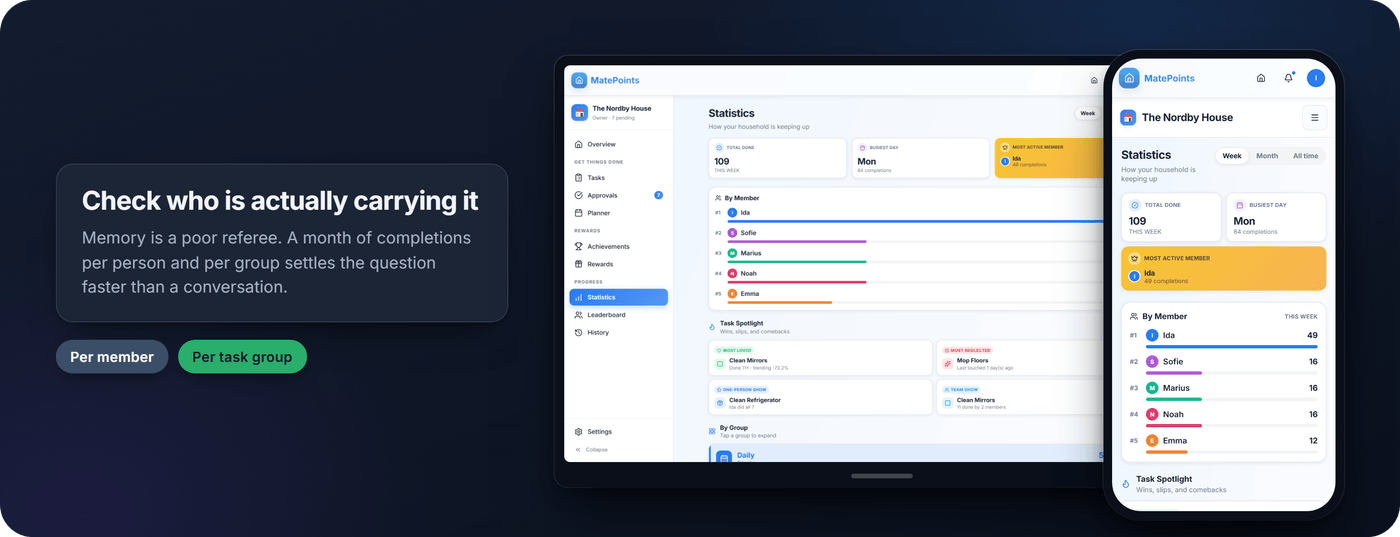
After a month, look at who actually did what. Memory is a poor referee, and a record settles it faster than a conversation does.
For children, which chores suit which age is a subject of its own: see the age-by-age family chore chart.
Sample recurring schedules you can copy
Solo or small household: 10 to 15 minutes daily (dishes, a quick tidy), and one weekly deep-clean day rotating through bathroom, floors and kitchen.
Two adults: Split laundry by person, alternate heavy chores like vacuuming and trash every other week, and hold a five-minute Sunday check-in to reset the week. Sharing with friends rather than a partner? The roommate chore system adds cleaning standards and a chart template.
Family with kids: Younger children handle toy pickup and setting the table, older ones take trash and dishes. Home-Ec 101's weekly chore schedule (Heather Solos) keeps each day to one major and one minor task, which suits a family well. If you add small rewards, tie them to consistency rather than perfection; our reward chart for kids covers how.
Where MatePoints fits as a household task planner
Be clear about this first: MatePoints is not a recurring scheduler. It has no repeating tasks, no due dates, no automatic rotation, and it does not assign a chore to someone else. Your rotation stays on the odd/even week rule, a paper chart or a shared calendar. What MatePoints handles is the layer around it:
- Daily, Weekly and Monthly groups. Labels that organise the task list to mirror this rhythm. They do not schedule anything.
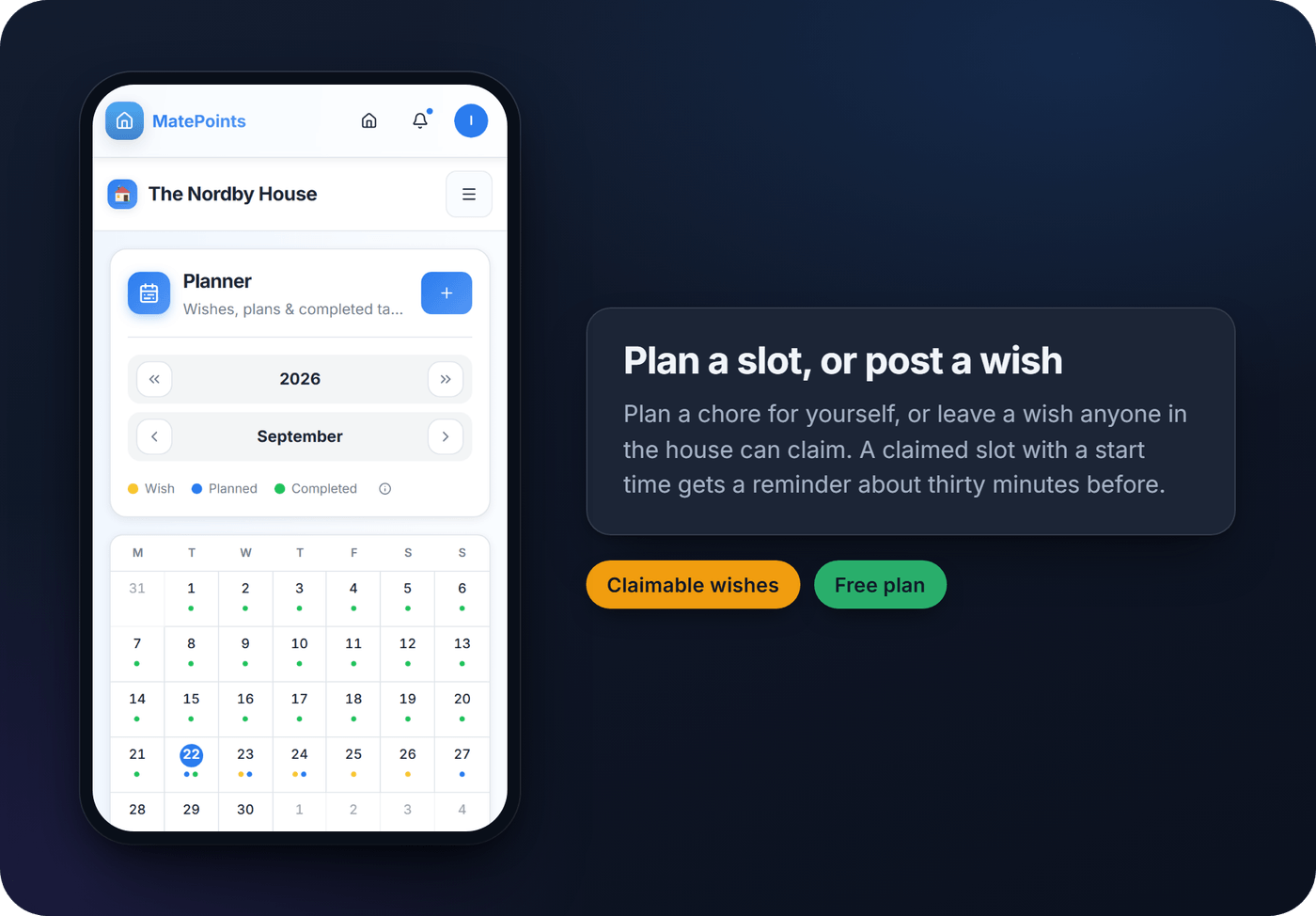
- The Planner. A month calendar where you plan a slot for yourself, or post a wish that anyone in the house can claim. Give a claimed entry a start time and a push reminder arrives about 30 minutes before. A slot whose day passes is cancelled, and whoever claimed it gets a notice.
- Points and approvals. Each chore carries its own point value, and a completion can wait for someone with approver rights to confirm it. Points count once it is approved.
- Statistics. Per member and per task group, with spotlights such as "One-Person Show" when one person did every completion of a task, and "Most Neglected" for the one nobody has touched. That is the month-end check, without the tally sheet.
All of that is on the free plan. Accounts start at 13, so a younger child's jobs stay on a paper chart the parent keeps, while teenagers and adults in the same house use the app.
Give it about two months
Consistency beats perfection. Don't scrap the system over one missed Tuesday. After two weeks, shorten any task that keeps getting skipped, make the schedule more visible, and rotate owners if resentment is building. Then give it about two months before judging whether it stuck.
In Phillippa Lally's 2010 study of everyday habits, it took 66 days on average for a new behaviour to become automatic, with a range from 18 days to a predicted 254. A single missed day made little difference. Many missed days did.

Start with the daily reset this week, add one focus day next week, and grow it from there.
Marcus
FAQ
What is a good weekly housework schedule?
One focus area per weekday, kept to 30 to 45 minutes, paired with a daily reset of 20 to 30 minutes split between morning and evening. That keeps weekends free instead of lost to one marathon cleaning session.
What is the most disliked chore?
Cleaning the bathroom. In YouGov's 2025 survey, 52 percent of US adults said they hate or dislike it, more than any other chore; dishes came next. That is exactly why it belongs on a rotation rather than on one person's permanent list.
What is the 6/10 rule for cleaning?
It is a list of six daily and ten weekly cleaning tasks, shared by the Organized Chaos blog in 2022 and later written up by Homes & Gardens (Lola Houlton, 2023). It fits the same idea as this article: a short daily list, and a longer weekly one.
Can MatePoints rotate chores automatically?
No. MatePoints has no repeating tasks, due dates or automatic rotation. Keep the rotation on a week-number rule or a calendar, and use MatePoints for points, approvals, the Planner and statistics.
How long does a new chore routine take to stick?
Give it about two months. In Lally's 2010 study, a new daily behaviour took 66 days on average to become automatic, and one missed day did not reset it.
Sources
- Survey Results: Americans Spend Nearly Six Hours Each Week Cleaning But Wonder, Is It Enough?, American Cleaning Institute, 2018
- American Time Use Survey 2025 Results, US Bureau of Labor Statistics, released June 2026
- American Time Use Survey, Table A-1: Time spent in detailed primary activities, US Bureau of Labor Statistics, 2026
- Daily Cleaning Checklist, 101 Planners, updated June 2026
- Implementation intentions and goal achievement: a meta-analysis of effects and processes, Gollwitzer and Sheeran, Advances in Experimental Social Psychology, 2006
- Weekly Cleaning Schedule: Free Printable Checklist, Sarah Mitchell, Refresh Routine, 2026
- How Americans feel about household chores, and dividing them, Taylor Orth, YouGov, 2026
- Weekly Chore Schedule with a Printable Chore Chart, Heather Solos, Home-Ec 101
- How are habits formed: Modelling habit formation in the real world, Lally, van Jaarsveld, Potts and Wardle, European Journal of Social Psychology, 2010
- How to form a habit, British Psychological Society Research Digest, 2010
- The 6/10 List, Organized Chaos, 2022
- The 6/10 cleaning method, Lola Houlton, Homes & Gardens, 2023