Reward redemption policy for families: rules to agree first
A reward redemption policy for families: who confirms a reward, how fast it is handed over, and why an earned reward is never taken back.

Most household reward systems do not break at the earning. They break at the handover. A child finishes the week, asks for the film night they were promised, and somebody says "that's not what we agreed". One conversation like that costs the whole chart its credibility. A reward redemption policy stops it: a short page of rules, agreed before anyone redeems anything, that says who hands a reward over, when, and what happens when something goes wrong.
The term comes from loyalty programmes. A family needs the same small print, only shorter and kinder, and it works on a paper chart or in an app. If you are still deciding how rewards get earned in the first place, start with our chore reward system guide and come back when the earning side works.
Redemption policy guidelines: what to agree first
Eight rules cover most of the arguments a household has about rewards:
- Who can redeem, and who confirms
- How fast a reward is handed over
- When and where it happens
- How much checking each reward needs
- How reversals work, and what can never be reversed
- How varied the rewards are
- How much say older children get
- When the rules get reviewed
Write the answers on one page.
Conditions for reward redemption: who redeems and who confirms
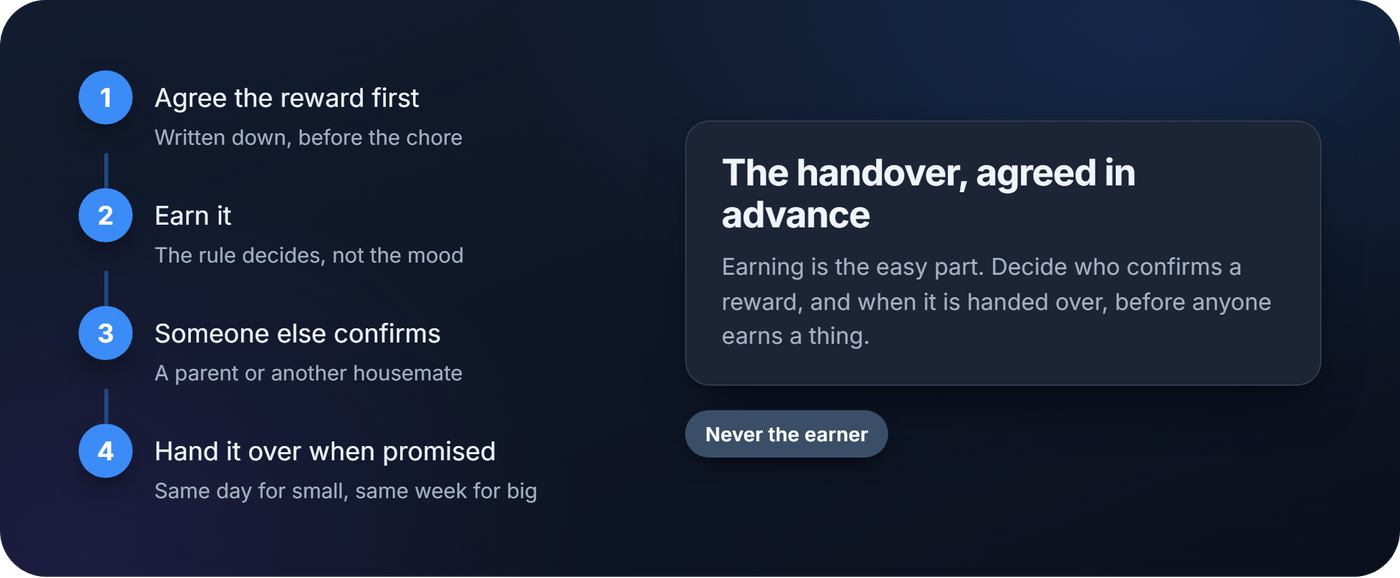
The person who earned a reward asks for it. Someone else confirms it. That second person is the point: a reward nobody else confirmed is a reward you will argue about later.
In a family, the confirmer is usually a parent. In a shared flat, it can be any housemate other than the earner. Name a backup for the weeks the first one is away.
Agree the conditions at the same time. "Movie night pick after ten evenings of clearing the table" is a condition. "When you've been good" is not, and everyone at the table will read it differently.
Hand it over fast
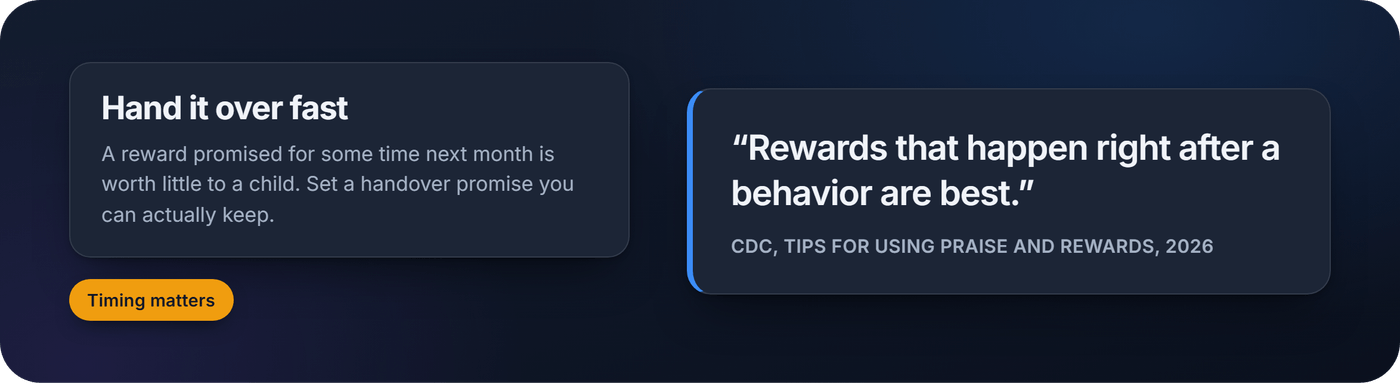
Timing is the easiest rule to break without noticing. The CDC's guidance for parents is plain: rewards that happen right after a behavior are best (Centers for Disease Control and Prevention, Tips for Using Praise and Rewards, reviewed 2026).
Research on how young people value delayed rewards points the same way. A study that followed 140 people aged 9 to 23 for about ten years found that the younger participants discounted delayed rewards more steeply, and that the change levelled off in late adolescence (Klein, Collins and Luciana, Cognitive Psychology, 2022). Waiting costs a child more than it costs an older teenager.
So set a handover promise you can keep. The same day for small rewards and the same week for bigger ones is a sensible default.
Write down when and where fulfilment happens
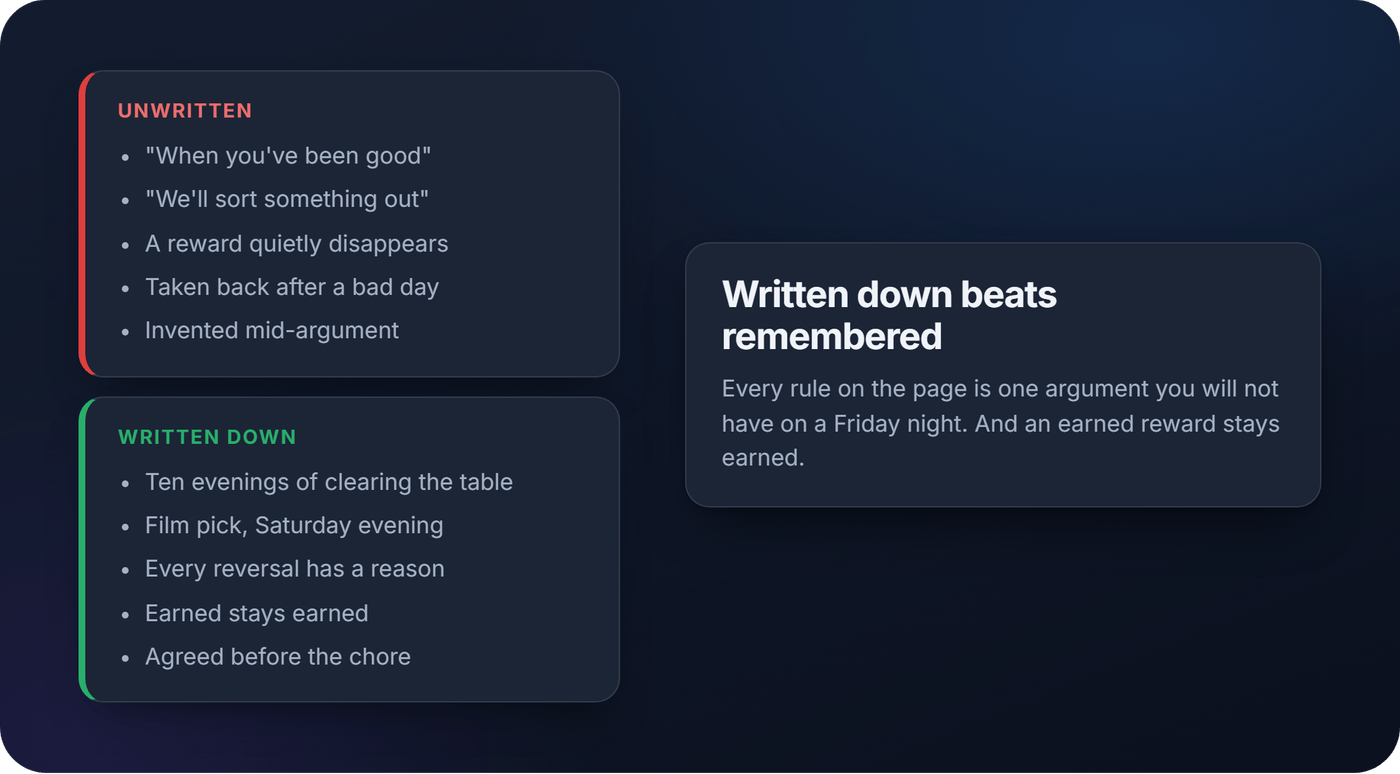
Some rewards cannot happen the moment they are earned. Choosing Friday's takeaway happens on Friday. That is fine, as long as it was written down before anyone earned it. "Your pick of the film, Saturday evening" is a promise. "We'll sort something out" is a future argument.
Writing it down in advance also keeps a reward from sliding into a bribe. Dr Kevin Nelson of Utah Valley Pediatrics draws the line at planning: rewards are determined ahead of time so that your child knows what to expect, while bribes tend to happen in the middle of a crisis (2019). A reward invented mid-meltdown teaches a child that meltdowns are how rewards arrive.
Best practices for redemption: match the check to the stakes
A small treat for a chore you watched happen can run on trust. A bigger reward, the one somebody worked a month for, deserves a moment where the confirmer actually looks at the work. Demanding evidence for every small reward tells a child you expect to be cheated, and it turns you into an inspector.
Reversals need a written reason, and earned stays earned
Mistakes happen. A reward gets granted for a chore that was never done, or twice for the same week. Fix it, but write down why, where everyone can see it. "Removed: Dad did the bins this week, not you" can be checked. A reward that silently disappears cannot, and it looks like punishment.
The line to hold is between correcting an error and taking back something earned. Place2Be's parenting guidance is direct: "Always follow through with promised rewards. Otherwise, your child won't trust you when you offer a reward." The CDC says the same from the other side: never take away rewards your child has earned, not even for misbehaviour. If a child misbehaves after earning the film pick, deal with the misbehaviour on its own. The film pick stays.
Vary the rewards so easy wins don't dominate
When every route to a reward pays the same, people take the easiest route. A 2019 study gave 67 children aged 9 to 13 at a summer camp points for physical activity, without distinguishing light activity from vigorous activity. The children in the points group did significantly more light and significantly less vigorous activity than those without points, the early boost in activity had faded by the end, and the authors suggest the children may have learned to "beat the system". They recommend a varied reward structure (Ahn, Johnsen and Ball, Health Education & Behavior, 2019).
That was exercise at camp, not chores at home, but if emptying one bin earns the same as cleaning the bathroom, expect a lot of bins. Price the hard chores higher, and refresh the reward list. The CDC notes that children become tired of some rewards and develop new likes and interests, and suggests keeping a running list and changing it over time.
Give older children a say, and watch as little as you can
Teenagers take rules they helped write more seriously than rules handed down. Let them propose rewards and argue the conditions. You keep a veto.
Keep the monitoring light as well. A 2026 master's project at Iowa State University tested a gamified chore app with seven parent and child pairs. Its sharpest finding was a privacy paradox: older children identified parental access to reflection journals as an infringement on their digital safe spaces (Jun Kit David Tang, Responsibuddies, 2026). Seven families is a small sample with no comparison group, but the warning is useful: record what the reward rules need, and nothing more.
Review the rules on a fixed date
Put a review date in the calendar before you start; a month out suits most households. On the day, ask which rewards nobody redeems any more, which chores nobody picks, and whether any handover was late. Change one or two things, not everything.
Reward points usage: if your family spends points
Many paper systems work like a shop: children collect points and spend them on a priced menu. If yours does, add one rule to the incentive redemption process. Deduct the points when the reward is handed over, not when it is requested. Deducting at the request leaves a child with fewer points and nothing in hand if the handover is delayed or turned down. MatePoints works differently, as the section below explains.
Three household templates you can copy
Illustrative starting points. Change the details, keep the structure.
- Younger children, on paper. A chart on the fridge that a parent keeps. Rewards agreed with the child in advance, small ones handed over the same day, one bigger reward a few weeks out. A parent confirms, and nothing earned is ever taken back. Our reward chart for kids covers the setup.
- Roommates. Any housemate other than the earner can confirm. Rewards are small and shared: first pick of the film, a night off the washing-up. Handover within the week, and a review after a month. For the chore side, see the roommate chore system.
- A mixed household of teenagers and adults. Teenagers propose half the rewards, any adult can confirm, big rewards carry a written date, and every reversal carries a reason everyone can read.
How MatePoints handles rewards earning and redemption
MatePoints builds several of these rules into the handover itself, with one big difference from a points shop: points are never spent. They add up to levels and the household leaderboard, and nobody's total goes down when they collect a reward.
Rewards come from achievements. An achievement tracks one chore across three tiers, each unlocked at a number of approved completions. Each tier can carry a reward the household writes itself, such as choosing Friday's takeaway. When an approved completion crosses a tier, the reward is earned. Nobody has to remember.
Redemption follows the someone-else-confirms rule strictly:
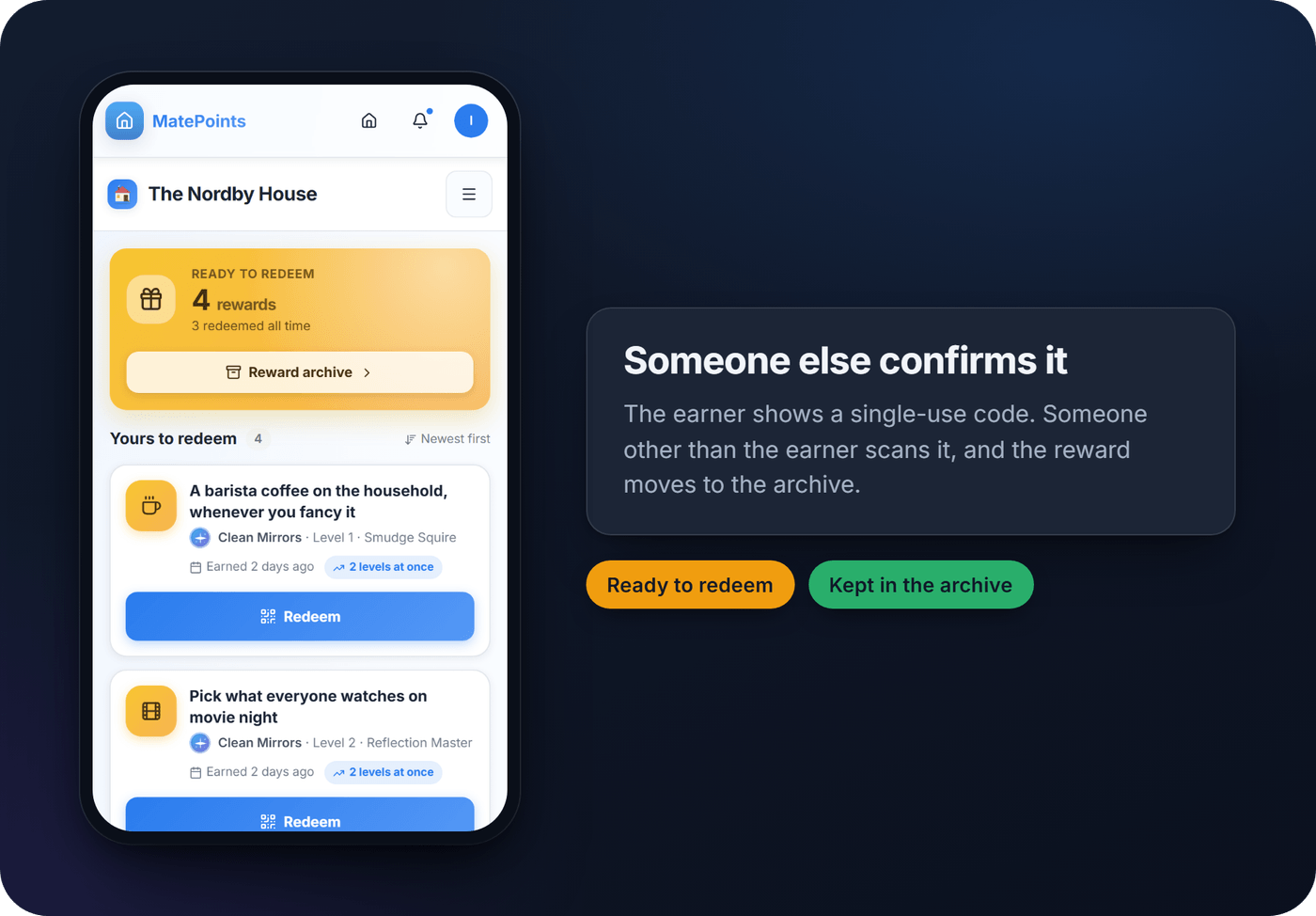
- The earner shows a single-use code as a QR on their phone. It lasts ten minutes.
- Someone else scans it: a member with the Approver role or above, and never the earner. They slide to confirm, and the reward moves to the archive.
- The archive keeps what was redeemed, so "did we ever do that film night?" has an answer.
- A revoke needs a written reason, shown in the archive. An owner or editor can withdraw a reward that has not been handed over. A redeemed reward cannot be revoked.
- An earned reward stays as it was earned. Editing or deleting the achievement later does not change it.
Creating achievements and reward definitions needs Pro. Earning, viewing and redeeming rewards is free. The MatePoints 2.2.0 release notes walk through the whole flow.
What it does not do: schedule the handover, run a shop where points are spent, or supply the reward. The household does that. Our Terms also set a minimum account age of 13, so a younger child's chart stays on paper while teenagers and adults use the app. If that fits your house, set up a household on MatePoints.
One page, agreed before the first reward
Write the rules down this week, before anyone has earned anything: who confirms, how fast, and what can never be taken back. It is far easier to agree on a quiet Sunday afternoon than in the middle of Friday's argument about the takeaway.
Marcus
FAQ
What is a reward redemption policy for a family?
A short set of rules, agreed before anyone redeems anything, covering who confirms a reward, how fast it is handed over, when and where it happens, and how mistakes are corrected. It works the same on a paper chart or in an app.
How should kids redeem rewards?
They ask, and someone other than themselves confirms. Hand small rewards over the same day and bigger ones within the week, on a date written down in advance.
When should points be deducted for a reward?
If your family spends points, deduct them when the reward is handed over, not when it is requested. That way a delayed or refused handover never leaves a child with fewer points and nothing to show for them.
Can I take back a reward if my child misbehaves?
No. Deal with the misbehaviour separately. Correcting a genuine mistake is different, and it should come with a written reason everyone can see.
Can you spend points on rewards in MatePoints?
No. Points are never spent in MatePoints. Rewards are earned at achievement tiers and handed over when someone other than the earner scans a single-use code.
Sources
- Tips for Using Praise and Rewards, Centers for Disease Control and Prevention, reviewed April 2026
- Developmental trajectories of delay discounting from childhood to young adulthood, Klein, Collins and Luciana, Cognitive Psychology, 2022
- Child Bribes vs. Rewards, Kevin Nelson MD PhD, Utah Valley Pediatrics, 2019
- Using praise and reward with children, Place2Be Parenting Smart
- Points-Based Reward Systems in Gamification Impact Children's Physical Activity Strategies and Psychological Needs, Ahn, Johnsen and Ball, Health Education & Behavior, 2019
- Responsibuddies: Reducing Family Conflict through Gamified Household Task Management, Jun Kit David Tang, Iowa State University, 2026