Chore reward system: which one actually fits your house
Six chore reward systems compared by what each costs you to run, the hour-long setup, and why most are quietly abandoned by the third week.

Choosing a chore reward system is mostly a choice about how much admin you can sustain. Almost any of them motivates a child in week one. The one that matters is the one still running in week three, when the novelty has gone and somebody still has to update the thing on a Tuesday night.
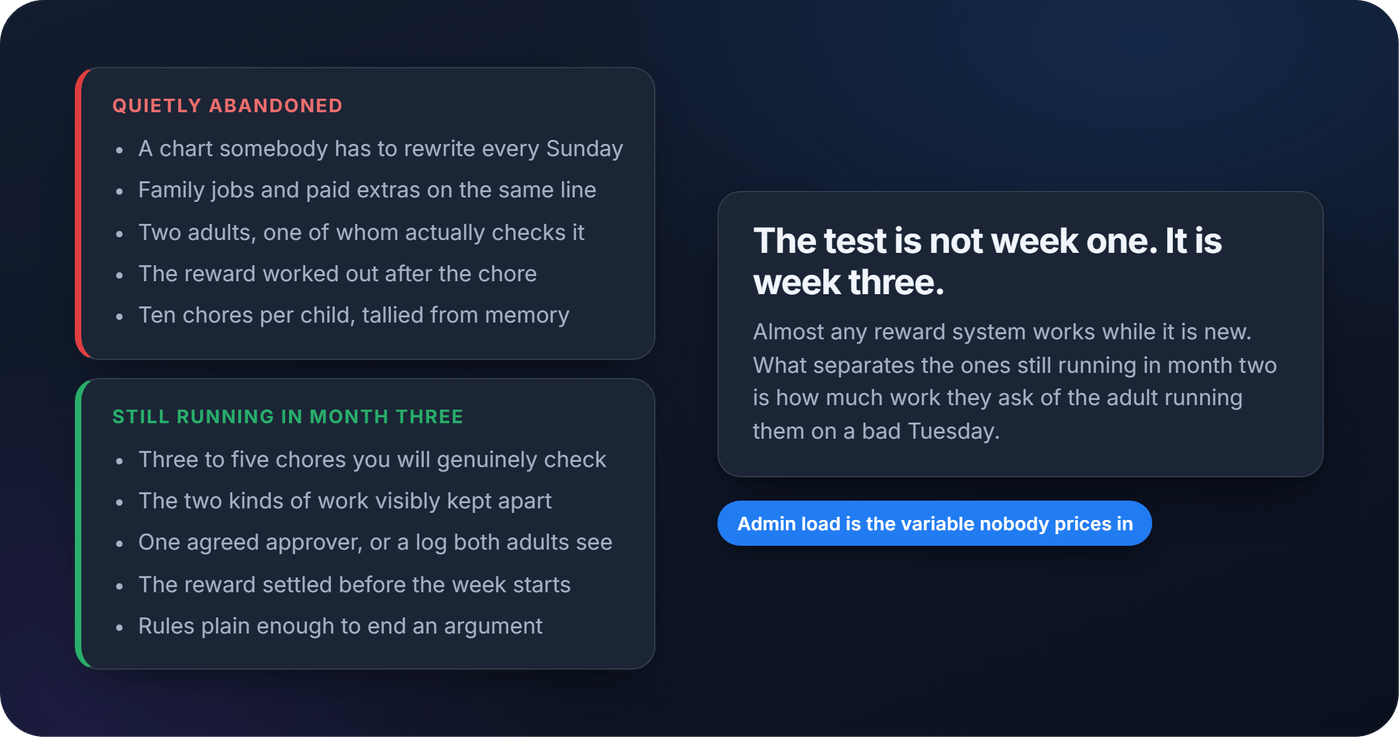
So the useful question is not "which system works best" but "which one fits this house". A two-income home with three kids under ten needs something different from a single parent with one teenager, and most of the frustration parents feel comes from picking a model that does not match their actual rhythm.
Six systems, and what each one costs you
Printable charts. Print a weekly grid, stick it on the fridge, tick boxes with a marker. Lowest friction to start, and genuinely fine for one or two kids. Admin: low, but somebody rewrites it every week.
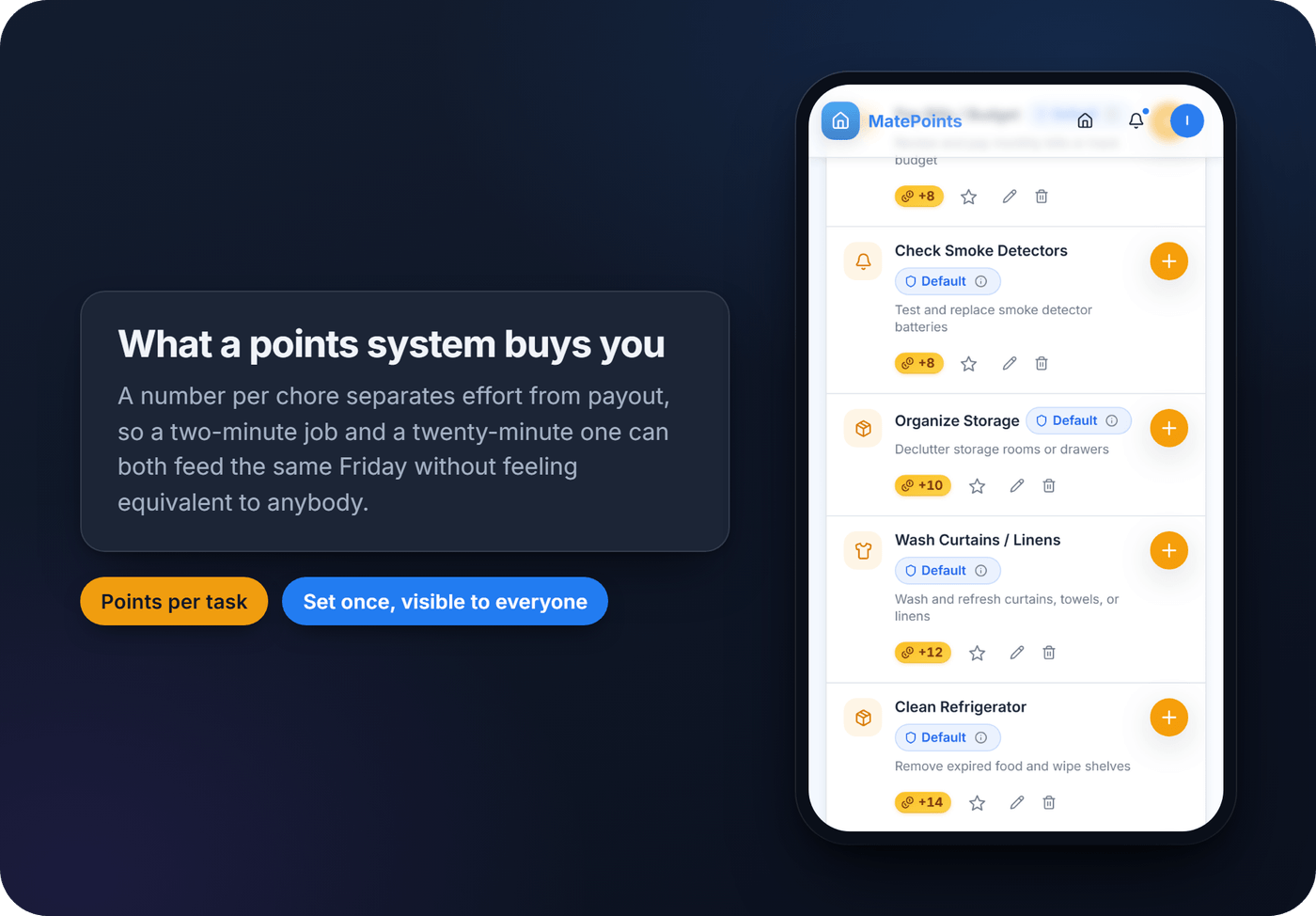
Points systems. Each task carries a number, redeemed against a reward menu you set together. The value is that it separates effort from payout, so a two-minute job and a twenty-minute one can both count toward Friday without feeling equivalent. Admin: medium — you need a running tally somebody trusts.
Allowance-tied systems. Real money, per chore or per week. Simple to explain, and it risks teaching that every task in a shared home carries a price tag. This one has more evidence behind it than the others, and it mostly points the same way — the full argument about paying kids for chores is worth reading before you commit. Admin: low to medium.

That is from the write-up of Marty Rossmann's research at the University of Minnesota, which is the study everyone is loosely referring to when they say early chores predict how children turn out. It is unusually direct on this point: children should help decide which tasks they take on, and should not be made to do them for an allowance.
Screen-time economies. Chores trade directly for tablet or gaming minutes. Fast to set up and immediately motivating, but it creates daily negotiation if the exchange rate is not crystal clear — and there is a specific catch with using screens as the currency. Admin: low, until the arguments start.
Token economies. Poker chips, marbles in a jar, physical stand-ins for points. Younger children respond well to something they can hold. Admin: low, but tokens get lost.
Reward wheels. A completed task earns a spin and the wheel picks the prize. Keeps novelty high; risky if the prizes start feeling random rather than earned. Admin: low, high novelty decay.
Set it up in an hour
You do not need a planning weekend. A workable system goes live in under an hour if you do it in this order.
- Decide scope first. Write down which chores are non-negotiable family contributions and which are optional paid extras. This one decision prevents half the disputes that come later.
- Pick a currency and a cadence. Young children need daily visible feedback. School-age children do well with a weekly total. Teens can handle a small payout every fortnight.
- Cap the list at five to ten tasks per child. More than that and the chart becomes a chore itself. If you want a starting list, six five-minute daily jobs is a reasonable place to begin.
- Write completion rules in plain language. "Bed made means pillows on and blanket pulled up" beats "clean room", which is vague enough to start an argument every single time.
- Choose how you will track it. Paper is fine for one or two children. Once three or more people are logging chores independently, an approval step matters more than the format.
- Launch it with a short family meeting, not a lecture. Rossmann's write-up is explicit that children should be part of deciding what they take on, which is also the cheapest way to find out that the reward you picked bores them.
- Check in after seven days and adjust point values based on what actually happened rather than what you assumed would.
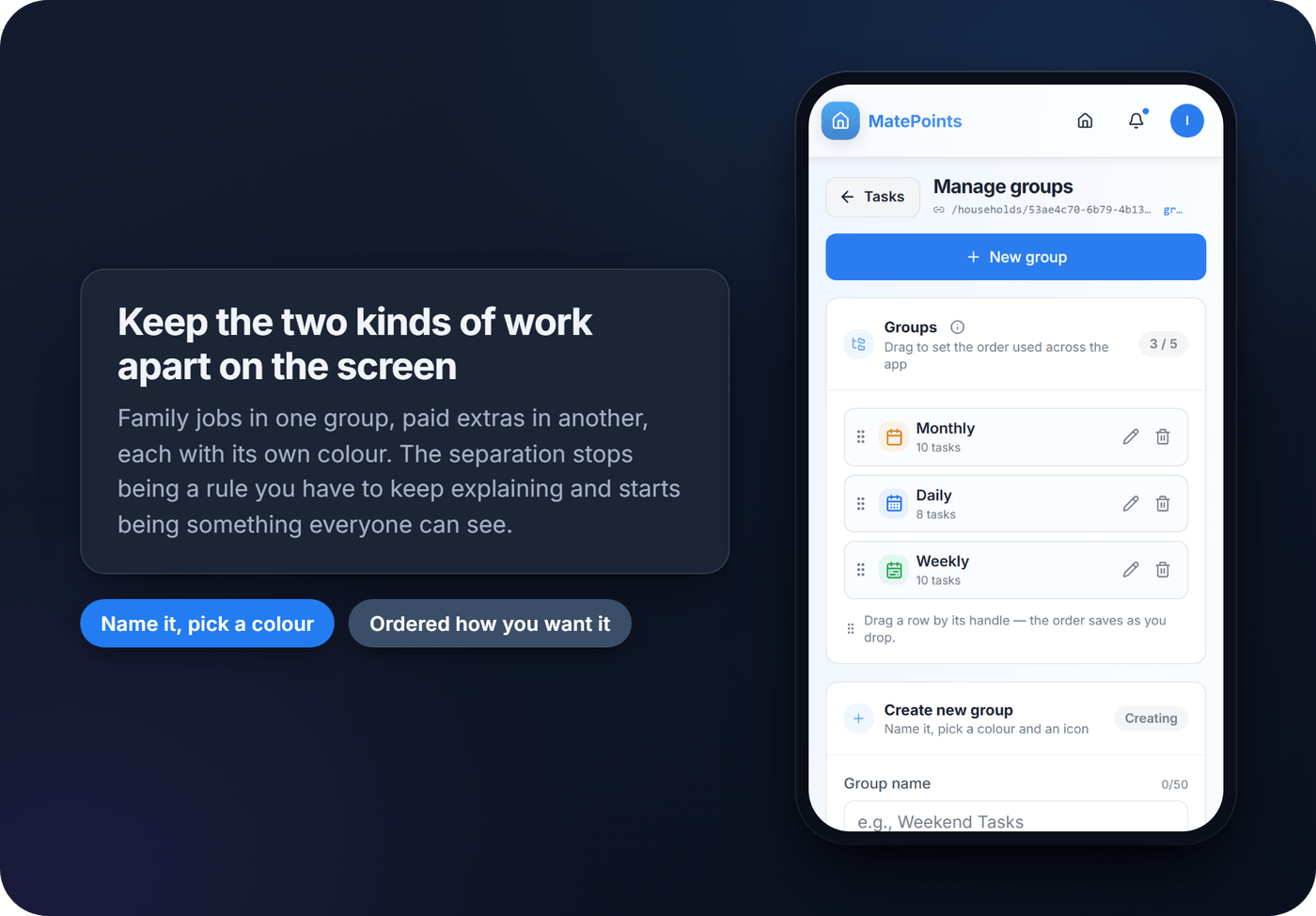
Step one is the one people skip, and it is the one that decides whether the system teaches anything. Family jobs and paid extras need to sit visibly apart — different columns on paper, different groups on a screen. When "make your bed" and "wash the car for cash" share a line with no distinction, children reasonably start expecting payment for basic responsibilities.
Pro tip: Laminate the printable chart or drop it in a dry-erase sleeve so you reuse one template instead of reprinting weekly. It sounds trivial. It is usually the difference between a system that survives month two and one that quietly disappears.
If the first month wobbles, run through this before scrapping it: is the chart somewhere people actually walk past? Is at least one adult checking it daily? Have the rewards gone stale? Did an unpaid chore drift into paid-extra territory without anyone deciding it should?
Why most of them fail
Not because the reward was wrong. Because the system became more work than the problem it solved.
- Overcomplication. Ten categories, three currencies and a conversion formula look thorough on paper and collapse in practice. Cut the list to what you will genuinely check.
- Inconsistent enforcement. If one parent checks nightly and the other forgets for a week, children stop trusting it. Name one approver, or use a log both adults can see.
- Blurred paid and unpaid work. Covered above, and it is the most common version of the system drifting away from its own purpose.
- Rewarding forever. This one has a real finding behind it. In a classic 1973 experiment, children who were promised a reward for drawing later showed less interest in drawing than children who were not — while children given the same reward as an unannounced surprise showed no such drop. The lesson is not to stop rewarding. It is that a permanent, promised payout for every task is the version most likely to erode the motivation you were building.
Fading rewards is also the harder half in practice. A 2024 gamification trial found the behaviour gains stopped being statistically significant once the intervention ended, which is a useful thing to expect rather than be surprised by. Shift gradually toward occasional recognition, and say out loud that you are doing it.
For a child with ADHD or executive-function differences, the failure mode is different again and the fixes are specific — that one has its own guide.
What it's actually for
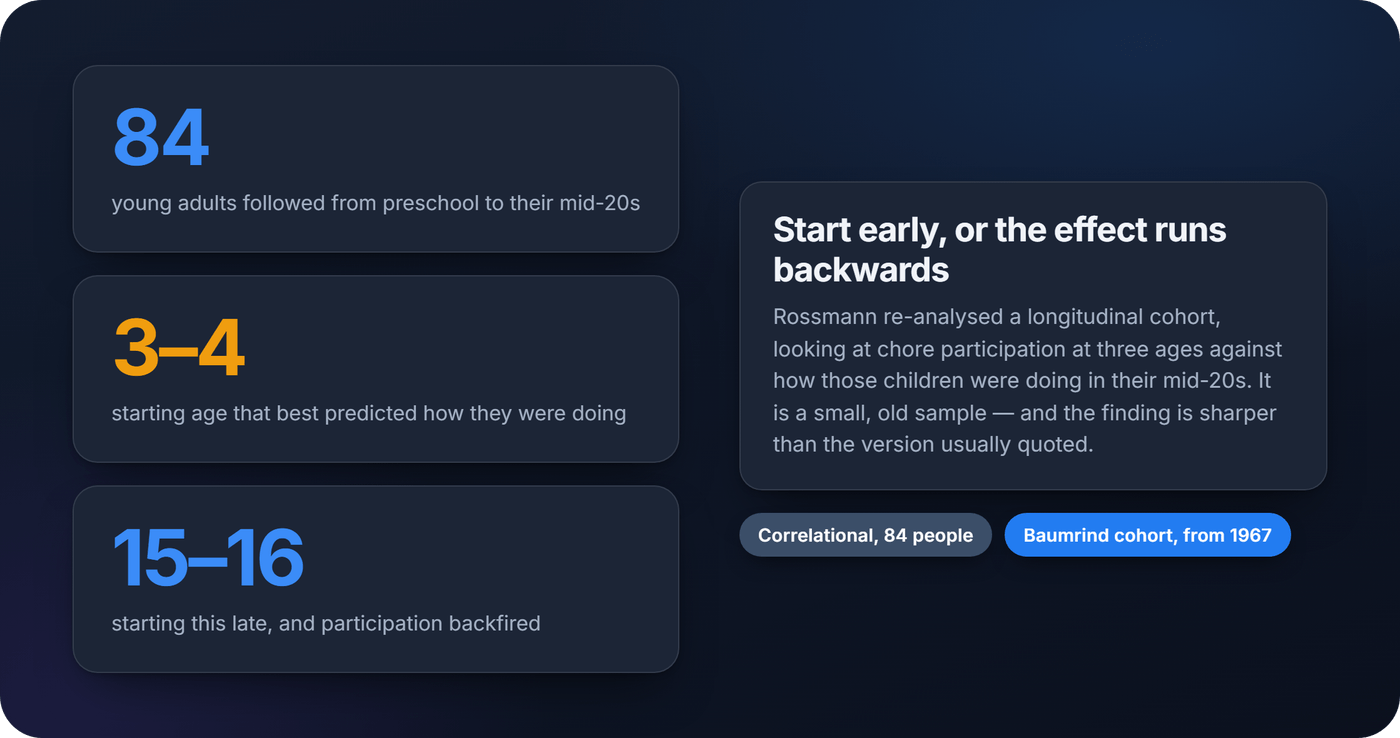
Rossmann re-analysed a longitudinal cohort of 84 young adults, looking at their participation in household tasks at ages three to four, nine to ten and fifteen to sixteen against how they were doing in their mid-twenties. The best predictor of success in their mid-20s was participation at three or four. The part rarely quoted is the other end: for those who did not start until fifteen or sixteen, participation backfired, and they did worse.
Two honest caveats. It is correlational, and it is a secondary analysis of 84 people from a cohort recruited in the San Francisco Bay area in 1967 — small, old and geographically narrow. If you have seen this described as a "Harvard study", that version is a misattribution that has been traced and debunked repeatedly.
What survives the caveats is worth having anyway: consistent expectations, begun early and asked for in a way children had some say in, gave those children more practice at connecting effort to outcome. That is the actual product of a chore system. The chart is just how you keep track.
What this looks like in MatePoints
MatePoints is a points system with an approval step, which is the combination the list above says gets expensive to run on paper once a household passes two or three people.

The approval queue is the part worth understanding. It turns "did you actually do it" from a confrontation into a queue — nobody gets challenged at dinner, and nobody has to take anybody's word for it either. Points post after approval, so the tally means something without anybody policing it.
Around that: task groups keep family jobs and paid extras visibly separate, and they are not plan-gated. Tapping an NFC tag or scanning a QR code logs a chore without anyone writing anything down, which needs a household owned by a Pro member. So do achievements that pay out a reward at a milestone, and running more than one household — the thing blended families and co-parents actually need.
Two things it does not do, so you can plan around them: achievements count approved completions of a chore rather than streaks, and there is no photo attached to a completion, only a note. If photo proof is the thing your house needs, that is worth knowing before you switch anything.
Below three people, honestly, a laminated chart is fine.
Why simple beats clever
The biggest misconception here is that a more sophisticated system produces better behaviour. It does not. What produces better behaviour is a system a family can run without thinking hard about it every day, which is why every recommendation above points at simplicity over cleverness. Complexity feels like progress when you are designing a chart at 9pm on a Sunday. It feels like a burden by the third week, and burdened systems get abandoned quietly rather than fixed.
If your current system is falling apart, do not rebuild it from scratch. Strip it to three or four chores, reset the reward menu, and build back slowly. Iteration beats reinvention almost every time.
Sources
- Involving children in household tasks: is it worth the effort? — Marty Rossmann, as published by the University of Minnesota
- Undermining children's intrinsic interest with extrinsic reward — Lepper, Greene & Nisbett, Journal of Personality and Social Psychology, 1973
- Gamification of Behavior Change: Mathematical Principle and Proof-of-Concept Study — Lieder, Chen, Prentice, Amo & Tošić, JMIR Serious Games, 2024