Homework reward system: a 30-day plan for parents
A homework reward system that rewards effort you can see, not grades. Set it up in an hour, test it for 30 days, then fade the prizes.

A homework reward system works best when it rewards the work your child can do tonight, not the grade that arrives in six weeks. Pick a few inputs you can see, like "30 minutes of reading" or "maths sheet started before 5pm". Reward them soon after. Write the deal down together. Then run it for 30 days with a review date on the calendar, and change what the month tells you to change.
Set up a homework reward system in an hour
You don't need a planning meeting that drags into the weekend. You need five decisions, made once, revisited in a month.
- Pick one place to track it. A chart on the fridge or one app, not both. Two systems drift apart by week two.
- Choose three to five homework tasks, and write them specifically. "30 minutes of reading" beats "do your homework", because a vague task is easy to dodge and hard to check.
- Set point values in simple tiers. If you can't do the sum in your head, neither can a ten-year-old.
- Pick a tracking method. Match it to your house, not to what looks impressive.
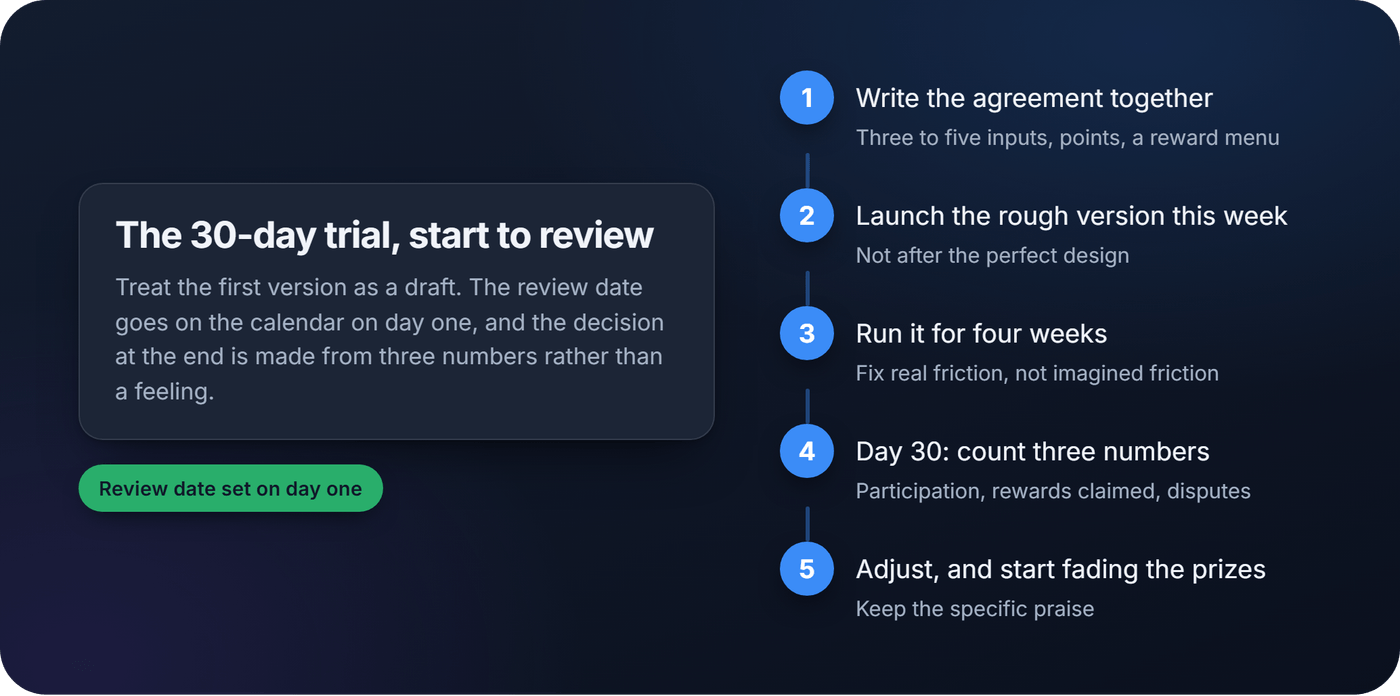
- Write the agreement together, and set a 30-day review date. Put the date in the calendar now, not "sometime next month."
The written part is not bureaucracy. In a small study, Miller and Kelley (1994) had parents and children set homework goals and agree a written contract, and homework accuracy improved. It was four families, so read it as a good sign rather than proof. And a deal your child helped write is hard to call unfair later.
Pro tip: Don't design the perfect system before launch. Launch a rough version this week and let real friction, not imagined friction, tell you what to fix.
Reward the work, not the report card
Roland Fryer ran school trials that paid students for different things: reading books in Dallas, test scores in New York, grades in Chicago. In the published results (Quarterly Journal of Economics, 2011), the estimated effect on achievement was statistically zero in all three cities. The one significant gain was among English-speaking students in Dallas, the city that paid for reading. That is not proof that paying for reading works, but paying for grades gave nothing to build on. Fryer's earlier working paper offers the useful part: children often have little idea how to turn wanting a reward into a better grade. They do know how to read for 30 minutes.
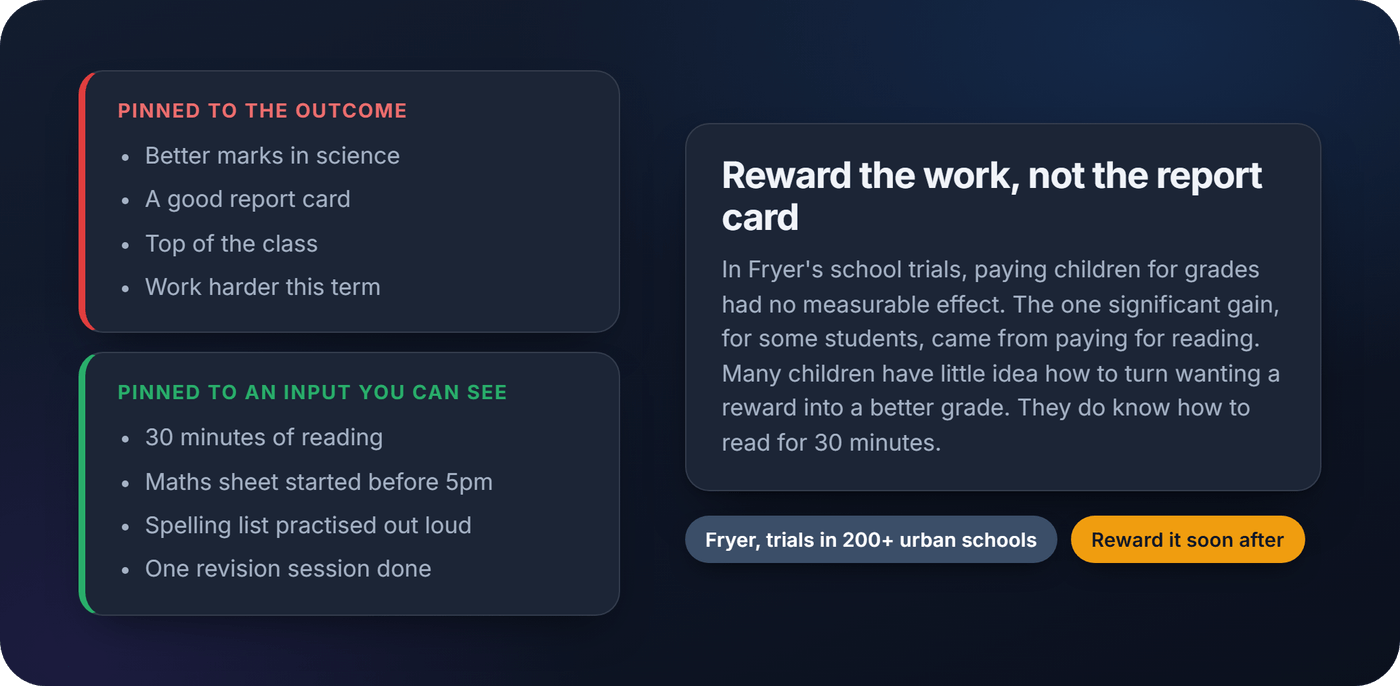
Two more rules come from the research.
Reward soon after. Levitt, List, Neckermann and Sadoff (2016) offered students rewards tied to how they did on a low-stakes test. Rewards handed over straight away raised scores. Delayed rewards had no effect. A point that lands tonight beats a treat promised for the end of term.
Praise the effort, not the brain. In Mueller and Dweck's 1998 experiments, fifth graders praised for being clever enjoyed a task less, persisted less and did worse after a setback than children praised for effort. "You kept going on that fraction problem" teaches something. "You're so smart" turns the next hard worksheet into a threat.
Points, tiers and reward ideas for students
Keep the scale small:
- Small inputs (15 minutes of reading, one spelling practice): 5 points.
- Medium inputs (a full worksheet, 30 minutes of reading): 10 points.
- Large inputs (an hour on a project, revising for a test): 20 points.
Peg Dawson, writing for the Child Mind Institute, recommends a menu of rewards, "since no single reward will be attractive for long". Build it with your child, and keep it non-cash:
- Small: choosing the music in the car, picking dessert.
- Medium: choosing Friday's film, a later bedtime on Friday, a trip to the library or the park.
- Large: cooking a dinner they choose, together.
On paper, one steady rate keeps it simple: 100 points buys a medium reward, say.
Now the honest caveat. Deci, Koestner and Ryan's 1999 meta-analysis of 128 experiments found that expected tangible rewards for doing or finishing a task lowered later interest in doing it by choice, while positive feedback raised it. Cameron and Pierce (1994) concluded that rewards overall do not lower intrinsic motivation, yet they also found praise helps and that the negative case was an expected tangible reward for simply doing the task.
That shared ground is the rule. Praise helps. The expected prize for just doing the work is the risky layer, so plan to fade it: once homework has started on time for a few weeks, move from a weekly prize to an occasional surprise, and keep the praise.
Paper chart, app or a tag on the desk
- A paper homework reward chart is fine for one child and one parent, as long as somebody remembers to tick it.
- An app earns its place when two parents both check homework, or the tally for several children has become its own chore.
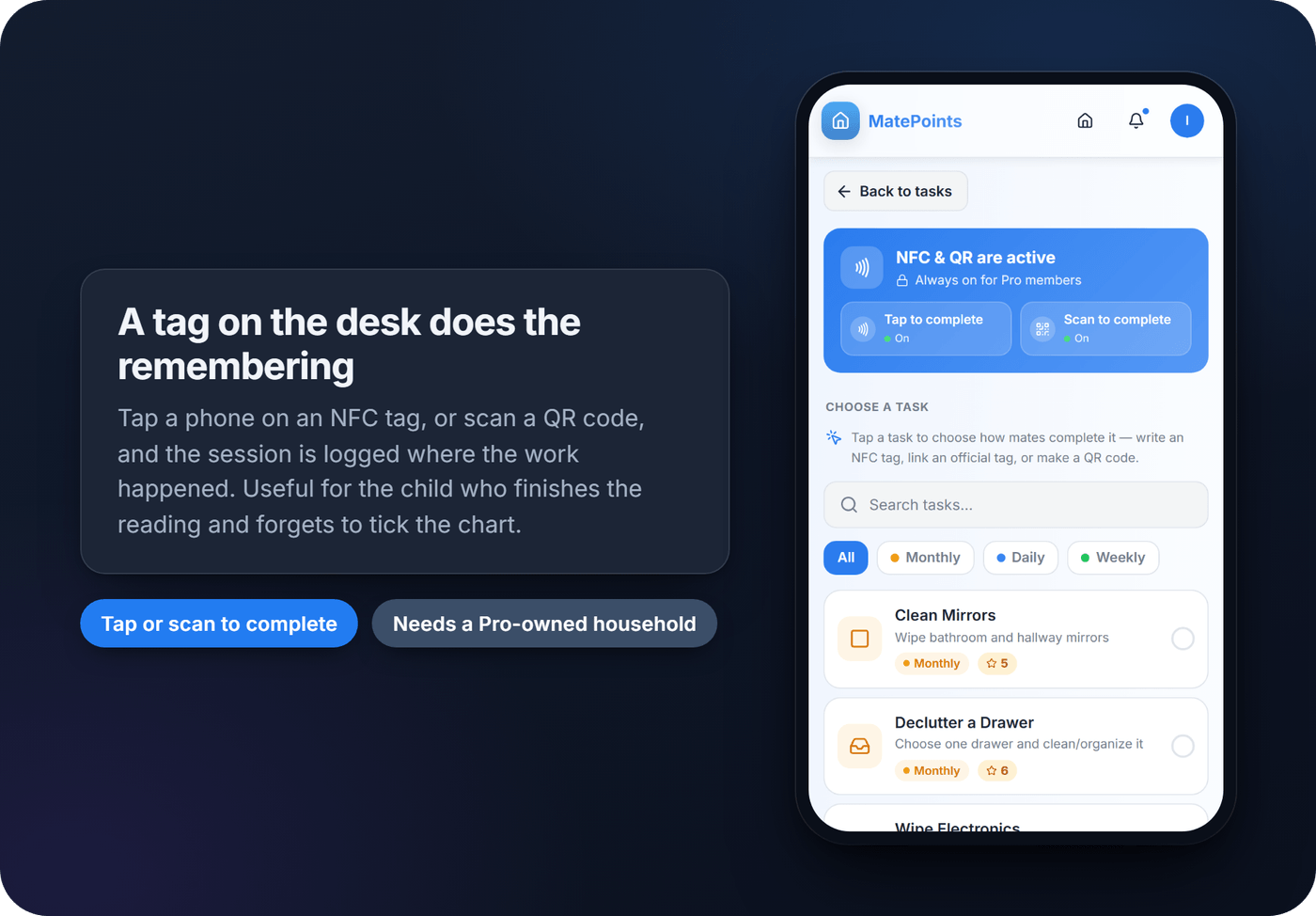
- An NFC tag or QR code on the desk logs a session with a tap or a scan, where the work happened. It suits the child who does the reading and forgets to log it.
Help without hovering
Most homework systems go wrong here, and not through laziness. The parent turns into a supervisor.
A meta-analysis of 50 studies by Hill and Tyson (2009) found parental involvement in middle school positively linked to achievement, with one exception: help with homework. The strongest link was academic socialization, such as talking about why school matters. A study of 1,685 sixth graders by Moroni and colleagues (2015) helps explain it. How often parents helped was linked to weaker progress. Help children saw as supportive predicted gains, and help they saw as intrusive predicted declines.
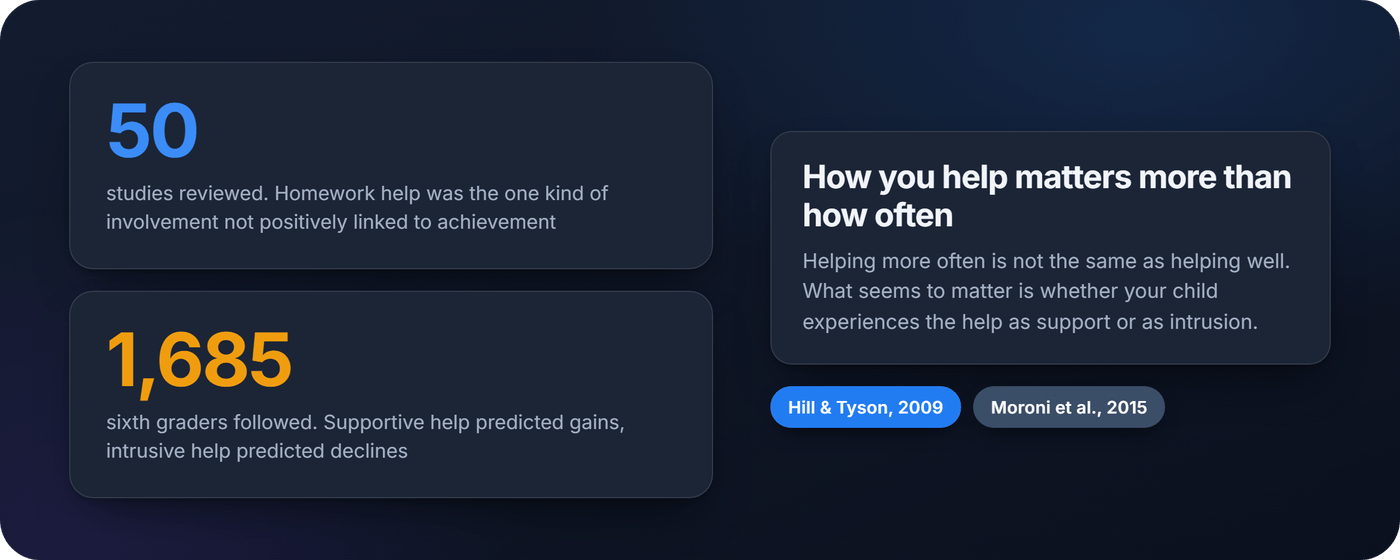
That is the case for neutral tracking. The real shift a system makes is who plays the enforcer. When the chart records the reading, you don't have to ask "have you done your homework?" at seven o'clock on a Tuesday. You check the log and say something specific about the effort. The system does the reminding, and you get to be the supportive one.
Privacy and trust for older kids
A teenager who feels tracked hears "we don't trust you". In Stattin and Kerr's 2000 study of 703 Swedish 14-year-olds, what parents knew came mainly from what their teenagers chose to tell them, and the authors concluded that tracking and surveillance were not the best prescription.
A small recent project points the same way. In Jun Kit David Tang's Iowa State University study of a gamified family task app (May 2026, seven parent-child pairs), older children saw parents' access to their reflection journals as an intrusion. Too small to generalise, but a fair warning about where the line sits.
So, for older kids:
- Track the agreed input, like "revision session done", not how long they sat there.
- Let them propose the tasks and point values, then write down what you agreed.
- Agree before launch what you will and won't look at, and stick to it.
Pro tip: If a teenager balks at being tracked, track less. Autonomy plus accountability beats surveillance every time.
When the system stops working
Expect it. Dawson is blunt: "it is a rare incentive system that works the first time." Most stalls have quick fixes.
- Participation falls off: refresh the reward menu with your child.
- Your child feels micromanaged: track fewer things, and hand them more of the design.
- Arguments about what counts: rewrite the task more specifically.
At the 30-day review, look at three numbers instead of the feeling:
- Participation. On how many school days did the agreed input happen?
- Rewards claimed. A reward nobody claims has stopped motivating.
- Disputes. A rising dispute count is your earliest warning sign.
What this looks like in MatePoints
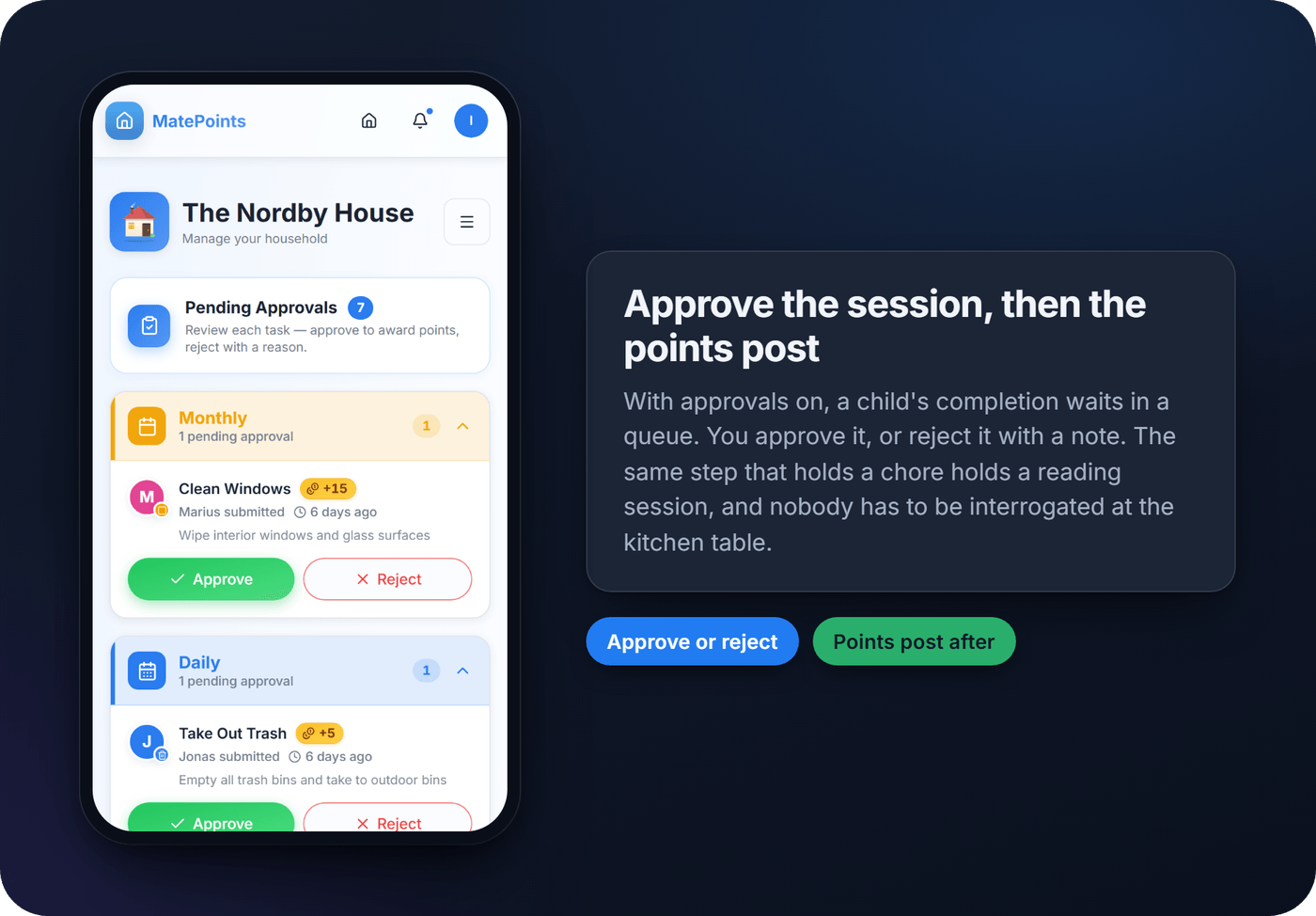
MatePoints was built for household chores, but the mechanics carry over. A task like "30 minutes of reading" carries its own points. With approvals switched on, your child's completion waits in a queue until you approve it, or reject it with a note. Points post after approval.
An achievement counts approved completions of one task across three tiers, and any tier can carry a reward, so twenty approved reading sessions can unlock a reward your family writes, like "pick Friday's film". You redeem it by scanning a single-use code. Points are never spent, so there is no points-for-a-film exchange; rewards hang on achievement tiers instead. Creating achievements and rewards needs Pro. Earning and redeeming them does not. Setting tiers a child will chase has its own guide.
There is also a statistics page, a day streak, and cheers: a one-tap cheer for a housemate, shown in the app and sent as a push notification. Tap-to-complete with a tag or QR code needs a household owned by a Pro member.
What it does not do:
- Due dates. Tasks have none, and nothing repeats on a schedule by itself. The planner can put a session on a calendar day, but you add each one.
- A private view for teenagers. Members see the household's tasks and points, and only people you invite are members, as the privacy and security page explains.
- Photo proof. A completion carries a text note, not a picture of the worksheet.
- Young children's accounts. The Terms require users to be at least 13, and ask under-18s to get a parent's consent. For a younger child, use the paper chart.
Launch a rough version this week
Most parents setting up a homework reward system assume the mechanics are the hard part: point values, reward menus, chart design. They're not. The hard part is trust, and trust breaks the moment your child feels the system was built to police them rather than include them.
Start small. Run the 30-day trial you already scheduled, and treat the first version as a draft, not a contract. The families that keep a system going all school year are almost never the ones that nailed the setup on day one. They're the ones that kept adjusting.
Marcus
FAQ
What is a homework reward system?
An agreement between you and your child where specific homework inputs, like 30 minutes of reading, earn points or praise soon after they happen, toward rewards you chose together. It works best when it rewards effort you can see rather than grades.
Should I reward my child for good grades?
The evidence leans against it. In Fryer's school trials, paying for grades had no measurable effect on achievement, and the one significant gain came from paying for reading, among English-speaking students in Dallas. Reward the steps your child controls.
What are good rewards for homework completion?
Cheap, non-cash privileges your child picks from a menu: choosing Friday's film, a later bedtime on Friday, a trip to the library or the park, or cooking a chosen dinner together.
Will rewards kill my child's motivation to learn?
Praise for effort helps. The risky case is an expected prize for simply doing the task, so pair rewards with specific praise and fade the prizes once the habit sticks.
How do I encourage homework without nagging?
Agree specific tasks in writing, let a chart or an app do the recording, and be the supportive helper rather than the checker. In Moroni's study, help children saw as supportive predicted gains and intrusive help predicted declines.
Sources
- Financial Incentives and Student Achievement: Evidence from Randomized Trials, Roland G. Fryer Jr., Quarterly Journal of Economics 126(4), 2011
- Financial Incentives and Student Achievement: Evidence from Randomized Trials, Roland G. Fryer Jr., NBER Working Paper 15898, 2010
- The Behavioralist Goes to School: Leveraging Behavioral Economics to Improve Educational Performance, Levitt, List, Neckermann & Sadoff, American Economic Journal: Economic Policy, 2016
- Praise for intelligence can undermine children's motivation and performance, Mueller & Dweck, Journal of Personality and Social Psychology, 1998
- A meta-analytic review of experiments examining the effects of extrinsic rewards on intrinsic motivation, Deci, Koestner & Ryan, Psychological Bulletin, 1999
- Reinforcement, Reward, and Intrinsic Motivation: A Meta-Analysis, Cameron & Pierce, Review of Educational Research, 1994
- The use of goal setting and contingency contracting for improving children's homework performance, Miller & Kelley, Journal of Applied Behavior Analysis, 1994
- Strategies to Make Homework Go More Smoothly, Peg Dawson, Child Mind Institute, updated February 2026
- Parental Involvement in Middle School: A Meta-Analytic Assessment of the Strategies That Promote Achievement, Hill & Tyson, Developmental Psychology, 2009
- The Need to Distinguish between Quantity and Quality in Research on Parental Involvement: The Example of Parental Help with Homework, Moroni, Dumont, Trautwein, Niggli & Baeriswyl, Journal of Educational Research, 2015
- Parental Monitoring: A Reinterpretation, Stattin & Kerr, Child Development, 2000
- Responsibuddies: Reducing Family Conflict through Gamified Household Task Management, Jun Kit David Tang, Iowa State University, May 2026